

Most business leaders know the feeling: you make a bold move, and six months later a competitor copies it. You invest in a new capability, and the market shifts before you see returns. The pressure to stay ahead is relentless, and the frustration is real. What separates businesses that consistently outpace their rivals from those that are always playing catch-up is not luck or budget size. It is the quality of their strategic intelligence and the speed at which they act on it. AI is changing both of those variables in ways that are now accessible to companies of every size.
Table of Contents
- Understanding competitive advantage: Criteria and AI’s evolving role
- Real-world champions: Examples of businesses with AI-driven advantages
- Quick wins for SMBs: Embedded AI over custom builds
- Selecting your AI advantage: Key factors and common pitfalls
- Summary comparison: Which AI strategies offer the most value?
- Why chasing the perfect strategy can put you behind
- Bring AI-powered strategic advantage to your business
- Frequently asked questions
Key Takeaways
| Point | Details |
|---|---|
| AI amplifies advantages | Businesses that integrate AI gain measurable improvements in productivity and efficiency. |
| SMBs should choose embedded AI | Using built-in AI features in existing tools is safer and delivers faster results than custom solutions. |
| Frameworks guide, but action wins | Evaluating opportunities is important, but executing quickly and adapting is what leads to real advantages. |
| Learn from real-world leaders | Studying proven examples helps SMBs avoid mistakes and adopt battle-tested strategies. |
Understanding competitive advantage: Criteria and AI’s evolving role
To build on the importance of gaining an edge, let’s clarify what actually constitutes a competitive advantage and why traditional frameworks are no longer enough on their own.
The VRIO framework has been a staple of business strategy for decades. It asks four questions about any resource or capability your business holds:
- Value: Does it help you exploit an opportunity or neutralize a threat?
- Rarity: Do few or no competitors possess it?
- Imitability: Is it costly or difficult for others to replicate?
- Organization: Is your business set up to actually exploit it?
These four criteria are genuinely useful. They force discipline. They stop you from calling every internal process a “core competency” when it is really just a cost center. But here is the problem: VRIO is a snapshot. It describes your position at a fixed point in time, in a market that is anything but fixed.
As one analysis of the framework puts it, VRIO identifies potential advantages but execution and dynamic capabilities determine whether those advantages are ever realized. Frameworks are static. Markets are not.
“A framework tells you where the treasure might be buried. Execution is the act of digging. Most companies stop at drawing the map.”
This is where AI changes the equation. When you layer AI-driven intelligence on top of VRIO thinking, you shift from a static analysis to a living, breathing strategic process. AI can help you continuously monitor whether a capability remains rare, flag when a competitor is closing the imitation gap, and surface new opportunities before your rivals even recognize them. If you want to see how AI venture evaluation tools apply this kind of dynamic analysis in practice, the difference from a traditional spreadsheet exercise is striking.
The bottom line: VRIO is a starting point, not a destination. Pair it with real-time intelligence and you have something genuinely powerful.
Real-world champions: Examples of businesses with AI-driven advantages
Now that we have outlined what creates advantage, it is time to see which businesses are putting theory into spectacular practice.
The most compelling case study right now is the Siemens factory in Erlangen, Germany. Recognized as a World Economic Forum Lighthouse facility, it achieved +69% productivity gains and a 42% reduction in energy consumption through the integration of AI and digital twin technology. A digital twin, for context, is a real-time virtual replica of a physical system. It allows engineers to simulate changes, predict failures, and optimize processes without touching the actual production line.
+69% productivity. 42% less energy. Same factory. Different intelligence layer.
What makes this relevant for SMB leaders is not the scale of Siemens, it is the principle. The factory did not reinvent its operations from scratch. It layered intelligence on top of existing infrastructure. That is a lesson every mid-market manufacturer, distributor, or service business can apply.

Graco, the fluid handling equipment company, offers another instructive example. Rather than waiting for disruption to force their hand, Graco made proactive AI investments to build operational resilience before they needed it. They treated AI as a strategic hedge, not a reactive fix. The result was a business that could absorb supply chain shocks and market volatility better than peers who were still debating whether AI was “ready.”
Key lessons from both examples:
- Do not wait for a crisis. Graco’s proactive posture meant they were not scrambling when conditions changed.
- Intelligence layering beats infrastructure replacement. Siemens did not bulldoze its factory. It made the existing factory smarter.
- Measurable outcomes justify investment. Both companies tied AI adoption to specific, quantifiable results, not vague efficiency gains.
Pro Tip: When evaluating AI investments, ask vendors for case studies with specific metrics, not testimonials. If a vendor cannot tell you what changed and by how much, that is a red flag. You can explore AI features in business operations to see what measurable intelligence looks like in practice.
Quick wins for SMBs: Embedded AI over custom builds
For smaller companies inspired by big-league examples, it is essential to focus on what is both practical and powerful. Not every business needs to build a digital twin. Most do not need to build anything at all.
Custom AI projects are genuinely risky for SMBs. The reasons are straightforward:
- Cost: Custom model development requires data scientists, infrastructure, and months of iteration. Costs routinely run into six or seven figures before you see a single useful output.
- Complexity: Managing training data, model drift, and integration with existing systems is a full-time job for a specialized team most SMBs do not have.
- Time to value: The average custom AI project takes 12 to 18 months to reach production. Markets do not wait.
The smarter path, as strategic AI guidance for SMBs consistently recommends, is to prioritize embedded AI in tools you already use or are evaluating. CRM platforms like Salesforce and HubSpot now include AI features that predict churn, score leads, and recommend next actions. Marketing suites use AI to optimize ad spend and personalize content at scale. Analytics platforms surface anomalies and forecast trends without requiring a data science team.
Here is a practical comparison to frame the decision:
| Criteria | Custom AI | Embedded AI |
|---|---|---|
| Upfront cost | High ($100K+) | Low to moderate |
| Deployment speed | 12 to 18 months | Days to weeks |
| Technical expertise needed | Significant | Minimal |
| Ongoing maintenance | Heavy | Managed by vendor |
| Risk level | High | Low to moderate |
| Time to first value | Long | Short |
The table makes it obvious why embedded AI wins for most SMBs. But there is a catch: not all “AI-powered” features are created equal. Vendors slap AI labels on rule-based automation all the time. Real AI learns from data, adapts over time, and surfaces insights you did not specifically ask for. Fake AI just executes a preset logic tree faster.
Pro Tip: Ask any vendor three questions to cut through the hype. First, what data does the AI learn from? Second, how does the model improve over time? Third, can you show me a specific decision the AI made that a human would not have caught? If they cannot answer all three clearly, keep shopping. Leveraging built-in AI through a platform designed for strategic intelligence sidesteps this problem entirely.
Selecting your AI advantage: Key factors and common pitfalls
Once you know embedded AI is the right direction, how do you choose and implement it well? Here is a step-by-step process that keeps you moving without overbuilding.
- Audit your current pain points. Before evaluating any AI tool, list the three decisions in your business that take the most time or carry the most risk. That is where AI should go first.
- Apply VRIO as a filter, not a gate. Use the framework to check whether an AI capability could be rare and hard to imitate in your specific market context. Do not use it to delay action.
- Prioritize speed to value. Choose tools that deliver a measurable result within 90 days. If a vendor cannot articulate what you will see in the first quarter, the timeline is probably longer than they are admitting.
- Start with one workflow, not the whole business. The companies that fail at AI adoption usually try to transform everything at once. Pick one high-impact process and prove the model.
- Build feedback loops. AI gets better with feedback. Assign someone to review outputs, flag errors, and feed corrections back into the system. This is not optional.
- Scale what works. Once you have a proven win, expand the same approach to adjacent workflows. Resist the urge to add new tools before the first one is fully embedded.
Common mistakes to avoid:
- Overbuilding: Buying enterprise AI infrastructure for a 50-person company is like buying a freight elevator for a two-story office. Impressive, expensive, and mostly unused.
- Ignoring execution: The VRIO framework identifies potential, but execution determines outcomes. A mediocre tool implemented well beats a brilliant tool that nobody uses.
- Falling for buzzwords: “Generative AI,” “agentic AI,” and “autonomous intelligence” are real concepts, but they are also marketing terms. Focus on outcomes, not terminology.
“Markets move. Competitors move. The only strategy that ages well is one built on the ability to adapt faster than the next company.”
If you want to see the VRIO model in action as a dynamic validation tool rather than a static checklist, the difference in output quality is significant.
Summary comparison: Which AI strategies offer the most value?
To help you match options to your business needs, here is a side-by-side view of the three main paths available to most SMB leaders.
| Strategy | Deployment speed | Cost | Scalability | Impact potential | Best for |
|---|---|---|---|---|---|
| Custom AI | Slow (12+ months) | Very high | High (if built right) | Very high (if executed) | Large enterprises with dedicated AI teams |
| Embedded AI | Fast (days to weeks) | Low to moderate | Moderate to high | High | SMBs seeking quick, measurable wins |
| No AI | Immediate | None | N/A | Declining over time | Businesses comfortable ceding ground to competitors |
The “no AI” row is not a joke. Every month a business delays meaningful AI adoption, competitors who have already embedded these tools are compounding their advantages. The gap does not stay the same size. It grows.
Embedded AI is the clear winner for most SMBs right now. It is fast, affordable, and increasingly capable. The question is not whether to adopt it, but which workflows to target first and which platforms to trust.
Why chasing the perfect strategy can put you behind
Here is something most strategy articles will not tell you: the obsession with finding the right framework before acting is itself a competitive liability.
We have seen this pattern repeatedly. A leadership team spends three months running VRIO analyses, building comparison tables, and debating which AI vendor has the best roadmap. Meanwhile, a leaner competitor picks a good-enough tool, deploys it in two weeks, and starts learning from real data. Six months later, the competitor has iterated three times and has a genuine edge. The team that was still “evaluating” is now playing catch-up.
Execution, not just identification of advantage, determines whether a business pulls ahead and stays there. This is uncomfortable because it means accepting imperfection. It means shipping a 70% solution and improving it, rather than waiting for the 95% solution that arrives too late.
The businesses we see consistently winning with AI share one trait: they treat strategy as a verb, not a noun. They are not executing a strategy. They are strategizing, continuously, using real-time intelligence to adjust their position as conditions change. Operationalizing strategy through AI-powered tools is what makes this kind of continuous adaptation possible at scale.
The frameworks matter. The comparisons matter. But they are inputs to action, not substitutes for it. If your last strategy session produced a beautiful document that lives in a shared drive, you have a documentation problem, not a strategy.
Bring AI-powered strategic advantage to your business
Understanding the theory is one thing. Putting it to work in your specific market, against your specific competitors, is where most businesses stall.
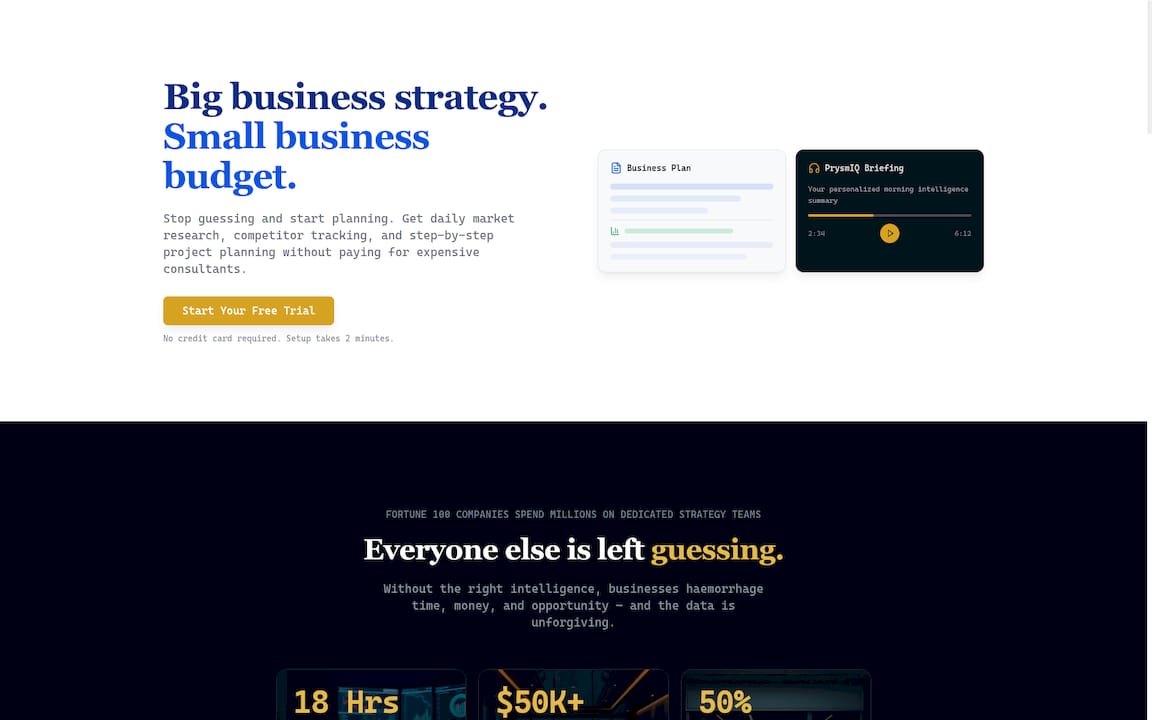
Blue Prysm is built for exactly this moment. The platform gives SMB leaders access to daily market briefings, competitor monitoring, and AI-driven business planning tools that used to require a team of consultants and a Fortune 100 budget. You can see how Blue Prysm works to understand how embedded intelligence fits into your existing decision-making process. If you want to validate a new initiative or stress-test a strategic move before committing resources, get your AI venture score and see where your idea stands against real market criteria. When you are ready to go deeper, explore Blue Prysm and find the tools that match where your business is right now.
Frequently asked questions
What is the VRIO framework and why does it matter?
The VRIO framework helps you evaluate whether your business resources and capabilities can give you a real advantage over competitors, but as VRIO identifies potential rather than guarantees it, execution is what turns the analysis into actual results.
How did Siemens achieve its competitive advantage with AI?
Siemens layered AI and digital twin technology onto its existing Erlangen factory, achieving +69% productivity and a 42% reduction in energy use without rebuilding from scratch.
What is the safest way for small businesses to harness AI?
The safest and fastest path is to use embedded AI in CRM and marketing platforms you already trust, avoiding the cost and complexity of custom model development.
Can small businesses really compete with large ones using AI?
Absolutely. Embedded AI tools give SMBs access to capabilities that were once reserved for enterprise teams, often at a fraction of the cost and with faster deployment timelines.