


Most SME leaders are making high-stakes decisions with outdated playbooks, gut instincts, and tools built for a world that no longer exists. That gap is widening fast. 82% of SMBs using AI grew their workforce, while those sitting on the sidelines are watching competitors move faster, price smarter, and serve customers better. The question isn’t whether AI-driven decision-making is transforming how businesses operate. It already has. The real question is whether you have a clear framework for choosing which trends to act on, in which order, and with what resources.
Table of Contents
- How to assess decision-making trends for SMEs
- Top trends shaping business decisions in 2026
- Comparing the top trends: Risks, ROI, and readiness
- From trend to action: Aligning with your SME strategy
- Why chasing every trend can backfire: What most SMEs miss
- Move from insight to action with Blue Prysm
- Frequently asked questions
Key Takeaways
| Point | Details |
|---|---|
| AI adoption accelerates | Over half of SMEs now use generative AI, driving speed, accuracy, and workforce growth. |
| Prioritize structured tasks | Automate structured decisions first for the fastest ROI and ease of adoption. |
| Assess trend fit | Choose trends that match your current maturity, skills, and resources to avoid wasted investment. |
| Beware of trend chasing | Sustainable gains depend on practical best practices, not pursuing every new AI technology. |
| Bridge insight to action | Use trustworthy tools and thoughtful sequencing to put trends to work for your business. |
How to assess decision-making trends for SMEs
With urgency established, let’s build a framework for how SMEs can evaluate which decision-making trends make sense for their size and resources. Not every trend deserves your attention. Some are genuinely transformative. Others are expensive distractions dressed up in impressive-sounding language.
The first step is understanding where your business sits on the AI maturity spectrum. The OECD identifies four SME AI adoption stages: Novices (using embedded AI tools like spell-check or basic recommendations), Explorers (experimenting with bespoke AI solutions), Optimizers (running multiple AI tools across functions), and Champions (enterprise-wide AI integration with measurable outcomes). Knowing your stage tells you which trends are realistic investments versus aspirational noise.
Once you know your maturity level, apply these selection criteria to any trend you’re evaluating:
| Criterion | What to ask | Why it matters |
|---|---|---|
| Value alignment | Does this improve a core revenue or cost driver? | Prevents chasing shiny objects |
| Adoption effort | How much training and change management is needed? | Underestimated by most SMEs |
| Time to ROI | Will this pay off in 6, 12, or 24+ months? | Cash flow reality for SMEs |
| Risk exposure | What breaks if this fails or produces bad outputs? | Critical for regulated industries |
| Data readiness | Do we have clean, sufficient data to feed this tool? | Data quality and AI barriers are the #1 adoption killer |
Understanding decision intelligence for SMEs means recognizing that the framework matters as much as the technology itself. A great tool applied to the wrong problem is still a bad investment.
Pro Tip: Before evaluating any new trend, honestly score your business against the OECD taxonomy. If you’re a Novice, a trend designed for Champions will drain resources without delivering results. Start where you are, not where you want to be.
Good decision-making best practices always begin with self-awareness, not vendor pitches.
Top trends shaping business decisions in 2026
With a decision framework in hand, here’s what the latest top trends look like up close and why they matter for SME leaders right now.

The data is hard to ignore. AI-assisted decisions show a median 18.5% improvement in decision speed, a 14.2% gain in accuracy, and cost savings ranging from 8% to 35%, with the strongest results in structured, repeatable tasks. That’s not a rounding error. That’s a competitive gap that compounds over time.
Here are the five trends driving the most meaningful change for SMEs:
-
Generative AI for operational decisions. Tools like AI-powered market analysis, content generation, and customer response systems are now accessible to businesses without dedicated data science teams. The barrier to entry has collapsed. SMEs that invest in AI efficiency gains are compressing weeks of research into hours.
-
Agentic AI. This is the next evolution beyond chatbots. Agentic AI systems can take sequences of actions autonomously, like researching competitors, drafting reports, and flagging anomalies, without a human triggering each step. It’s powerful, but it comes with real oversight requirements we’ll address shortly.
-
Decision intelligence platforms. These platforms integrate data from multiple sources, apply analytical models, and present structured recommendations rather than raw data. Think of it as moving from a spreadsheet to a strategic co-pilot. Platforms in this category support the kind of AI strategy trends that separate fast-moving SMEs from those still debating which dashboard to use.
-
Hybrid human-AI decision models. The smartest SMEs aren’t replacing human judgment. They’re augmenting it. Hybrid models use AI to surface options, model scenarios, and flag risks, while experienced managers make the final call. This is especially critical in areas like hiring, pricing strategy, and customer relationship management where context and nuance still matter enormously.
-
AI-powered customer intelligence. Sales, marketing, and service functions are being transformed by AI tools that predict customer behavior, personalize outreach, and identify churn risk before it becomes revenue loss. AI battle card tools are a practical example of how competitive intelligence is now being generated in real time rather than quarterly.
Pro Tip: Don’t try to implement all five trends simultaneously. Start with structured task automation in one function, measure the ROI clearly, then use that proof of concept to build internal momentum for broader adoption.
Comparing the top trends: Risks, ROI, and readiness
Having identified the top trends, it’s vital to evaluate how they stack up and which ones actually deliver for SMEs operating with real budget constraints and lean teams.
| Trend | ROI potential | Time to value | Adoption difficulty | Risk level |
|---|---|---|---|---|
| Generative AI (ops) | High | 1 to 3 months | Low to medium | Low |
| Agentic AI | Very high | 6 to 12 months | High | High |
| Decision intelligence platforms | High | 3 to 6 months | Medium | Medium |
| Hybrid human-AI models | Medium to high | 3 to 6 months | Medium | Low |
| AI customer intelligence | High | 1 to 3 months | Low to medium | Low to medium |
The OECD’s SME research makes clear that the biggest barriers aren’t technology costs. They’re data quality issues, skills shortages, and financing gaps. An SME with messy CRM data will get messy AI outputs. Garbage in, garbage out is not a cliché. It’s a budget-destroying reality.
The common barriers SMEs consistently underestimate include:
- Data fragmentation. Most SMEs have customer data scattered across email, spreadsheets, and disconnected software. AI tools need clean, centralized data to function reliably.
- Skills gaps. Implementing AI tools requires someone who understands both the technology and the business context. That person is rare and expensive.
- Change resistance. Teams that have operated on gut instinct for years don’t automatically trust algorithmic recommendations. Manager buy-in is non-negotiable.
- Financial runway. Some AI tools require 6 to 12 months before ROI becomes visible. SMEs with tight cash flow may pull the plug too early.
“Agentic AI represents a significant leap in capability, but SMEs must build in human oversight checkpoints, especially for decisions involving customer relationships, financial commitments, or brand reputation. Autonomy without accountability is a liability, not an asset.”
This is especially relevant when evaluating efficiency and profit gains from agentic systems. The gains are real, but so are the failure modes when oversight is absent.
A practical risk assessment of your current decision processes will reveal which areas are safe for AI autonomy and which require human judgment to remain in the loop. Don’t skip this step.
From trend to action: Aligning with your SME strategy
With comparison insights in hand, you’re ready to translate trends into your next strategic moves. Here’s a practical roadmap for SMEs that want to move from evaluation to execution without burning resources on false starts.
The key to SME competitive edge lies in prioritizing data-driven operations and AI adoption in customer-facing functions like service, marketing, and sales, while ensuring the foundational enablers are in place: connectivity, skills development, and access to financing.
Follow this four-step sequence:
-
Benchmark your current state. Use the OECD AI maturity taxonomy to honestly assess where you are. Map your current decision processes and identify which ones are structured and repeatable versus complex and judgment-heavy. Structured decisions are your best starting point for AI adoption.
-
Prioritize by impact and readiness. Cross-reference your business goals against the trend comparison table above. If customer retention is your top priority and your CRM data is reasonably clean, AI customer intelligence is your obvious first move. If operational costs are bleeding you dry, generative AI for ops is likely the faster win.
-
Pilot before you scale. Pick one function, one tool, and one clear success metric. Run a 60 to 90 day pilot. Measure decision speed, accuracy, or cost reduction against a pre-AI baseline. This gives you real data to justify broader investment and builds internal credibility for the change.
-
Expand with enablers in place. Before scaling to additional functions, ensure your data infrastructure is solid, your team has the skills to operate the tools effectively, and you have the financial runway to sustain the investment through the learning curve. Skipping this step is how SMEs end up with expensive tools that nobody uses.
Pro Tip: Leverage available funding programs, government grants, and technology partner subsidies to reduce the financial risk of AI adoption. Many SMEs leave significant enablement resources on the table simply because they don’t know they exist.
Revisiting decision best practices at each stage of your rollout keeps you grounded in what’s actually working versus what looks impressive in a vendor demo.
Why chasing every trend can backfire: What most SMEs miss
After mapping your actions, let’s reconsider the hype cycle and what really matters for long-term SME growth. This is where we’ll say something most AI vendors won’t.
Most SMEs overestimate the ROI of new technology and dramatically underestimate the cultural and skill barriers that determine whether that technology actually gets used. A shiny new decision intelligence platform sitting unused because your team doesn’t trust it or understand it is not a competitive advantage. It’s an expensive lesson.
Here’s the uncomfortable truth: executives are significantly more bullish on AI’s value than the managers who actually implement it day to day. Executives see the strategic potential. Managers see the workflow disruption, the training burden, and the gap between vendor promises and operational reality. That disconnect is where most AI initiatives quietly fail.
The businesses that win long-term aren’t the ones that adopt every trend first. They’re the ones that build genuine capability in a few areas, measure rigorously, and scale what actually works. That’s boring advice. It’s also correct.
True competitive advantage comes from what we’d call “boring best practices”: clean data pipelines, consistent decision frameworks, regular performance reviews against benchmarks, and gradual capability building. These aren’t headline-grabbing moves. But they’re what separates the SMEs that are still thriving in five years from the ones that burned through their innovation budget chasing the next big thing.
The best practices for transformation that stand the test of time share one common thread: they prioritize sustained execution over sporadic experimentation. Trend-hopping feels like progress. Deliberate scaling actually is progress.
Our honest recommendation: pick two trends from the list above, build genuine competency in both over the next 12 months, and resist the urge to add a third until you can clearly articulate the ROI of the first two. That discipline is rarer than any AI tool, and more valuable.
Move from insight to action with Blue Prysm
To act on these insights with confidence, here’s how Blue Prysm can help you build decision intelligence that actually scales.
Understanding which trends apply to your business is one thing. Having the tools to act on them without a team of analysts or a Fortune 500 budget is another challenge entirely.
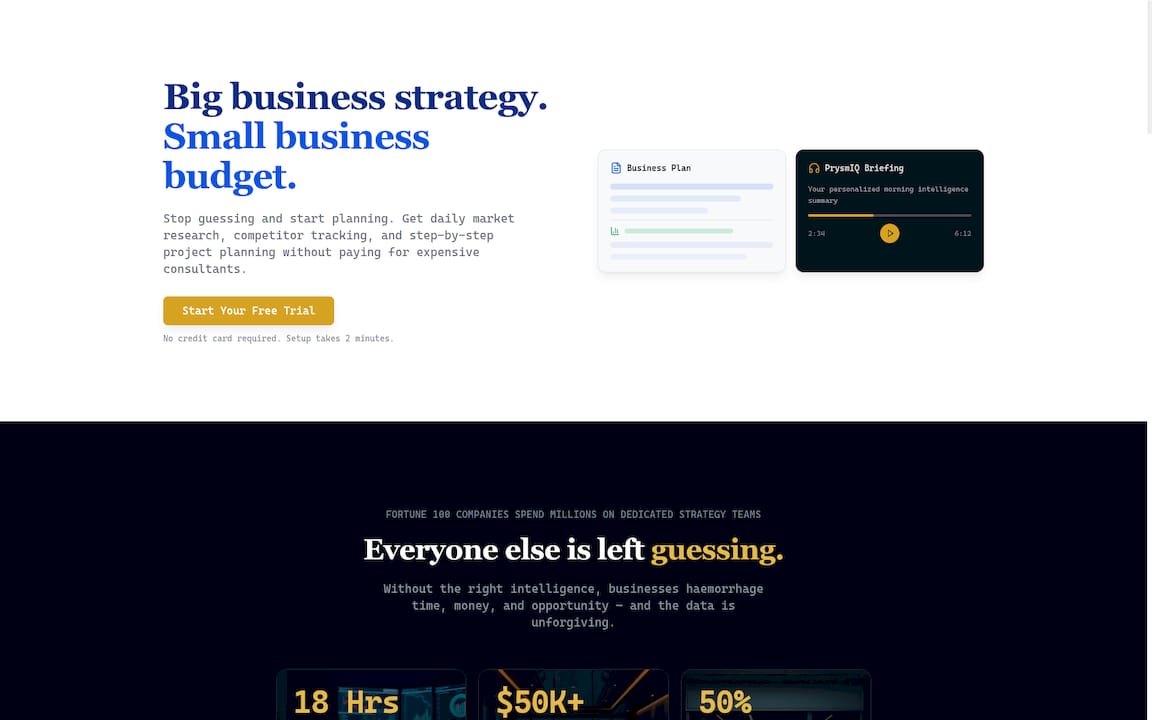
Blue Prysm was built specifically for this gap. How Blue Prysm works gives you a clear picture of how our AI-powered platform delivers daily market briefings, competitor monitoring, and strategic planning tools designed for SME decision-makers who need actionable intelligence fast. If you’re evaluating a new market move or testing whether a trend applies to your specific context, the AI venture assessment tool gives you a structured, data-driven score in minutes. And when vendor claims or market data seem too good to be true, the AI credibility tools help you cut through the noise. Strategic clarity shouldn’t require a consulting retainer.
Frequently asked questions
What is the biggest business decision-making trend for 2026?
The widespread adoption of generative AI and decision intelligence platforms is the biggest driver of improved decision speed and business outcomes for SMEs in 2026, with 58% of small businesses now using generative AI, up from 40% in 2024.
How much can AI improve business decisions?
AI adoption has delivered a median 18.5% improvement in decision speed, a 14.2% gain in accuracy, and cost savings ranging from 8% to 35%, with the strongest results appearing in structured, repeatable business tasks.
What are the main barriers for SMEs adopting AI decision-making tools?
The top barriers are data quality concerns, skills shortages, and financing obstacles, especially for advanced or enterprise-wide AI solutions that require significant upfront investment and change management effort.
How should SMEs prioritize trends to adopt?
Prioritize trends that align with your AI maturity stage, key business goals, and available resources, focusing first on structured task automation in customer-facing functions like sales, marketing, and service for the fastest and most measurable early wins.
Recommended
- Decision-making best practices for smarter business moves – Blue Prysm – Articles & Blogs
- How It Works | Blue Prysm
- AI strategies that actually build competitive advantage – Blue Prysm – Articles & Blogs
- Assess competitive advantage: practical steps for business leaders – Blue Prysm – Articles & Blogs
- competitive advantage explained: how entrepreneurs win in 2026 | siift
- Decision Making Frameworks – Powering Digital Transformation