

Picture this: your sales rep is on a call with a hot prospect. The prospect mentions they’re also talking to your top competitor. Your rep fumbles, pulls up a two-year-old PDF, and wings it. The deal goes cold. That scenario plays out every day at SMBs that rely on outdated or nonexistent competitive intelligence. The good news? AI tools boost win rates up to 41% and cut battle card creation time by 80%, turning a painful manual process into a strategic advantage you can actually use.
Table of Contents
- What you need to get started with AI-driven battle cards
- Step-by-step: Building a competitive battle card using AI
- Common pitfalls and how to avoid them
- How to measure impact and keep your battle cards updated
- Why most battle cards fail—and what actually works for SMBs
- Unlock faster, smarter battle cards with Blue Prysm
- Frequently asked questions
Key Takeaways
| Point | Details |
|---|---|
| AI tools save time | Battle card creation and updating can be 50-80% faster with AI-driven platforms. |
| Personalization boosts results | Segmented, personalized battle cards can drive up to 3x more conversions for SMBs. |
| Regular updates matter | Quarterly reviews with AI help keep intelligence current and actionable. |
| Focus on key differentiators | Highlight unique speed, pricing, or implementation benefits for your market. |
What you need to get started with AI-driven battle cards
Before you can build a high-impact battle card, you need the right basics in place for data and tools. Think of it like prepping ingredients before you cook. Skip this step, and even the best AI platform will serve up something half-baked.
The core ingredients you need:
- A prioritized list of your top three to five direct competitors
- Clear sales scenarios where you most often face those competitors
- Access to internal data: win/loss records, CRM notes, pricing sheets, and product documentation
- Public data sources: competitor websites, G2 or Capterra reviews, LinkedIn, press releases, and job postings
- A designated competitive intelligence owner, even if it’s a part-time responsibility
The people who need to be involved:
Getting the right voices in the room matters as much as the tools you choose. Your sales team knows which objections actually kill deals. Your product team knows where your roadmap beats the competition. Marketing knows how your positioning lands in the market. Without all three perspectives, your battle card will be fluffy at best and misleading at worst.
Here’s a quick look at the tools available for SMBs at different budget levels:
| Tool type | Examples | Best for | Approximate cost |
|---|---|---|---|
| Free AI battle card makers | Mailmodo, Canva AI | Getting started, basic templates | $0 |
| Mid-tier AI platforms | Crayon, Klue Lite | Automated monitoring, alerts | $200 to $800/month |
| Advanced AI platforms | Playwise HQ, AeraVision | Full automation, segment personalization | $800+/month |
| Strategic intelligence suites | Blue Prysm | Daily briefings, competitor monitoring, planning | Flexible SMB pricing |
AI tools can reduce research time by 50% for SMBs, which means even a lean two-person marketing team can produce battle cards that rival what a Fortune 500 company’s research department would build. Understanding how AI tools work before you commit to a platform saves you from paying for features you’ll never use.
Pro Tip: Start with free tools to validate your format and data sources with your sales team. Only scale to premium platforms once you know which competitor matchups actually move the needle in your deals.
The real trap most SMBs fall into is treating this as a one-time setup task. It isn’t. The prerequisites phase is ongoing. Your competitor list will change. Your sales scenarios will evolve. Build the habit of revisiting your inputs at least once a quarter, and your AI outputs will stay sharp.
Step-by-step: Building a competitive battle card using AI
With everything prepped, you’re ready to start building your first battle card using the right AI platform. This isn’t complicated, but sequence matters. Rushing straight to the AI without clean inputs is like asking someone to write a report without giving them any source material.
Step 1: Define your competitor list and target deals
Start narrow. Pick one or two competitors you lose to most often. Pull your CRM data and identify the deal types where those losses cluster. Are you losing on price? On features? On brand recognition? Knowing the “why” behind your losses shapes everything that follows.

Step 2: Gather and clean your data
Raw data is messy. Before feeding anything into an AI platform, standardize your sources. Scrape competitor pricing pages, pull recent G2 reviews, and note any product updates from their blog or changelog. Delete anything older than 12 months unless it’s foundational context. Stale data produces stale battle cards, full stop.
Step 3: Input into your AI platform
Most modern AI battle card platforms accept structured inputs: competitor name, product category, pricing tier, key features, and customer sentiment. Some platforms like Playwise HQ can ingest raw text and auto-structure it. Others require a more guided template approach. Either way, the quality of your output is directly proportional to the quality of your input.
Step 4: Review AI-generated suggestions
AI platforms will generate positioning statements, objection handlers, and competitive differentiators. Don’t accept them blindly. Read each section with a critical eye. Ask yourself: would a sales rep actually say this on a call? If the language sounds robotic or too generic, flag it for revision.
Step 5: Validate with your sales and product teams
This is the step most SMBs skip, and it’s the reason so many battle cards collect digital dust. Run a 30-minute review session with two or three reps and one product manager. Their gut reactions will surface gaps you never would have caught on your own. Assessing differentiation through their lens is what turns a document into a tool people actually trust.
Step 6: Finalize and distribute
Format matters. A battle card that lives in a shared Google Drive folder nobody checks is useless. Embed it in your CRM, link it from your sales playbook, and send a brief Slack message when it’s updated. Accessibility drives adoption.
Here’s a comparison of how different AI tool tiers perform on the key dimensions that matter for SMBs:
| Feature | Free tools | Mid-tier | Advanced platforms |
|---|---|---|---|
| Time to first draft | 2 to 4 hours | 30 to 60 minutes | Under 15 minutes |
| Auto-update capability | No | Partial | Yes |
| Segment personalization | No | Limited | Full |
| CRM integration | No | Some | Yes |
| Win rate impact | Minimal | Moderate | 16 to 41% increase |
The data is clear. AI-driven platforms accelerate creation by 80% and meaningfully move win rates. And when you personalize by segment, SMBs can see up to 3x higher conversions compared to generic one-size-fits-all cards. That’s not a marginal improvement. That’s the difference between a tool that collects dust and one that closes deals.
Pro Tip: Focus your mid-market battle cards on differentiators like speed of implementation and transparent pricing. Enterprise competitors often can’t compete on either, and those are the exact pain points your prospects care about most.
Common pitfalls and how to avoid them
After building your card, it’s crucial to avoid the mistakes that cause most competitive intelligence efforts to fail. And they do fail, often. Not because the strategy is wrong, but because execution breaks down in predictable ways.
“58% of CI professionals struggle to keep battle cards current.” This isn’t a resource problem. It’s a process problem. AI solves it, but only if you set it up correctly.
Here are the most common pitfalls and exactly how to fix them:
- Outdated information: Set up automated alerts for competitor website changes, press releases, and review site updates. AI platforms with monitoring features handle this passively. Without automation, updates fall through the cracks every single time.
- Generic templates: A battle card that could apply to any company in your industry is worthless. Customize every section for the specific competitor and the specific deal type. Generic language signals to your sales team that nobody actually thought this through.
- Ignoring sales feedback: Build a simple feedback loop. After every competitive deal, whether you win or lose, ask the rep what worked and what didn’t. Feed that back into your AI platform as a new data input. Your battle card should get smarter with every deal cycle.
- Under-utilizing AI features: Most SMBs use AI platforms at about 30% of their capability. They generate the initial draft and stop there. But features like real-time alerts, sentiment analysis of competitor reviews, and scenario modeling are where the real leverage lives. Explore your platform’s full feature set before assuming you’re getting everything out of it.
- Skipping the pricing section: This is a big one. If your battle card doesn’t address how your pricing your solution compares to the competitor’s, your sales team will improvise on the call. That improvisation often costs you the deal.
The pattern here is consistent. Battle cards fail because they’re treated as documents instead of living tools. The moment you stop updating and validating, the card starts working against you by giving your reps false confidence based on stale data.
How to measure impact and keep your battle cards updated
Now that your card is in use, here’s how to make sure it’s continually driving results. Building the card is only half the job. The other half is proving it works and keeping it sharp.
The KPIs that actually matter:
- Win rate per competitive segment (track separately for each competitor matchup)
- Time to update (how long does it take your team to refresh a card when a competitor makes a move?)
- Conversion rate on deals where the battle card was used versus where it wasn’t
- Sales rep adoption rate (are people actually pulling the card up during calls?)
A simple maintenance process that won’t drain your team:
- Quarterly reviews: Block 60 minutes every quarter to review each active battle card. Assign a specific owner, not a committee. Committees produce delays.
- AI-triggered updates: Configure your AI platform to flag changes in competitor pricing, product launches, or significant review shifts. Most mid-tier and advanced platforms offer this natively.
- CRM sync: Tag deals in your CRM as competitive when they involve a known competitor. This creates a data trail that makes your quarterly reviews faster and more data-driven.
- Feedback loops: Create a simple one-click survey in your CRM or Slack that reps can fill out after competitive deals. Three questions max. What objection came up? Did the battle card help? What was missing?
The numbers that should motivate you:
Battle cards using AI drove 16 to 41% win rate increases and halved research time across SMB deployments. That’s not a theoretical benefit. Those are real deal outcomes from teams that committed to the process. If your battle cards aren’t moving your win rate after 90 days, the issue is almost always one of three things: stale data, low adoption, or a mismatch between the card’s content and the actual objections your reps face.
The fix is always the same. Go back to your sales team, listen harder, and update faster. AI makes that cycle dramatically shorter than it used to be.
Why most battle cards fail—and what actually works for SMBs
Here’s the uncomfortable truth we’ve seen play out repeatedly: most battle cards fail not because of bad data or wrong tools. They fail because they were built for the wrong audience.
Enterprise battle card templates are designed for large sales teams with dedicated enablement staff, long deal cycles, and buyers who respond to detailed feature comparisons. SMB deals move faster, buyers are less patient, and your reps often don’t have time to read a six-page document between calls. When SMB leaders copy enterprise templates, they get enterprise-style failure rates.
What actually works is ruthless simplicity combined with segment-specific personalization. A battle card that answers three questions clearly wins every time: what does this competitor do well, where do we beat them, and what’s the one thing to say when the prospect brings them up? That’s it. Everything else is noise.
Personalization by segment can lead to a 3x conversion rate increase, and the reason is straightforward. A prospect in the healthcare vertical has completely different buying criteria than one in retail tech. A single generic card can’t serve both. AI makes it practical to maintain segment-specific versions without tripling your workload, which is exactly why the technology matters so much for resource-constrained SMB teams.
The other thing we’ve learned is that speed beats perfection. A battle card that’s 80% accurate and available today beats a perfect card that’s ready in three weeks. Your competitors are moving. Your prospects are talking to them right now. An AI battle card workflow that produces a usable draft in under an hour changes the economics of competitive intelligence for SMBs entirely.
The teams that win with battle cards treat them like living products, not static documents. They ship fast, gather feedback, iterate, and ship again. Sound familiar? It should. It’s the same mindset that wins in product development, and it works just as well in competitive intelligence.
Unlock faster, smarter battle cards with Blue Prysm
If the process above sounds like exactly what your team needs but the manual work still feels daunting, you’re not alone. Most SMB leaders know they need better competitive intelligence. The gap is in execution.
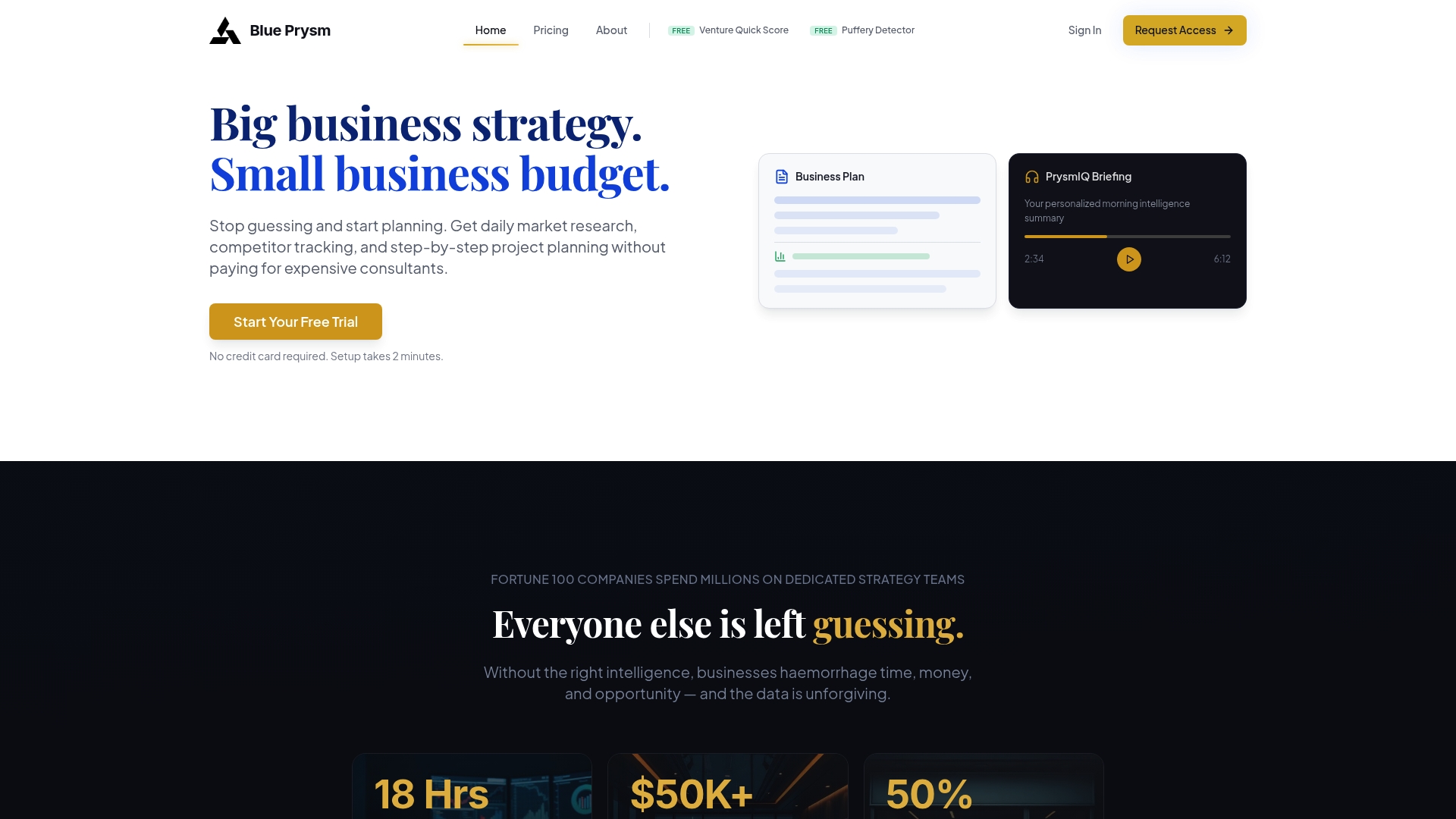
Blue Prysm is built specifically for that gap. The platform gives you AI-powered competitor monitoring, daily market briefings, and the strategic frameworks to turn raw intelligence into battle-ready content your sales team will actually use. You don’t need a dedicated research team or an expensive consulting contract. You need a system that works while you focus on running your business. See how it works and explore affordable pricing designed for SMBs at every stage. When you’re ready to move from reactive to proactive competitive intelligence, get started with Blue Prysm today.
Frequently asked questions
What is the purpose of a competitive battle card?
A battle card gives your sales team quick, tailored insights on specific competitors so they can handle objections confidently and win more deals without scrambling for information mid-call.
How often should I update battle cards for my business?
Most experts recommend quarterly reviews at minimum, but trigger-based updates are smarter. Since 58% of CI professionals struggle to keep cards current, AI-powered alerts that flag competitor changes in real time are the most reliable solution.
Can small businesses really see a big boost from using AI in battle cards?
Absolutely. AI-driven battle cards can cut creation time by up to 80% and drive win rate increases of 16 to 41%, while personalized AI approaches have delivered up to 3x higher conversions for SMBs.
Which AI tools work well for building battle cards in 2026?
Free tools like Mailmodo are solid starting points for validating your format, while platforms like Playwise HQ and AeraVision offer advanced features including auto-updates and segment personalization for teams ready to scale their competitive intelligence program.