


Most businesses today are drowning in data and still making decisions based on gut feeling. That’s not a paradox; it’s a trap. You can have dashboards, reports, and spreadsheets stacked to the ceiling, but if your decision-making process lacks structure and context, you’re still flying blind. Decision intelligence (DI) is the discipline that bridges the gap between raw data and genuinely smart choices. In this article, we’ll break down what DI actually means, why it matters specifically for small and medium-sized enterprises (SMEs), and how you can start applying it without a Fortune 100 budget.
Table of Contents
- What is decision intelligence (DI)?
- How decision intelligence drives value for SMEs
- Decision intelligence in action: Frameworks and tools for SMEs
- Human-AI collaboration: Why governance matters in decision intelligence
- Our take: What most decision intelligence guides don’t tell you
- Explore decision intelligence solutions tailored for your business
- Frequently asked questions
Key Takeaways
| Point | Details |
|---|---|
| DI is decision-centric | Decision intelligence treats each decision as an asset, focusing on context, logic, and outcomes. |
| SME-friendly potential | SMEs can boost performance with DI but must address skills gaps and costs. |
| Human + AI synergy | Combining human judgment and AI reduces risk and improves decision reliability. |
| Start small for impact | Pilot projects with clear goals deliver the best early wins with DI tools. |
What is decision intelligence (DI)?
Now that you see why gut instinct doesn’t cut it, let’s break down exactly what decision intelligence means and why it’s a game-changer.
Decision intelligence is not just another buzzword layered on top of artificial intelligence. It’s a discipline that treats every significant business decision as a structured asset, one with explicit context, defined logic, and measurable outcomes. Think of it this way: traditional business intelligence (BI) tells you what happened. Standard AI tells you what might happen. Decision intelligence tells you what you should do about it and why.
The distinction matters enormously. A BI dashboard might show you that customer churn spiked 18% last quarter. An AI model might predict it will spike again. But a DI system asks: given your business context, your constraints, your risk tolerance, and your strategic goals, what is the best decision to make right now?
As David Pidsley explains, DI treats decisions as assets with explicit context and logic to avoid bias and risk in AI automation. It’s not simply BI or AI rebranded; it’s decision-centric engineering. That framing is critical. It shifts the focus from data collection to decision quality.
Here’s how DI compares to what most SMEs are already using:
| Feature | Business intelligence | Standard AI | Decision intelligence |
|---|---|---|---|
| Primary output | Reports and dashboards | Predictions and patterns | Actionable decision recommendations |
| Handles context | Limited | Moderate | Yes, explicitly |
| Reduces cognitive bias | No | Partially | Yes, by design |
| Supports accountability | Low | Low | High |
| SME accessibility | High | Moderate | Growing rapidly |
The key pillars of a solid DI approach include:
- Context embedding: Every decision is tagged with the conditions under which it was made
- Logic transparency: The reasoning behind a recommendation is visible and auditable
- Bias mitigation: Structured frameworks reduce the influence of cognitive shortcuts
- Outcome tracking: Decisions are linked to results so the system learns over time
To understand how decision intelligence works in practice, the process is less about building a complex AI system and more about creating a repeatable, structured way to move from information to action.
“Decision intelligence is not about replacing human judgment. It’s about making human judgment more reliable, consistent, and defensible.” This is the shift that separates high-performing SMEs from those stuck in reactive mode.
How decision intelligence drives value for SMEs
With a solid definition, let’s explore how decision intelligence can directly impact your business’s bottom line.

Here’s the honest reality: most SMEs don’t lack data. They lack a system for converting data into decisions that stick. Decision intelligence fills that gap in a way that’s measurable and repeatable.
Research confirms that data-driven approaches improve financial and operational performance for SMEs, though challenges like upfront costs, skills gaps, and context-specific variables mean that positive ROI is not automatic. It depends heavily on how you implement DI and what problems you target first.
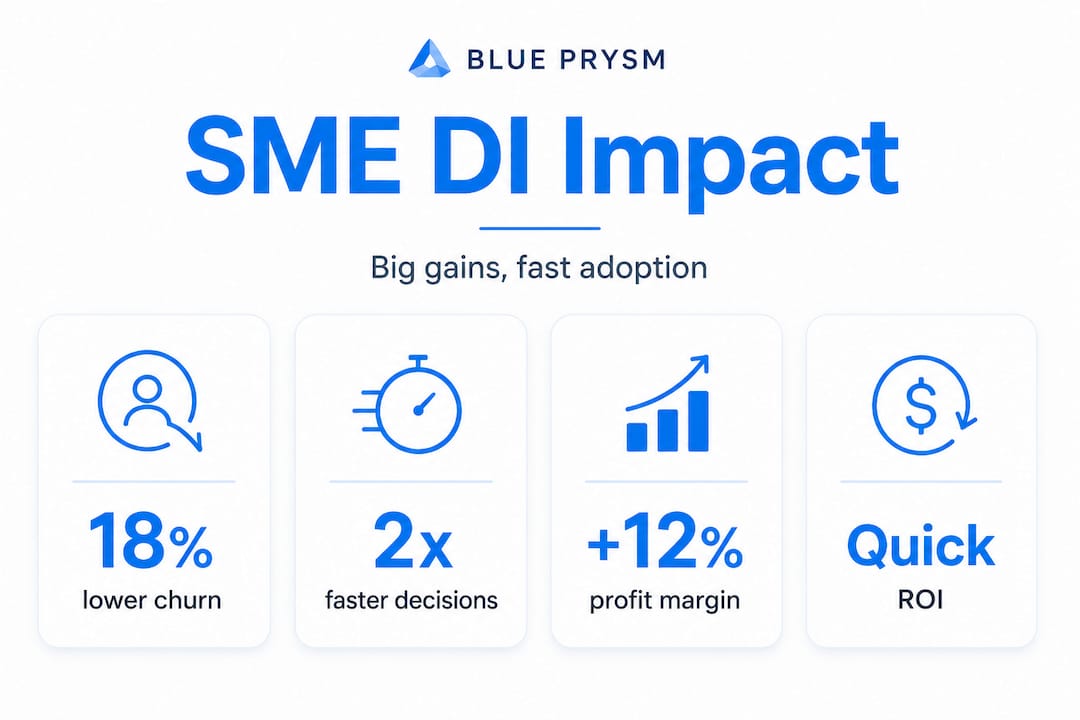
The value shows up across multiple business functions:
| Business area | DI application | Potential impact |
|---|---|---|
| Sales forecasting | Structured scenario modeling | 15-30% improvement in forecast accuracy |
| Inventory management | Demand-driven decision triggers | Reduced overstock and stockouts |
| Hiring decisions | Bias-reduced candidate evaluation | Better retention and team fit |
| Pricing strategy | Competitive and margin-aware recommendations | Improved unit economics |
| Market entry | Validated opportunity scoring | Faster, lower-risk expansion |
The SME advantage here is actually speed. Larger organizations have layers of bureaucracy that slow DI adoption. You can move faster, test more aggressively, and iterate without needing board approval for every pilot program.
That said, the challenges are real. Skills gaps are the most common barrier. Many SME teams don’t have a dedicated data analyst, let alone a decision scientist. The cost of building DI infrastructure from scratch can be prohibitive. And without clear metrics from the start, it’s easy to implement a DI tool and have no idea whether it’s actually working.
Pro Tip: Don’t try to boil the ocean. Pick one high-stakes, recurring decision in your business, such as which customers to prioritize for upselling or when to reorder inventory, and apply DI principles there first. A focused pilot with clear success metrics is worth far more than a sprawling initiative with fuzzy goals.
The strategy for small businesses that works best is one that starts narrow, proves value quickly, and then expands. That’s not timidity; that’s smart resource allocation.
Decision intelligence in action: Frameworks and tools for SMEs
Understanding the value, let’s get practical and look at how SMEs can put decision intelligence to work with frameworks and real tools.
The global DI market tells you everything you need to know about where this is heading. The DI market is projected to grow to over $47 billion by 2030. That’s not a niche trend; it’s a fundamental shift in how businesses operate. The question is not whether DI will become standard practice, but whether you’ll be ahead of it or scrambling to catch up.
Here’s a practical four-step framework for SMEs starting their DI journey:
-
Identify your decision inventory. Map out the 10 to 15 most consequential recurring decisions in your business. These might include pricing adjustments, budget allocations, hiring choices, or market entry timing. You can’t improve what you haven’t named.
-
Audit your current decision process. For each decision, ask: What data do we currently use? Who makes the final call? How long does it take? What biases might be influencing the outcome? This audit often reveals uncomfortable truths about how ad hoc most “strategic” decisions actually are.
-
Run a targeted pilot. Choose one decision from your inventory where the stakes are high and the data is reasonably available. Apply a structured DI approach: define the decision criteria, gather relevant data, model the options, and document the reasoning. Use an AI venture assessment tool to validate assumptions and stress-test your logic before committing.
-
Measure, learn, and scale. Track outcomes against your original decision criteria. Did the structured approach lead to better results? Where did the model miss context that a human caught? Use those lessons to refine your process and expand to other decisions.
Common pitfalls to avoid at each stage:
- Stage 1 trap: Listing too many decisions and spreading effort too thin. Focus on high-frequency, high-impact choices.
- Stage 2 trap: Assuming your current process is more rational than it is. Be honest about where emotion and politics drive decisions.
- Stage 3 trap: Choosing a pilot that’s too complex or politically sensitive. Start where the data is clean and the stakes are manageable.
- Stage 4 trap: Measuring the wrong things. If you track activity instead of outcomes, you’ll think DI is working when it isn’t.
The tools available to SMEs today are dramatically better than they were even three years ago. AI-powered platforms can now handle market analysis, competitor monitoring, and scenario modeling at a fraction of what enterprise consulting used to cost. The barrier to entry has dropped significantly.
Human-AI collaboration: Why governance matters in decision intelligence
Before you launch your DI initiatives, it’s crucial to understand the limits of automation and the power of effective governance.
Let’s be direct about something the DI hype often glosses over: AI does not make better decisions than humans in all contexts. It makes faster, more consistent decisions within defined parameters. The moment you step outside those parameters, without human oversight, you’re exposed.
Research from PeerJ Computer Science highlights this tension clearly. Effective DI is not about full AI autonomy, which carries real risks around bias and explainability. The hybrid human-AI model, with proper governance, is essential, especially for SMEs operating under resource constraints where a single bad decision can have outsized consequences.
“The goal is not to remove humans from the decision loop. The goal is to make the human’s role in that loop more informed, more structured, and more defensible.”
Governance in DI means building clear rules around how decisions are made, who has authority to override AI recommendations, and how outcomes are tracked and reviewed. Without governance, DI becomes a black box that nobody trusts, and eventually nobody uses.
Best practices for human-AI governance in SME decision intelligence:
- Explainability first: Any AI recommendation should come with a clear explanation of the factors driving it. If you can’t explain why the system recommended a decision, you shouldn’t implement it.
- Override protocols: Define in advance the conditions under which a human can and should override an AI recommendation. This isn’t about distrust; it’s about accountability.
- Bias audits: Regularly review your DI outputs for patterns that suggest systematic bias, particularly in hiring, pricing, or customer segmentation decisions.
- Decision logs: Maintain a record of significant decisions, the data and logic behind them, and the outcomes. This creates institutional memory and supports continuous improvement.
- Escalation paths: Not every decision should go through the same process. Define which decisions require human review before action and which can be automated with confidence.
The SME context adds a specific wrinkle here. You likely don’t have a dedicated AI ethics officer or a data governance team. That’s fine. What you do need is a designated decision owner for each major decision category, someone who understands the DI outputs and takes responsibility for the final call.
Our take: What most decision intelligence guides don’t tell you
Having mapped out the mechanics, it’s time to share hard-earned lessons and realities too often glossed over in the hype.
Here’s what we see consistently: businesses that fail at DI adoption don’t fail because the technology didn’t work. They fail because leadership wasn’t genuinely committed to changing how decisions get made. DI is not a software installation; it’s a behavioral shift. And behavioral shifts require executive buy-in from day one, not as an afterthought.
The second uncomfortable truth is about change management. Most DI implementations that stall do so because the people whose judgment is being “augmented” feel threatened. Your sales director who has spent 15 years building instincts about which deals to pursue is not going to embrace a system that questions those instincts unless they understand the value and feel respected in the process. Ignore this human dynamic and your DI investment will collect digital dust.
We also see a tendency to measure DI success by adoption metrics, how many people are using the tool, how many decisions have been logged, rather than by actual decision quality and business outcomes. Those are vanity metrics. What matters is whether your decisions are getting faster, more accurate, and more consistently aligned with your strategic goals.
The practical path that works is this: start with practical DI adoption steps that are transparent, tied to clear business metrics, and championed by someone with real authority in the organization. Iterate ruthlessly. Celebrate early wins publicly. And treat every failure as data, not as a reason to abandon the approach.
Decision intelligence is genuinely powerful. But it rewards the disciplined and the patient, not the enthusiastic and the hasty.
Explore decision intelligence solutions tailored for your business
Ready to take the next step? Here’s where to find tools and personalized support for your DI journey.
If this article has made one thing clear, it’s that decision intelligence is not a luxury reserved for large enterprises with deep pockets. SMEs that move now will build a compounding advantage over competitors still relying on gut instinct and quarterly reports.
The Blue Prysm platform is built specifically for business leaders who want Fortune 100-level strategic intelligence without the Fortune 100 price tag. From daily market briefings and competitor monitoring to structured business planning tools, Blue Prysm puts DI within reach for growing businesses. Want to validate a new idea or stress-test a strategic move? Start with a free AI assessment to score your venture’s readiness and identify your highest-priority decision gaps. Then see how it works and explore the full suite of tools designed to help you make smarter, faster, more defensible decisions.
Frequently asked questions
What makes decision intelligence different from traditional business intelligence?
Decision intelligence focuses on treating decisions as structured assets with embedded context and logic to support better outcomes, whereas business intelligence mainly reports historical data and surface-level trends without guiding action.
Can small businesses afford to implement decision intelligence tools?
Yes, but success depends on careful planning. Upfront costs and skills gaps are real challenges, so starting with a focused, high-impact use case and clear success metrics is the most cost-effective approach.
Does DI mean decisions are fully automated by AI?
No. Effective DI combines human oversight with AI-generated insights to ensure governance, transparency, and reduced bias, particularly important for SMEs where a single poor decision carries significant risk.
What industries benefit most from decision intelligence?
Almost any sector can benefit, but industries with complex operations, high data volumes, or rapid market shifts, including retail, finance, and healthcare, tend to see the fastest and most measurable results from DI adoption.