
Most SMEs can tell you what they sell. Far fewer can tell you why customers keep choosing them over the competition. That gap is dangerous. Without a clear, honest read on your real sources of competitive advantage, you are essentially flying blind, making investment decisions on gut feeling and hoping your edge holds. A study of 1,286 SME firms found that employee competence, R&D activity, and modern technology adoption are the factors that most significantly increase market share against competitors. Yet most SME leaders never formally assess these areas. This article walks you through a systematic, practical approach to change that.
Table of Contents
- Understand what competitive advantage means
- Gather your strategic intelligence: What you need before assessing
- Step-by-step: How to assess your competitive advantage
- Avoid common mistakes and pitfalls
- Turning assessment into lasting strategic advantage
- What most SME leaders overlook about competitive advantage
- How Blue Prysm can help your business gain the edge
- Frequently asked questions
Key Takeaways
| Point | Details |
|---|---|
| Define your advantage | Understand what truly differentiates your business and how it translates to market success. |
| Use frameworks wisely | Apply tools like Porter, VRIO, or GIANN appropriately to avoid overwhelm and focus on impact. |
| Prioritize people and tech | Staff competence, innovation, and modern technology are proven drivers of market share growth. |
| Streamline metrics | Limit KPIs to essential performance indicators for clarity and actionable decision-making. |
| Turn insights into action | Regularly assess, communicate, and act on your findings to maintain and grow your competitive edge. |
Understand what competitive advantage means
To clearly assess your competitive edge, you first need to understand the core elements and why they matter.
Competitive advantage, in plain terms, is whatever allows your business to create more value for customers than your rivals can, at a cost that still generates profit. For SMEs, that definition gets complicated fast. You are not operating with the brand budgets of a Fortune 500 company or the R&D labs of a tech giant. Your advantages tend to be more specific, more personal, and often more fragile if left unmanaged.
There are two main schools of thought on where competitive advantage comes from:
- External drivers (Porter’s view): Porter’s Five Forces analyzes industry structure, including competitive rivalry, threat of new entrants, substitute products, and buyer and supplier bargaining power, to assess profitability and competitive intensity. This framework asks: how favorable is the environment you are competing in?
- Internal drivers (Resource-Based View): This perspective argues that sustainable advantage comes from inside the firm, from unique resources and capabilities that competitors cannot easily copy or buy. Think proprietary processes, specialized staff knowledge, or deeply embedded customer relationships.
For most SMEs, the honest answer is that both matter. But research consistently shows that internal capabilities, especially people and technology, are the more controllable and actionable levers.
“SME competitiveness is not just about market positioning. It is about building and protecting internal assets that competitors cannot replicate overnight.” This is the insight that separates businesses that grow intentionally from those that drift.
Losing sight of your real advantages is how businesses stagnate. You start competing on price because you stopped investing in what made you different. You lose a key employee and suddenly realize your “advantage” walked out the door. Formal assessment prevents that kind of slow erosion.
Gather your strategic intelligence: What you need before assessing
Now that you know what competitive advantage entails, gather the right strategic intelligence to get a clear baseline.

Strategic intelligence, for SMEs, means having the right data about your market, your competitors, and your own operations before you sit down to analyze anything. Too many leaders jump straight to frameworks without the raw material to fill them in meaningfully. The result is a SWOT analysis full of vague statements and zero actionable insight.
Here is what you need to gather before you start any formal assessment:
- Market data: Industry growth rates, segment trends, customer satisfaction benchmarks, and pricing norms in your sector
- Internal metrics: Revenue per employee, customer retention rate, product return rates, staff tenure and training investment, R&D spend as a percentage of revenue
- Competitor benchmarks: Pricing, product range, customer reviews, hiring activity, and any publicly available financial data
- Technology audit: What tech for small businesses are you currently using, and how does it compare to industry standards?
One of the most common traps SMEs fall into is tracking too many metrics at once. You end up drowning in data that does not connect to actual decisions. The GIANN methodology addresses this directly. Research shows it optimizes competitiveness models by reducing KPIs by 39% while maintaining accuracy. That is a significant finding. It means you can measure less and still get a sharper picture of where you stand.
| Information category | What to collect | Why it matters |
|---|---|---|
| Market data | Growth rates, segment trends | Frames your external opportunity |
| Internal metrics | Revenue per employee, retention | Reveals operational strengths |
| Competitor benchmarks | Pricing, reviews, hiring signals | Identifies gaps and threats |
| Technology stack | Tools, automation, integrations | Highlights capability gaps |
| People data | Skills inventory, training spend | Surfaces your human capital edge |
Pro Tip: Before your assessment, cut your KPI list to the ten metrics most directly tied to customer value and revenue. Everything else is noise until you have clarity on those ten.
Platforms built around leveraging innovation in strategic intelligence can dramatically shorten this data-gathering phase. Instead of spending weeks pulling reports, you can access structured competitor monitoring and market briefings that feed directly into your assessment process. Explore what strategy resources are available to you before you start from scratch.
Step-by-step: How to assess your competitive advantage
With preparation complete, here is how to systematically assess your own competitive advantage in clear, actionable steps.
You have three main frameworks to choose from, and the right choice depends on your resources and goals. Here is a quick comparison:
| Framework | Focus | Best for | Key limitation |
|---|---|---|---|
| Porter’s Five Forces | External industry structure | Understanding market dynamics | Ignores internal strengths |
| VRIO | Internal resources and capabilities | Identifying sustainable advantages | Requires honest self-assessment |
| GIANN | Streamlined KPI-based competitiveness | SMEs with limited analytical capacity | Less established than Porter/VRIO |
A combined Porter and VRIO approach gives you the most complete picture. External analysis tells you where the battlefield is; internal analysis tells you whether you are equipped to win on it.
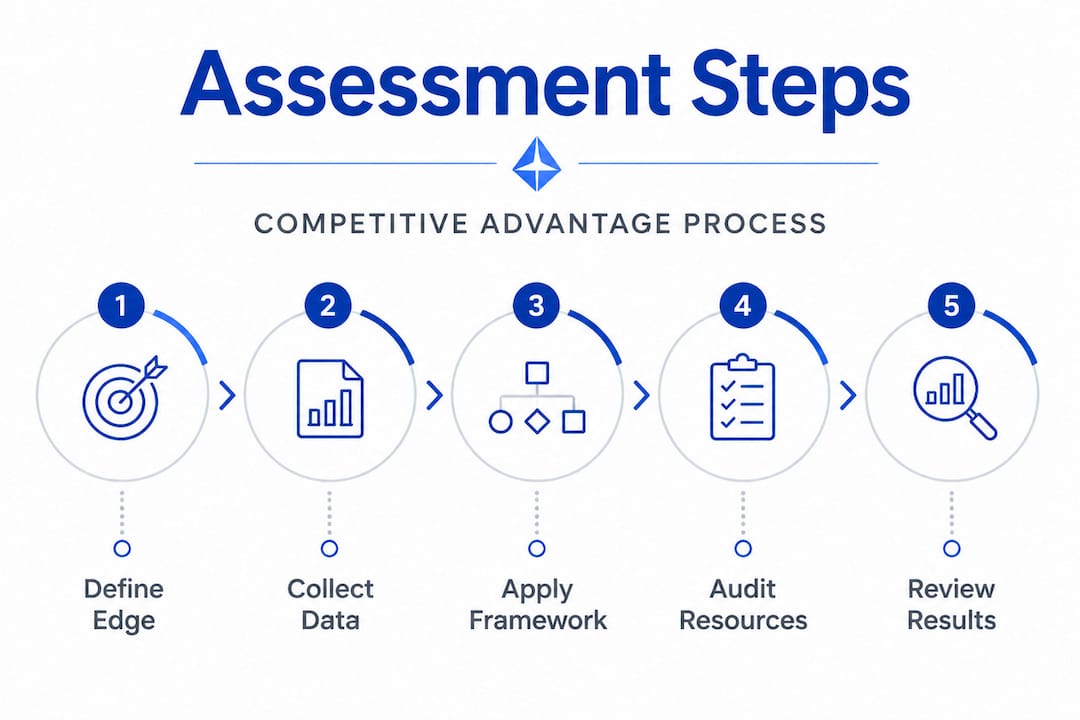
Here is the step-by-step process:
-
Analyze your industry environment using Porter’s Five Forces. Map out each of the five forces for your specific market. Score each one as high, medium, or low threat. This gives you a structured view of external pressure and where your margins are most at risk.
-
Audit your internal resources using VRIO. VRIO stands for Valuable, Rare, Inimitable, and Organized. For each key resource or capability, ask: Does it create value for customers? Is it rare among competitors? Is it difficult to copy or substitute? Is your organization set up to exploit it? Resources that pass all four tests are your sustained competitive advantages. Ones that pass only one or two are temporary and need reinforcement.
-
Streamline using GIANN. Once you have a long list of potential KPIs from your Porter and VRIO work, apply the GIANN approach to cut the list down to what actually predicts competitive performance. This keeps your ongoing monitoring manageable and focused.
-
Score and prioritize your findings. Not all advantages are equal. Rank them by durability (how hard they are to copy), customer impact (how much they influence buying decisions), and scalability (can you grow them?).
-
Identify your vulnerability gaps. Where are competitors gaining ground? Which of your advantages are eroding? This is where honest assessment matters most. Use digital transformation strategies to identify where technology investments could shore up weaknesses quickly.
-
Use an AI venture assessment tool to stress-test your findings against market benchmarks. AI-driven scoring can surface blind spots that internal teams miss because they are too close to the business.
Pro Tip: When completing your VRIO audit, weight employee competence and technology investments heavily. Research consistently shows these are the highest-impact internal factors for SME market share growth. Do not let them get buried under financial metrics.
Avoid common mistakes and pitfalls
Even with the right tools, certain mistakes can undermine your assessment. Here is what to watch out for.
The biggest mistake is also the most common: overcomplicating the process. Leaders pull in too many KPIs, too many frameworks, and too many stakeholder opinions. The assessment becomes a project in itself, and the insights never translate into decisions. GIANN’s 39% KPI reduction finding is a direct response to this problem. More data does not mean more clarity.
Here are the other traps to avoid:
- Ignoring intangible assets. Staff skills, institutional knowledge, supplier relationships, and brand trust are hard to quantify but often represent your most durable advantages. If your assessment only covers financial metrics and market share, you are missing the real story.
- Benchmarking only against large competitors. If you run a regional logistics firm, comparing yourself to a national carrier is not useful. Your real competitive battle is with similar-sized rivals in your geography. Benchmark against businesses your customers actually consider as alternatives.
- Treating assessment as a one-time event. Markets shift. Competitors invest. Technology changes the rules. An assessment done once and filed away is worse than no assessment at all, because it creates false confidence.
- Confusing activity with advantage. Being busy is not a competitive advantage. Having a large social media following is not a competitive advantage unless it demonstrably drives revenue that competitors cannot replicate.
“SMEs should prioritize internal capabilities like R&D and technology adoption over broad industry analysis, given their resource constraints. The firms that outperform their peers are those that invest decisively in what they can control.”
This is a contrarian but important point. External analysis feels productive because it generates impressive-looking reports. But for most SMEs, the real leverage is internal. Fix your capabilities first, then worry about industry trends.
Turning assessment into lasting strategic advantage
Once assessment is complete, it is essential to activate your new understanding. Here is how to turn your findings into results.
An assessment that sits in a slide deck changes nothing. The goal is to connect your findings directly to decisions, investments, and team priorities. Here is how to do that systematically:
-
Translate findings into investment decisions. If your VRIO audit reveals that employee competence is your strongest advantage, the logical response is to protect and grow it. That means training budgets, retention programs, and hiring criteria tied directly to the skills that drive your edge. SME research confirms that firms investing in employee competence, R&D, and modern technology see measurable market share gains.
-
Communicate strategic priorities to your team. Your team cannot execute on a strategy they do not understand. Translate your assessment findings into clear priorities: what you are doubling down on, what you are deprioritizing, and why. This alignment is what separates businesses that execute well from those that have great plans and mediocre results.
-
Set up a quarterly review cycle. Competitive landscapes shift faster than annual planning cycles can accommodate. A quarterly check-in on your top ten KPIs, combined with a bi-annual full reassessment, keeps your strategy grounded in current reality rather than last year’s assumptions.
-
Assign ownership. Each identified advantage or vulnerability gap should have a named owner responsible for monitoring and improving it. Without ownership, insights become orphaned good intentions.
-
Stay current on digital transformation trends that could either threaten your current advantages or create new ones. Technology is reshaping competitive dynamics in virtually every sector, and SMEs that track these shifts proactively are far better positioned than those that react after the fact.
-
Build iteration into your process. The first assessment will be imperfect. That is fine. The goal is a living, improving process that gets sharper with each cycle, not a perfect document produced once.
The businesses that sustain their advantage over time are not necessarily the ones with the best initial assessment. They are the ones that make assessment a habit, not a project.
What most SME leaders overlook about competitive advantage
Here is the uncomfortable truth we see repeatedly: most SME leaders are far better at analyzing their industry than they are at honestly auditing themselves. They can tell you about competitor pricing, market trends, and regulatory changes. Ask them to rate their own team’s skills against what the business actually needs to win, and the conversation gets vague fast.
This is the mindset gap that frameworks alone cannot fix. Porter’s Five Forces is a genuinely useful tool. But if you use it as a reason to obsess over external threats while avoiding hard internal questions, it becomes a sophisticated form of procrastination.
The businesses we see gaining ground are not the ones with the most detailed industry reports. They are the ones that made a decision, based on honest internal assessment, to invest heavily in two or three specific capabilities and then executed relentlessly. They hired better. They trained more. They adopted technology earlier than their peers. And they stopped trying to track everything, focusing instead on the handful of metrics that actually predicted their performance.
The big business strategy insights available through AI-powered platforms are no longer out of reach for SMEs. The tools exist. The question is whether you will use them to take action or to generate more analysis. Our strong recommendation: set a deadline for your assessment, commit to three priority actions from your findings, and start moving. Iteration beats perfection every time.
How Blue Prysm can help your business gain the edge
If you have worked through this article and are thinking “this is exactly what we need, but where do we start,” that is precisely the problem Blue Prysm was built to solve.
Blue Prysm gives SME leaders AI-powered strategic intelligence without the consulting fees or the months-long setup. You can run competitor monitoring, access daily market briefings, and use structured planning tools that map directly to the frameworks covered here. Want to stress-test your competitive position before committing to a major investment? The venture quick score tool gives you a rapid, data-driven read on your market viability. Ready to see how Blue Prysm works in practice? You can get started in minutes and have your first strategic briefing before the end of the day.
Frequently asked questions
What is the most effective framework for assessing competitive advantage in SMEs?
The GIANN methodology is particularly well-suited for SMEs because it reduces unnecessary KPIs by 39% while maintaining assessment accuracy, making it practical for teams without dedicated strategy departments.
How does VRIO analysis differ from Porter’s Five Forces?
VRIO focuses on internal resources to identify sustained competitive advantages, while Porter’s Five Forces examines external industry structure and competitive intensity. Together, they give you a complete picture.
Which internal factors boost competitive advantage the most for SMEs?
Employee competence, R&D, and modern technology adoption have the strongest measurable effect on market share growth for SMEs, based on a study of 1,286 firms.
How often should a business reassess its competitive advantage?
A quarterly review of key metrics combined with a full reassessment every six to twelve months keeps your strategy current and responsive to market shifts.
What is the biggest mistake SMEs make when benchmarking competitors?
Most SMEs benchmark only against the largest players in their industry, which skews their perception of where they actually stand. Comparing against similar-sized, geographically relevant competitors gives you far more actionable insight.
0 responses