
Every business leader faces a relentless stream of choices, from hiring calls and pricing shifts to market pivots and vendor contracts. Research shows that decision fatigue impairs judgment as the sheer volume of daily decisions accumulates, and for SME leaders wearing multiple hats, that risk is magnified. The good news? There is a proven path out of reactive, gut-driven decision-making and into structured, evidence-backed strategic choices. This article gives you a practical toolkit, from setting decision criteria to leveraging real-time data, so every call you make moves the business forward instead of sideways.
Table of Contents
- Set decision-making criteria: The foundation for every choice
- Explore proven structured decision frameworks
- Leverage real-time data and digital agility for superior results
- Choosing the right approach: Evidence, intuition, or consensus?
- Comparison and action plan: Fast-track your decision-making gains
- Why “best practice” isn’t always best for your business
- Power your decisions with Blue Prysm’s strategic intelligence
- Frequently asked questions
Key Takeaways
| Point | Details |
|---|---|
| Start with clear criteria | Defining decision goals and importance first helps filter options and prevents overwhelm. |
| Use proven frameworks | Decision models like SWOT, Fishbone, and weighted matrices make choices faster and more creative. |
| Leverage real-time data | Digital tools and updated information lead to higher growth and smarter decisions. |
| Match approach to problem | Use evidence, intuition, or consensus based on risk, urgency, and available information. |
| Adapt rather than copy | Customize best practices for your business context to get the best results. |
Set decision-making criteria: The foundation for every choice
With decision overload top of mind, let’s start by solidifying foundational criteria before exploring major techniques.
Most leaders skip this step entirely. They jump straight into evaluating options without first agreeing on what a good decision actually looks like for their business. That is the trap. Without clear criteria, every choice becomes a negotiation from scratch, and that burns time, energy, and credibility.
Think of decision criteria as your filter system. Before you evaluate a single option, you define what matters: cost thresholds, strategic alignment, time to implement, risk tolerance, and impact on customers. Once those filters are in place, most options either pass or fail quickly. You spend your energy on the ones that genuinely deserve debate.
Understanding decision types changes everything. Jeff Bezos famously distinguished between Type 1 decisions (irreversible, high-stakes, requiring deliberate analysis) and Type 2 decisions (reversible, lower-stakes, requiring speed). Most SME leaders treat everything like a Type 1 decision, which is exhausting and unnecessary. Recognizing that 80% of your daily choices are actually Type 2 frees you to delegate, automate, or decide quickly without losing sleep.
Here is a simple process to set criteria before your next major decision:
- Define the decision type. Is it reversible or irreversible? High-stakes or routine?
- Identify your non-negotiables. What constraints are absolute (budget, legal, timeline)?
- List your weighted priorities. Rank factors like ROI, risk, and strategic fit on a 1 to 5 scale.
- Choose your analytical tool. Use a SWOT analysis for strategic options, a cost-benefit analysis for financial choices, or a weighted decision matrix when comparing multiple alternatives with different attributes.
- Assign decision ownership. Who has the final call? Who provides input? Clarity here prevents circular meetings.
“The quality of a decision is not determined by its outcome alone, but by the rigor of the process used to make it.”
The decision intelligence for SMEs space has grown precisely because leaders recognize that criteria-setting is a skill, not a luxury. It is the difference between a leadership team that moves fast and one that spins its wheels.
Pro Tip: Reserve your sharpest thinking for decisions made before noon. Studies consistently show that decision fatigue impairs judgment as the day progresses. Schedule high-stakes decisions in the morning and delegate low-stakes calls to trusted team members.
Explore proven structured decision frameworks
Once your criteria are set, structured frameworks provide the next layer for making informed business moves.
Here is a fact that should change how you run your next leadership meeting: formalized decision processes help organizations make decisions twice as fast, require 50% fewer meetings, and make them 75% more likely to find creative solutions. That is not a marginal gain. That is a structural competitive advantage.
The challenge is knowing which framework fits which situation. Here is a breakdown of the most practical tools for SME leaders:
- SWOT analysis: Best for strategic planning and new market entry. Maps Strengths, Weaknesses, Opportunities, and Threats to give a 360-degree view before committing.
- Fishbone diagram (Ishikawa): Best for root cause analysis. When something goes wrong, this tool prevents the classic mistake of treating symptoms instead of causes.
- Vroom-Yetton-Jago (VYJ) model: Best for deciding how to decide. It guides you through a series of questions to determine whether a decision should be autocratic, consultative, or consensus-based depending on the stakes and information available.
- 5 Whys: Best for operational problems. Ask “why” five times and you almost always reach the actual root cause rather than a surface-level explanation.
| Framework | Best for | Time required | Team involvement |
|---|---|---|---|
| SWOT analysis | Strategic choices | Medium | High |
| Fishbone diagram | Problem diagnosis | Low to medium | Medium |
| VYJ model | Deciding decision style | Low | Variable |
| 5 Whys | Operational issues | Low | Low to medium |
| Weighted matrix | Multi-option comparison | Medium | Medium |
The VYJ model deserves special attention because it solves a problem most leaders do not even realize they have: choosing the wrong style of decision-making for the context. Bringing everyone into a consensus process for a low-stakes operational call is as damaging as making a high-stakes strategic call autocratically. The model removes the guesswork.
Pro Tip: Before your next quarterly planning session, use an AI venture assessment to pre-validate strategic options. Walking into a planning meeting with data-backed scoring on your top three options cuts discussion time dramatically and focuses energy on implementation rather than debate.
For leaders looking to build sharper competitive advantage steps, pairing these frameworks with ongoing competitor monitoring creates a feedback loop that keeps your strategy grounded in market reality, not internal assumptions.
Leverage real-time data and digital agility for superior results
After mastering frameworks, data-driven agility amplifies the power of every choice. Here is how to use it.
Speed matters, but accuracy matters more. The sweet spot is both simultaneously, and that is exactly what real-time data enables. Real-time businesses achieve over 50% higher revenue growth and net margins compared to those in the bottom performance quartile. That gap is not explained by better products or bigger teams. It is explained by faster, better-informed decisions made consistently over time.
50%+ higher revenue growth is the performance gap between businesses that use real-time decision data and those that do not.
The mechanics behind this advantage are straightforward:
- Real-time dashboards replace monthly reports with live visibility into sales, margins, customer behavior, and operational performance.
- Data visualization tools translate complex datasets into patterns a leadership team can act on in minutes rather than days.
- Automated alerts flag anomalies, like a sudden drop in conversion rate or a spike in customer complaints, before they become crises.
- Scenario modeling lets you test the financial impact of a decision before committing, replacing gut feeling with quantified projections.
Agile decision processes make companies 70% more likely to rank in the top financial quartile and enable decisions to be made 2.5 times faster than competitors using traditional processes. That speed advantage compounds. Faster decisions mean faster learning, faster course correction, and faster growth.

The practical shift for most SMEs is not a massive technology overhaul. It starts with identifying the three to five metrics that most directly predict business performance, then building a simple dashboard that keeps those metrics visible to decision-makers every day. You do not need a data science team. You need the right platform and the discipline to use it.
AI strategies for competitive advantage are increasingly accessible to SMEs, and the leaders who adopt them now are building a data fluency that will be very hard for late movers to replicate. Understanding how AI drives business growth is no longer optional reading for growth-focused leaders. It is table stakes.
Choosing the right approach: Evidence, intuition, or consensus?
Real-world decisions rarely fit neatly into one category. This section helps you match your approach to the situation for best outcomes.
The debate between data-driven and intuitive decision-making is largely a false one. Both have a place. The skill is knowing which to deploy when.
Here is a practical guide to matching your decision style to the context:
- Evidence-based decisions work best when data is available, the stakes are high, and there is time to analyze. Think pricing strategy, market entry, or capital allocation.
- Intuitive decisions are most valuable in genuine crises, when speed trumps precision and an experienced leader’s pattern recognition is faster than any analysis. Think a sudden PR crisis or an unexpected competitor move.
- Consensus decisions are appropriate when team buy-in is essential for execution, and when diverse perspectives genuinely improve the quality of the outcome. Think culture changes or cross-functional process redesigns.
- Delegated decisions apply when the decision falls within someone else’s expertise or accountability. Delegating these frees leadership bandwidth for higher-leverage choices.
“The best decision-makers are not those who always use data or always trust their gut. They are the ones who know which tool to pick up and when.”
Evidence-based approaches versus intuitive judgment each have legitimate roles depending on urgency, complexity, and available information. The danger is defaulting to one style for everything. Leaders who always demand data analysis create paralysis. Leaders who always trust their gut create blind spots.
Scenario planning bridges the gap. By mapping out two or three plausible futures before a major decision, you prepare your intuition with structured thinking. When the moment arrives, your gut is informed, not just reactive.
The decision intelligence discussion increasingly points toward hybrid approaches as the gold standard for SMEs. Platforms like the strategic intelligence workflow at Blue Prysm are built precisely to support this kind of nuanced, context-sensitive decision-making without requiring a dedicated strategy team.
Pro Tip: When you are unsure whether to go data-driven or intuitive, ask yourself: “Would I be comfortable explaining this decision to my board using only my gut feeling?” If the answer is no, gather the data first.
Comparison and action plan: Fast-track your decision-making gains
With each method unpacked, here is an easy comparison and roadmap to start leveling up your decision outcomes.
| Approach | Speed | Accuracy | Best context | Risk level |
|---|---|---|---|---|
| Evidence-based | Slower | High | Strategic, high-stakes | Low |
| Intuitive | Fast | Variable | Crisis, time-sensitive | Medium to high |
| Consensus | Slowest | High (with buy-in) | Culture, cross-functional | Low |
| Delegated | Fast | Depends on delegate | Routine, specialized | Low to medium |
| Framework-driven | Medium | High | Structured problems | Low |
The data is clear: formalized decision processes deliver measurable gains in speed, creativity, and meeting efficiency. The question is how to get started without disrupting your current operations.
Here is a five-step adoption plan any SME can execute within 30 days:
- Audit your current decision process. Map the last five major decisions your team made. How long did they take? Who was involved? What data was used? Identify the biggest friction points.
- Classify your recurring decisions. Sort them into Type 1 and Type 2. Assign clear ownership and default processes for each category.
- Pick one framework to pilot. Start with the weighted decision matrix for your next strategic choice. Run it in parallel with your usual process and compare the outcomes.
- Build your core metrics dashboard. Identify your top five performance indicators and create a simple, visible dashboard. Review it in every leadership meeting.
- Schedule a decision retrospective. Once a month, review two or three recent decisions. What worked? What would you change? This habit builds organizational decision intelligence over time.
Common mistakes to avoid: over-involving too many people in Type 2 decisions, skipping the criteria-setting step under time pressure, and confusing data availability with data relevance. More data is not always better. The right data, at the right time, is what creates advantage.
For leaders building competitive intelligence into their workflow, competitive battle cards are a practical tool that puts structured competitor insight directly into your decision process. Pair that with digital transformation frameworks and you have a system that scales with your business.
Why “best practice” isn’t always best for your business
Here is the uncomfortable truth: most articles about decision-making best practices (including this one) describe what works on average across many businesses. But your business is not average. It has a specific team, a specific market position, a specific culture, and specific constraints that no generic framework fully accounts for.
Blindly copying what worked for a competitor or a case study is one of the most common strategic mistakes we see. A consensus-based decision culture might thrive in a creative agency and suffocate a fast-moving logistics startup. A data-heavy evidence-based approach might be perfect for a fintech company and completely impractical for a boutique consulting firm with limited data infrastructure.
The real edge comes from iteration. You adopt a framework, you use it, you observe what it does to your team’s speed and quality of thinking, and then you adjust. You build a version of these practices that fits your business the way a tailored suit fits, not the way an off-the-rack jacket fits.
Self-awareness is a strategic asset. Leaders who understand their own cognitive biases, their team’s decision-making tendencies, and their business’s risk appetite make better choices than leaders who simply follow a playbook. The playbook is a starting point, not a destination.
The tailored strategic frameworks available through platforms like Blue Prysm exist precisely because one-size-fits-all thinking produces one-size-fits-all results. Build your decision-making system the same way you would build your product: test, learn, and refine relentlessly.
Power your decisions with Blue Prysm’s strategic intelligence
Ready to put these best practices to work? The right tools make all the difference.
Knowing the frameworks is one thing. Having them embedded in your daily workflow is another. Blue Prysm gives SME leaders access to AI-powered strategic intelligence that was previously only available to Fortune 100 companies, at a fraction of the cost and without the need for a dedicated strategy team.
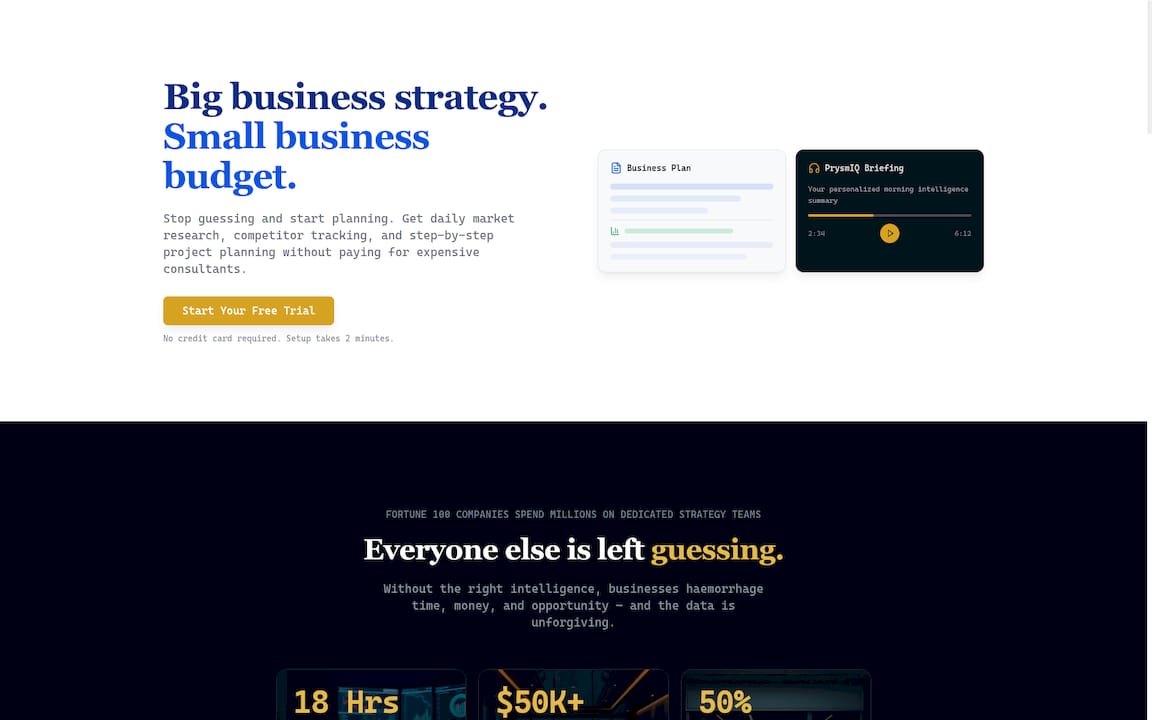
From daily market briefings and competitor monitoring to structured planning tools and scenario testing, the platform is built to support every stage of the decision process described in this article. You can see how Blue Prysm works and understand how it fits your existing workflow in minutes. If you want to validate a new venture or strategic initiative before committing resources, try Venture Quick Score for a fast, data-backed assessment that replaces weeks of manual research.
Frequently asked questions
What are the most effective decision-making frameworks for SMEs?
Popular frameworks for SMEs include SWOT analysis, Fishbone diagrams, the Vroom-Yetton-Jago model, and weighted decision matrices, each suited to different decision types and complexity levels.
How can I speed up decision-making in my business without sacrificing quality?
Formalizing your decision process is the fastest route: formalized processes double decision speed and cut meeting time by 50% without reducing decision quality.
What role does data play in business decision-making?
Real-time data enables faster, more accurate decisions, and businesses that use it consistently achieve over 50% higher revenue growth compared to those relying on lagging indicators.
How can I avoid decision fatigue as a business leader?
Delegate low-risk decisions, set clear criteria upfront, and schedule your most important choices in the morning, since decision fatigue builds throughout the day and measurably impairs judgment by afternoon.
Recommended
- How It Works | Blue Prysm
- Unlock the power of decision intelligence for SMEs – Blue Prysm – Articles & Blogs
- AI strategies that actually build competitive advantage – Blue Prysm – Articles & Blogs
- Assess competitive advantage: practical steps for business leaders – Blue Prysm – Articles & Blogs
- Decision Making Frameworks – Powering Digital Transformation
0 responses