

The assumption that cutting-edge AI is reserved for enterprises with deep pockets and dedicated data science teams is wrong, and 2026 is proving it decisively. The gap between what a Fortune 500 company can deploy and what a well-informed SME can access has narrowed to a degree that would have seemed implausible three years ago. This guide cuts through the noise to give you a clear-eyed view of what’s genuinely new, what’s still hype, and how you can translate 2026’s most consequential AI trends into practical, affordable competitive advantages for your business.
Table of Contents
- What’s new in AI in 2026?
- Edge AI: Power at your fingertips
- Rethinking AI assessment: Beyond benchmarks
- Putting trends to work: SME playbook for 2026
- Perspective: Why playing it safe with AI is riskier than you think
- How Blue Prysm helps you leverage AI trends for advantage
- Frequently asked questions
Key Takeaways
| Point | Details |
|---|---|
| AI is SME-accessible | 2026’s AI technologies are affordable and practical for small and mid-sized businesses. |
| Edge AI delivers value | Processing data locally with edge AI boosts speed, privacy, and automation opportunities for SMEs. |
| Use simulations, not benchmarks | Simulation-driven strategy now outperforms reliance on traditional AI benchmarks. |
| Action trumps hesitation | Early AI adoption—even when incremental—offers compounding competitive advantages. |
What’s new in AI in 2026?
Not everything labeled “new” in AI is actually new. Plenty of vendors are repackaging 2023 capabilities with a fresh coat of marketing. So before you chase trends, it’s worth getting precise about what has actually changed this year, and why it matters for businesses operating outside the enterprise bracket.
Here’s what’s genuinely different in 2026:
- AI democratization is real now. Advanced language models, computer vision tools, and automation frameworks are available via API at pricing tiers accessible to teams of five. You no longer need a full ML engineering team to build a meaningful AI-powered workflow.
- Hybrid and edge deployments are mainstream. Cloud-only AI was the default for years. Now, AI strategies for competitive advantage increasingly run on a mix of local hardware and cloud services, giving SMEs more control over latency, cost, and data privacy.
- Generic benchmarks are losing relevance. A model that scores brilliantly on a public leaderboard may perform poorly on your specific data and workflows. The industry is waking up to this, and forward-thinking teams are replacing benchmark-chasing with simulation-driven evaluation.
- Workflow automation has exploded. AI agents that can plan, execute, and adapt multi-step business processes are no longer experimental. They’re shipping in production tools right now.
Statistic callout: Edge AI on affordable hardware has crossed a practical threshold: a $35 Raspberry Pi running YOLOv8n achieves 3.8 FPS at 640×480, while a $500 Jetson Nano delivers 28.5 FPS for the same task. Real-time SME automation is no longer a hardware budget problem.
The shift from “AI is expensive and complex” to “AI is accessible and practical” didn’t happen overnight, but the compounding effect of hardware improvements, open-source model releases, and falling API costs means 2026 is the year the equation tips decisively in your favor.
Edge AI: Power at your fingertips
Edge AI refers to running AI models locally on a device, rather than sending data to a remote cloud server for processing. That distinction matters enormously for SMEs because it translates directly into three business advantages: speed, privacy, and cost.

When your AI processes data on-site, you get real-time responses without round-trip latency. You keep sensitive business and customer data off third-party servers. And over time, you pay less in cloud compute fees. For a manufacturing business monitoring equipment, a retailer tracking foot traffic, or a logistics company optimizing last-mile delivery, those advantages compound quickly.
Let’s get concrete about what the hardware actually delivers today:
| Device | Cost | Model | Resolution | Performance |
|---|---|---|---|---|
| Raspberry Pi 4 | ~$35 | YOLOv8n | 640×480 | 3.8 FPS |
| Nvidia Jetson Nano | ~$500 | YOLOv8n | 640×480 | 28.5 FPS |
| Cloud GPU (equivalent) | Variable/month | YOLOv8n | 640×480 | 60+ FPS |
The Raspberry Pi won’t replace a cloud GPU for high-throughput tasks. But 3.8 FPS is more than sufficient for monitoring a production line, counting customers at a retail entrance, or detecting anomalies in an inventory shelf. The Jetson Nano pushes into genuinely smooth real-time territory for under $500 total hardware investment.
Practical SME use cases worth your attention:
- Inventory monitoring: A camera with edge AI can detect low-stock shelves, misplaced items, or unauthorized access in a warehouse, all locally, without sending footage to the cloud.
- Predictive maintenance: Attach a sensor and edge device to critical equipment. The AI learns normal operating patterns and flags anomalies before they become expensive failures.
- Customer behavior analytics: Retail SMEs can analyze foot traffic patterns, dwell time, and queue lengths in real time without sending customer video off-site, a significant privacy compliance win.
- Quality control: Small manufacturers can automate visual inspection of products coming off a line for a fraction of what traditional machine vision systems cost.
The key to making decision intelligence for SMEs work at the edge is matching the use case to the hardware tier. Don’t invest in a Jetson Nano for a task where a Pi will do. And don’t expect either to replace cloud AI for complex language tasks or large-scale data analysis.
Pro Tip: Before buying any edge hardware, document exactly what decision you’re trying to automate and how fast that decision needs to be made. If you need to identify a defect and stop a production line within one second, your FPS requirement is clear. If you’re summarizing daily footage overnight, almost any hardware works. Starting with the decision, not the device, saves you from expensive mismatches.
For SMEs looking at real AI business strategies, edge AI is not about being on the cutting edge for its own sake. It’s about owning a capability that reduces your dependency on third-party infrastructure and gives you control over your own data pipeline.
Rethinking AI assessment: Beyond benchmarks
Here’s a trap many SME leaders fall into when evaluating AI tools: they look at benchmark scores and assume a higher number means better business outcomes. That assumption is increasingly dangerous in 2026.
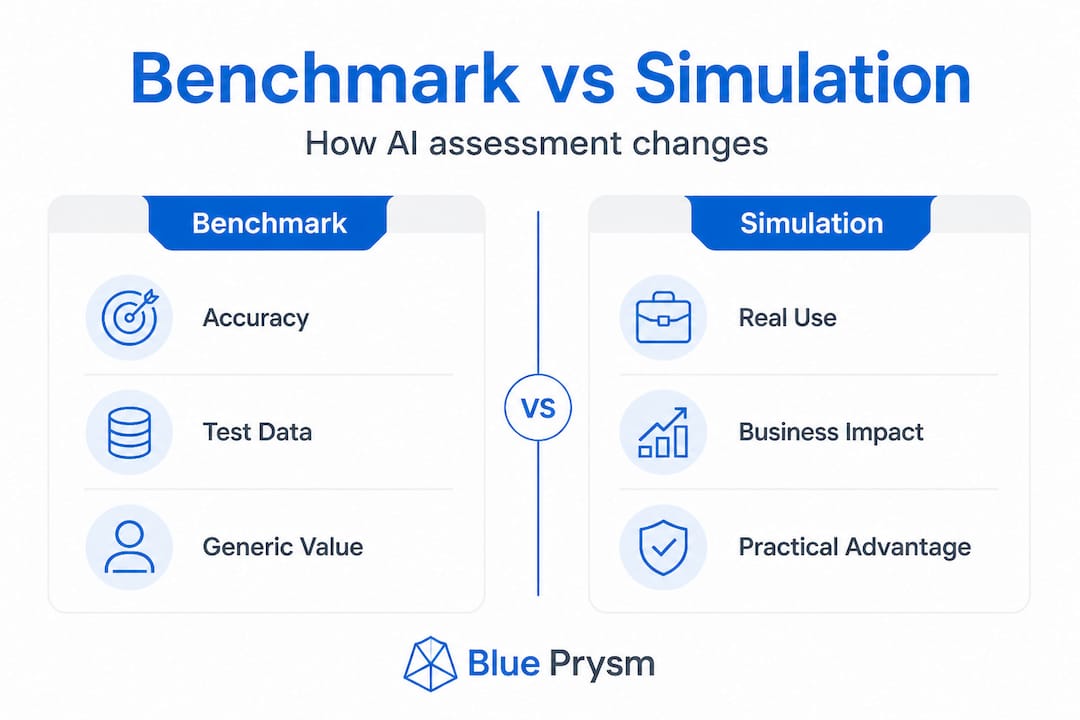
Benchmarks were designed to give researchers a standardized way to compare models. They’re useful for that narrow purpose. But benchmarks saturate when models begin scoring near the maximum possible, which means differences between top-performing models on a standard benchmark tell you almost nothing about how they’ll perform on your specific task, with your specific data, in your specific competitive environment.
“The frontier of AI evaluation has moved from ‘how well does it score?’ to ‘how well does it decide?’ Those are fundamentally different questions.”
Strategy games like chess and Go were the first domain to expose this gap clearly. An AI could be optimized to win under tournament rules but fail when rules changed slightly, or when an opponent introduced a strategy outside its training distribution. That same brittleness shows up in business AI when you move from the benchmark to the real world.
The shift to simulation-driven evaluation
Here’s what leading teams are now doing instead, and what you should be doing too:
- Define your decision environment. What decisions does this AI need to support? What inputs will it see? What’s the cost of a wrong answer? Map this out before you evaluate any tool.
- Build or borrow a simulation of your context. This doesn’t have to be sophisticated. A spreadsheet model of your sales funnel, or a historical dataset from your operations, is a valid simulation environment. Feed candidate AI tools the same inputs and compare their outputs against known outcomes.
- Stress-test with edge cases. Benchmarks use standardized inputs. Your business will throw up unusual inputs constantly. Test how your chosen AI performs when data is messy, incomplete, or outside the normal range.
- Evaluate on business metrics, not model metrics. Accuracy is a model metric. Time saved, decisions improved, and revenue protected are business metrics. Always translate AI performance into the latter.
The comparison between approaches is striking:
| Evaluation method | What it measures | Business relevance |
|---|---|---|
| Standard benchmark | Model accuracy on test dataset | Low to moderate |
| Vendor demo | Best-case performance | Low |
| Simulation on your data | Performance in your context | High |
| Simulation with stress tests | Resilience to real-world variance | Very high |
Building AI-powered competitive battle cards without simulation-driven evaluation is like designing a product without customer research. You might get lucky, but you’re operating on hope rather than evidence.
For SMEs assessing competitive advantage, the move to simulation-based evaluation is one of the highest-leverage changes you can make in 2026. It costs almost nothing extra in tooling and pays dividends in avoided bad investments.
Putting trends to work: SME playbook for 2026
Let’s make this concrete. Understanding edge AI and simulation-driven evaluation is useful. Having a prioritized action plan is what actually creates advantage.
Map your processes first. Before spending a dollar on AI tools or hardware, spend a few hours walking through your key workflows and asking: where does a human currently make a repetitive decision based on data? Where does a delay in information cost you money? Those are your highest-payoff automation candidates. The businesses getting the most value from AI right now are not the ones with the most tools. They’re the ones who matched the right tool to a specific, high-value bottleneck.
Pilot edge AI where real-time data matters most. You don’t need to retrofit your entire operation. Pick one process where local, real-time processing would give you a meaningful advantage, whether that’s production quality control, customer flow monitoring, or equipment health. Run a 60-day pilot with defined success metrics. Edge AI is key for SME automation, but only when it’s deployed against a problem worth solving.
Prioritize your 2026 AI investments with this framework:
- High priority: Automation of repetitive, data-driven decisions that happen daily or weekly
- High priority: Any process where real-time data would prevent a costly error or capture a missed opportunity
- Medium priority: AI tools that improve the quality of strategic decisions (market analysis, competitor monitoring, scenario planning)
- Lower priority: Flashy AI demos that don’t map to a specific business problem you actually have
Embrace simulation-driven evaluation before every major AI investment. This applies whether you’re choosing a new AI platform, expanding an existing deployment, or evaluating a vendor claim. The decision intelligence playbook for 2026 runs on evidence from your own context, not vendor benchmarks.
Invest in practical training, not just tools. The SMEs that struggle with AI adoption usually don’t have a tool problem. They have a capability gap. Your team needs to understand what the AI is actually doing, where it can go wrong, and how to interpret its outputs critically. Half a day of structured training per team member on your core AI tools will return far more than another software license.
Pro Tip: Create a simple AI investment scorecard for your business. For every proposed AI tool, rate it on three dimensions: clarity of the business problem it solves (1 to 5), quality of evidence that it works in your context (1 to 5), and total cost of deployment including training (compared to expected value). Anything that doesn’t score at least 3 on the first two dimensions doesn’t get past evaluation.
Perspective: Why playing it safe with AI is riskier than you think
Here’s the uncomfortable truth that most cautious SME leaders don’t want to hear: “wait and see” used to be a defensible strategy. In 2026, it is not. And the reason is compounding.
Every quarter a competitor builds a real AI capability into their operations, the gap between you and them gets harder to close. It’s not linear. An SME that pilots edge AI for inventory monitoring this year builds the operational knowledge, the data pipelines, and the internal confidence to move faster next year. Meanwhile, the business that waited is starting from scratch twelve months behind, against a competitor who is now two steps ahead.
The other misconception worth challenging directly: strategic conservatism is not the same as strategic rigor. We’ve seen too many SME leaders mistake “not moving fast” for “moving carefully.” Real strategic rigor means running simulations, testing assumptions against evidence, and making informed bets, not avoiding bets altogether.
Benchmarks alone do not guarantee market resilience. A competitor who evaluates AI tools against their actual business context, using simulation-driven assessment, will consistently outinvest you on a dollar-for-dollar basis. They’ll buy tools that work for their situation. You’ll buy tools that looked good on a vendor slide.
The good news is that next-level AI strategies do not require a large budget. The Jetson Nano costs $500. Simulation-driven evaluation costs a spreadsheet and an afternoon. The decision to start costs nothing except the willingness to move past the assumption that this is someone else’s game. It isn’t.
How Blue Prysm helps you leverage AI trends for advantage
The strategies in this guide require one thing most SMEs don’t have in abundance: time to research, synthesize, and act on AI intelligence before competitors do.
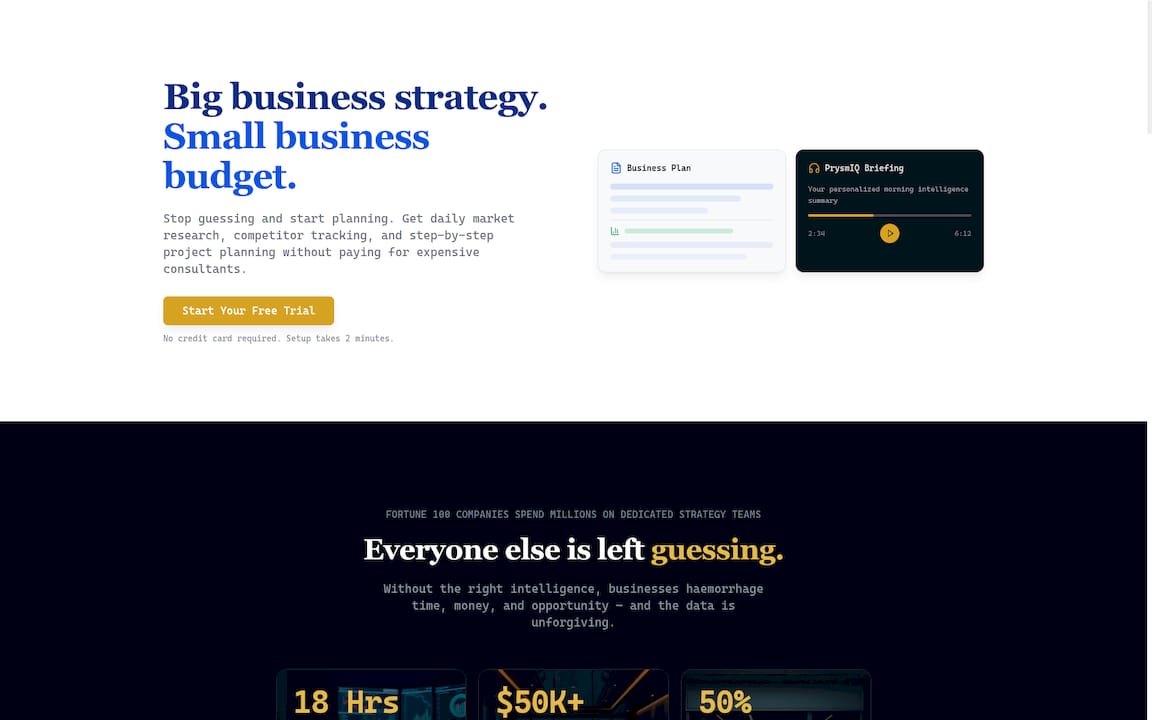
That’s exactly the gap that Blue Prysm is built to close. The platform delivers daily AI-powered market briefings, competitor monitoring, and strategic scenario tools calibrated for SME decision-makers, not enterprise teams with armies of analysts. Whether you’re mapping your processes for automation opportunities or pressure-testing a new strategic direction, how Blue Prysm works is simple: you get the strategic intelligence that used to require a consultant, on demand, at a fraction of the cost. And if you’re evaluating a new AI-driven venture or initiative, the AI venture assessment tool gives you a structured, evidence-based readiness score so you move on evidence, not gut feeling.
Frequently asked questions
What is Edge AI and why is it important for SMEs in 2026?
Edge AI processes data locally on affordable devices rather than in the cloud, delivering real-time responses, stronger data privacy, and lower ongoing costs. Affordable hardware like the Raspberry Pi and Jetson Nano now makes this practical for SME automation tasks.
Why are AI benchmarks alone not enough to evaluate performance?
Standard benchmarks measure model accuracy on test datasets, not how an AI performs on your specific data and business decisions. As benchmarks saturate, simulation-driven evaluation against your own context has become the more reliable standard for strategic investment decisions.
How can SMEs identify the best processes to automate with AI?
Target workflows involving routine, repetitive decisions made on structured data, or any process where a delay in information directly costs you money or causes errors. Those two criteria identify your highest-return automation opportunities faster than any vendor assessment.
Is advanced AI hardware necessary for most SME use cases in 2026?
No. Affordable platforms like the Raspberry Pi at $35 and Jetson Nano at $500 handle a wide range of real-world automation tasks effectively, from visual inspection to inventory monitoring, without enterprise-grade hardware budgets.
Recommended
- AI strategies that actually build competitive advantage – Blue Prysm – Articles & Blogs
- Build powerful competitive battle cards with AI tools fast – Blue Prysm – Articles & Blogs
- Unlock the power of decision intelligence for SMEs – Blue Prysm – Articles & Blogs
- Assess competitive advantage: practical steps for business leaders – Blue Prysm – Articles & Blogs