


Market trends must feed into planning as recurring decision inputs, not one-off signals you check before an annual offsite. That’s the entire role of market trends in planning: they set the direction and pace of every prioritization call, budget shift, and hiring decision your team makes.
Here’s what changes when you take that seriously:
- Prioritization shifts from “what’s loudest internally” to “what’s moving externally.”
- Investment sizing shrinks upfront and scales only after a signal is validated.
- Timing gets tied to trend velocity, not fiscal calendars.
- KPIs expand to include leading indicators (search interest, sentiment shifts), not just lagging revenue numbers.
The verdict: embed a trend check into every monthly planning cycle, and require a small, cheap test before any large bet gets funded.
Key Takeaways
Market trends work as planning inputs only when they’re checked on a fixed cadence, validated with a small test, and tied to a specific KPI before any large investment follows.
| Point | Details |
|---|---|
| Embed trends in cycles | Run a monthly scan and quarterly prioritization instead of an annual review. |
| Pilot before scaling | Cap early tests at a small, predefined budget to limit downside. |
| Match KPI to trend type | Track acquisition cost and margin separately since trends hit each at different speeds. |
| Pair trends with competitors | Confirm a signal is real when competitor behavior and trend data align. |
| Build in flex triggers | Set predefined thresholds that trigger off-cycle plan reviews. |
What Market Trends Are and the Types Planners Should Watch
A market trend is a sustained directional shift in customer behavior, demand, pricing, or competitive activity, measurable over time and distinct from short-term noise. Planners generally track six patterns:
- Uptrend/growth — sustained rising demand (electric vehicle adoption over the last decade).
- Downtrend/decline — sustained falling demand (print newspaper subscriptions).
- Sideways/plateau — flat demand with no clear direction (many mature grocery categories).
- Seasonal — predictable annual cycles (holiday retail spikes).
- Cyclical — multi-year swings tied to broader economic cycles (housing starts).
- Structural/technological shifts — permanent changes in how a market works, like the AI investment wave reshaping enterprise software regimes.
A newer pattern worth naming separately: K-shaped divergence, where one consumer segment pulls away from another instead of the whole market moving together. Retailers now design localized assortments around exactly this split rather than assuming one strategy fits every customer.
Why Market Trends Matter for Strategic and Operational Planning
Trend-aware planning reduces risk and surfaces opportunity earlier than competitors notice it. That’s the whole case in one sentence, and it plays out across every function:
- Product roadmaps get reordered when a feature request pattern shows up in three unrelated customer segments at once.
- Marketing timing and channels shift toward wherever search or social attention is currently concentrated, not where last year’s budget was allocated.
- Inventory and supplier planning adjusts before a shortage or demand spike hits, not after.
- Hiring and resourcing moves toward capabilities a trend will require in six to twelve months.
The KPI connection is direct. Revenue forecasting accuracy, customer retention, and margin protection all move with how well a plan tracks external conditions. Market trends materially affect business valuation too. Growth expectations, discount rates, and multiples all shift with market conditions. A plan that ignores that isn’t just risky. It’s mispricing the business.
How to Identify Market Trends Before They Become Obvious
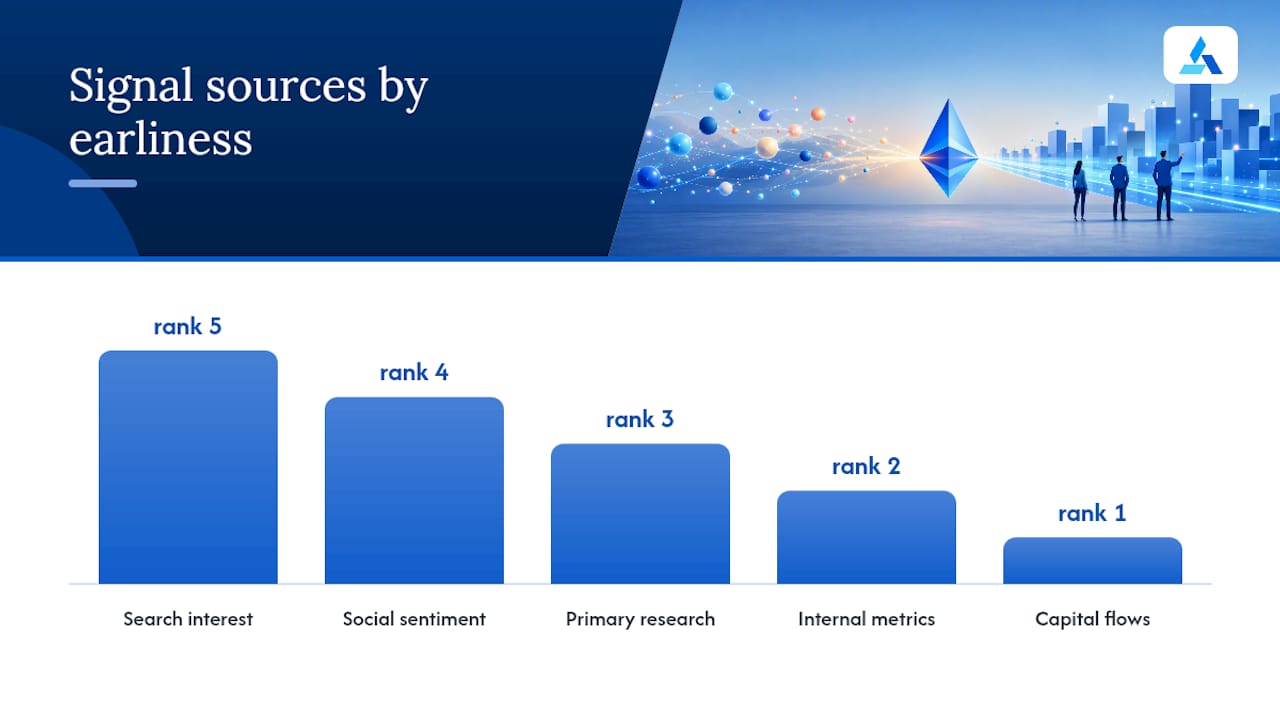
The top signal sources, in order of how early they warn you: search interest data, social sentiment, primary research, internal sales and ops metrics, and capital flows. Each catches a different stage of a trend’s life cycle, and relying on just one is how teams get blindsided.
For the tool layer specifically:
- Google Trends shows what people are actively searching for, right now, at no cost. It’s the fastest way to confirm whether a topic is gaining or losing search interest.
- Brandwatch tracks sentiment and volume across social platforms and news, useful for catching how people feel about a shift, not just whether they’re talking about it.
- Sprout Social combines social listening with publishing and reporting, which makes it strong for teams that need to act on a signal and measure the response in one place.
Beyond named tools, four techniques hold up well:
- Run a lightweight PEST scan (political, economic, social, technological) quarterly, not just during annual strategy week.
- Track venture capital funding flows in adjacent categories. Money tends to move before mainstream adoption does, and leaders who watch funding patterns often catch shifts a full cycle ahead of competitors.
- Monitor supplier and procurement signals, since cost or availability changes upstream usually show up in customer demand later.
- Take front-line sales feedback seriously as data, not anecdote.
Pro Tip: If three unrelated customers or prospects raise the same request or objection within a month, treat it as an early trend signal worth a small test, even if it never showed up in a formal report.
Primary vs. Secondary Data: When to Use Each
Secondary data gives you market context and benchmarks; primary data tells you the specific why and how behind your own customers’ behavior. Use secondary sources first to frame a hypothesis cheaply, then spend on primary research only to validate it.
- Rely on secondary data (industry reports, syndicated trend data, competitor filings) when you need a fast read on market direction or a benchmark to size an opportunity.
- Run surveys, interviews, or focus groups when you need to know whether your specific customers will actually act on a trend you’ve spotted.
Pro Tip: Follow the sequence “secondary to frame, primary to validate.” Frame a hypothesis from a trend report, then run a lean survey or five customer interviews before committing budget. This mirrors how market research supports strategic planning more broadly: secondary sources set direction, primary work confirms it applies to you.
Frameworks That Turn Trend Signals Into Actual Plans
Six frameworks do most of the heavy lifting: SWOT, PEST, scenario planning, gap analysis, roadmaps, and OKRs. Each converts a raw trend signal into something a team can act on.
| Framework | What it does with trend data |
|---|---|
| SWOT | Places a trend under “opportunity” or “threat” and forces a response decision |
| PEST | Categorizes the trend’s root cause (political, economic, social, technological) |
| Scenario planning | Models best, worst, and base cases for how the trend evolves |
| Gap analysis | Compares current capability against what the trend will require |
| Roadmaps | Sequences the response into phases with dates and owners |
| OKRs | Sets a measurable target tied directly to the trend’s expected impact |
A useful decision rule: if a trend’s signal strength clears an internal threshold and primary research confirms it applies to your customer base, fund a pilot capped at a small, predefined budget before committing further. Teams that skip straight from “interesting trend” to “full rollout” are the ones that get burned when the trend fizzles. Blue Prysm’s strategy framework library packages templates for exactly this handoff, so a signal doesn’t stall out waiting for someone to build a SWOT from scratch.
Pro Tip: Run gap analysis and scenario planning together. A capability gap without a scenario for how the trend evolves is a wish list, not a plan.
A Workflow for Embedding Trends Into Every Planning Cycle
The recurring cycle is simple: scan monthly, prioritize quarterly, test in short pilots, integrate what works, and monitor continuously. Miss any one step and trends either get ignored or chased impulsively.
- Scan — A designated analyst or strategy lead reviews trend tools and front-line feedback monthly.
- Prioritize — Leadership ranks flagged signals quarterly against strategic fit and effort.
- Test — Product or marketing owners run a capped four-to-six-week pilot on the top signals.
- Integrate — Validated pilots get folded into the roadmap and OKRs, with a named owner.
- Monitor — Finance or ops tracks the KPI tied to that trend on a standing dashboard.
Pro Tip: Set a hard budget ceiling for pilots before anyone gets excited about a trend. A $5,000 test that fails costs you a Tuesday. A quarter-long rollout that fails costs you a quarter.
- Own the scan: one analyst, not a committee.
- Own the approval: one leader signs off on pilot budgets.
- Own the measurement: finance or ops, never the team that ran the pilot.
Where Trend Analysis Goes Wrong
The most common mistake is treating a single data point as a trend, then reallocating budget before anyone checks if it holds. The fix is simple: require at least two independent signals before you act.
Watch for these red flags:
- Small-sample overreach, one viral post treated as market-wide sentiment.
- Confirmation bias, cherry-picking data that supports a decision someone already wanted to make.
- Chasing hype cycles instead of validated demand.
- Mis-timed investment, entering a trend after the growth window has closed.
Trend analysis turns historical data into forecasts, but past patterns don’t reliably predict future outcomes on their own. Combining statistical trend data with real-time listening is what keeps a plan honest.
That combination, not any single tool, is what separates disciplined trend use from expensive guessing, a point NetSuite’s research on trend analysis backs up directly.
Operationalizing Trends With an Agentic AI Workflow
Agentic AI can automate the grunt work of scanning, scoring, and routing trend signals, so your team spends its time on judgment calls instead of data collection. Here’s what that looks like in practice: a real-time market feed flags a competitor’s pricing shift, the system scores it against your current strategy, and drafts a brief before your Monday planning meeting even starts.
The operational pieces that make this work:
- Real-time market feeds that replace manual report pulling.
- Automated competitor tracking that flags moves as they happen.
- Idea scoring that ranks signals by strategic fit before a human reviews them.
- Automated brief generation that turns a raw signal into a one-page decision document.
One click, in practice: a trend gets scored, an OKR gets drafted against it, and a four-week pilot launches with its KPIs already on a dashboard. Blue Prysm’s market analysis platform builds this loop for small and mid-sized teams that don’t have a dedicated research analyst on staff.
| Manual process | Agentic AI equivalent |
|---|---|
| Analyst compiles weekly trend report | Real-time feed flags signals continuously |
| Team debates whether to act | Idea scoring ranks urgency automatically |
| Someone drafts a brief by hand | Brief generates in minutes, ready for review |
Forecasting How Long a Trend Will Last
Most trends fail not because teams miss them, but because teams misjudge how long they’ll matter. A trend’s longevity depends on three factors: the size of the underlying behavioral shift, how many adjacent industries are adopting it simultaneously, and whether capital keeps flowing into it.
Structural shifts, like the AI infrastructure buildout, tend to last years because they reshape how entire categories operate, not just how one product performs. Seasonal and hype-driven trends, by contrast, often peak within a single quarter or two. The practical test: ask whether the trend is solving a persistent problem (structural, likely durable) or riding a moment of attention (likely short-lived).
Funding flows are one of the more reliable longevity indicators available to planners without access to expensive forecasting models. Leaders who track venture capital patterns in adjacent categories often see staying power before it shows up in consumer-facing data, because capital commitments imply a multi-year bet, not a one-quarter experiment.
A second useful check: watch whether a trend spreads across unrelated industries. A shift confined to one niche is more fragile than one showing up simultaneously in retail, logistics, and software, which suggests a deeper structural cause rather than a fad. Scenario planning helps here too. Model a short-lived version and a durable version of the same trend, and build decision triggers for each so you’re not caught flat-footed regardless of which one plays out.
Getting Cross-Functional Teams Involved in Trend-Driven Planning
Trend signals die in silos. A marketing team that spots a shift and a product team that never hears about it both end up reacting late, from opposite directions. The fix is a standing cross-functional structure, not a one-time meeting.
A practical version: form a small trend task force with one representative each from product, marketing, sales, and finance, meeting briefly on a fixed monthly cadence. This isn’t a new committee layer bolted onto existing meetings. It’s a rotating slot inside planning cycles that already exist, where each function brings the strongest signal it has seen that month.
The task force’s job isn’t to decide anything alone. It routes signals to the right owner and runs them through a shared framework, like the trend maps and gap analyses that turn scattered inputs into one coherent view. Sales brings front-line objections. Marketing brings channel and sentiment shifts. Product brings feature request patterns. Finance brings margin and cost pressure. Combined, those four views catch what any single function would miss alone.
Sandboxing matters too. Before a trend response gets funded broadly, run it as a small prototype inside one function, with the task force reviewing results before wider rollout. That keeps the group focused on validated signals instead of theoretical ones, and it keeps any one department from unilaterally betting the roadmap on a trend nobody else has confirmed.
Combining Competitive Analysis With Market Trend Insights
A trend tells you where the market is heading; competitive analysis tells you who’s already moving and how fast. Treated separately, both are incomplete. A rival’s pricing change might look like noise until you connect it to a broader downtrend in category margins, at which point it becomes a market signal worth acting on.
The practical integration point is simple: every trend review should include a look at how competitors are already responding to it. If three competitors have quietly shifted messaging toward the same theme, that’s stronger confirmation than any single search-trend spike. The SBA’s guidance on market research and competitive analysis treats these as paired planning steps for exactly this reason. Neither one alone tells the full story.
Automated competitor tracking makes this pairing far less manual than it used to be. Instead of quarterly competitor audits, a continuous tracking system flags pricing, messaging, or product changes as they happen, and a planner can cross-reference that against the trend data already on the dashboard. That turns a lagging, reactive exercise into something closer to real time.
Watch for one trap here: don’t mistake competitor imitation for trend validation. If a competitor is chasing the same hype cycle you are, that’s two guesses stacked on top of each other, not confirmation. The stronger signal is when a competitor’s move aligns with independently sourced customer or search data you’ve already gathered.
Adjusting Strategic Plans as Trends Shift Mid Cycle
A strategic plan written in January and left untouched until December isn’t a plan. It’s a guess with a deadline. Market trends shift inside planning cycles, not just between them, and the plan has to be built to flex without collapsing into chaos every time a new signal appears.

The practical mechanism is a standing review cadence with predefined trigger points, not an open-ended promise to “stay agile.” Set specific thresholds in advance: if a tracked KPI moves beyond a set range, or a trend score crosses a defined line, that triggers an off-cycle review rather than waiting for the next quarterly planning meeting. This keeps adjustments disciplined instead of reactive.
Short-cycle leadership reviews on a handful of live indicators catch small gaps before they compound into major losses. That’s a very different posture than an annual strategy refresh, and it’s the one that actually keeps pace with how fast trends move now.
Roadmaps and OKRs should be written with this flexibility built in from the start; a roadmap with quarterly checkpoints and a defined “what changes this” clause survives a shifting trend far better than one written as a fixed, twelve-month commitment.
Measuring How Much a Trend Actually Moves Your Numbers
Quantifying trend impact starts with picking the right KPI for the type of shift you’re tracking, then measuring before and after a response, not just watching a number float. Revenue growth rate, customer acquisition cost, retention, and margin are the four that tie most directly to trend response, but they measure different things.
A trend that shifts customer preference shows up first in acquisition cost and conversion rate, often weeks before it touches revenue. A structural trend, like a supply cost shift, shows up in margin before it touches top-line growth at all. Matching the KPI to the trend type keeps you from concluding “no impact” simply because you were watching the wrong number.
The cleanest measurement approach is a controlled pilot: launch a trend response in one segment, region, or channel, and hold a comparable group steady as a baseline. The difference between the two groups over four to six weeks gives you a real read on impact, not a guess dressed up as one.
Valuation is the outer boundary of this measurement, and it’s easy to overlook. Market trends affect expected growth rates and discount rates used in valuation work, which means a plan that responds well to trends doesn’t just protect quarterly KPIs. It protects the multiple the business eventually gets valued at, whether that valuation happens at a funding round, an acquisition, or an internal budget review.
Balancing Curiosity With Discipline
Curiosity finds the signal. Discipline decides whether it’s real. The best planning teams treat every trend as a hypothesis worth testing cheaply, never a certainty worth funding immediately.
Pick one recurring signal your team keeps noticing anecdotally, and commit to tracking it formally for the next four weeks before deciding anything.
Sources
- Market research and competitive analysis (SBA)
- The Role of Market Research in Strategic Planning
- Trend analysis: what it is and how to use it
- 24 ways leaders stay ahead of market changes
- Five shifts reshaping markets (T. Rowe Price)
- How a K-shaped economy is shaping retail planning strategies
FAQ
What are the four main types of market trends?
The four most commonly cited types are uptrends (sustained growth), downtrends (sustained decline), sideways or plateau trends (flat demand), and seasonal trends (predictable annual cycles). Cyclical and structural shifts are often added as a fifth and sixth category in more detailed frameworks.
What are market trends, exactly?
Market trends are sustained, measurable shifts in customer demand, pricing, or competitive behavior over time, distinct from short-term fluctuations or noise. They show up in search data, sales patterns, sentiment, and competitor moves.
What are the 5 P’s of a marketing plan?
The 5 P’s typically refer to product, price, place, promotion, and people, the core levers marketers adjust when responding to a trend. Some frameworks swap “people” for “physical evidence” depending on the industry.
What is the main purpose of market planning?
Market planning exists to align a business’s resources and strategy with actual customer demand and competitive conditions, reducing risk and improving the odds that an investment pays off. Done well, it turns trend signals into tested, budgeted actions rather than reactive guesses.