


TL;DR:
- Most SMB owners rely on intuition for major decisions, risking failure without structured processes. Implementing systematic steps like problem identification, data gathering, and outcome review enhances decision quality and scalability. Integrating AI tools with proven frameworks leads to faster, more accurate choices and measurable business growth.
Most SMB owners make their biggest business calls the same way they pick a restaurant, go with their gut and hope for the best. That works until it catastrophically doesn’t. Structured business decisions follow 6-7 repeatable steps: identify the problem, gather information, generate alternatives, evaluate options, choose and implement, then review outcomes. The gap between companies that scale and those that stall is rarely about talent or funding. It’s almost always about process. This guide gives you that process, the frameworks to run it, the AI tools to supercharge it, and the KPIs to prove it’s working.
Table of Contents
- Core steps of the business decision making process
- Top frameworks and AI-powered methods for SMB decisions
- Common decision pitfalls and science-backed solutions
- Measuring decision success: KPIs and real-world outcomes
- How hybrid and AI-first approaches transform SMB decision making
- Scale your business decisions with Blue Prysm solutions
- Frequently asked questions
Key Takeaways
| Point | Details |
|---|---|
| Follow a structured process | A consistent 6-7 step process dramatically improves confidence and results in business decisions. |
| Leverage AI tools | AI increases decision speed, accuracy, and market insight while saving significant time for SMBs. |
| Use a hybrid model | Blending data-driven methods with intuition boosts business outcomes as much as 38 percent. |
| Avoid biases | Structured frameworks, diverse teams, and AI help SMBs sidestep cognitive traps for smarter choices. |
| Track outcomes with KPIs | Monitor speed, ROI, and accuracy to optimize and validate your business decision process continually. |
Core steps of the business decision making process
With the promise of a systematic guide, it’s essential to first understand what the core decision-making process is actually made of. Most business owners think they’re following a process. In practice, they’re skipping steps two through five and calling it decisiveness. That’s not strategy. That’s luck with extra steps.
Decision-making best practices consistently point back to this structured foundation as the repeatable backbone of smart business choices:
- Identify the problem. Define exactly what decision needs to be made and why it matters. Vague problems produce vague decisions.
- Gather information. Collect relevant data, market signals, customer feedback, and internal performance metrics. Don’t rely on what you already believe.
- Generate alternatives. Brainstorm at least three to five distinct options. If you only see one path forward, you haven’t looked hard enough.
- Evaluate options. Weigh each alternative against your goals, resources, risk tolerance, and time horizon. Use a scoring matrix if needed.
- Choose and implement. Select the best option and build a clear action plan with owners, timelines, and resource allocation.
- Review outcomes. Measure results against your expected benchmarks. Document what happened and why.
- Iterate. Feed those learnings back into your next decision cycle. This is where compounding starts.
Here’s a quick view of how classic decision stages map to different approaches:
| Decision stage | Rational model | Intuitive model | Hybrid model |
|---|---|---|---|
| Problem identification | Data-driven framing | Pattern recognition | Mixed signals + gut check |
| Information gathering | Extensive research | Experience-based | Targeted + AI-assisted |
| Alternative generation | Systematic analysis | Creative brainstorm | Structured ideation |
| Evaluation | Scoring models | Expert judgment | Weighted criteria |
| Implementation | Detailed planning | Rapid execution | Agile planning |
| Review | Quantitative KPIs | Lessons learned | AI-monitored metrics |
Pro Tip: Keep a decision log. Record the reasoning behind major choices, who was involved, what data you used, and what actually happened. Teams that review past decisions improve their accuracy over time because they can spot patterns in their own blind spots.
Top frameworks and AI-powered methods for SMB decisions
With the standard process covered, see how practical frameworks and cutting-edge AI can elevate decision quality and speed. Frameworks are not bureaucracy. They are thinking shortcuts built on decades of evidence about what actually works.
Key methodologies for SMBs include the following:
- Rational model. Best for complex, novel decisions where the stakes are high and time allows careful analysis. Think entering a new market or acquiring a competitor.
- Intuitive model. Best for time-pressured decisions in domains where you have deep expertise. An experienced sales leader reading a deal is using this well.
- Collaborative model. Best when cross-functional buy-in matters. Diverse teams reduce blind spots and increase implementation success.
- SWOT analysis. A fast, structured way to map Strengths, Weaknesses, Opportunities, and Threats before committing to a strategic direction.
- Cost-Benefit Analysis (CBA). Translates options into financial terms so you can compare apples to apples. Essential for capital allocation decisions.
- SPADE framework. Setting, People, Alternatives, Decide, Explain. Built for decisions that need clear ownership and transparent reasoning. Popularized by high-growth tech teams and increasingly adopted by sharp SMB operators.
Now layer AI on top of that, and the leverage gets real. AI-driven strategies for SMBs include predictive analytics, customer segmentation, automated lead scoring, and routine decision automation, saving teams anywhere from 18 to 40 hours per week and enabling genuinely proactive rather than reactive choices.
Here’s how frameworks pair with AI integration:
| Framework | Best AI integration | Likely business impact |
|---|---|---|
| Rational model | Predictive analytics, scenario modeling | Faster analysis, fewer blind spots |
| Intuitive model | Pattern recognition tools | Validates gut with real data |
| Collaborative | AI meeting summaries, voting tools | Cleaner consensus, less bias |
| SWOT | Competitive intelligence platforms | Real-time threat and opportunity mapping |
| CBA | Automated financial modeling | Faster ROI comparisons |
| SPADE | AI documentation and decision tracking | Clear ownership and accountability |
Understanding decision intelligence for SMEs isn’t just about adopting new tools. It’s about recognizing that intelligence is a business asset, and AI is now making that asset accessible to teams of five people, not just Fortune 500 strategy departments.
The most practical AI strategies for SMBs start with one or two high-impact use cases, prove measurable ROI, then scale. Don’t try to automate everything at once. Pick the decisions that cost you the most time or money when they go wrong, and start there.
Real-world AI decision success examples consistently show the same pattern: SMBs that integrate AI tools into structured frameworks outperform those that use AI as a standalone novelty.
Common decision pitfalls and science-backed solutions
Knowing what works is crucial, but sidestepping mistakes and bias is just as important for maximizing your success. The uncomfortable truth? Most business decisions don’t fail because of bad strategy. They fail because of how the human brain is wired.
Here are the top five biases that undermine SMB decisions, and what to do about each:
- Confirmation bias. You search for information that confirms what you already believe and unconsciously ignore what challenges it. Fix it by actively assigning someone on your team to argue the opposite position before any major call.
- Sunk cost fallacy. You keep investing in a failing direction because you’ve already put money or time into it. Fix it by asking a simple question: “If we hadn’t already spent anything, would we still choose this path?” If the answer is no, stop.
- Overconfidence bias. Founders are especially vulnerable here. You overestimate your own accuracy and underestimate uncertainty. Fix it by forcing probability estimates. Instead of “we’ll definitely land this client,” say “we have a 60% chance based on these signals.”
- Status quo bias. Choosing inaction because change feels risky, even when inaction is the riskier path. Fix it by reframing: “What is the cost of doing nothing for six months?”
- Groupthink. When team harmony suppresses honest dissent, decisions get made based on what everyone is comfortable saying rather than what the data actually shows.
“The most dangerous business decisions are the ones that feel obvious to everyone in the room. That consensus often means critical questions were never asked.”
Science-backed decision-making trends point to three consistent interventions that work:
- Premortems. Before executing, imagine it’s six months later and the decision failed. What went wrong? This exercise surfaces risks your optimism was hiding.
- Devil’s advocate assignment. Formally designate someone to challenge the preferred option. Not as punishment, as process.
- Outside view benchmarking. Look at how similar decisions played out for comparable companies. Your situation is rarely as unique as it feels.
Cognitive biases like confirmation bias and the sunk cost fallacy are best mitigated by structural process rather than willpower. You can’t think your way out of biases. You have to design processes that catch them before they cost you.
Pro Tip: Use AI to challenge your assumptions rather than confirm them. Feed your business thesis into an AI analysis tool and explicitly ask it to surface contradictory evidence. Most founders are shocked by what they’ve been ignoring.
When assessing competitive advantage, the same logic applies. Don’t just validate your strengths. Build a process that forces honest evaluation of where competitors are closing the gap.

Measuring decision success: KPIs and real-world outcomes
Avoiding mistakes sets the stage for measuring progress. Here’s how to gauge real success and double down on what delivers the best business results.
You cannot improve what you don’t measure. Most SMBs track revenue and call it done. But revenue is a lagging indicator. By the time it tells you a decision was wrong, you’ve already paid the price.
Here are the KPIs that actually tell you whether your decision-making process is working:
- Decision speed. How long does it take from problem identification to final choice? Track this per decision category. Most teams don’t realize how much time low-stakes decisions are stealing.
- Decision accuracy rate. Of the decisions made in a given quarter, what percentage produced outcomes within 10% of projections? This is your calibration metric.
- Revenue impact per decision. Assign expected and actual revenue impact to major calls. Which types of decisions drive the most growth?
- Time-to-implementation. How long between “we decided” and “we executed”? Bottlenecks here often reveal process failures, not resource shortages.
- Reversal rate. How often are decisions reversed within 90 days? High reversal rates signal insufficient information gathering or misaligned stakeholders.
- ROI from AI-assisted decisions. Track separately which decisions were AI-assisted and compare outcomes. You need this data to justify and scale AI investment.
The benchmarks aren’t guesses. Real-time decision-making produces 50% higher revenue growth for SMBs that adopt it. AI consistently improves decision speed by 15 to 20% and accuracy by 10 to 18%. Over three years, the median analytics ROI for SMBs sits at 4.2x, with advanced adopters seeing returns of 29 to 40%.
| KPI | What it measures | Aligned framework | Target benchmark |
|---|---|---|---|
| Decision speed | Process efficiency | All models | 15-20% faster with AI |
| Accuracy rate | Quality of choices | Rational, Hybrid | 10-18% improvement |
| Revenue impact | Strategic value | CBA, SPADE | Tracked per decision |
| Time-to-implementation | Execution lag | Collaborative | Reduce by 25%+ |
| ROI from AI tools | Technology value | AI-enhanced | Median 4.2x over 3 years |

Reviewing these KPIs quarterly, rather than annually, gives you enough data to iterate fast. Don’t wait for year-end reviews. Build monthly decision check-ins into your rhythm.
Understanding emerging AI trends is especially important here. The tools available today are already shifting what’s measurable. Automated decision tracking, real-time sentiment analysis, and AI-generated scenario modeling are no longer enterprise-only capabilities.
How hybrid and AI-first approaches transform SMB decision making
Here’s the pattern we see again and again: SMB owners either trust their gut completely or spiral into analysis paralysis waiting for perfect data. Both are traps. The gut-only crowd moves fast and crashes into avoidable walls. The analysis-paralysis crowd watches their window of opportunity close while waiting for certainty that never comes.
The evidence consistently backs a middle path. Hybrid approaches combining analytical and intuitive methods deliver 38% better outcomes than either method used alone. Rational analysis excels in novel and complex scenarios where you lack prior experience. Intuitive judgment works in time-pressured domains where deep expertise compensates for incomplete data. The best teams know when to use which mode and actively manage the switch.
AI doesn’t replace either approach. It sharpens both. When you feed AI tools your market data, customer behavior patterns, and competitive signals, you’re not outsourcing judgment. You’re expanding the information your judgment can operate on. Think of it less like handing the wheel to a robot and more like giving yourself night-vision goggles in a dark room.
The practical path for most SMBs is to start small and measure obsessively. Lead scoring tools are a great entry point. They’re low-risk, immediately measurable, and almost always deliver clear ROI within 60 to 90 days. Email filtering and prioritization tools are another quick win. Routine customer segmentation is a third. None of these require enterprise budgets or data science teams.
What we’d caution against is chasing AI hype without a measurement framework. Every AI tool you add should map to a specific KPI, have a clear owner, and have a defined review date. If you can’t articulate what success looks like in numbers before you deploy a tool, you’re not ready to deploy it yet.
The best operators we see are using decision intelligence as a genuine competitive strategy, not as a tech novelty. They’re treating their decision process as a system to be improved over time, the same way they treat their sales process or their operations workflow. That mindset shift is what separates the businesses that scale from the ones that plateau.
Scale your business decisions with Blue Prysm solutions
You’ve got the framework. You understand the biases, the KPIs, and the AI integration playbook. The next step is putting it all into motion with tools built specifically for businesses like yours.
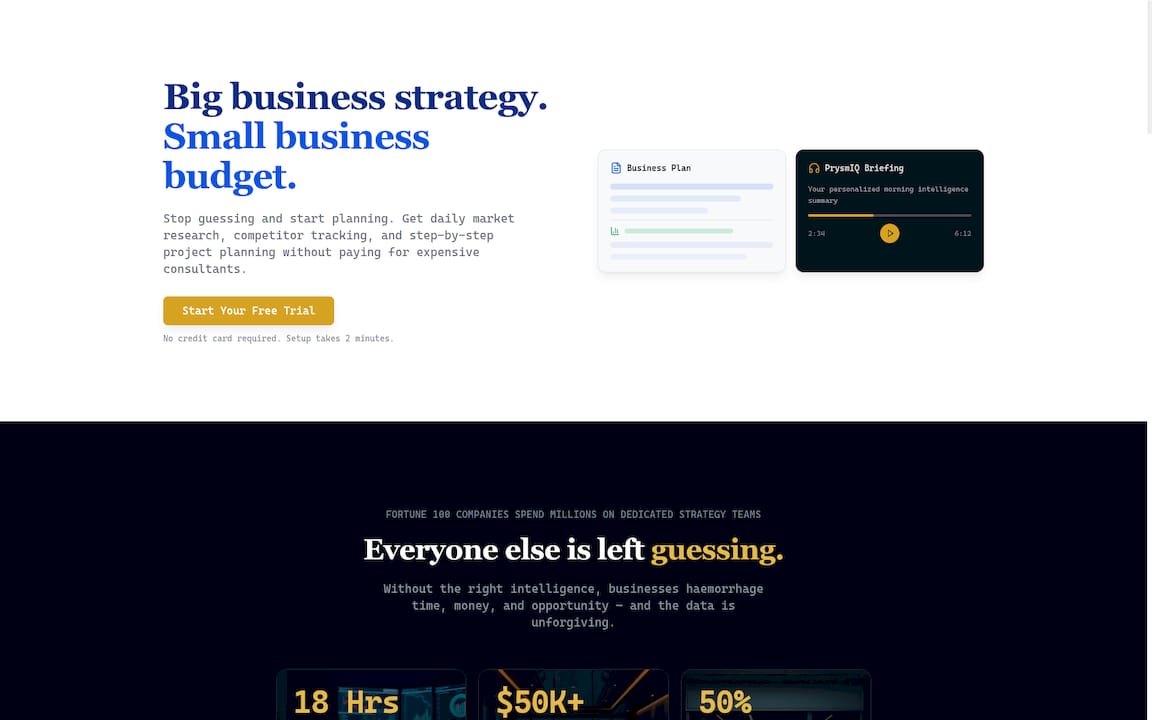
Blue Prysm is an AI-powered strategic intelligence platform designed to give SMBs the decision-making capabilities that used to require a full consulting team. See how Blue Prysm works to run real-time market briefings, competitor monitoring, and opportunity scoring inside a single platform. Before you commit to any major direction, use the AI credibility assessment tool to pressure-test assumptions and cut through fluffy projections. And if you’re evaluating a new market or business idea, the venture opportunity scoring tool gives you a structured, data-backed viability read in minutes rather than weeks. Smarter decisions start with better intelligence.
Frequently asked questions
What is the most effective decision-making framework for SMBs?
Hybrid models combining data-driven and intuitive methods consistently deliver 38% better outcomes, making them the most practical and proven choice for SMBs navigating complex decisions.
How does AI specifically reduce decision-making time for small businesses?
AI improves decision speed by 15 to 20% through faster analysis and scenario modeling, while automating routine tasks saves teams up to 40 hours per week.
What are common cognitive biases in business decisions and how can they be avoided?
Confirmation bias, sunk cost fallacy, and status quo bias are the most common culprits, and structured approaches like premortems, devil’s advocate assignments, and diverse team input are the most reliable mitigations.
Which KPIs best measure successful business decision making?
Decision speed, accuracy rate, and revenue impact are the core KPIs, with analytics ROI tracking serving as the most telling long-term indicator of whether your decision process is genuinely improving.