


Market intelligence is the continuous, systematic process of gathering and interpreting information about your market, including customers, competitors, and broader industry trends, to inform strategic decisions. Not a one-time project. Not a quarterly report you file and forget. A living function that runs in the background of every smart business decision you make.
Think of it as the difference between checking the weather once a week and having a real-time forecast on your phone. One gives you a snapshot. The other keeps you from getting caught in the rain.
What is market intelligence, and what does it actually include?
Market intelligence is a systemic, continuous process that analyzes external information about customers, competitors, and market trends to guide strategic business decisions. The BDA Body of Competency and Knowledge defines it as “the systematic process of gathering, analyzing, and interpreting information about markets, customers, competitors, and the broader business environment to inform strategic decision-making and identify business development opportunities.”

What separates it from a one-off research project is the word continuous. You are not answering a single question. You are building an ongoing capability that keeps your strategy grounded in reality, not gut feeling.
The four core elements that make up a complete market intelligence function are:
- Competitor intelligence: What your rivals are doing, where they are investing, how they are positioning, and where they are vulnerable
- Customer intelligence: What your buyers actually want, how their needs are shifting, and what drives their purchasing decisions
- Market and industry trends: Macro forces, regulatory changes, emerging technologies, and shifts in demand that reshape your playing field
- Product and company intelligence: How your own offerings compare in the market, where gaps exist, and what the data says about your positioning
Each element feeds the others. Competitor moves only make sense when you understand customer expectations. Trend data only matters when you know how your product stacks up.
What are the main types of market intelligence?
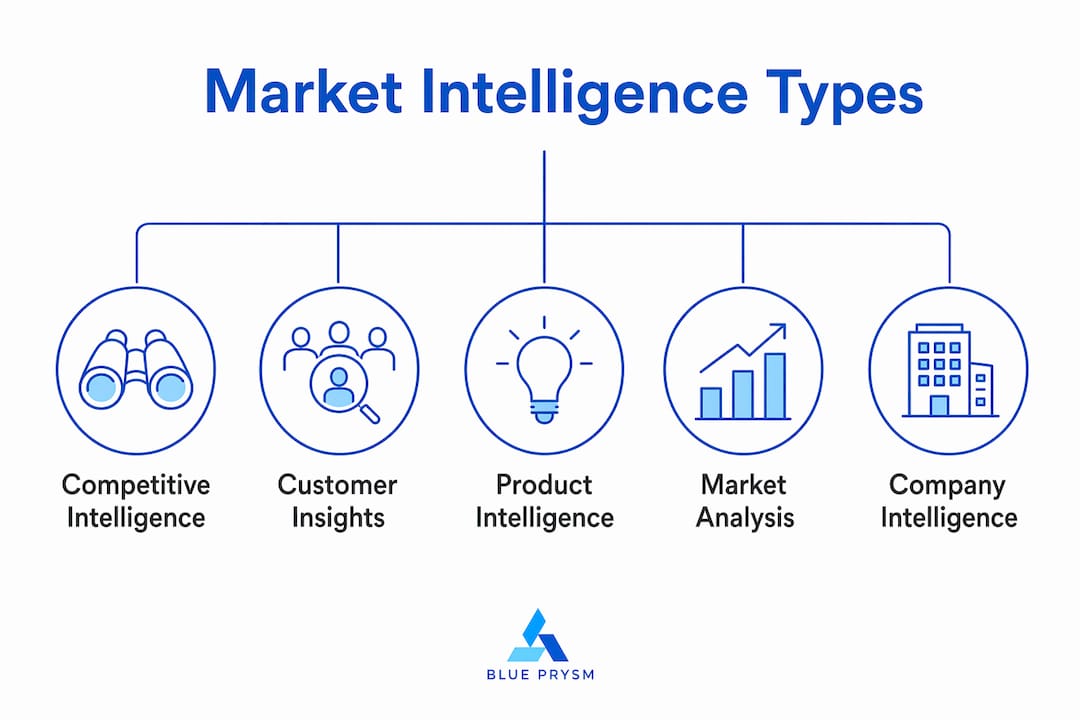
Market intelligence covers four core areas: customer intelligence, competitor intelligence, product and company intelligence, and market and industry trends. Each one answers a different strategic question.
- Competitive intelligence focuses on rival behavior: pricing changes, product launches, hiring patterns, partnership announcements, and messaging shifts. It tells you what the competitive field looks like right now and where it is heading.
- Customer intelligence goes deeper than demographics. It covers buying behavior, unmet needs, satisfaction drivers, and churn signals. The best customer intelligence programs combine survey data, behavioral analytics, support ticket analysis, and direct interviews.
- Market and industry intelligence tracks the broader environment: Total Addressable Market size, regulatory developments, macroeconomic signals, and technology adoption curves. This is where you spot the wave before it breaks.
- Product and company intelligence benchmarks your own offerings against the market. It answers questions like: Are we priced correctly? Do buyers perceive our differentiators the way we intend? Where are we losing deals we should win?
The real power comes from integrating all four. A company that only watches competitors but ignores customer sentiment will miss the moment when the market stops caring about the features it is racing to build.
How does market intelligence differ from business intelligence and competitive intelligence?

This is where most teams get tangled. The three concepts overlap, but they are not interchangeable. Market intelligence is broader than competitive intelligence, which focuses solely on competitors, and more strategic than market research, which is project-based and retrospective.
| Concept | Scope | Time orientation | Primary focus |
|---|---|---|---|
| Market intelligence | External: customers, competitors, trends, environment | Continuous, forward-looking | Strategic decisions and growth opportunities |
| Business intelligence | Internal: sales data, operations, financials | Historical and current | Operational performance and efficiency |
| Competitive intelligence | External: competitor behavior and positioning | Ongoing, but narrowly scoped | Rival moves and market positioning |
| Market research | External: specific questions at a point in time | Project-based, retrospective | Answering defined research questions |
Business intelligence tells you how your business performed last quarter. Market intelligence tells you what the market will demand next quarter. Competitive intelligence is a focused subset of market intelligence, concerned specifically with what rivals are doing. Market research is an input methodology, a zoom lens you use to answer a specific question, while market intelligence is the wide-angle lens that provides continuous context.
The BDA BoCK classifies market intelligence as a core business development performance domain, competitive intelligence as a competency within that domain, and market research as an input methodology within the intelligence cycle. That hierarchy matters when you are deciding where to invest resources.
Why does market intelligence matter, and what does it actually do for your business?
The honest answer: it replaces guesswork with evidence. And it does that continuously, not just when someone schedules a research project.
The practical benefits of market intelligence break down into four areas:
- Better strategic decisions: When your GTM strategy is built on real market data rather than assumptions, you allocate resources to opportunities that actually exist. You stop chasing markets that look attractive on a whiteboard but fall apart under scrutiny.
- Faster response to change: Continuous monitoring enables teams to detect market trends early, monitor competitor moves, and integrate internal and external data for decisions before a shift becomes a crisis.
- Reduced risk: Knowing what competitors are doing, how regulations are evolving, and where customer needs are drifting lets you anticipate threats rather than absorb them.
- Opportunity identification: The companies that spot emerging segments, underserved customers, or pricing gaps first are the ones that grow fastest. Market intelligence is how you find those gaps before your competitors do.
For small and medium businesses, the advantages of market intelligence used to feel out of reach. Enterprise teams with dedicated analysts and six-figure research budgets had a structural advantage. That gap has closed considerably, thanks to AI-powered platforms that automate data synthesis at a fraction of the traditional cost.
Pro Tip: Before you launch any market intelligence program, establish a performance baseline. Without one, you cannot accurately measure what the intelligence is actually changing in your decisions or your results.
How do you collect and analyze market intelligence effectively?
Most teams skip straight to tools. That is the wrong starting point. The process matters more than the platform.
-
Define your intelligence requirements. What decisions are you trying to improve? Which markets, segments, or competitors matter most right now? Vague requirements produce vague intelligence. Start with the decisions you need to make, then work backward to the data you need.
-
Identify and diversify your data sources. Primary sources include customer interviews, win/loss analysis, and sales team feedback. Secondary sources include industry reports, regulatory filings, job postings, patent databases, news monitoring, and social listening. The mix of qualitative and quantitative, formal and informal, is what gives you a complete picture.
-
Validate before you act. Improper or unethical acquisition of market data poses significant risks, including regulatory failures and reputational damage. Beyond ethics, bad data leads to bad decisions. Every source needs a credibility check: Is it current? Is it representative? Does it conflict with other signals?
-
Process and synthesize. Raw data is not intelligence. This step transforms collected information into patterns, trends, and insights. Data mining techniques, AI-assisted analysis, and structured frameworks like Porter’s Five Forces help you move from “here is what we found” to “here is what it means.”
-
Communicate findings to decision-makers. Intelligence that sits in a spreadsheet does nothing. The final step is translating analysis into clear, decision-ready outputs: briefings, dashboards, scenario models, or strategy recommendations that the right people can act on quickly.
-
Monitor continuously and update. One-time or infrequent studies lead to stale data and poorer decisions. Treating market intelligence as a continuous operational loop rather than a project avoids what practitioners call “intelligence debt,” the compounding cost of decisions made on outdated information.
The tools that support this process range from web scraping and social listening platforms to AI-powered synthesis engines and industry monitoring tools that flag relevant signals automatically. The right stack depends on your budget, team size, and the markets you are watching.
A real-world example: how market intelligence changes the outcome
Consider a mid-sized SaaS company preparing to expand into a new vertical. The leadership team had a gut feeling the segment was underserved. They had one analyst report and a few customer conversations. They were ready to commit budget.
Before they did, they ran a structured market intelligence process: competitive mapping of existing players in the vertical, win/loss interviews with buyers who had recently evaluated similar tools, regulatory tracking for compliance requirements specific to that industry, and pricing benchmarks from publicly available data.
What they found changed the plan entirely.
The team repositioned the offering, adjusted pricing to match the segment’s procurement norms, and built compliance features they had not originally planned. The expansion launched on time and hit its first-year targets. Without the intelligence process, they would have launched a product the market did not want at a price it would not pay.
The lesson is not that market intelligence always changes your direction. Sometimes it confirms what you already believed, and that confirmation is itself valuable. The lesson is that decisions made with continuous, validated intelligence consistently outperform decisions made on instinct alone.
How AI and Blue Prysm make market intelligence work for smaller teams
AI has fundamentally changed what a small team can do with market intelligence. Tasks that once required a dedicated analyst team, pulling reports, cross-referencing sources, and synthesizing signals, can now run automatically in the background while your team focuses on decisions.
Blue Prysm’s AI-powered platform was built specifically for this gap. Most market intelligence tools were designed for enterprise teams with dedicated research staff. Blue Prysm targets the founders, executives, and strategy leads at small and medium businesses who need the same quality of insight without the overhead.
Here is what that looks like in practice:
- Real-time market insights: The platform continuously monitors your defined market segments and surfaces relevant signals, so you are not waiting for a quarterly report to find out what changed.
- Automated competitor tracking: Blue Prysm’s competitor tracking software watches rival pricing, messaging, product updates, and hiring patterns, flagging changes as they happen rather than after you notice them in a sales call.
- Strategy library: Access to over 95 business strategy frameworks, including SWOT, Porter’s Five Forces, and the Business Model Canvas, means your intelligence feeds directly into structured strategic thinking rather than sitting in a raw data dump.
- Team alignment: When everyone on your leadership team is working from the same real-time intelligence, you spend less time debating what the market looks like and more time deciding what to do about it.
AI integration enhances market intelligence accuracy and efficiency for strategy teams by automating the synthesis step, the part of the process that traditionally consumed the most analyst time. For SMBs, that means getting enterprise-grade insight without enterprise-level cost.
Pro Tip: Integrate your market intelligence outputs directly into your planning cadence. A weekly intelligence brief reviewed before your leadership meeting is worth more than a monthly deep-dive that arrives after the decisions have already been made.
Blue Prysm gives you the market intelligence function you have been missing
Most small business owners know they should be watching the market more closely. The honest reason they are not? The traditional options are either too expensive, too slow, or too generic to be useful.
Blue Prysm is the practical alternative. Not a consulting retainer. Not a static research subscription. An AI-powered platform that runs your market intelligence function continuously, surfaces competitor moves, customer signals, and trend data in real time, and connects those insights to the strategic frameworks your team actually uses to make decisions.
If you have been making calls based on last year’s data or a gut feeling that has not been tested against the market, that is the problem Blue Prysm solves. You get the clarity of a dedicated intelligence team at a fraction of the cost, built for the pace at which small and medium businesses actually operate.
See how it works at blueprysm.com/market-research-tools and run your first market analysis today.
Key Takeaways
Market intelligence is a continuous strategic function, not a project, and businesses that treat it as ongoing consistently make faster, better-informed decisions than those relying on periodic research.
| Point | Details |
|---|---|
| Continuous, not one-time | Market intelligence runs as an ongoing function; one-time studies create intelligence debt and stale decisions. |
| Four core areas | Customer, competitor, product, and market trend intelligence together give a complete picture of your environment. |
| Distinct from business intelligence | Business intelligence covers internal performance data; market intelligence covers the external environment and future opportunities. |
| AI closes the SMB gap | AI-powered platforms now make continuous market intelligence accessible to small and medium businesses without enterprise budgets. |
| Blue Prysm | Blue Prysm automates real-time market insights, competitor tracking, and strategy frameworks for SMB teams. |
FAQ
What is meant by market intelligence?
Market intelligence is the continuous process of gathering, analyzing, and interpreting information about your market, including customers, competitors, and industry trends, to inform strategic business decisions. Unlike a one-time research project, it functions as an ongoing capability that keeps strategy grounded in current market reality.
What are the four types of market intelligence?
The four core types are competitive intelligence, customer intelligence, product and company intelligence, and market and industry trend intelligence. Each addresses a different strategic question, and the most effective programs integrate all four rather than treating them separately.
What does a market intelligence team do?
A market intelligence team continuously monitors external data sources, validates and synthesizes findings, and translates them into decision-ready insights for leadership. Their output feeds directly into GTM strategies, competitive positioning, product planning, and risk management across the organization.
How is market intelligence different from market research?
Market research is a project-based activity that answers specific questions at a point in time. Market intelligence is a continuous, forward-looking function that monitors the full market environment and feeds ongoing strategic decisions, making it broader in scope and more embedded in day-to-day operations.
Can small businesses realistically use market intelligence?
Yes, and the barrier has dropped considerably. AI-powered platforms like Blue Prysm automate the data synthesis and monitoring steps that once required dedicated analyst teams, making continuous market intelligence accessible to SMBs at a cost that fits their budgets.