


TL;DR:
- Choosing the appropriate strategic framework depends on aligning its scope and focus with your specific decision or challenge.
- Effective use of frameworks involves disciplined application linked to operational goals and decision-making processes rather than mere documentation.
Most business professionals have encountered a dozen strategic frameworks by now. SWOT, Porter’s Five Forces, the Balanced Scorecard. The problem isn’t access to examples of strategic frameworks. It’s knowing which framework to reach for, when, and how to make it do real work inside your organization. Pick the wrong one for the job and you’ll produce a beautifully formatted document that collects dust. Pick the right one and apply it with discipline, and you build a decision engine that your whole team can run.
Table of Contents
- Key takeaways
- Key criteria for evaluating examples of strategic frameworks
- In-depth examples of popular strategic frameworks
- 1. SWOT analysis
- 2. Porter’s Five Forces
- 3. Balanced Scorecard
- 4. Ansoff Matrix
- 5. Blue Ocean Strategy
- 6. PESTLE analysis
- 7. McKinsey 7S Framework
- Comparing strategic frameworks: strengths, weaknesses, and best use cases
- How to integrate strategic frameworks into real decision-making
- My honest take on frameworks after working with dozens of organizations
- How Blueprysm helps you put frameworks to work
- FAQ
Key takeaways
| Point | Details |
|---|---|
| Choose frameworks by context | Match the framework’s scope and focus to the specific decision or planning challenge at hand. |
| Sequence your analysis | Start with internal analysis before applying industry-level frameworks for sharper strategic insight. |
| Avoid mechanical application | Frameworks organize thinking but cannot replace human judgment in complex business situations. |
| Combine frameworks deliberately | Pairing tools like SWOT with Porter’s Five Forces gives you macro, industry, and firm-level coverage. |
| Connect to execution systems | Link frameworks to OKRs or 90-day cycles or risk producing strategy that never reaches operations. |
Key criteria for evaluating examples of strategic frameworks
Before you commit to any framework, you need a filter. Most organizations pick frameworks based on familiarity or trend, which is a trap. A better approach is to evaluate each tool against five specific criteria.
Clarity and simplicity. If a framework requires a consultant to explain it every time you use it, it will not survive contact with a busy organization. The best tools give people a shared language that sticks. Common frameworks like SWOT and SOSTAC enhance consistent messaging precisely because they are simple enough to use repeatedly without a manual.
Relevance to your actual decision. A framework designed for industry analysis will not help you align internal teams. A growth strategy tool will not help you assess competitive threats. Map the framework to the specific problem before you open the template.
Scalability and adaptability. The tool should work whether you are a 12-person startup or a 5,000-person enterprise. Some frameworks scale naturally; others collapse under organizational complexity.
Alignment with execution. This is where most strategy fails. 52% of digital initiatives fail due to execution gaps, not strategy gaps. A framework that cannot be connected to metrics, accountability, and review cycles is decorative, not functional.
Complementarity with other tools. No single framework sees the whole picture. Evaluate whether a tool integrates naturally with what you already use.
Pro Tip: Before selecting a framework, write down the specific decision or question you need to answer. If the framework does not directly address that question, keep looking.
In-depth examples of popular strategic frameworks
Here are the six most widely used strategic frameworks, what they actually do, and where they produce the most value.
1. SWOT analysis
SWOT (Strengths, Weaknesses, Opportunities, Threats) is the entry point for most strategic conversations. It maps internal factors (what you control) against external factors (what you face). Used well, it produces clarity. Used badly, it produces a laundry list nobody acts on.
A consumer goods brand entering a new regional market might identify strong distribution infrastructure as a strength, limited local brand recognition as a weakness, growing middle-class demand as an opportunity, and entrenched local competitors as a threat. The SWOT itself does not tell you what to do. It tells you what is true. Your job is to build strategy from that truth.
2. Porter’s Five Forces
Porter’s Five Forces evaluates industry profitability by examining five competitive pressures: the threat of new entrants, the bargaining power of suppliers, the bargaining power of buyers, the threat of substitute products, and the intensity of competitive rivalry. It is particularly powerful for market entry decisions and competitive positioning.
Consider a SaaS company evaluating the project management software category. Buyer power is high because switching costs are low and options are abundant. The threat of substitutes is significant because spreadsheets and email still handle basic coordination. Rivalry is intense. That analysis alone tells you the category is a tough margin business, and you need a differentiated wedge to survive in it. Porter’s Five Forces remains foundational for evaluating industry profitability, which is why it appears in roughly one in eight strategy consulting cases.
3. Balanced Scorecard
The Balanced Scorecard moves strategy from aspiration to management system. It organizes performance measurement across four perspectives: financial, customer, internal processes, and learning and growth. Rather than tracking only revenue or profit, it forces leaders to ask what operational capabilities and customer outcomes are actually producing those financial results.
The Balanced Scorecard links long-term strategy with short-term actions through four management processes: clarifying vision, aligning goals, integrating planning, and enabling strategic learning. For organizations that struggle to connect annual strategy documents to quarterly behavior, this framework is the closest thing to a wiring diagram for execution.
4. Ansoff Matrix
The Ansoff Matrix maps four growth strategies based on whether you are selling existing or new products into existing or new markets. Market Penetration (existing product, existing market) carries the lowest risk. Diversification (new product, new market) carries the highest.
This matters because growth strategy risk must align with operational and capital readiness. A bootstrapped company that attempts diversification before fully penetrating its core market is burning capital it does not have on a bet it is not positioned to win. The Ansoff Matrix is not a one-time tool. It is a standing question about whether your growth ambitions match your current capabilities.

Pro Tip: Map your proposed growth initiative to one of the four Ansoff quadrants before budgeting it. If you are in the Diversification quadrant, your risk model needs to reflect that explicitly.
5. Blue Ocean Strategy
Blue Ocean Strategy challenges the assumption that competition is inevitable. Instead of fighting for market share in overcrowded industries, the framework asks you to identify and create uncontested market space where competition is irrelevant.
The classic example is Cirque du Soleil, which eliminated costly animal acts and star performers, reduced factors that drove up cost, and created entirely new elements like theatrical themes and sophisticated choreography. The result was a new category that attracted audiences who had never attended a traditional circus. For businesses trapped in price wars, this framework forces a fundamentally different strategic conversation.
6. PESTLE analysis
PESTLE (Political, Economic, Social, Technological, Legal, Environmental) is a macro-environment scan. On its own it is descriptive, not prescriptive. Its real power emerges when you pair it with other tools.
Combining Porter’s Five Forces with SWOT and PESTLE gives you a three-layered view: macro environment, industry structure, and firm-level capabilities. That combination is how serious strategists ground decisions in context rather than gut feeling.
7. McKinsey 7S Framework
McKinsey 7S examines organizational alignment across seven interdependent elements: Strategy, Structure, Systems, Shared Values, Skills, Style, and Staff. It is particularly useful during mergers, restructuring, or any transformation where misalignment between organizational elements can kill execution.
A tech company acquiring a traditional services firm might find that its target has the right strategy and structure but deeply misaligned systems and shared values. Without resolving those gaps, integration fails regardless of deal price. The 7S framework makes those gaps visible before they become expensive.
Comparing strategic frameworks: strengths, weaknesses, and best use cases
Knowing the frameworks is one thing. Knowing which one to deploy in a given situation is where strategy actually lives.
| Framework | Primary scope | Core focus | Complexity | Best use case |
|---|---|---|---|---|
| SWOT | Firm-level | Internal + external snapshot | Low | Situational analysis, planning kickoffs |
| Porter’s Five Forces | Industry-level | Competitive structure | Medium | Market entry, competitive positioning |
| Balanced Scorecard | Firm-level | Execution and performance | High | Linking strategy to operational metrics |
| Ansoff Matrix | Growth strategy | Risk and opportunity | Low | Product and market expansion decisions |
| Blue Ocean Strategy | Market-level | Value innovation | Medium | Differentiation and category creation |
| PESTLE | Macro-level | External environment | Low | Environmental scanning, risk assessment |
| McKinsey 7S | Organizational | Internal alignment | High | Transformation, mergers, restructuring |
The critical lesson here is that these frameworks are not competing with each other. They are complementary lenses. Using only one is like evaluating a business opportunity with only a financial model. You get one dimension of a multi-dimensional reality.
Where strategists go wrong is treating high-complexity frameworks like the Balanced Scorecard or McKinsey 7S as universal tools. They are not. Apply them when the organizational complexity or execution challenge justifies the overhead. For fast-moving decisions, SWOT or Ansoff gets you 80% of the insight in 20% of the time.
How to integrate strategic frameworks into real decision-making
Having a framework is not a strategy. Using it mechanically is worse than not using it at all. Mechanical application is one of the most common pitfalls, producing outputs that look rigorous but lack the strategic insight that makes frameworks actually valuable.
Here is how to embed frameworks into your organization’s decision-making in a way that produces real outcomes:
- Start internal before external. Applying Value Chain and Resource-Based View analysis before running Porter’s Five Forces yields sharper competitive insight. Knowing your capabilities first prevents you from building strategy around market opportunities you cannot actually pursue.
- Tie frameworks to operating rhythms. Link framework outputs to OKRs or 90-day sprint cycles. Strategy that lives only in an annual planning document dies in the filing cabinet. Connecting it to recurring review cycles closes the gap between strategy formulation and daily execution.
- Build shared language across teams. When your product, finance, and sales teams all work from the same SWOT or Balanced Scorecard, you eliminate the fragmented communication that causes cross-functional misalignment. Frameworks serve as cognitive scaffolds for disciplined analysis, not just one-off strategy exercises.
- Review and update regularly. An Ansoff Matrix built on last year’s market position gives you last year’s strategy. Frameworks need to be living documents, revisited as conditions change.
Pro Tip: After completing any framework exercise, ask: “What decision does this change?” If the answer is nothing, you ran the framework for process, not for insight. Go back and push harder on the analysis.
My honest take on frameworks after working with dozens of organizations
I’ve worked with organizations that worship frameworks and organizations that dismiss them entirely. Both get it wrong.
The ones who worship them treat SWOT outputs as strategy and Balanced Scorecards as performance theater. They fill in the boxes, present the slides, and file the documents. Nothing changes. The framework becomes a ritual rather than a tool.
The ones who dismiss them trust gut feeling and experience over structure. In fast-changing markets, that is not confidence. That is just undisciplined optimism.
What I’ve learned is that the most effective strategists treat frameworks exactly as they are: cognitive scaffolds, not solutions. They use SWOT to surface conversations that were not happening. They use Porter’s Five Forces to pressure-test market assumptions before committing capital. They use the Balanced Scorecard to catch the gap between what the leadership team says matters and what the metrics actually measure.
The most common failure I see is not picking the wrong framework. It is picking the right framework and then not connecting it to anything that changes daily behavior. A strategic intelligence platform can help operationalize analysis, but the discipline of linking strategy to execution is a leadership choice. No tool makes that choice for you.
If you take one thing from this: frameworks are questions, not answers. Use them to ask better questions, faster.
— Colin
How Blueprysm helps you put frameworks to work
Strategic frameworks are only as good as the data and intelligence feeding them. That is exactly what Blueprysm is built for.
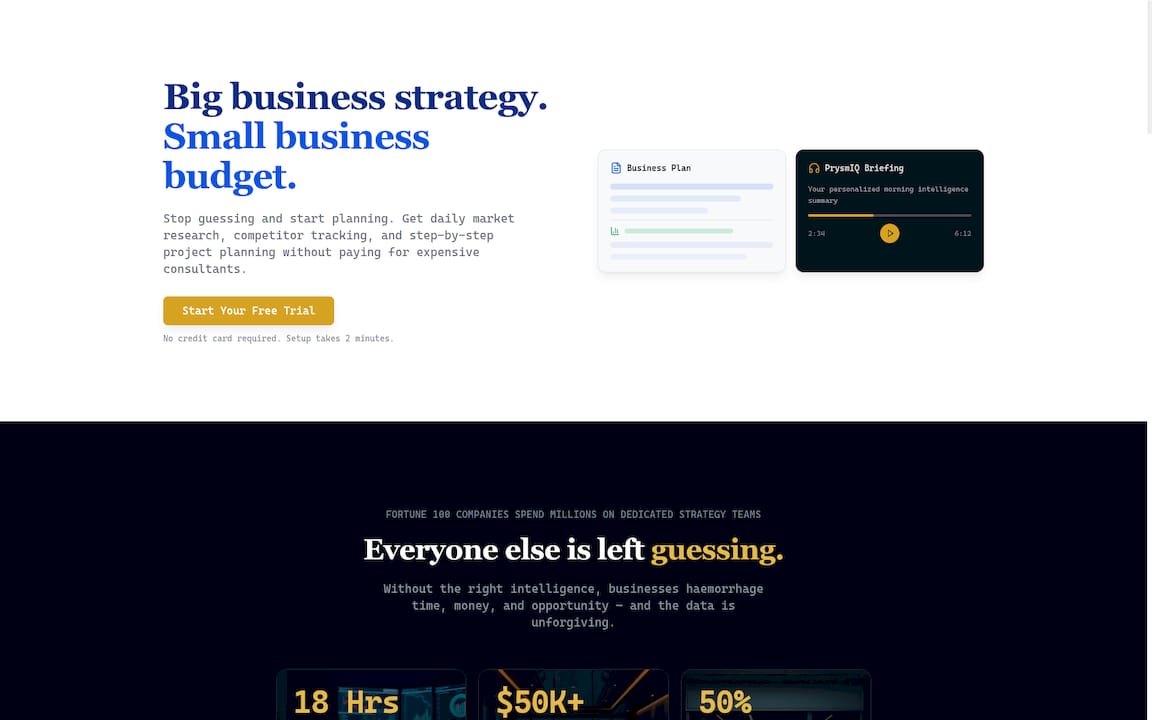
Blueprysm’s AI-powered platform gives business decision-makers access to daily market briefings, competitor monitoring, and strategic planning tools that used to be reserved for Fortune 100 strategy teams. Whether you are running a Porter’s Five Forces analysis and need real competitor intelligence, or validating an Ansoff-based growth move with current market data, Blueprysm puts the inputs in your hands. You can explore the platform’s full capabilities and review the pricing plans to find the tier that fits your team’s planning cycle.
FAQ
What is a strategic framework?
A strategic framework is a structured tool that organizes information and guides decision-making by surfacing the factors most critical to a specific business problem. Examples range from SWOT analysis to the Balanced Scorecard.
Why use strategic frameworks instead of gut instinct?
Frameworks provide shared language and repeatable processes that prevent fragmented communication and keep decisions grounded in structured analysis rather than individual bias.
Which strategic framework is best for growth decisions?
The Ansoff Matrix is purpose-built for growth strategy, mapping four options across existing and new products and markets with explicit risk profiles for each quadrant.
How many strategic frameworks should a business use at once?
Most organizations benefit from pairing two to three complementary frameworks, such as SWOT for internal clarity, Porter’s Five Forces for industry context, and the Balanced Scorecard for execution alignment.
Why do strategic frameworks fail in practice?
Most framework failures stem from execution gaps, not strategy gaps. When frameworks are not connected to metrics, accountability, and regular review cycles, they produce analysis without behavioral change.