


TL;DR:
- Effective competitive intelligence requires a coordinated program analyzing markets, customers, suppliers, macro trends, and competitors to inform strategic decisions. Ethical intelligence relies on publicly available data, structured workflows, and connecting insights directly to business outcomes, not just gathering raw information. Modern tools and frameworks, including AI integration, help organizations translate data into actionable insights that provide a competitive edge.
Most business leaders think competitive information means tracking what rivals are doing. That’s part of it, but only a fraction of the real picture. Truly useful competitive information is a coordinated intelligence program covering customers, suppliers, market conditions, macro forces, and yes, competitors — all synthesized to sharpen strategic decisions. The organizations that treat it as a narrow surveillance exercise leave enormous strategic value on the table. This guide gives you a more complete framework.
Table of Contents
- Key takeaways
- What competitive information actually means
- Where to find credible competitive data
- Building a systematic analysis workflow
- Strategic applications that move the needle
- What’s changing in competitive intelligence
- My take: data collection is the easy part
- How Blue Prysm accelerates your intelligence workflow
- FAQ
Key takeaways
| Point | Details |
|---|---|
| Broaden your scope | Competitive information covers markets, customers, suppliers, and macro forces — not just rival products. |
| Use verified data sources | Federal sources like BLS, SEC EDGAR, and Census Bureau data provide credible, auditable intelligence. |
| Build a systematic workflow | Structured competitor identification, data gathering, and SWOT analysis produces far better outputs than ad hoc research. |
| Deliver implications, not data | The most valued intelligence outputs include recommendations and strategic meaning, not raw facts. |
| Connect intelligence to outcomes | Tie every analysis exercise to a specific business decision or measurable strategic objective. |
What competitive information actually means
There is a persistent myth that competitive intelligence sits in a legal gray area, somewhere close to corporate espionage. It does not. Ethical competitive intelligence is entirely legal, built on transparent and non-deceptive information gathering methods. The line between legitimate research and espionage is clear: if you are deceiving someone to obtain information, you have crossed it. If you are analyzing publicly available signals intelligently, you have not.
The more useful distinction is between competitive information and market research. Market research typically focuses on customer behavior, preferences, and size of opportunity. Competitive information is broader. It pulls together data on your rivals, yes, but also on supplier dynamics, regulatory shifts, labor market conditions, and macro trends that could reshape your industry before anyone sees it coming.
The SBA recommends a competitive analysis that identifies competitors by product line and market segment, assesses market share, maps strengths and weaknesses, and evaluates barriers to entry for indirect competitors too. That scope is closer to the right mindset.
“Competitive intelligence is not about spying on competitors. It is about building a structured picture of the forces shaping your market so you can make faster, smarter decisions than anyone else in the room.”
The ethical and legal framework for gathering competitive information rests on three pillars. First, information must come from publicly accessible or legitimately licensed sources. Second, collection methods must be transparent. Third, the purpose must be organizational improvement, not sabotage or misappropriation of trade secrets.
Where to find credible competitive data
The single biggest mistake analysts make in competitor benchmarking is building conclusions on unverified vendor data or industry guesswork. The good news is that an enormous amount of rigorous, auditable competitive data is sitting in public federal databases, largely underused.
Breaking competitive data into categories helps clarify which source to consult for which question.
| Intelligence Type | Key Sources | Update Frequency | Best Used For |
|---|---|---|---|
| Structural (market size, firm counts) | Census CBP, Census SUSB | Annual | Sizing markets, mapping competitive density |
| Labor and capacity | BLS QCEW, BLS OES | Quarterly / Annual | Assessing competitor headcount, wage benchmarks |
| Financial performance | SEC EDGAR | Quarterly / Annual | Revenue trends, margins, capital allocation |
| Macroeconomic context | FRED (St. Louis Fed) | Varies | Demand forecasting, input cost pressures |
| Competitor messaging and positioning | Company websites, press releases, job postings | Ongoing | GTM strategy signals, product roadmap hints |
This breakdown matters because separating intelligence into structural, labor, and financial types helps you ask sharper questions. If you want to understand whether a competitor is scaling aggressively, BLS QCEW data on their regional employment growth tells you far more than their press releases do.
Pro Tip: Job postings are underrated competitive signals. A competitor suddenly hiring ten machine learning engineers when they have never operated in that space is a concrete indication of a strategic shift, often six to twelve months before any public announcement.
For publicly traded companies, SEC EDGAR filings give you segment revenue, cost structure, and management commentary on competitive threats. These are the words executives use when they are legally obligated to be accurate. That alone makes them more reliable than most paid market research reports.

Building a systematic analysis workflow
Ad hoc research feels productive but rarely produces insights you can act on. A repeatable workflow changes that. The US Chamber of Commerce outlines a practical operational checklist for evaluating competitors on products, messaging, pricing, and distribution. Use that as a starting structure, then layer in analytical depth.
Here is a workflow that holds up at any organizational scale:
- Define your competitive set. Separate direct competitors (same product, same customer segment) from indirect ones (different product, same job-to-be-done). Missing indirect competitors is where most analyses go wrong early.
- Map the key intelligence questions. Every analysis should start with a business question, not a data collection exercise. “Where are we most vulnerable in the mid-market segment?” is better than “Let’s gather everything on Competitor X.”
- Collect data across source types. Pull from primary sources (customer interviews, win/loss calls) and secondary sources (federal databases, EDGAR, trade publications). Do not rely on any single category.
- Apply structured analysis frameworks. Run a competitor SWOT analysis for each primary competitor, combined with landscape mapping to see relative positioning across two or three key dimensions.
- Build deliverables tied to decisions. Sales battlecards are one of the most practical outputs: a one-page document with competitor overview, product comparison, pricing intelligence, common objections, and recent moves. Built well, they end the “I don’t know how to position against them” problem in sales conversations.
- Distribute insights to the right stakeholders. Intelligence that sits in a shared drive accomplishes nothing. Build a distribution cadence for product, sales, and strategy teams.
Pro Tip: The most common pitfall in competitor research strategies is collecting more data than you analyze. Set a time boundary on collection — two weeks maximum for most projects — and spend the remaining time on interpretation.
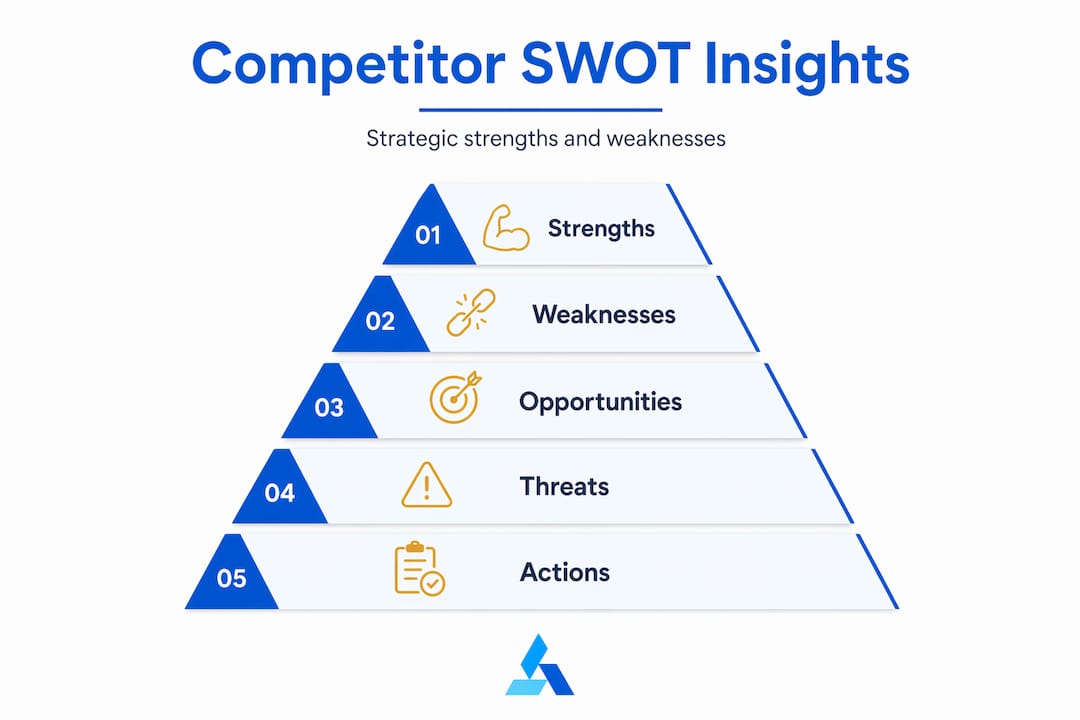
Applying SWOT analysis specifically to competitors (not only to your own organization) unlocks a genuinely different kind of clarity. When you map a rival’s weaknesses and threats alongside their strengths, you can identify specific market entry opportunities that pure market analysis would miss.
Strategic applications that move the needle
The most valued intelligence outputs are not news digests or raw data dashboards. According to Forrester research, the deliverables that drive the most organizational value are competitive SWOTs, competitor profiles, market sizing, product comparisons, and landscape analyses. The common thread is that they deliver implications, not just information.
Here is how that plays out across the four highest-impact use cases:
- Go-to-market targeting. When your industry trend analysis shows a competitor retreating from a specific segment, whether through pricing, messaging, or reduced sales activity, that is a window. Systematic competitive information lets you see it before your sales team starts losing deals in that space.
- Competitive response planning. When a rival launches a new product or drops pricing, organizations with a standing intelligence process respond in days, not months. Those without one spend weeks just gathering the facts.
- Product roadmap prioritization. Feature gaps identified through systematic competitor benchmarking give product teams objective criteria for sequencing development priorities, rather than relying on gut feeling or whoever last spoke at an all-hands.
- Risk management. Macro intelligence from sources like FRED combined with competitor financial filings can signal an industry pricing war or demand contraction before it hits your own numbers. That lead time is where strategy actually gets made.
The SBA is direct about this: competitive information tied to strategy creates measurable competitive edge, while intelligence treated as an isolated research exercise produces reports nobody reads. The difference is in how the outputs connect to actual decisions.
What’s changing in competitive intelligence
The mechanics of how to gather market information are shifting faster than most programs are adapting. Two trends stand out above the noise.
- AI-driven synthesis is collapsing timelines. Forrester data shows expanding use of AI platforms and generative AI tools for faster research synthesis, analysis generation, and cross-stakeholder delivery. Work that once took a week of analyst time can now be drafted in hours. The constraint has shifted from data processing to question quality.
- Stakeholder breadth is growing. Intelligence programs that used to serve strategy teams are now expected to support sales, product, and operations simultaneously. That requires more structured workflows, cleaner deliverables, and deliberate distribution. You cannot send the same 40-page report to a sales rep and a CFO and expect both to find it useful.
- Measurement of impact remains weak. Even as tools improve, most organizations struggle to connect intelligence outputs to business outcomes. Teams that do solve this — by tracking win rates in targeted segments, time-to-response on competitive threats, or revenue in identified opportunity windows — gain organizational credibility that protects the function from budget cuts.
For teams looking to stay ahead, AI-powered competitive strategies are worth examining as the category matures rapidly.
My take: data collection is the easy part
I have worked with dozens of strategy teams across industries, and the pattern is almost identical every time. They invest heavily in tools and subscriptions, build an impressive data stack, and then produce outputs that collect digital dust. The bottleneck is almost never data. It is the translation layer between what the data shows and what a decision-maker should do about it.
The trap is assuming that analysis is what happens after data collection ends. In my experience, the best competitive intelligence work starts with the decision first. What is the actual choice on the table? A market entry call, a pricing response, a build-versus-buy on a product feature? Define that first, then gather only the information that changes the decision calculus.
I am also skeptical of organizations that rely heavily on a single source or tool. No platform, however sophisticated, eliminates the need for analytical judgment. Verified federal data gives you a defensible foundation. Primary research from customers gives you the context to interpret it. Neither works well in isolation.
What I have found separates genuinely useful competitive programs from expensive noise machines is this: the teams that win tie every intelligence output to a measurable business question and review whether the answer was right. Not as a performance review, but as a calibration mechanism. Over time, that feedback loop compounds into genuine rivalry insights that nobody without the institutional history can replicate.
— Colin Bowdery
How Blue Prysm accelerates your intelligence workflow
If the framework above describes where you want to be, but your current reality is scattered spreadsheets, delayed briefings, and analysts buried in data collection, Blue Prysm was built for exactly that gap.
Blue Prysm is an AI-powered strategic intelligence platform that handles the heavy lifting of data integration, competitive monitoring, and analysis generation so your team focuses on decisions instead of data wrangling. The platform delivers daily market briefings, structured competitor profiles, and strategic planning tools sized for the budget realities of growing businesses, not just Fortune 100 companies. Whether you are running formal competitor benchmarking or tracking market signals in real time, Blue Prysm turns the process from a quarterly project into a continuous advantage. Explore strategic intelligence pricing to see which plan fits your team’s workflow.
FAQ
What is competitive information in business?
Competitive information is the systematic collection and analysis of data about competitors, customers, suppliers, market conditions, and macro factors to support strategic decision-making. It is broader than simple competitor monitoring and covers the full context shaping a business’s market position.
How is competitive intelligence different from corporate espionage?
Ethical competitive intelligence relies exclusively on publicly available or legitimately licensed sources and transparent collection methods. Corporate espionage involves deception, theft, or illegal access to confidential information, which is both unlawful and outside the scope of legitimate business competitor analysis.
What are the best sources for competitive information?
Federal public databases including Census Bureau data, BLS QCEW, BLS OES, SEC EDGAR, and FRED provide verified, auditable competitive data. Company websites, job postings, press releases, and primary customer interviews add qualitative context that quantitative sources cannot supply.
What deliverables should a competitive analysis produce?
The highest-value outputs include competitor SWOT analyses, landscape maps, product comparison matrices, and sales battlecards. Each should translate raw data into specific implications and recommendations tied to an active business decision.
How often should you update your competitive information?
Ongoing monitoring for major competitors should be continuous, with structured deep-dive analyses conducted quarterly or when a significant market event occurs, such as a competitor product launch, pricing change, or leadership transition.
Recommended
- Competitive intelligence for SMEs: strategies and tools – Articles & Blogs
- Assess competitive advantage: practical steps for business leaders – Blue Prysm – Articles & Blogs
- Competitive mapping: an AI-powered guide for SMBs
- AI strategies that actually build competitive advantage – Blue Prysm – Articles & Blogs