


TL;DR:
- Effective decision tools are precisely matched to decision types, uncertainty levels, and organizational needs rather than their complexity or cost.
- Traditional frameworks like decision matrices, decision trees, and cost-benefit analyses remain essential, especially when integrated into decision support systems that enable real-time, collaborative actions.
Business decision tools are defined as structured frameworks, analytical methods, and software platforms that organizations use to evaluate options, reduce uncertainty, and execute better choices at every level of operations. The best examples of business decision tools range from classic frameworks like SWOT analysis and decision trees to AI-powered decision intelligence platforms such as Domo and Microsoft Power BI. The decision intelligence market is growing at 19.1% annually, yet 58% of business leaders still base key decisions on inaccurate data. That gap is exactly where the right tool, chosen for the right decision type, creates competitive advantage.
1. Examples of business decision tools: the classical frameworks
Traditional decision-making frameworks remain the backbone of sound organizational strategy. They are not outdated. They are underused, misapplied, or replaced prematurely by technology that cannot replicate their clarity.

Decision matrix (Multi-Criteria Decision Analysis)
A decision matrix lets you compare multiple options against weighted criteria in a single grid. If you are choosing between three vendors, you score each on cost, reliability, and integration fit, then multiply by importance weights. The highest score wins, and the gut feeling loses. This is the tool that keeps procurement decisions defensible and documented.
Decision tree
A decision tree maps multistage decisions under uncertainty by branching each choice into probable outcomes with assigned values. It is the right tool when a decision has sequential steps and each step changes the probability of downstream results. Supply chain teams use decision trees to model whether to hold inventory or expedite shipments based on demand forecasts.
Cost-benefit analysis
Cost-benefit analysis converts every option into financial terms so you can compare apples to apples. It works best for capital expenditure decisions, hiring plans, and technology investments where the costs and benefits can be quantified over a defined time horizon. The weakness is that it breaks down when benefits are qualitative or when the future is genuinely uncertain.
SWOT and PEST analyses
SWOT (Strengths, Weaknesses, Opportunities, Threats) and PEST (Political, Economic, Social, Technological) analyses are situational assessment tools. SWOT works at the organizational level; PEST works at the market and macro-environment level. Neither produces a decision on its own. Both produce the context that makes other tools more accurate.
Pareto analysis and pro/con lists
Pareto analysis applies the 80/20 rule to prioritization: identify the 20% of causes driving 80% of your problems and fix those first. Pro/con lists are the simplest form of structured thinking and are genuinely useful for low-stakes, reversible decisions where speed matters more than precision.
Pro Tip: Decision-making frameworks are categorized by use case: comparing options, binary decisions, and time-pressured decisions. Match the framework to the decision type before you open a spreadsheet.
2. How AI-powered platforms are changing decision intelligence
The difference between traditional business intelligence tools and modern decision intelligence platforms is not just processing speed. It is the difference between a rearview mirror and a navigation system.
Traditional BI tools like early versions of Tableau or Excel-based dashboards show you what happened. Decision intelligence platforms integrate AI, predictive modeling, and workflow automation to move beyond passive reporting into closed-loop decision execution. They do not just surface data. They trigger actions.
Domo provides real-time dashboards, AI-powered natural language queries, and closed-loop workflow automation with over 1,000 connectors, making it ideal for teams without dedicated data science staff. A retail operations team can use Domo to automatically reorder inventory when stock drops below a threshold, without a human reviewing a report first.
Microsoft Power BI integrates AI visuals and the full Microsoft ecosystem, offering a low-cost analytics entry point for small to medium teams. The trade-off is limited decision automation. Power BI tells you what the data says. It does not act on it.
ThoughtSpot uses natural language search to let non-technical users query data the way they would ask a colleague a question. SAS Intelligent Decisioning goes further, combining analytics with real-time decisioning rules for industries like financial services and healthcare where compliance and speed both matter.
The practical use cases for these platforms include inventory management, predictive maintenance, and fraud detection. AI tools minimize human bias, speed decision processes, and enable forward-looking decisions that reactive reporting simply cannot support. That said, these platforms require organizational adoption to deliver value. The technology is only as good as the processes built around it.
“AI augments human judgment rather than replaces it, minimizing biases and enhancing workflows.” This is the operating principle that separates organizations that get ROI from AI tools from those that buy expensive software and revert to spreadsheets six months later.
Pro Tip: Before evaluating any AI decision platform, map your three most frequent operational decisions. If the platform cannot automate or accelerate at least two of them, it is solving the wrong problem for your organization.
3. How to choose decision tools that actually fit your organization
Choosing the wrong tool is not a neutral mistake. It adds cognitive load, slows decisions, and creates false confidence in outputs that do not match the decision context.
The first filter is decision type. Speed-focused tools suit low-stakes, reversible decisions. Rigorous analytical frameworks suit high-stakes, irreversible strategic decisions. Applying a full cost-benefit analysis to a meeting scheduling decision wastes time. Applying a pro/con list to a market entry decision is negligent.
The second filter is uncertainty type. Misapplying probability-based tools to decisions with deep uncertainty produces flawed outcomes. When you genuinely cannot assign reliable probabilities to outcomes, scenario planning or minimax regret methods are more honest and more useful than expected value calculations that rest on invented numbers.
Here is a practical comparison to guide tool selection:
| Decision type | Recommended tool | Key consideration |
|---|---|---|
| Low-stakes, reversible | Pro/con list, Eisenhower Matrix | Speed over rigor |
| Multi-option comparison | Decision matrix, Pugh Matrix | Weight criteria by strategic priority |
| Sequential uncertainty | Decision tree, scenario planning | Map probabilities at each branch |
| High-stakes, irreversible | Cost-benefit analysis, AHP | Quantify all assumptions explicitly |
| Deep uncertainty | Minimax regret, scenario planning | Avoid false precision |
The third filter is the Decision Subtraction Framework, which evaluates whether a tool truly reduces decision load or adds complexity. The two metrics are Replacement Ratio (how many decisions does the tool eliminate versus create) and Attention ROI (does the tool free up cognitive bandwidth or consume it). A tool that generates more decisions to verify than it removes is a net negative, regardless of its feature list.
Finally, consider organizational buy-in. The best analytical tool fails if the team does not trust its outputs or understand its logic. Training, workflow integration, and visible leadership adoption are not soft factors. They are adoption requirements.
4. How decision support systems bring these tools together
Decision support systems (DSS) are the technological layer that combines data sources, analytical models, and user interfaces to implement business decision-making tools at scale. Think of a DSS as the operating environment in which your frameworks and platforms run.
A DSS does not replace a decision matrix or a predictive model. It connects them. A well-designed DSS pulls live data from your ERP, runs it through an analytical model, and presents the output in a format that a decision-maker can act on in real time. The AI-driven insights for SME strategy that were once available only to Fortune 100 companies with dedicated analytics teams are now accessible through cloud-based DSS platforms.
Key benefits of integrating DSS with your decision tools include:
- Real-time scenario simulation: Test the financial impact of a pricing change before you implement it, using live cost and demand data.
- Collaborative decision-making: Multiple stakeholders can view the same model, adjust assumptions, and see updated outputs simultaneously.
- Audit trails: Every decision, its inputs, and its rationale are logged, which matters for compliance, post-mortems, and organizational learning.
- Reduced analysis paralysis: A DSS narrows the option set before it reaches a human decision-maker, so the cognitive load is on judgment, not data gathering.
Microsoft Power BI embedded in a sales operations workflow is a DSS. Domo with automated workflow triggers is a DSS. The best decision-making practices for organizations adopting these systems start with defining the decision, not the technology.
Key takeaways
The most effective business decision tools are those matched precisely to decision type, uncertainty level, and organizational context, not the most sophisticated or expensive options available.
| Point | Details |
|---|---|
| Match tool to decision type | Use speed tools for reversible decisions and rigorous frameworks for high-stakes, irreversible ones. |
| AI platforms require adoption | Decision intelligence tools like Domo and Power BI only deliver value when integrated into real workflows. |
| Apply the Decision Subtraction test | Evaluate any new tool by whether it reduces net decision load, not just by its feature count. |
| DSS connects tools to execution | Decision support systems turn analytical frameworks into real-time, collaborative, auditable decisions. |
| Uncertainty type changes the tool | Deep uncertainty calls for scenario planning or minimax regret, not probability-based expected value models. |
Why most organizations pick the wrong tools and how to stop
I have watched smart leadership teams spend months evaluating decision intelligence platforms when their actual problem was that nobody agreed on what decision they were trying to make. The tool selection process became a proxy for the strategic clarity conversation they were avoiding.
Here is what I have learned from working with organizations across industries: the tool is rarely the constraint. The constraint is the absence of a decision type filter at the front of the process. Before you evaluate any software or framework, you need to answer three questions. What decision are we making? How reversible is it? How much genuine uncertainty exists in the outcome? Those three answers will eliminate 80% of the tools on your shortlist before you read a single product review.
The complexity trap is real. AI tools that create more decisions to verify or manage than they replace often fail to improve efficiency despite advanced capabilities. I have seen organizations adopt sophisticated platforms that generated so many alerts, dashboards, and model outputs that analysts spent more time managing the tool than making decisions. That is not intelligence. That is noise with a good user interface.
My honest recommendation is to start with the classical frameworks. A well-run decision matrix or a properly structured cost-benefit analysis will outperform a poorly implemented AI platform every time. Once your team has discipline around structured decision-making, layering in AI-powered decision making becomes an accelerant rather than a crutch. The sequence matters. Build the judgment first, then automate it.
— Colin Bowdery
Make smarter decisions with Blue Prysm
Blue Prysm is built for exactly the gap this article describes: the space between having data and making a confident decision.
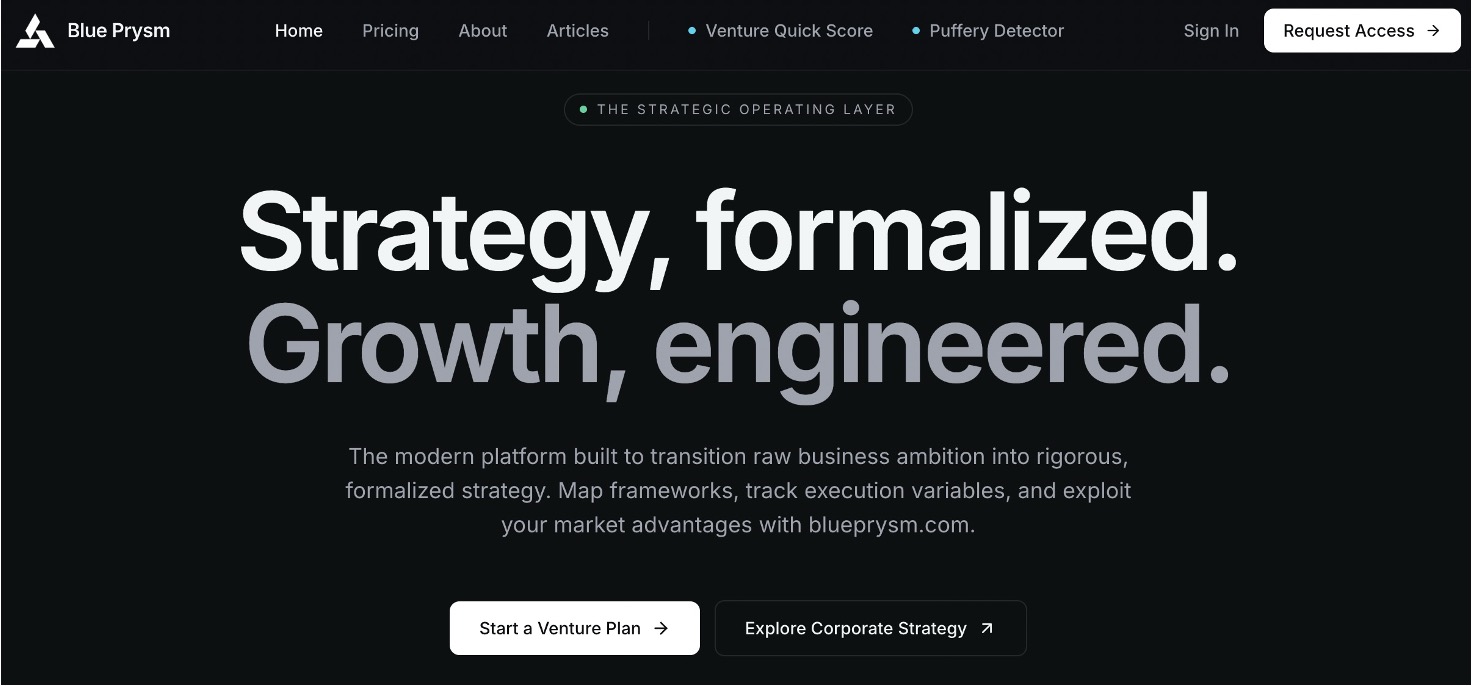
The platform combines AI-powered market briefings, competitor monitoring, and scenario testing into a single workflow designed for business leaders who do not have a Fortune 100 analytics budget but face Fortune 100 complexity. Blue Prysm delivers strategic intelligence that connects classical decision frameworks with real-time market data, so your team spends less time gathering information and more time acting on it. If you are ready to see how closed-loop decision intelligence works in practice, explore what Blue Prysm makes possible at blueprysm.com.
FAQ
What are the most common examples of business decision tools?
The most common examples include SWOT analysis, decision matrices, decision trees, cost-benefit analysis, and AI-powered platforms like Microsoft Power BI and Domo. Each tool suits a different decision type, from quick prioritization to complex strategic planning.
How do decision support systems differ from business intelligence tools?
Decision support systems combine data sources, analytical models, and user interfaces to support specific decisions in real time, while traditional BI tools primarily report on historical data. DSS platforms like Domo go further by automating workflow triggers based on analytical outputs.
How do I choose the right decision-making tool for my business?
Start by identifying the decision type: reversible or irreversible, simple or complex, certain or deeply uncertain. Speed-focused tools suit low-stakes decisions, while rigorous analytical frameworks suit high-stakes strategic ones.
Can AI replace traditional decision-making frameworks?
No. AI augments human judgment rather than replacing it, and it works best when layered on top of structured decision processes, not substituted for them. Classical frameworks provide the logic; AI platforms provide the speed and scale.
What is the Decision Subtraction Framework?
The Decision Subtraction Framework evaluates any decision tool by measuring whether it reduces net decision load. It uses two metrics: Replacement Ratio and Attention ROI, to determine if a tool genuinely improves efficiency or simply adds complexity.