


A Regulated Investment Company (RIC) is a U.S. tax designation under IRC Subchapter M that allows qualifying investment entities to pass income directly to shareholders, bypassing entity-level corporate tax entirely. To earn and keep that status, a fund must clear three statutory hurdles: derive at least 90% of its gross income from qualifying sources (dividends, interest, and capital gains), satisfy asset-diversification tests, and distribute the vast majority of that income to shareholders each year. Miss any one of those tests and the fund loses its pass-through shield.
The governing statute is IRC Section 851, which sits inside Subchapter M of the Internal Revenue Code. Most RICs are also registered under the Investment Company Act of 1940 and subject to SEC oversight, though the tax election and the registration requirement are legally separate tracks.
Quick compliance checklist at a glance:
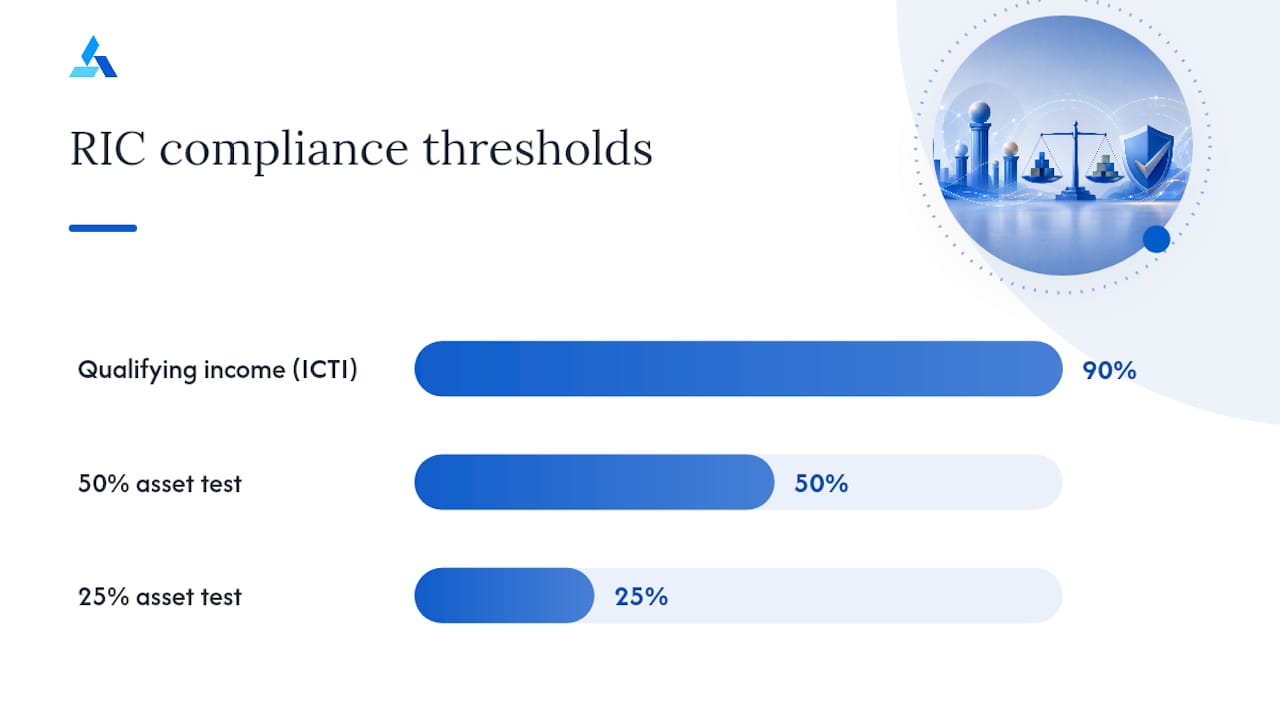
- At least 90% of gross income from qualifying sources (the income test)
- Asset diversification: 50% rule and 25% concentration cap (the diversification tests)
- Annual distribution of at least 90% of investment company taxable income
- Domestic corporation status (or treated as such)
- Timely tax election filed with the IRS
Key Takeaways
A Regulated Investment Company under IRC Subchapter M avoids entity-level corporate tax by passing income directly to shareholders, provided it meets three statutory tests every year.
| Point | Details |
|---|---|
| RIC definition | A U.S. tax designation under IRC Section 851 allowing qualifying investment entities to pass income to shareholders without entity-level tax. |
| 90% income test | At least 90% of gross income must come from qualifying sources: dividends, interest, and capital gains. |
| Diversification thresholds | The 50% rule and 25% concentration cap apply at each quarter-end; inadvertent failures have a 30-day cure window. |
| Distribution requirement | Funds must distribute at least 90% of investment company taxable income annually to preserve pass-through treatment. |
| Investor reporting | Shareholders receive Form 1099-DIV classifying distributions as ordinary income, qualified dividends, capital gains, or return of capital. |
Consult qualified tax counsel and review primary sources below before making any compliance or investment decisions based on this article.
Why RIC status matters for your fund’s economics and your tax bill
The core appeal is simple: a fund that qualifies as a RIC pays no federal corporate income tax at the entity level on income it distributes. Without that designation, a fund would pay corporate tax first, then shareholders would pay income tax on dividends received — classic double taxation. RIC status collapses that two-step into one.
Think of it as a tax conduit. The fund collects dividends, interest, and capital gains from its portfolio, then passes them through to investors, who report and pay tax on their share. The fund itself is largely invisible to the IRS on distributed income. That structural efficiency is why virtually every major open-end mutual fund and ETF in the U.S. operates as a RIC.
For investors, the practical consequences include:
- Tax character preservation. Qualified dividends passed through a RIC retain their preferential tax rate at the investor level.
- Capital gain distributions. Long-term capital gains distributed by the fund are taxed at long-term rates for the investor, not as ordinary income.
- Recordkeeping obligations. Investors receive a Form 1099-DIV each year that breaks distributions into ordinary income, qualified dividends, and capital gain distributions.
- Basis adjustments. Return-of-capital distributions reduce an investor’s cost basis rather than triggering immediate tax.
The market role is equally significant. RICs are the primary vehicle through which retail investors access diversified securities markets. Without the pass-through structure, the economics of pooled investing would look very different — fund expenses would have to absorb a corporate tax layer before any return reached shareholders.
Which entities actually qualify as RICs, and which ones don’t?
Legal dictionary definitions describe a RIC as any investment company registered under the Investment Company Act that has made the Subchapter M election. In practice, the most common RIC forms are:
Open-end mutual funds are the canonical example. They issue and redeem shares daily at net asset value, hold diversified securities portfolios, and distribute income annually or quarterly.
Exchange-traded funds (ETFs) qualify as RICs in the same way mutual funds do. Their in-kind creation/redemption mechanism actually gives them a structural tax advantage over traditional mutual funds in managing capital gain distributions, but the underlying RIC election is identical.
Closed-end funds can also elect RIC status. Unlike open-end funds, they trade on exchanges at prices that may differ from NAV, but the tax treatment of their distributed income follows the same Subchapter M rules.
Unit investment trusts (UITs) are a less common but valid RIC form. They hold a fixed portfolio and issue redeemable units rather than shares.
What does NOT qualify
Real Estate Investment Trusts (REITs) operate under a parallel but distinct tax regime — Subchapter M also covers REITs, but the income and asset tests differ materially.
Business Development Companies (BDCs) are a hybrid: they are regulated under the Investment Company Act and can elect RIC status, but their portfolio composition (primarily debt and equity in private companies) creates unique compliance challenges around the diversification tests.
Operating businesses and insurance companies cannot be RICs. The statute requires that the entity function as an investment vehicle, not as an operating enterprise. An insurance company holding an investment portfolio is still an insurance company for tax purposes.
The statutory qualification tests every fund must pass
Freeman Law’s practitioner guide describes the election as deceptively straightforward on paper but demanding in ongoing execution. Three tests govern qualification, and all three must be met continuously.
The 90% qualifying-income test
Income from operating businesses, real estate rents (in most cases), or commodity trading that falls outside the qualifying categories counts against the fund.
The asset-diversification tests
These tests are measured at the close of each quarter of the fund’s taxable year. Two rules apply simultaneously:
| Test | Requirement | What it means in practice |
|---|---|---|
| 50% diversification rule | At least 50% of total assets must be in cash, government securities, or securities where no single issuer exceeds 5% of total assets and 10% of the issuer’s voting securities | Prevents heavy concentration in any one holding |
| 25% concentration cap | No single issuer (other than government securities or other RICs) can represent more than 25% of total assets | Blocks a fund from being a de facto single-stock vehicle |
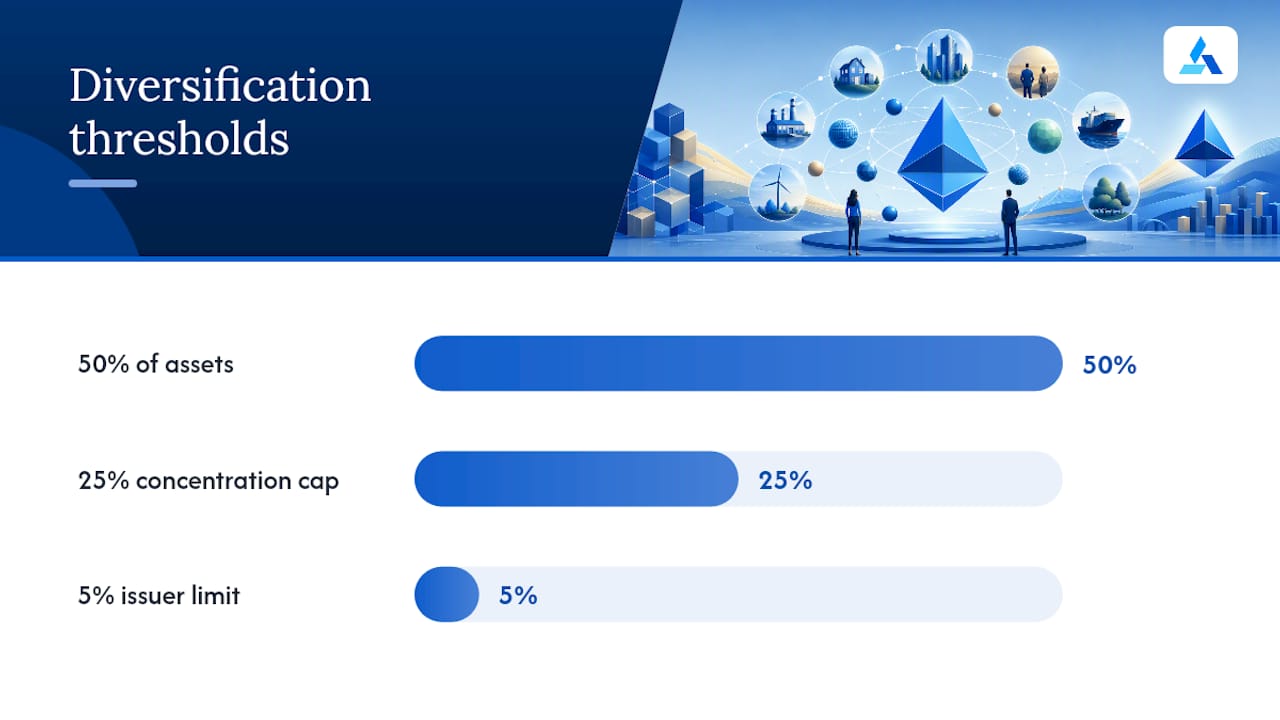
A fund that passes the income test but fails the diversification test at quarter-end has a narrow cure window. The IRS allows a 30-day correction period for inadvertent failures caused by market movements, but deliberate or repeated violations carry harsher consequences.
The distribution requirement
ICTI is essentially net investment income plus net short-term capital gains, minus deductions.
- Distributions must be made by the end of the calendar year (or within a short window after year-end under specific IRS rules)
- Capital gain distributions follow a separate but related schedule
- Funds often declare a “spillback” dividend in January that is treated as paid in the prior December for tax purposes
How taxation actually works for RICs and their shareholders
The mechanism is a conduit. The fund collects income, nets it against expenses, and passes what remains to shareholders. Investopedia’s RIC explainer frames it precisely: the fund avoids double taxation by distributing most of its net investment income, leaving investors to pay tax on what they receive.
Distribution types and how each is taxed at the investor level:
- Ordinary income dividends. Taxed at the investor’s marginal income tax rate. These come from interest income and short-term gains the fund earned.
- Qualified dividends. Passed through from underlying portfolio companies that meet the IRS holding-period requirements. Taxed at preferential long-term capital gains rates (0%, 15%, or 20% depending on the investor’s income).
- Long-term capital gain distributions. Arise when the fund sells securities held longer than one year. Taxed at long-term rates regardless of how long the investor has held fund shares.
- Return of capital (ROC). Not immediately taxable. Instead, it reduces the investor’s cost basis. When basis reaches zero, subsequent ROC distributions become taxable as capital gains.
Reporting flows through Form 1099-DIV, issued by the fund or its transfer agent by January 31 each year. Box 1a covers total ordinary dividends, Box 1b covers qualified dividends, and Box 2a covers total capital gain distributions. Investors and their advisers should reconcile 1099-DIV data against fund annual reports to catch any reclassifications that occur after preliminary distributions.
How to elect RIC status and keep it year after year
The election itself is not a form you file with the IRS in the traditional sense. A fund elects RIC status by filing its first tax return as a RIC — the act of filing under Subchapter M constitutes the election. But the groundwork before that filing is where most of the work happens.
Sequential steps for a new fund:
- Confirm domestic corporation status. The entity must be organized as a domestic corporation (or a trust or association taxable as a corporation).
- Register under the Investment Company Act (if applicable) or confirm an exemption applies.
- Adopt a distribution policy that commits the fund to distributing at least 90% of ICTI annually, with board-level authorization.
- Build portfolio construction guidelines that embed the 50% and 25% asset tests into investment policy statements and trading limits.
- File the first tax return under Subchapter M. The election is irrevocable once made — there is no going back without significant tax consequences.
- Establish quarterly asset-test monitoring. Assign responsibility to the fund’s compliance officer or external counsel to certify diversification at each quarter-end.
Ongoing compliance checklist:
- Monthly income-source tracking against the 90% qualifying-income threshold
- Quarterly asset-test certification with written documentation
- Year-end distribution calculation and board approval of any spillback dividend
- Annual tax return preparation under Subchapter M with supporting workpapers
- Coordination between portfolio managers and tax counsel before any significant portfolio shift
Pro Tip: Keep a dedicated compliance workbook that logs every quarter’s asset-test calculation, every income-source classification decision, and every distribution authorization. When an auditor or outside counsel reviews your RIC compliance, that workbook is the difference between a clean opinion and a months-long inquiry.
If a fund misses a test, the cure options depend on the type of failure. For the income test, a fund can pay a tax equal to the excess non-qualifying income rather than lose RIC status entirely, provided the failure was not due to willful neglect. For the diversification tests, the 30-day cure window applies to inadvertent failures.
Red flags that should put investors and managers on alert
Most funds that lose RIC status do so quietly, through accumulated small failures rather than a single dramatic breach. Here is what to watch for.
Investor due-diligence checklist:
- Does the fund’s annual report include a tax section confirming RIC status and qualifying-income compliance?
- Are distributions consistent with the fund’s stated income and gain? Irregular or suspended distributions can signal income-test pressure.
- Does the fund hold any unusual assets (commodity-linked notes, foreign currency positions, real estate) that could generate non-qualifying income?
- Has the fund disclosed any excise tax payments? A 4% excise tax on undistributed income is a yellow flag, not necessarily a crisis, but it warrants a closer look.
- Are there concentrated positions that approach or exceed 25% of total assets?
Red flags that demand immediate attention:
- Repeated footnote disclosures about “uncertainty regarding RIC qualification” in audited financial statements
- Large, concentrated holdings in a single issuer that fluctuate near the 25% cap
- Significant non-qualifying income streams that management has not explained in shareholder communications
- Late or reclassified distributions that suggest year-end scrambling to meet the 90% distribution threshold
- Absence of a quarterly asset-test certification process in the fund’s compliance program
For borderline cases, there is no substitute for timely consultation with qualified tax counsel and independent auditors. SEC filings and historical fund disclosures show how funds have documented RIC compliance in public filings — reviewing those disclosures is a practical benchmark for what adequate documentation looks like.
A quick note on other things “RIC” can mean
Before you go further, it’s worth flagging that “RIC” carries at least two other meanings in finance and industry unrelated to Subchapter M.
The Refinitiv Instrument Code is a proprietary, ticker-like identifier used on Refinitiv (formerly Reuters) data networks. It combines a short ticker root with an exchange-specific suffix (IBM.N for IBM on the NYSE, for example). It is not an industry-wide standard like ISIN and cannot be used interchangeably outside Refinitiv systems.
The Resin Identification Code is the numeric symbol (01 through 07) stamped on plastic products to identify resin type. It does not indicate recyclability — a persistent consumer misconception that modern labeling standards have tried to correct by replacing the chasing-arrows symbol with a solid triangle.
Neither of those meanings has any legal or regulatory connection to the investment company definition. If you are reading a fund prospectus, a tax opinion, or an SEC filing and you see “RIC,” it means Regulated Investment Company under Subchapter M, full stop.
What actually matters most in practice
Most articles about RICs spend their energy on the statute. The statute matters, but the real risk for fund managers is not ignorance of the rules — it is the gap between knowing the rules and having the operational infrastructure to monitor them in real time.
The income test sounds simple until a portfolio manager buys a structured note with commodity exposure and the tax team finds out at year-end. These are not hypothetical scenarios. They are the kinds of failures that show up in fund restatements and SEC comment letters.
For investors, the practical priority is equally clear: do not assume RIC status is permanent just because a fund held it last year. Read the tax section of every annual report. Look for the qualifying-income disclosure. If it is missing or vague, ask.
The RIC structure is genuinely powerful — it is the reason pooled investing works as efficiently as it does in the U.S. But that power is conditional. It exists only as long as the fund keeps passing three tests, every quarter, every year.
Track regulatory signals the way fund managers track their portfolios
If you are monitoring fund disclosures, tracking competitor fund structures, or validating claims in investment marketing materials, Blue Prysm’s market research tools give you AI-powered signal tracking across public filings and market data. The same discipline that keeps a RIC compliant — continuous monitoring, clear documentation, no surprises at year-end — applies to competitive intelligence. Blue Prysm’s market analysis platform is built for exactly that kind of ongoing vigilance.

Sources
The sources below are the primary authorities cited throughout this article. Each serves a different purpose depending on whether you need statute text, regulatory precedent, or practitioner guidance.
- Understanding Regulated Investment Companies (RICs): Definition, Taxes & Examples
- Regulated Investment Companies | Freeman Law
- Sec
- Refinitiv Identification Code
- RIC Definition: 1k Samples
This article is general information, not a substitute for advice from a qualified financial advisor. Consult a qualified financial professional about your own circumstances before acting on anything here.
FAQ
What does RIC stand for in finance?
RIC stands for Regulated Investment Company, a U.S. tax designation under IRC Subchapter M (Section 851) that allows qualifying investment entities to pass income directly to shareholders and avoid entity-level corporate tax.
What is the full meaning of RIC under U.S. law?
What is an RIC in business, and which entities use it?
In business, an RIC is the tax structure used by most open-end mutual funds, ETFs, closed-end funds, and unit investment trusts in the United States. Operating companies, insurance companies, and most REITs do not qualify or use a separate parallel regime.
What does RIC mean in an email or financial document?
In a financial document or fund prospectus, RIC almost always refers to Regulated Investment Company under Subchapter M. In a data or trading context, it may refer to a Refinitiv Instrument Code, a proprietary ticker-like identifier used on Refinitiv networks — the two meanings are entirely unrelated.
Can a fund lose its RIC status?
Yes. Some failures allow a cure period or a corrective tax payment, but willful or repeated violations carry harsher consequences.