


Strategic planning is the process where leaders define their vision for the future, set goals and objectives, and sequence the actions and resources needed to reach that vision. It is not a one-time document. It is a disciplined, repeatable process that keeps your organization moving in the same direction, even when the market shifts under your feet.
Three things strategic planning actually does for you:
- Sets direction. It forces a choice about where you are going and, just as critically, what you are not doing.
- Allocates resources. Budget, headcount, and attention flow toward the highest-priority bets instead of spreading thin across everything.
- Creates alignment. When your team understands how their daily work connects to the organization’s goals, execution gets faster and accountability gets real.
Key Takeaways
Strategic planning works when it is treated as a disciplined, iterative conversation that builds shared assumptions, not as a document produced once a year and filed away.
| Point | Details |
|---|---|
| Definition | Strategic planning sets direction, allocates resources, and aligns teams around measurable goals. |
| Research evidence | A meta-analysis of 87 correlations from 31 studies found a positive, moderate, statistically significant link between planning and performance. |
| Process discipline matters | Governance, owners, and review triggers attached to every initiative separate plans that drive results from plans that collect dust. |
| Right framework for context | Use SWOT and PESTEL for analysis, Balanced Scorecard for governance, and OKRs for quarterly execution cadence. |
| Blue Prysm | Blue Prysm’s AI platform compresses the research and analysis phases and tracks execution through OKR and KPI dashboards. |
Why does strategic planning matter for your organization?
Most leaders already know they should plan strategically. The honest question is whether it actually changes outcomes. The answer is yes, and the evidence is specific.
Formal strategic planning creates a forward-focused vision that aligns employees and clarifies how individual roles connect to organizational KPIs. That connection is not soft or motivational. It is structural. When people can trace their work to a measurable outcome, accountability follows naturally.
The practical benefits stack up quickly:
- Reduced reactive decision-making. When priorities are explicit, leaders stop making judgment calls from gut feeling and start making them from a shared fact base.
- Better resource allocation. Priorities on paper become budget decisions in practice. Planning forces the trade-off conversation before a crisis does.
- Risk anticipation. Scenario planning and environmental scans surface threats early, when you still have options.
- Clearer KPIs. A plan without metrics is a wish list. Strategic planning provides the structure to link day-to-day decisions to a larger vision and gives teams a scoreboard they can actually read.
- Improved accountability. Owners, timelines, and review triggers attached to every initiative mean someone is always responsible.
The behavioral shift is just as important as the structural one. Strategic planning moves decision-making away from reactive, opinion-based choices toward a systematic, evidence-based process. Leaders stop debating opinions and start debating assumptions, which is a much more productive argument.
What belongs inside a strategic plan?
A strategic plan is not a single spreadsheet or a slide deck. It is a set of connected documents and decisions that answer different questions at different levels of specificity. Here is what a complete plan includes.
The nine core elements
- Mission statement. Why the organization exists. One or two sentences, present tense, focused on purpose rather than product.
- Vision statement. Where the organization is going. A concrete, aspirational picture of the future, typically three to five years out.
- Core values. The non-negotiable behaviors that govern how decisions get made when no one is watching.
- Situational analysis (SWOT). An honest snapshot of internal strengths and weaknesses alongside external opportunities and threats.
- Strategic objectives. Three to five high-level goals that define what winning looks like over the planning horizon.
- Key Performance Indicators (KPIs). The specific, measurable signals that tell you whether you are on track toward each objective.
- Strategic initiatives. The projects and programs that will move the KPIs. Each initiative needs an owner, a budget envelope, and a timeline.
- Resource and budget allocation. How money, people, and time are distributed across initiatives.
- Governance and review cadence. Who reviews progress, how often, and what triggers a course correction.
Goals vs. objectives vs. KPIs — a quick distinction:
- Goal: Broad, directional statement (“Grow market share in the Southeast”).
- Objective: Specific, time-bound target (“Increase Southeast revenue by 20% by Q4”).
- KPI: The metric tracked to confirm progress (“Monthly Southeast revenue, new customer count”).
Pro Tip: Write every objective in SMART format (Specific, Measurable, Achievable, Relevant, Time-bound) and immediately pair it with the KPI that will confirm it. If you cannot name the KPI, the objective is not specific enough yet.
MIT Sloan Management Review makes a point worth internalizing: the primary value of planning often lies in the disciplined process of building a shared fact base, not in the static document that comes out of it. The plan is the output. The conversation is the product.
How do you run a strategic planning process?
A full planning cycle typically runs four to twelve weeks for a small to mid-sized organization, depending on how much environmental scanning is required and how many stakeholders need to be aligned. Here are the six phases.
-
Prepare. Confirm the planning team, set the time horizon, and agree on the process. Assign a facilitator. Gather existing performance data and prior-year plans. Owner: CEO or strategy lead. Timeline: one to two weeks.
-
Analyze. Run your situational analysis. SWOT, PESTEL, or Porter’s Five Forces depending on your context. Collect market data, competitor intelligence, and customer feedback. Owner: Strategy team with department input. Timeline: two to three weeks.
-
Decide. Synthesize the analysis into strategic choices. Where will you compete? What will you prioritize? What will you stop doing? This is the hardest conversation and the most important one. Owner: Executive team. Timeline: one to two weeks.
-
Plan. Translate decisions into objectives, KPIs, initiatives, owners, and budgets. Build the roadmap. Owner: Department heads with strategy lead. Timeline: one to two weeks.
-
Implement. Communicate the plan to the full organization. Launch initiatives. Embed KPI tracking into existing operating rhythms. Owner: All managers. Timeline: ongoing.
-
Monitor and revise. Review KPIs monthly or quarterly. Revisit assumptions at least twice a year. Treat the plan as a living document with pre-defined decision triggers, not a file that gets archived after the offsite. Owner: Executive team and board. Timeline: ongoing.
| Phase | Key Deliverable | Primary Owner | Governance Trigger |
|---|---|---|---|
| Prepare | Planning charter, data inventory | CEO / Strategy lead | Kick-off meeting |
| Analyze | SWOT, competitive brief | Strategy team | Analysis review session |
| Decide | Strategic choices memo | Executive team | Board or leadership sign-off |
| Plan | Roadmap with KPIs and owners | Department heads | Budget approval |
| Implement | Launched initiatives, dashboards | All managers | First monthly review |
| Monitor & Revise | Updated KPI scorecard | Executive team | Quarterly strategy review |
Pro Tip: Schedule your first quarterly review before you publish the plan. If the review date is not on the calendar before implementation begins, it will not happen. Treat planning as a learning cycle, not a launch event.
This is exactly where Agentic AI changes the math. Blue Prysm’s platform compresses the Analyze phase significantly by automating competitive scans, surfacing trend signals, and scoring strategic hypotheses before your team walks into the decision meeting. You still make the call. The AI just makes sure you are not walking in blind.

Which strategic frameworks should you actually use?
The framework question trips up a lot of leaders. The honest answer is that no single framework covers everything, and most organizations need two or three working together.
- SWOT Analysis. Core question: Where do we stand right now? Best for an internal/external snapshot at the start of a planning cycle. Fast to run, easy to communicate, but shallow on its own.
- PESTEL Analysis. Core question: What macro forces could reshape our environment? Best for industries with significant regulatory, technological, or geopolitical exposure. Pairs well with SWOT.
- Porter’s Five Forces. Core question: How attractive is our competitive position? Best for evaluating market entry, pricing power, and competitive intensity. More useful for strategy decisions than for execution.
- Balanced Scorecard. Core question: Are we executing across all four performance dimensions? Best for organizations that need to track financial, customer, internal process, and learning outcomes simultaneously. Strong governance tool.
- OKRs (Objectives and Key Results). Core question: Are we hitting our quarterly execution targets? Best for fast-moving teams that need a short-cycle accountability rhythm. Pairs naturally with longer-horizon strategic plans.
| Framework | Best For | Time Horizon | Evidence Required |
|---|---|---|---|
| SWOT | Initial situational snapshot | Current state | Internal data, market scan |
| PESTEL | Macro-environment scan | 2–5 years | Industry reports, regulatory data |
| Porter’s Five Forces | Competitive position analysis | 1–3 years | Market and competitor data |
| Balanced Scorecard | Execution governance | Annual, reviewed quarterly | Financial and operational KPIs |
| OKRs | Team-level execution cadence | Quarterly | Performance tracking data |
For ready-made templates across all five frameworks, Blue Prysm’s strategy framework library includes 95+ templates you can adapt immediately. If you want a deeper walkthrough of how these frameworks apply in practice, the examples of strategic frameworks for business strategists guide covers real-world applications.
What type of strategic plan does your organization need?
Not every organization needs a five-year enterprise plan. The right scope depends on your size, industry, and how fast your environment moves.
- Enterprise strategic plan (3–5 years). For executive teams and boards in established organizations. Sets the long-horizon direction, capital allocation priorities, and major market bets. Asset-heavy industries like manufacturing and infrastructure typically use this horizon because their investment cycles demand it.
- Functional or departmental plan (1–2 years). For department heads translating enterprise strategy into team-level priorities. Marketing, operations, and product each need their own version that maps to the enterprise objectives.
- Business-unit plan (1–3 years). For organizations with distinct divisions or product lines that compete in different markets. Each unit needs its own competitive analysis and resource plan.
- Agile rolling plan (12–18 months, reviewed quarterly). For software companies, retail, and any business where the competitive environment shifts faster than an annual planning cycle can track. Fast-moving sectors often prefer rolling 12–18 month cycles with quarterly OKRs rather than fixed multi-year plans.
- Board-level strategic brief. A condensed version of the full plan for governance purposes. Focuses on strategic choices, risk exposure, and financial targets rather than operational detail.
Organizational culture shapes which of these actually works. A plan that requires monthly cross-functional reviews will fail in a siloed culture where departments rarely talk. Before you choose a format, be honest about how your organization actually makes decisions and where accountability currently lives.
Does strategic planning actually improve performance?
Yes, and the evidence is specific enough to be useful. A meta-analysis of 87 correlations from 31 empirical studies found a positive, moderate, and statistically significant relationship between strategic planning and organizational performance across both public and private sectors. That is not a weak signal. Across 31 different study designs and organizational contexts, the direction of the effect was consistent.
What the research does not say is that any planning process will work. The effect size varied across sectors and study designs, which means execution quality and governance discipline matter as much as the plan itself.
| Research Takeaway | Practical Implication |
|---|---|
| Positive, moderate effect across 31 studies | Planning is worth the investment, but not a guarantee |
| Effect holds across public and private sectors | The discipline transfers regardless of industry |
| Heterogeneity across study designs | Generic planning processes underperform tailored ones |
| Process quality matters as much as plan quality | Governance and review cadence are not optional |
Two things practitioners should build into their planning cycle based on this evidence:
- Design for iteration, not publication. The organizations that benefit most from planning treat it as a recurring conversation, not a document production exercise.
- Attach governance from day one. Operationalizing governance early by assigning owners, budget envelopes, and review triggers to every initiative is what separates plans that drive results from plans that collect dust.
For SMBs specifically, data-driven planning approaches have produced measurable results even with lean teams and limited research budgets.
What do successful strategic plans actually look like?
The best strategic plans share a few structural traits regardless of industry or organization size. They are specific about trade-offs, honest about constraints, and built around measurable outcomes rather than aspirational language.

A regional healthcare network using the Balanced Scorecard approach might set four objectives across financial, patient experience, operational efficiency, and staff development dimensions. Each objective carries two or three KPIs, a named owner, and a quarterly review date. The plan is eight pages, not eighty. Every initiative has a budget line and a person accountable for it.
A software startup running OKRs might set three company-level objectives per quarter, each with three to five key results that are binary or numeric. The leadership team reviews progress every two weeks. Objectives that are off-track get resources reallocated or get dropped. The plan is a living Notion document, not a PDF.
What both have in common: the plan is used in real meetings to make real decisions. That is the test. If your strategic plan is not being referenced in budget conversations, hiring decisions, and product prioritization calls, it is not functioning as a strategic plan. It is a communications artifact.
For a practical step-by-step framework you can adapt for your own organization, the strategic planning step-by-step guide walks through each phase with templates.
How is strategic planning different from business planning and operational planning?
These three terms get used interchangeably, and they should not. Each answers a different question at a different level of the organization.
Strategic planning answers: Where are we going and why? It sets the long-horizon direction, defines competitive positioning, and allocates resources across major bets. Typical horizon: one to five years. Primary audience: executive team and board.
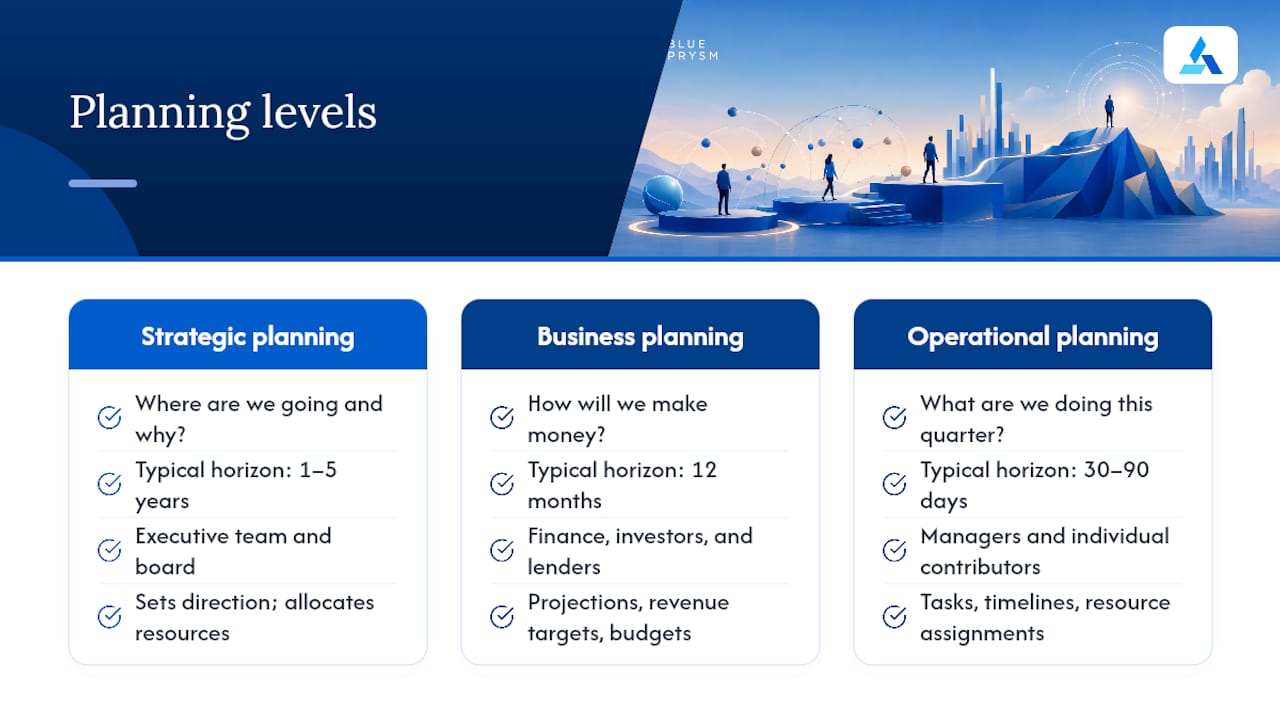
Business planning answers: How will we make money this year? It translates strategic direction into financial projections, revenue targets, and operational budgets. Typical horizon: twelve months. Primary audience: finance, investors, and lenders. A business plan is often a required document for funding; a strategic plan is an internal governance tool.
Operational planning answers: What are we doing this quarter? It breaks annual targets into specific tasks, timelines, and resource assignments at the team or department level. Typical horizon: thirty to ninety days. Primary audience: managers and individual contributors.
The relationship is hierarchical. Strategic planning sets the direction. Business planning translates it into financial terms. Operational planning executes it week by week. When the three are misaligned, you get teams working hard on the wrong things, which is one of the most common and most expensive organizational problems there is.
For SMB leaders who want a more operational companion to their strategic plan, the step-by-step business planning guide covers how to connect the two levels without creating redundant documentation.
The part of strategic planning most guides get wrong
Most strategic planning content focuses on the document. The mission statement, the SWOT grid, the five-year roadmap. That framing is backwards.
The document is not the point. The conversation that produces it is. When a leadership team sits down to build a strategic plan, they are forced to surface their assumptions about the market, their competitors, their own capabilities, and their customers. Those assumptions are almost never fully shared before the planning process begins. The plan forces them into the open, where they can be tested.
That is why MIT Sloan’s research frames the real value of planning as building a shared fact base. Teams that have gone through a rigorous planning process together respond faster and more coherently when the market shifts, because they already know what they collectively believe and where their assumptions are fragile.
The second thing most guides get wrong is treating planning as an annual event. The organizations that get the most out of strategic planning run it as a continuous learning cycle with quarterly check-ins, pre-defined decision triggers, and a willingness to revise assumptions when the evidence changes. A plan that cannot be updated is a liability, not an asset.
For SMB leaders, the practical implication is this: do not wait until you have a perfect process or a full strategy team. Start with a clear mission, three honest strategic objectives, and a monthly review date. The discipline of the process matters more than the sophistication of the framework.
Real-time market intelligence, without the research backlog
Knowing what strategic planning is and actually running one are two different problems. The research phase alone, competitive scans, market sizing, trend analysis, can consume weeks of leadership time that most SMB teams do not have.
Blue Prysm’s AI-powered market research tools compress that research cycle from weeks to hours. The platform runs automated competitive intelligence briefings, surfaces trend signals relevant to your market, and scores strategic hypotheses before your team walks into the planning session. You get the rigor of a consulting-grade analysis without the consulting-grade timeline or retainer.
The platform maps directly to the planning process covered in this guide:
- Situational analysis: Real-time market analysis and automated competitor tracking replace manual research.
- Framework selection: A library of 95+ strategy templates covers SWOT, OKRs, Balanced Scorecard, and more.
- Execution governance: OKR and KPI dashboards keep initiatives visible and owners accountable after the plan is published.
If you are ready to run a planning cycle that actually produces decisions, not just documents, see how Blue Prysm works or book a consulting engagement with the team.
Sources
- Why Is Strategic Planning Important? | HBS Online
- What is strategic planning? — IMD blog
- The real value of strategic planning — MIT Sloan Management Review
- Strategic Planning: Why It Makes a Difference, and How to Do It – PMC
- What is strategic planning? | Definition from TechTarget
FAQ
What is strategic planning in simple words?
Strategic planning is the process of deciding where your organization is going, why, and how you will get there. It sets direction, allocates resources, and gives your team a shared framework for making decisions.
What is the main purpose of a strategic plan?
The main purpose is alignment: making sure that every team, budget decision, and initiative points toward the same long-term goals. HBS Online frames it as creating a forward-focused vision that connects individual roles to organizational KPIs.
What are the core elements of a strategic plan?
A complete strategic plan includes a mission statement, vision statement, core values, situational analysis, strategic objectives, KPIs, initiatives with owners and budgets, and a governance and review cadence. Nine elements in total, each answering a different question about direction, execution, and accountability.
How long does a strategic planning cycle take?
A full planning cycle for a small to mid-sized organization typically runs four to twelve weeks, depending on the depth of environmental scanning and the number of stakeholders involved. Ongoing monitoring and quarterly reviews continue after the plan is published.
How is strategic planning different from operational planning?
Strategic planning sets long-horizon direction (one to five years) for executive teams. Operational planning translates that direction into specific tasks and timelines at the team level, typically covering thirty to ninety days. The two must be aligned, but they answer different questions at different levels of the organization.