


Every business leader has felt it: the pressure to be “data-driven” while drowning in dashboards, buzzwords, and vendor promises that never quite materialize into results. The problem isn’t data itself. It’s knowing which strategy examples are worth your attention and which are just expensive noise. Picking the wrong approach wastes budget, stalls momentum, and breeds cynicism inside your team. This guide cuts through that friction by mapping real-world, evidence-based strategy examples to the situations where they actually deliver ROI for small and medium-sized enterprises (SMEs).
Table of Contents
- How to evaluate a data-driven strategy: Decision criteria that matter
- Foundational data-driven strategy examples: Inventory, sales, and benchmarking
- Advanced data-driven strategy examples: AI enablement and real-time analytics
- When data-driven goes wrong: Pitfalls and how to avoid them
- Summary comparison: Which data-driven strategy fits your SME?
- Perspective: The uncomfortable truth about data-driven strategy for SMEs
- How Blue Prysm empowers data-driven businesses
- Frequently asked questions
Key Takeaways
| Point | Details |
|---|---|
| Start with SMART goals | Clear objectives and measurable outcomes keep data-driven strategies focused and effective. |
| Choose the right use case | Select practical strategies—like inventory optimization or sales forecasting—for the highest ROI in SMEs. |
| Balance data with judgment | Avoid common pitfalls by combining analytics with leadership context and thoughtful measurement. |
| Benchmark for perspective | Peer comparisons and KPIs reveal your real position and drive smarter decisions. |
| Adapt to your context | Customize strategies to match company size, resource levels, and growth objectives for best results. |
How to evaluate a data-driven strategy: Decision criteria that matter
With those challenges in mind, let’s set a framework for making the right choice.
Not all data strategies are created equal, and what works for a Fortune 500 company with a dedicated analytics division can fall flat inside a 50-person organization. Before you invest in tools, consultants, or data pipelines, you need clear criteria for evaluation.
Start with your business objectives. SMART goals and governance alignment are the foundation of any effective SME data strategy, connecting data initiatives directly to measurable KPIs rather than vague ambitions. A SMART goal (Specific, Measurable, Achievable, Relevant, Time-bound) forces you to define what success looks like before you collect a single data point. “We want better insights” is not a goal. “We want to reduce inventory carrying costs by 15% in Q3 by improving demand forecasting” is.
Next, assess your team’s data literacy. A sophisticated analytics platform is worthless if your managers can’t interpret the outputs or act on them. Many SMEs skip this step and end up with beautiful reports that nobody reads. Align your governance structure and your people’s capabilities with your strategic priorities before scaling up complexity.
Then watch for the traps. Common pitfalls include:
- Confusing correlation with causation. Just because two metrics move together does not mean one drives the other.
- Selection bias. If your data only reflects your existing customers, you’re making decisions blind to everyone who didn’t choose you.
- Measuring the wrong things. Optimizing for vanity metrics like page views or social followers while ignoring conversion rates or customer lifetime value is a fast road to nowhere.
The Harvard Kennedy School highlights that data decisions go wrong when leaders treat evidence as gospel or dismiss it without rigorous debate about its validity. Neither extreme serves you well.
Pro Tip: Before purchasing any analytics tool, write down three specific decisions you will make differently based on its outputs. If you can’t name them, you’re not ready for that tool.
Strong decision-making best practices and a foundational understanding of decision intelligence for SMEs will serve you better than any single platform.
Foundational data-driven strategy examples: Inventory, sales, and benchmarking
Armed with this criteria, let’s look at straightforward ways SMEs are actually applying data-driven strategies today.
The most accessible wins come from operational optimization. These aren’t glamorous, but they deliver fast, measurable returns with manageable complexity.
Inventory optimization is a strong starting point. Rather than ordering based on gut feel or historical averages alone, demand forecasting uses actual sales velocity, seasonal patterns, and lead time data to right-size stock levels. SME data strategies often start here, with use cases like inventory optimization and automated forecasting replacing static spreadsheet models. The practical result: less cash tied up in unsold stock, fewer emergency orders, and fewer stockouts that cost you customers.

Automated sales forecasting moves beyond the monthly spreadsheet ritual. Dynamic forecasting models ingest real-time sales data, pipeline stage conversions, and external signals like seasonality or market index shifts. The output gives sales leaders a rolling 90-day view of likely revenue, not just a point-in-time guess. That changes how you hire, how you price promotions, and how aggressively you pursue new deals.
Operational benchmarking is the most underutilized foundational strategy. Gartner’s benchmarking tools let businesses compare IT spend and staffing efficiency against industry peers, surfacing cost-optimization opportunities that internal teams often miss because they lack an external reference point. If you’re spending 8% of revenue on IT while your competitors spend 4%, that’s a strategic question worth answering.
Here’s a quick comparison of foundational options:
| Strategy | Primary benefit | Typical time to first results | Data required |
|---|---|---|---|
| Inventory optimization | Reduced carrying costs | 1 to 3 months | Sales history, lead times |
| Automated sales forecasting | Revenue visibility | 2 to 4 months | CRM data, pipeline records |
| Operational benchmarking | Cost efficiency gaps | Immediate (on setup) | Financial and HR records |
Pro Tip: Pair your own operational data with industry benchmarks. Internal data tells you what’s happening. Benchmarks tell you whether it’s acceptable. You need both to spot the blind spots you can’t see from the inside.
Building competitive battle cards with AI is a natural next step once you have your operational baseline locked in.
Advanced data-driven strategy examples: AI enablement and real-time analytics
Once foundational cases are in place, forward-thinking SMEs turn to advanced analytics for edge.
This is where the examples get more sophisticated, and where the risk of overclaiming results also increases. Let’s look at what the evidence actually shows.
Levi Strauss and AI-driven financial forecasting. The Levi Strauss case illustrates both the promise and the complexity of machine learning for financial prediction. AI models improved forecast accuracy compared to traditional methods, but the case also highlights that implementation and interpretation of AI outputs can be genuinely challenging. Getting the model to run is one problem. Getting your finance team to trust and act on it is a different one entirely.
P&G’s real-time analytics operating model. Procter and Gamble’s approach offers a structural lesson that translates well to SMEs thinking about analytics infrastructure. P&G embedded analysts directly within business units, providing direct access to live data and advanced analytics tools. The critical insight isn’t the technology. It’s the model: analytics capabilities positioned inside the teams making daily decisions, not siloed in a separate “data science” function that produces reports two weeks after the decision was already made.
McKinsey and Reckitt: Revenue growth management with AI. Reckitt partnered with McKinsey to implement AI-enabled tools for scenario analysis across pricing and promotion decisions. The result was faster iteration on commercial planning and better-tested assumptions before campaigns launched. For SMEs, the practical translation is using AI tools to stress-test your pricing strategy across three or four scenarios rather than committing to a single plan.
These advanced examples also come with a warning. More complexity demands more organizational readiness:
- Training time for teams to interpret and act on AI outputs
- Clear action plans for what happens when the model recommends something counterintuitive
- Ongoing calibration as market conditions shift
Connecting this work to clear AI strategies for advantage matters more than the tool selection itself.
When data-driven goes wrong: Pitfalls and how to avoid them
No approach is risk-free. Let’s highlight where things break down, so you can avoid preventable mistakes.
Data is not a strategy. It’s a resource. And like any resource, misuse is entirely possible.
“Decisions can go wrong when leaders treat evidence as gospel or dismiss it without rigorous discussions of validity.” — Harvard Kennedy School
Here are the top three failure patterns we see consistently:
-
Measurement and design flaws. The Hubble case study is instructive. When Hubble moved from digital to offline marketing channels, their existing attribution model broke completely. The lesson: “data-driven” requires maintaining your measurement design as your business model evolves, not just collecting more data into a broken system.
-
Local vs. global optimization. This is subtle but dangerous. You can optimize a single channel, product line, or department metric in ways that genuinely hurt overall business performance. Reducing customer service call volume sounds like efficiency until you realize it’s driving up churn. This failure pattern is common when teams optimize for what’s measurable rather than what matters strategically.
-
Delegating human judgment to the algorithm. The HBS BIG research on AI business advice tools found something sobering: an AI assistant designed to give entrepreneurs business advice did not improve outcomes on average and may have worsened performance gaps for low-performing entrepreneurs. AI without human context and judgment isn’t a shortcut. It’s a different kind of risk.
How do you protect against these failure modes? Design feedback loops intentionally. Set a review cadence where you question whether your metrics are still measuring the right things. Assign a “devil’s advocate” in strategic reviews whose job is to challenge the data interpretation, not just accept it. And critically, assess your competitive advantage independently of what your dashboards are telling you.
Summary comparison: Which data-driven strategy fits your SME?
With the pitfalls in view, it’s time to weigh options and decide which fits best for your business needs.
The Emirates Global Aluminium case is a useful anchor here. Their “digital factory” model delivered customized analytics use cases in quarterly waves, combining technology modernization with process discipline. The takeaway for SMEs: sequencing matters. You don’t build everything at once. You pick one wave, prove value, then expand.
Here’s how the major strategy types compare:
| Strategy type | Best for | Time to impact | Complexity | Cost range |
|---|---|---|---|---|
| Inventory optimization | Product-based businesses | 1 to 3 months | Low to medium | $ |
| Automated sales forecasting | B2B or recurring revenue | 2 to 4 months | Medium | $$ |
| AI-enabled financial modeling | Growth-stage, data-rich | 4 to 9 months | High | $$$ |
| Operational benchmarking | Any stage, any sector | Weeks | Low | $ |
| Real-time analytics operating model | Scaling businesses | 6 to 12 months | Very high | $$$$ |
Quick-match guidance for your context:
- Resource-constrained SME: Start with benchmarking, then inventory or sales forecasting. Prove ROI before adding complexity.
- Growth-stage with good CRM data: Automated forecasting delivers fast and measurable wins. Pair with AI scenario modeling once processes are stable.
- Competitive differentiation needed urgently: Real-time analytics embedded in decision-making teams, modeled after the P&G approach, offers the highest ceiling but demands organizational readiness.
- Pre-launch or testing a new market: Scenario analysis and AI-enabled planning tools reduce the cost of being wrong before you commit resources.
Explore how it works on the Blue Prysm platform to see how these strategy types map to specific tools available today.
Perspective: The uncomfortable truth about data-driven strategy for SMEs
Now, let’s step back for a candid, practical assessment based on deep hands-on experience.
Most SMEs that struggle with data-driven strategy aren’t failing because of bad tools or insufficient data. They’re failing because they copied the enterprise analytics playbook without the organizational infrastructure that makes it work at scale. A Fortune 100 company that embeds analysts in every business unit can do so because it has the headcount, the governance structure, and frankly the budget to absorb a few failed experiments. An SME with 30 employees and a lean leadership team does not have that margin for error.
Here’s what actually separates the SMEs that succeed from those that don’t: it’s almost never about the sophistication of the technology. It’s about whether leadership has defined a clear framework for acting on insights. Data tells you what happened. It does not tell you what to do next. That interpretation step, where you take a dashboard number and convert it into a specific operational decision, requires organizational context, people skills, and adaptive leadership that no algorithm can replicate.
The SMEs we see winning with data-driven strategy share a few consistent behaviors. They run short feedback loops, reviewing decisions against outcomes in weeks rather than quarters. They build psychological safety around being wrong, so teams don’t cherry-pick data to confirm existing beliefs. And they treat data as a challenge to their assumptions rather than a confirmation of them.
Pro Tip: Use data to question what you think you already know, not to validate what you’ve already decided. If every data review confirms your existing strategy, you’re probably not asking hard enough questions.
For a deeper foundation on decision intelligence for SMEs, the principles around adaptive leadership and structured decision reviews are worth your time.
How Blue Prysm empowers data-driven businesses
Ready to put these lessons to work? Blue Prysm offers practical solutions for each step of your data-driven journey.
Whether you’re validating a new market opportunity or monitoring competitors in real time, the platform gives SME leaders access to the kind of strategic intelligence that used to require an expensive consulting retainer.
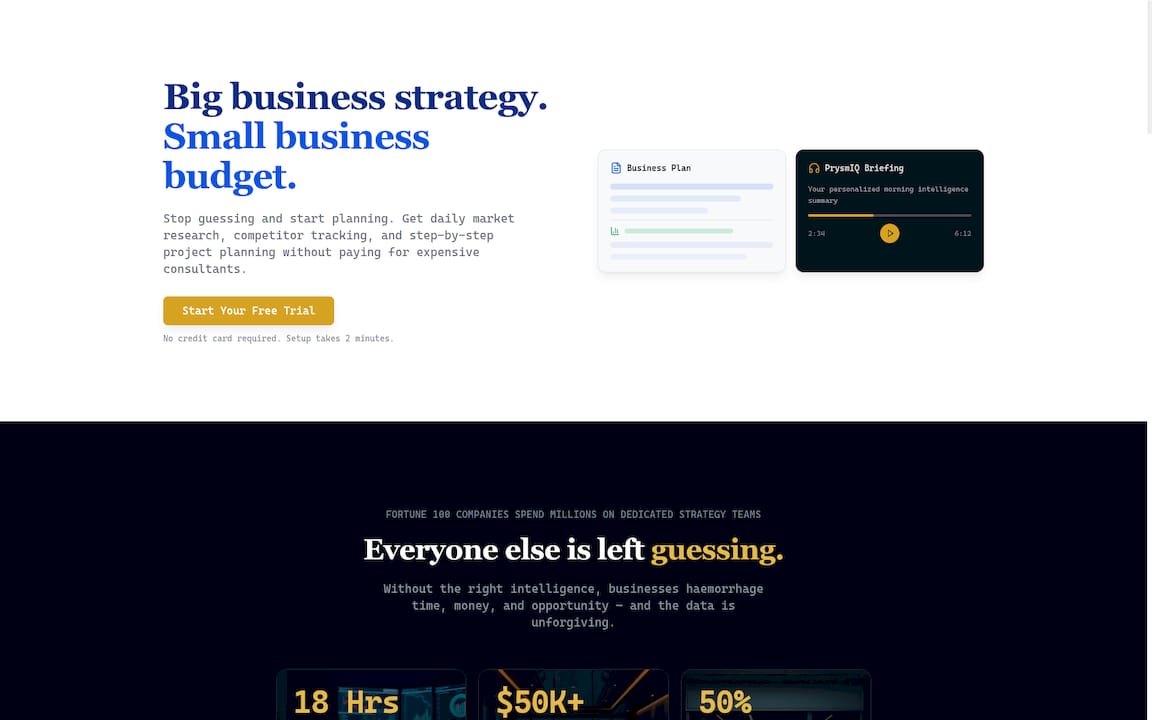
Start with the Venture Quick Score to rapidly test assumptions behind a new initiative before committing budget. Use the Puffery Detector to stress-test your own messaging and competitive claims against what the data actually supports. And explore how Blue Prysm works to see how daily market briefings, competitor monitoring, and AI-driven scenario planning integrate into a single intelligence workflow. These aren’t enterprise tools with enterprise price tags. They’re built for the decision-maker who needs actionable answers fast, without a six-week consulting engagement.
Frequently asked questions
What is a practical first step for building a data-driven strategy?
Define clear objectives and set SMART goals that align data initiatives with real business outcomes, as Gartner recommends for SME data governance and strategy mechanics.
How can SMEs measure the ROI of a data-driven strategy?
Benchmarking against industry peers and tracking operational KPIs before and after implementation are effective methods; Gartner’s benchmarking tools offer a structured starting point for IT spend and staffing comparisons.
What are common mistakes when implementing data-driven strategies?
Overreliance on data, neglecting measurement design, and failing to connect insights to business action are frequent missteps, and Harvard’s research confirms that treating evidence as gospel without validity checks is a leading cause of data-driven failures.
Can SMEs benefit from AI-based analytics or is it just for large enterprises?
AI tools can bring real benefits to SMEs, but they require careful implementation and continuous human interpretation; the Levi Strauss AI forecasting case shows accuracy gains are achievable while also demonstrating that interpretation challenges are real and must be planned for.