


AI business planning means using AI to run continuous market analysis, competitor tracking, scenario modeling, and roadmap execution for small and mid-sized companies. It’s not the same as an auto-generated business plan document. The recommendation is simple: pick one high-leverage use case, run a 60 to 90 day pilot, and capture the reasoning behind every decision as you go.
Before you sign anything or spin up a task force, three things matter more than the platform you choose:
- Scope the pilot narrowly. One workflow, not five.
- Measure time-to-decision and forecast accuracy from day one.
- Save your “Decision Memory,” the record of what you considered and why, so cycle two starts smarter than cycle one.
Blue Prysm is one provider built around this staged approach, but the sequence above applies whether you build it yourself or hire it out.
Key Takeaways
AI business planning works when SMBs treat it as a staged pilot with measured KPIs and captured decision rationale, not a one-time software purchase.
| Point | Details |
|---|---|
| Define scope narrowly | AI business planning here means continuous market analysis, scenario modeling, and roadmap execution, not auto-generated plan documents. |
| Start with one pilot | Choose two to three repeatable, customer-facing or internal use cases and run them for 60 to 90 days. |
| Measure from day one | Track time-to-decision, forecast accuracy, and initiative completion rate before scaling anything. |
| Avoid tool sprawl | Standardize on one default platform and enforce measurement discipline across teams. |
| Evaluate a vendor pilot | Blue Prysm offers real-time market insights, competitor tracking, and 50+ strategy frameworks for teams ready to pilot a vendor-led approach. |
Why AI-Powered Business Planning Matters for SMBs
Strategy work at a small company usually happens in the gaps between everything else. Someone stays late building a competitive slide deck. Someone else guesses at market sizing because nobody has three weeks for a proper study. AI-powered planning closes that gap by doing the grunt work of research and synthesis in hours instead of weeks, and by keeping the resulting analysis at hand for the next decision instead of buried in a slide deck nobody reopens.
The upside shows up in a few concrete places. Strategic decision support systems improve forecasting and responsiveness in SMEs, which lets managers plan past pure survival mode and start making calls based on where the market is heading, not just where it’s been.
- Speed: executive-ready briefs in hours, not weeks, because AI-generated strategic briefs can cut preparation cycles dramatically when grounded in real internal data.
- Coverage: more scenarios tested before a decision gets made, not fewer.
- Repeatability: decision memory means the next planning cycle doesn’t start from a blank page.
- P&L impact: faster, better-aligned roadmaps translate into fewer wasted quarters chasing the wrong priority.
None of this replaces judgment. It just means the judgment gets applied to better information, faster.
What Are the Core Components of an AI Business-Planning System?
A real system, not a chatbot with a strategy template bolted on, needs six working parts. Skip one and the whole thing quietly degrades into another dashboard nobody opens.
- Continuous market and competitive intelligence. Pricing changes, hiring signals, and product launches tracked automatically, not manually checked once a quarter.
- A populated framework library. SWOT, Porter’s Five Forces, and OKR cascades pre-filled from your own data, not blank templates you fill in from memory.
- A scenario-modeling engine. The ability to run multiple “what if” branches and stress-test the optimistic case against a genuinely pessimistic one.
- Data integrations. Financials, CRM, and analytics feeding the system directly, so recommendations are grounded in what’s actually happening in the business.
- Execution dashboards. Initiatives tied to owners, milestones, and KPIs, visible to the whole team, not just the person who built the plan.
- Decision Memory. A record of what was decided, what was rejected, and why, that compounds in value across every planning cycle.
Tools like Jeda illustrate the category well: upload your data and get a populated strategy map back instead of an empty canvas. The mechanism varies by vendor; the requirement doesn’t.
Pro Tip: Don’t let your framework library become a graveyard of half-filled SWOT documents. Populate one framework fully, act on it, then expand. A living document beats ten static ones.
How Do You Implement AI Business Planning Step by Step?
Most SMBs get this backward. They buy an enterprise-grade platform, roll it out to every department at once, and wonder why adoption stalls in month two. The better sequence starts small and expands only after the numbers justify it.
- Pick two to three pilot use cases. Favor repeatable, customer-facing workflows and internal automations over ambitious new-product bets. This sequencing, moving from operational leverage toward decision-support only after early wins, is what operational-leverage frameworks for SMBs recommend, and for good reason: it builds credibility with skeptical stakeholders before you ask them to trust AI with bigger calls.
- Connect the minimum viable data set. You don’t need every system integrated on day one. Financials, your CRM, and whatever analytics tool tracks customer behavior usually covers a first pilot.
- Run the pilot for 60 to 90 days with hard KPIs. Track time-to-decision, forecast accuracy against actuals, and whichever revenue or retention metric the use case touches directly.
- Capture Decision Memory and hold governance reviews. Document what the AI recommended, what leadership chose instead (if anything), and why. Review monthly, not just at the end.
- Scale once KPIs clear the bar. Move into decision-support use cases and start building a living strategic roadmap that updates as market conditions shift, rather than a static annual plan.
A few things worth having in place before you start:
- A named owner for the pilot who isn’t also running three other projects.
- A shared doc or dashboard where Decision Memory actually lives, not someone’s inbox.
- Agreement upfront on what “success” looks like numerically, before results start coming in and everyone reinterprets the goalposts.
Pro Tip: Resist the urge to pilot your most complicated, highest-stakes decision first. Save that for cycle two, once the team trusts the process and you’ve worked out the kinks on something lower-risk.
Governance, Measurement, and Common Pitfalls
The pilot is the easy part. Sustaining value past month four is where most AI planning efforts quietly die. Three failure modes show up constantly, and all three are avoidable.
Tool sprawl kills more initiatives than bad AI output does. One team adopts a scenario tool, another buys a separate competitive-intelligence subscription, and within a year nobody can say which system holds the “real” numbers. Pick one default platform for core planning work and enforce that discipline.
Analysis paralysis is the opposite failure: running scenario after scenario without ever committing to a call. Cap it. Three to five scenarios per decision, a hard deadline, and one dissenting “risk guardian” review built into the process to pressure-test the favored option before it ships.
Under-measurement is the quiet killer. Define success before you start, not after:
- Time-to-decision, measured cycle over cycle.
- Forecast accuracy against what actually happened.
- Initiative completion rate on the roadmap.
- ROI per pilot, in dollars or hours saved.
SMBs face real resource and capability constraints that make lean, implementation-focused planning outperform heavyweight processes almost every time. A fractional Chief AI Officer or a designated internal owner, paired with quarterly training and a fixed review cadence, tends to beat a big-bang enterprise rollout with no clear owner at all.
What Does AI Business Planning Cost for a Small Company?
Budgets here break into three rough categories, and mixing them up is how companies overspend without noticing. SaaS subscriptions for AI planning platforms typically scale with team size or feature tier, running from a few hundred dollars a month for a small team on core market-intelligence and dashboard features, up to enterprise pricing once you add advanced scenario modeling, deeper integrations, and dedicated support.
Consulting engagements, sold as project-based work rather than a subscription, cost more upfront but come with implementation help: getting your data connected, your frameworks populated, and your team trained on the workflow. This route makes sense for companies that don’t have the internal bandwidth to configure a platform themselves.
Training programs are the third bucket, often underbudgeted. A tool is only as good as the team’s ability to use it well, and skipping training is how expensive software turns into shelfware within two quarters.
The real budgeting mistake isn’t picking the wrong tier. It’s failing to budget for the pilot at all, treating AI planning like a discretionary experiment instead of a real line item with a defined 60 to 90 day cost and a measurable return attached to it. Set that number before you start, and compare it against the time-to-decision and forecast accuracy gains you’re tracking from the implementation steps above.
Is My Company’s Data Safe With an AI Planning Platform?
Feeding your financials, customer data, and competitive positioning into any third-party platform is a real question, not a formality to skip past. A few things are worth checking before you connect anything.
Ask where your data lives and whether it’s used to train models that other customers might later query. Reputable platforms keep customer data isolated and don’t repurpose it for general model training without explicit permission. Ask about access controls: who on your team can see what, and can you restrict sensitive financial data to a smaller group than the whole strategy team.
Encryption in transit and at rest should be table stakes, not a premium feature. So should a clear data retention policy: what happens to your information if you cancel the subscription. Get this in writing before signing, not after.
The practical middle ground most SMBs land on: start the pilot with less sensitive data (market intelligence, competitor tracking, public-facing metrics) and expand to financials and CRM data only once you’ve validated the platform’s security posture and your team’s comfort with it. That staged trust-building mirrors the staged pilot approach itself. Neither should happen all at once.
Comparing AI Planning Approaches for SMBs
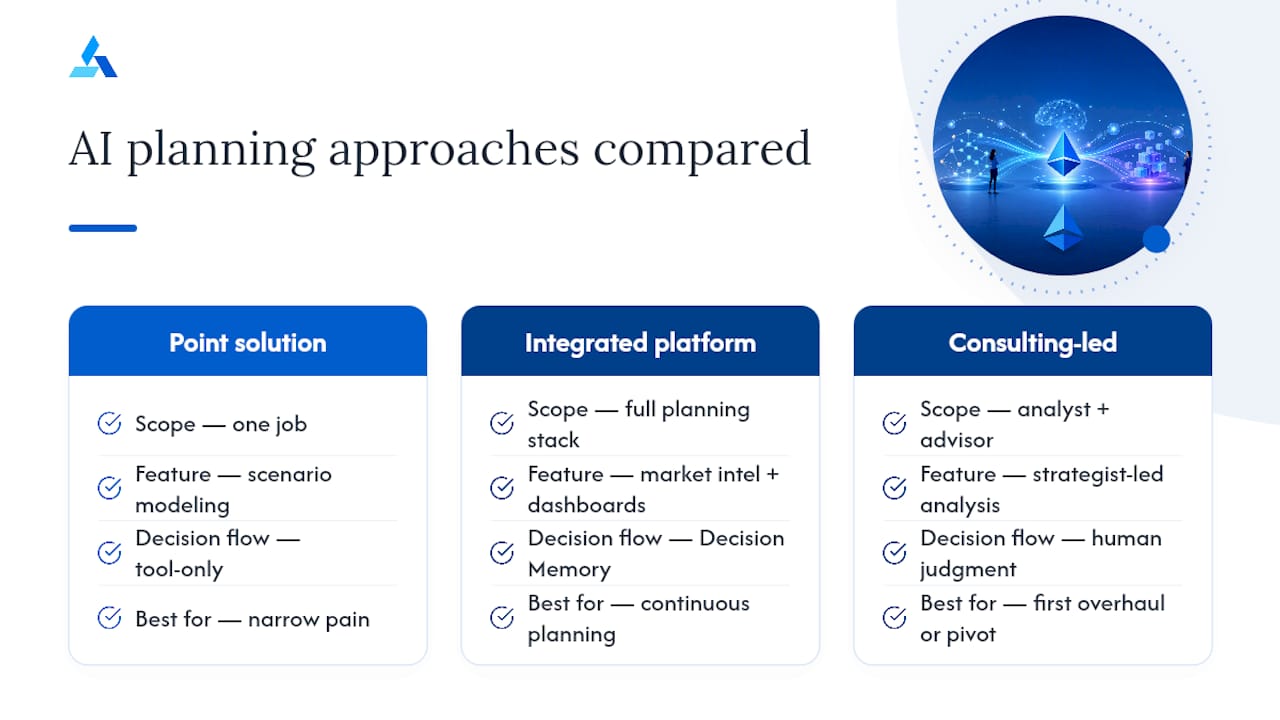
Three broad approaches exist, and picking the wrong one for your stage is a common, expensive mistake. Understanding the category, not the vendor list, helps you buy correctly.
Point-solution tools handle one job well: scenario modeling, or competitive tracking, or OKR cascades, but not all three. These suit companies with a narrow, well-defined pain point and no appetite for a bigger platform commitment yet.
Integrated planning platforms combine market intelligence, framework libraries, scenario modeling, and execution dashboards in one system, with Decision Memory carrying context across cycles. This suits companies ready to make planning a continuous discipline rather than a quarterly scramble, which is the model Blue Prysm and similar integrated platforms are built around.
Consulting-led engagements bring human strategists using AI tools as an input to their own process, rather than handing the analysis fully to software. This fits companies that want expert judgment layered on top of AI-generated groundwork, particularly for a first strategic overhaul or a high-stakes pivot.
None of these is universally correct. A five-person startup validating its first market doesn’t need the same setup as a 40-person company managing three product lines. Match the approach to how often you actually revisit strategy, not to what looks most impressive in a vendor deck.
What I’ve Learned Watching SMBs Adopt AI Planning
Start with the customer-facing workflow, not the flashy internal dashboard. Teams trust AI recommendations faster when they can see the output land somewhere real, a competitor brief that actually changes a pricing call, rather than an internal report that sits in a folder.
Decision Memory is the underrated piece. Most leaders focus on the first analysis and ignore that the second, third, and tenth planning cycle get dramatically faster once the system remembers what you already ruled out and why.
Expect trade-offs. Faster analysis and broader scenario coverage sometimes come at the cost of a governance step you’re tempted to skip. Don’t skip it. The companies that get burned by AI planning usually got burned by trusting a first output uncritically, not by the technology itself.
How Blue Prysm Fits Into Your Planning Pilot
Blue Prysm is built for exactly the staged approach this article recommends: start narrow, measure hard, expand once the numbers hold up. The platform runs real-time market analysis and automated competitor tracking so your team isn’t manually refreshing spreadsheets, backed by a library of more than 50 populated strategy frameworks you can adapt instead of building from a blank page.

A pilot with Blue Prysm typically looks like the sequence outlined above: one or two use cases, a connected data source or two, and a 60 to 90 day window with clear KPIs around time-to-decision and forecast accuracy. Execution dashboards keep the resulting roadmap visible to your whole team, not locked in one person’s head, and the platform’s Decision Memory carries context forward so your second planning cycle starts ahead of where the first one ended.
If you’re evaluating whether AI-powered planning fits your company at all, the strategy framework library is a low-friction place to look first. When you’re ready to see the market intelligence and competitor tracking in action against your own industry, request a demo of the market research tools and scope a pilot around the use case that matters most right now.
Sources
For deeper background on the research behind this approach: SME strategic planning outcomes are covered in Dream Journal’s analysis of decision support systems, and implementation constraints specific to small businesses appear in this empirical study on planning stumbling blocks. For a closer look at Blue Prysm’s approach to competitive tracking, see the competitive intelligence software overview.
- Strategic planning and decision support for SMEs (Dream Journal)
- Stumbling blocks to strategic planning implementation among small businesses
- AI strategy for SMBs: Operational leverage
FAQ
What Is AI Business Planning?
AI business planning is the use of AI tools for continuous market analysis, competitor tracking, scenario modeling, and roadmap execution at small and mid-sized companies. It’s distinct from AI tools that auto-generate business plan documents from a prompt.
How Long Should an AI Planning Pilot Run?
A focused pilot should run 60 to 90 days on two to three use cases, with hard KPIs around time-to-decision and forecast accuracy tracked from the start.
What Is Decision Memory in AI Strategic Planning?
Decision Memory is the captured record of what a team considered, decided, and rejected during planning, so the reasoning carries forward into future cycles instead of getting rebuilt from scratch each time.
How Much Does AI Business Planning Cost?
Costs vary by delivery model: SaaS subscriptions typically scale with team size and features, consulting engagements are priced per project, and training programs add a separate line item that’s easy to underbudget.
Does Blue Prysm Offer Strategic Planning Tools for Small Businesses?
Yes. Blue Prysm provides real-time market analysis, automated competitor tracking, a library of 50+ strategy frameworks, and execution dashboards built for staged, pilot-first adoption by SMB teams.