


BLUF: Use a five-step, human-supervised AI workflow—define, gather, analyze, surface, and monitor—to make AI competitive analysis decision-grade instead of guesswork dressed up in bullet points. The workflow only earns trust if you pair it with a fact-check discipline: every claim needs a source URL, and every number gets verified before it reaches a decision-maker.
Here’s your next 90 minutes. Pick one competitor. Run a single structured prompt asking for their pricing, positioning, and one recent product move, and demand a citable URL for each fact the model returns. If the AI can’t produce a source, treat the claim as [UNVERIFIED] and move on.
- A well-run AI competitive analysis can shrink a single-competitor SWOT from hours to minutes, according to AI Competitive Analysis: Tools and Frameworks.
- Treat the model like a junior analyst using the Model Context Protocol principle: fast on routine tasks, unreliable on judgment.
- Blue Prysm builds this exact discipline into its competitive intelligence software, so the workflow below isn’t theoretical.
Key Takeaways
AI competitive analysis works when a five-step human-supervised workflow, define, gather, analyze, surface, monitor, is paired with a mandatory source-for-every-claim fact-check log.
| Point | Details |
|---|---|
| Use the 5-step framework | Define goals, gather signals, analyze with a stable prompt, surface decision-ready insights, then monitor and automate. |
| Fact-check every number | Log each claim with its source URL and flag anything unsourced as [UNVERIFIED] before it reaches leadership. |
| Size your competitor set | Track three direct competitors closely and five adjacent players lightly to keep the fact-check discipline sustainable. |
| Combine tool categories | Pair continuous monitoring platforms with LLM synthesis and automation connectors rather than relying on one tool alone. |
| Blue Prysm automates the routine steps | Its platform handles competitor tracking, templated briefs, and a strategy library while leaving synthesis to your team. |
What Is the 5-Step AI Competitive Analysis Framework?
Most teams skip straight to “ask ChatGPT about our competitors” and wonder why the output feels generic. The fix is structure. Here’s the sequence that turns scattered AI queries into something you can actually act on.
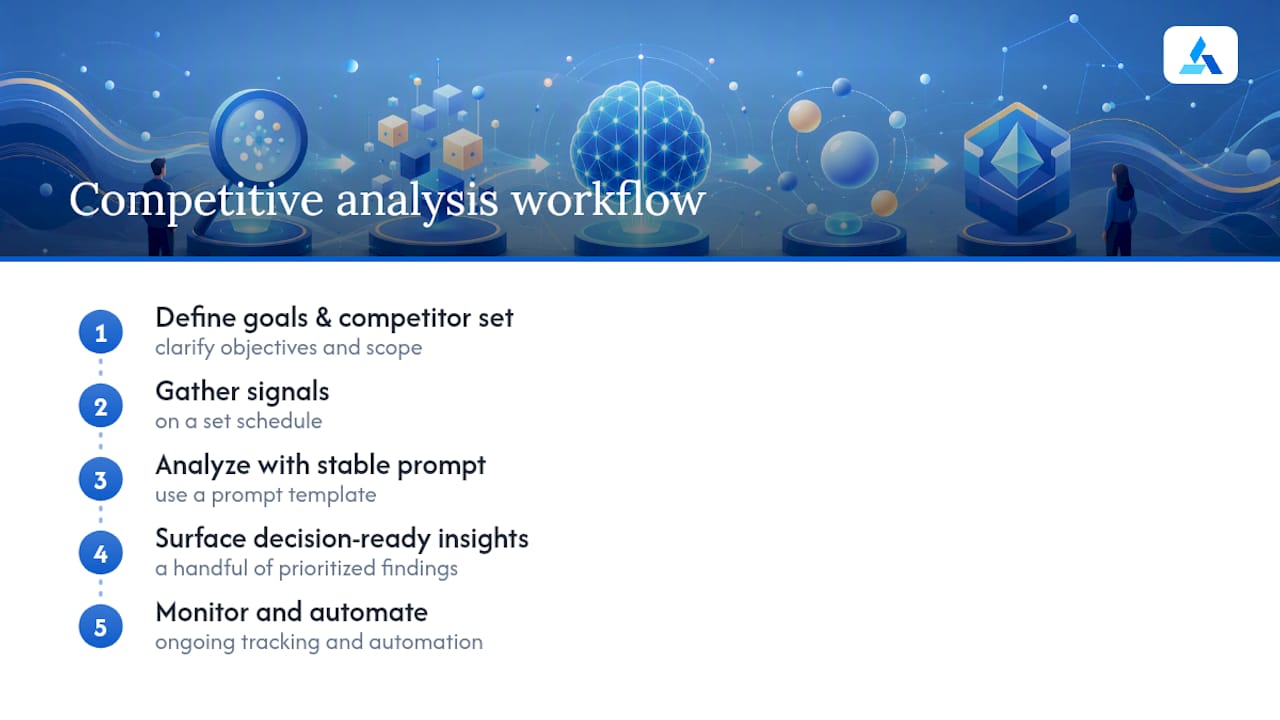
- Define. Name the decision this analysis feeds, a pricing change, a positioning pivot, a board update, and pick your competitor set. Use a “primary three, watch list five” split: track three direct competitors closely and five adjacent players lightly, a ratio recommended in AI Competitive Analysis: Tools and Frameworks. Lock in comparison dimensions, pricing tiers, messaging, feature releases, so every competitor gets scored the same way.
- Gather. Assign a source and cadence to each signal: pricing pages weekly, job postings biweekly (hiring data is a genuine leading indicator of product direction), press and funding news daily, and social/ad activity weekly.
- Analyze. Feed the gathered signals into an LLM using one stable prompt template, not a fresh, improvised question each time. A reusable structured prompt keeps outputs comparable across competitors and across months, which matters more than most marketers realize until they try to compare a March report against a June one written with a different prompt.
- Surface. Convert raw synthesis into three or four decision-ready insights, not a ten-page dump. If a finding doesn’t change what your team does next week, it doesn’t belong in the brief.
- Monitor & automate. Set alerts for pricing changes, new job listings, and messaging shifts. Automate the collection; keep a human reviewing anything that touches strategy.
Pro Tip: Save every AI output as a dated file, not a chat thread. Chat sessions vanish into scroll history. A dated file becomes a comparable asset you can reference six months later.
Which Tools Handle Each Step of the Workflow?
No single tool covers the whole framework, and vendors that claim otherwise are usually overstating one strength to hide a gap elsewhere. You’re really choosing from four categories, and most working setups combine at least two.
- Continuous CI platforms handle always-on monitoring so nobody has to remember to re-check a pricing page every Monday.
- LLM synthesis tools (ChatGPT, Claude, or a platform’s built-in AI) turn raw signals into a readable brief.
- Automation connectors like n8n stitch scraping, LLM calls, and alerts into one pipeline, and recent versions added native LLM nodes that cut setup time significantly, per AI Competitive Analysis: Tools and Frameworks.
- Ad-hoc research engines and primary sources, job boards, ad transparency centers, patent filings, fill gaps the other three miss.
Two recipes worth stealing:
| Recipe | What It Does |
|---|---|
| Nightly scrape to digest | An automation connector scrapes competitor pages nightly, an LLM writes a two-paragraph digest, and it lands in a team Slack channel by 8 AM. |
| Paste-based teardown | For a deep dive, paste raw competitor content directly into an LLM chat with your structured prompt for a one-off, thorough analysis. |
A non-engineer can run the paste-based teardown and manage most CI platform dashboards without help. Automation pipelines connecting scrapers, LLMs, and Slack alerts usually need a developer, at least for the initial build. The most common integration pitfall is scraper drift: a competitor redesigns their pricing page, and your automation quietly starts returning blank fields. Check pipeline output weekly, not just when something looks obviously broken.
Purpose-built platforms bundle monitoring with source attribution baked in, which cuts down the manual verification work that ad-hoc chat workflows leave entirely on you, according to Competely’s guide to AI-driven competitive analysis.
How Do You Stop AI From Hallucinating Competitor Data?
Here’s the uncomfortable truth: AI models are confident even when they’re wrong, and funding figures, ARR estimates, and headcount numbers are exactly the kind of specific, checkable facts they tend to fabricate with total conviction.
The fix is procedural, not aspirational. Require a source URL for every factual claim and every number before it enters a brief, a discipline laid out clearly in advice on fact-checking AI outputs. Build a simple fact-check log: one row per claim, logging the claim, source URL, date checked, and a status flag.
- Green: sourced, verified, ready to distribute.
- Amber: sourced but from a secondary outlet, spot-check before citing externally.
- Red: no source provided, mark [UNVERIFIED] and exclude from any executive-facing document.
Assign one person to own numeric spot-checks, pricing, funding rounds, ARR claims, headcount, against the primary source, not the AI’s memory. No brief reaches leadership without a human synthesis signoff.
The hallucination risk is real and specific: the most common failure mode isn’t vague generalities, it’s confidently wrong numbers presented with false precision, which is why the fact-check log maps every claim back to a primary source line rather than trusting model recall.

What’s a Realistic One-Week Rollout Plan?
You don’t need a quarter-long rollout to start getting value. Here’s a plan that fits inside a normal work week.
- Day 1 (30 minutes): Pick a small set of direct competitors and a few signal types (pricing, hiring, messaging).
- Day 2 (90 minutes): Run your structured prompt against all three competitors and log every claim in your fact-check sheet.
- Day 3 (60 minutes): Set up one automation, even a manual weekly calendar reminder counts if you’re not ready for n8n.
- Day 4 (45 minutes): Draft the first synthesized brief from verified claims only.
- Day 5 (30 minutes): Hold the first human synthesis meeting. Marketing owns messaging signals, product owns feature signals, and one analyst (or founder) owns the fact-check log.
Pro Tip: Resist the urge to add a tenth competitor in week two. Depth on three beats shallow coverage on ten every time, and a smaller set is the only reason the fact-check discipline stays sustainable.
How Blue Prysm Puts This Framework Into Practice
Blue Prysm’s platform was built around the exact five-step sequence outlined above, not retrofitted to match a trend. Real-time market insights replace the manual pricing-page checks, competitor tracking automates the gather step, and a 95+ template strategy library gives your analyze step a consistent structure instead of a blank prompt box every time.
- Automated competitive intelligence briefings can handle the surface step without manual write-ups each cycle.
- Execution dashboards help keep the monitor step visible instead of it being buried in someone’s inbox.
- The strategy library standardizes comparison dimensions across competitors automatically.
None of this replaces the human synthesis meeting. Automation handles the routine 80%, per the Model Context Protocol principle that AI is a force multiplier, not a strategist.
Coverage and automation matter less than the human synthesis discussion after the brief lands. A dashboard that nobody discusses is just an expensive screensaver.
What Marketers Get Wrong About AI Competitive Analysis
Here’s my honest read after working through this material: the popular advice on AI competitive analysis is obsessed with the wrong bottleneck. Most guides spend paragraphs explaining which model to use, GPT versus Claude versus whatever launches next quarter, when the real failure point is almost always process, not model choice.
Run “the puffery detector” on your own team’s competitive briefs sometime. How many claims in your last report had a source URL attached versus how many were the AI’s confident paraphrase of something it half-remembered? Most teams would fail that test badly, and that’s the actual risk, not which chatbot you picked.
The conventional wisdom treats automation as the finish line. It isn’t. Automation is the floor, not the ceiling. What separates a useful competitive brief from an expensive PDF nobody reads is the discipline of the fact-check log and a synthesis meeting where a human says “so what does this mean for us.” Prioritize that meeting before you prioritize your tool stack. Get the habit right first, then let the tools handle the grunt work.
Ready to Automate the Grunt Work of Competitor Tracking?
Running this five-step framework by hand, manual page checks, copy-pasting into chat windows, rebuilding the same prompt from memory every month, is exactly the kind of operational drag that eats a strategy team’s week. Blue Prysm replaces that manual grind with automated tracking, so the gather and monitor steps happen without someone remembering to log in and check.
The platform pairs real-time market insights with a competitor tracking system that feeds directly into templated strategic briefs, so the analyze and surface steps stop starting from a blank page every cycle. When you’re evaluating any competitive intelligence platform, including this one, check for four things: source transparency on every claim, alert cadence that matches how fast your market actually moves, a human-in-the-loop review step before anything reaches leadership, and coverage that fits your actual competitor set rather than a generic industry list.
See how the market analysis platform handles the monitoring and synthesis steps together, or start with the strategy library preview to see the template structure your analyze step has been missing.
Sources
- Fact-check your AI coworker to avoid hallucinations
- Model context protocol (Anthropic)
- How to Use AI for Competitive Analysis to Drive B2B Growth (CXL)
FAQ
Which AI Tool Is Best for Competitor Analysis?
No single tool covers the whole job. Most effective setups pair a continuous monitoring platform, like Blue Prysm’s competitive intelligence software, with an LLM for synthesis and an automation connector for alerts.

How Do You Use ChatGPT for Competitor Analysis?
Feed it a consistent structured prompt for every competitor, ask it to name a source URL for each factual claim, and save the dated output as a durable file rather than leaving it in a chat thread.
What Are the 5 Steps of a Competitive Analysis?
Define your goals and competitor set, gather signals on a set schedule, analyze them with a stable prompt template, surface a handful of decision-ready insights, and monitor and automate ongoing tracking.
Can ChatGPT Do Market Research?
ChatGPT can accelerate routine research tasks like summarizing competitor pages or drafting a SWOT outline, but it needs human verification for numeric claims and human judgment for strategic conclusions.
How Do You Prevent AI From Making Up Competitor Statistics?
Require a citable source for every number and log each claim in a fact-check sheet marked green, amber, or red before it reaches any executive-facing brief.