


Missed threats don’t just create security incidents. They derail product launches, poison investor confidence, and hand competitors the openings they’ve been waiting for. For small and mid-sized businesses, the gap between knowing a threat exists and knowing what to do about it is where real strategic damage happens. Most SMEs (small and medium-sized enterprises) rely on gut feeling or reactive patching instead of structured, repeatable workflows. This guide walks through a practical, AI-powered threat analysis workflow that turns raw threat data into decisions leadership can actually act on.
Table of Contents
- Understand prerequisites: Aligning objectives, assets, and risk appetite
- Step-by-step workflow: Threat enumeration to risk prioritization
- Integrate AI and threat intelligence for efficiency
- Verification and iterative improvement: Validating outcomes and closing gaps
- Common mistakes and troubleshooting: SME realities
- What most threat analysis guides miss: Operational impact and business context
- AI-powered workflows and tools for actionable threat analysis
- Frequently asked questions
Key Takeaways
| Point | Details |
|---|---|
| Start with business alignment | Align business goals, asset scope, and risk appetite before threat enumeration. |
| Follow a stepwise approach | Enumerate threats, model attack paths, map vulnerabilities and controls, then prioritize risks. |
| Leverage AI and CTI | Integrate AI-driven detection and contextual threat intelligence for increased efficiency and speed. |
| Verify real-world effectiveness | Use MITRE ATT&CK mapping and iterative testing to ensure your workflow covers actual threats. |
| Avoid common SME mistakes | Don’t over-automate or rely on theoretical models; measure real outcomes and expand iteratively. |
Understand prerequisites: Aligning objectives, assets, and risk appetite
Now that the rationale is clear, let’s lay the foundation for a reliable and scalable workflow.
Before you enumerate a single threat, you need to know what you’re protecting and why it matters. This sounds obvious. Surprisingly few organizations do it well. A practical threat modeling approach requires aligning business objectives, asset scope, and risk appetite before anything else. Without that alignment, you end up with a threat list that’s technically thorough but strategically irrelevant.
Start by answering three foundational questions:
- What are your top business objectives this year? Revenue growth, market expansion, regulatory compliance? Each objective attracts different threat profiles.
- What are your critical assets? Customer data, IP, operational systems, supplier relationships? Not everything needs the same protection level.
- What’s your risk tolerance? Some organizations can absorb short-term downtime. Others can’t survive a 48-hour outage. Your tolerance shapes how aggressively you prioritize.
Strong decision-making best practices reinforce the same principle: decisions made without clear context produce results that look right on paper but fail in the field. The same trap applies to threat modeling.
Prerequisite checklist comparison table:
| Prerequisite element | Why it matters | Common mistake |
|---|---|---|
| Business objectives | Focuses threat scope | Listing threats without purpose |
| Asset inventory | Defines what needs protection | Protecting everything equally |
| Risk appetite statement | Guides prioritization | Treating all risks as critical |
| Stakeholder roles | Ensures clear ownership | No one owns remediation |
| Information flow map | Exposes attack surfaces | Missing third-party exposures |
Stakeholder roles matter more than people realize. If your IT lead owns detection but your COO owns the asset, those two people need to be talking regularly. Define the handoffs before the workflow runs, not during an incident.
Pro Tip: Don’t rush the asset enumeration phase. Teams that skip this step spend twice as long later filtering out irrelevant threats. One hour of structured scoping saves ten hours of noise.
Better yet, use this phase to connect your threat model to business strategy. Your decision intelligence for SMEs approach should inform which assets are existentially critical versus merely inconvenient to lose. That distinction changes everything downstream.
Step-by-step workflow: Threat enumeration to risk prioritization
Once prerequisites are set, you can confidently follow these steps to operationalize your workflow.
The mechanics of a solid threat analysis workflow follow a clear, repeatable pattern. One proven structure moves from business scope through residual risk: scope definition, threat enumeration, attack modeling, vulnerability mapping, and risk prioritization. Each step builds on the last. Skip one and the chain breaks.
Here’s how to execute each phase:
- Define scope. Confirm which systems, data flows, and business processes are in play. Limit your first iteration to your highest-value asset cluster.
- Enumerate threats. List plausible threats relevant to each asset. Use established libraries like STRIDE (Spoofing, Tampering, Repudiation, Information disclosure, Denial of service, Elevation of privilege) to structure your thinking.
- Build attack trees. For your top three threats, visualize attacker paths using a tree structure. Root node is the attacker goal; branches are steps to reach it. This surfaces non-obvious paths.
- Map to vulnerabilities and controls. For each attack path, identify which existing vulnerabilities it exploits and which controls (technical or procedural) already block or reduce it.
- Score and prioritize using a likelihood x impact matrix. Likelihood runs from rare to almost certain. Impact runs from negligible to catastrophic. Plot each threat. The upper-right quadrant gets your immediate attention.
- Document residual risk. After applying controls, what risk remains? That residual risk is what leadership needs to accept, transfer, or address with additional investment.
| Workflow step | Output | Typical time investment |
|---|---|---|
| Scope definition | Asset and boundary list | 2 to 4 hours |
| Threat enumeration | Threat register | 3 to 6 hours |
| Attack tree modeling | Visual attack maps | 4 to 8 hours |
| Vulnerability mapping | Control gap list | 3 to 5 hours |
| Likelihood x impact scoring | Prioritized risk list | 2 to 3 hours |
| Residual risk documentation | Leadership risk report | 1 to 2 hours |
When you assess competitive advantage through this lens, something interesting happens. Threats to your competitive position, like IP theft or supplier disruption, start appearing in the same workflow as cybersecurity threats. That’s intentional. Business threats and cyber threats share the same root: exposure.
Pro Tip: Limit your first threat modeling sprint to two or three high-probability attack paths. Full-scope modeling is valuable eventually, but starting narrow builds operational muscle and produces faster wins. See how the workflow works in practice before expanding scope.
Integrate AI and threat intelligence for efficiency
With your workflow defined and operational, it’s critical to leverage AI and threat intelligence for maximum efficiency.

Manual threat analysis doesn’t scale. A lean SME team simply cannot process the volume of threat signals generated by modern business environments. This is where AI and Cyber Threat Intelligence (CTI) platforms shift the equation. The key efficiency gain comes from operationalizing CTI by integrating it directly into existing security tooling and decision points, including automated detection and prevention updates.
What does that look like practically? Consider these integration patterns:
- Feed CTI into your SIEM (Security Information and Event Management). Real-time threat intelligence updates detection rules without analyst intervention.
- Automate indicator-of-compromise (IOC) blocking. Known malicious IPs, domains, and file hashes get blocked automatically, freeing analysts to focus on novel threats.
- Use AI to correlate low-signal events. Individual log entries look harmless. AI finds the pattern across thousands of events that a human analyst would miss after hour six of a shift.
- Apply confidence scoring to every AI decision. Not all AI outputs deserve equal trust. Route high-confidence detections to automated response. Route low-confidence or novel cases to human review.
That last point is not optional. AI-driven SOC governance is explicit: decisioning requires confidence thresholds, with low-confidence or novel cases routed to analysts rather than automated away.
“High-confidence AI decisions proceed. Novel cases require human review.” This isn’t a limitation of AI. It’s smart governance that protects against the specific failure mode SMEs can least afford: a false negative on a novel attack that the system silently ignored.
SMEs that have implemented AI-enabled threat workflows have seen up to 50% faster threat intelligence integration and measurably fewer false positives compared to purely manual approaches. That means less analyst burnout and faster mean-time-to-detect (MTTD), which is the time between a threat entering your environment and your team knowing about it.
Explore AI strategies for competitive advantage to see how AI-driven intelligence applies beyond security and into broader strategic planning. The same principle, using AI to surface signal from noise, applies whether you’re analyzing market threats or network threats.
Strong AI tools for threat workflows are already within reach for SMEs. You don’t need a Fortune 500 security budget to run a structured, AI-assisted threat analysis process.
Verification and iterative improvement: Validating outcomes and closing gaps
After integration, verifying and refining your process ensures it delivers real-world protection, not theoretical coverage.

Here’s the uncomfortable truth about most threat models: they describe what should happen, not what actually happens. The only way to know whether your threat analysis workflow is working is to test it against real attacker behavior. That’s what verification is for.
The MITRE ATT&CK framework gives you a repeatable backbone for this. ATT&CK is a globally recognized matrix of attacker tactics and techniques, documented from real-world intrusions. You map your preventive, detective, and response controls against it and immediately see which techniques you can detect, which you can block, and which you’re completely blind to.
Your verification process should include:
- ATT&CK coverage mapping. For each technique relevant to your threat profile, mark your detection and prevention status: covered, partial, or gap.
- Gap assessment. Prioritize gaps by technique prevalence in your industry sector. Some gaps are theoretical. Others are actively exploited against companies your size.
- Purple team exercises. Purple teaming combines red team attack simulation with blue team defense validation. It’s the fastest way to confirm that your theoretical control actually fires when tested. Don’t skip this step.
- Cycle-based reassessment. Threat landscapes change. Your workflow should too.
“Validation is essential. Never assume threat models work as intended.” Assumptions are fine at the start of a project. They’re dangerous at the end of a security review.
The most effective SME teams treat threat analysis as a cycle-based process: integrate CTI, map to controls, assess outcomes, update controls, repeat. This is not compliance work. This is operational hygiene that compounds over time.
Review business decision-making trends to see how iterative validation in strategic planning mirrors the same discipline required in threat analysis. The best-run SMEs treat both with the same rigor.
Common mistakes and troubleshooting: SME realities
Even well-designed workflows are susceptible to common mistakes. Recognizing and troubleshooting these ensures long-term resilience.
The most expensive mistakes in threat analysis don’t happen during attack modeling. They happen before and after, in the planning and the follow-through. SME threat workflows need to measure operational outcomes like detection timing, containment speed, false-positive rate, and analyst minutes per incident. Without these metrics, you’re flying blind on whether your investment is working.
The most common mistakes we see:
- Over-automating without governance. Automating everything sounds efficient. But a fully automated system that encounters a novel attack it doesn’t recognize will either block the wrong thing or silently ignore the threat. Both outcomes are bad.
- Theoretical-only mapping. Building a beautiful threat model and never testing it is like installing a fire alarm without batteries. The documentation looks great. The building still burns.
- Too many controls, too little focus. SMEs that try to address every theoretical threat spread analyst attention too thin. Focus your controls on the top five to eight highest-probability, highest-impact risks. Make those airtight before expanding.
- No feedback loop. Threat analysis that doesn’t feed back into updated controls is just an expensive reporting exercise. Build a formal update cycle into your workflow calendar.
- Ignoring business context. A threat that’s low-priority from a pure technical standpoint might be catastrophic from a business standpoint. If losing a specific supplier relationship would shut down your operations, that risk needs to appear in your threat register, even if it doesn’t show up in a network scan.
Pro Tip: Start your threat analysis workflow with a deliberately limited scope, two to three critical assets, three to five high-probability attack paths, and expand only after you’ve validated the process works. This prevents false-positive overload and keeps analyst time focused on real risk. Reinforce this with decision best practices that prioritize focused, iterative action over comprehensive but unfocused coverage.
What most threat analysis guides miss: Operational impact and business context
Most guides hand you a framework and call it a day. STRIDE, MITRE ATT&CK, likelihood-impact matrices. All useful. All incomplete without one critical ingredient: business context.
Here’s what we’ve observed again and again. Organizations implement technically rigorous threat models that their security team loves and their leadership ignores. Why? Because the outputs are written in security language, not business language. Detection rate and mean-time-to-respond matter to a CISO. Revenue exposure and competitive positioning matter to a CEO. If your threat analysis workflow doesn’t translate between those two worlds, it will gather dust.
The most operationally impactful threat analysis programs we’ve seen share three qualities. They tie every threat to a specific business outcome. They report in metrics that leadership can measure and act on. And they treat threat analysis as a competitive strategy tool, not just a compliance checkbox.
Think about it this way. If a competitor exploits a vulnerability in your supply chain before you do, that’s not just a security incident. It’s a market share event. Threat analysis, done right, feeds directly into your decision intelligence insights and strategic planning, not just your IT risk register.
The second thing most guides miss is the danger of framework worship. MITRE ATT&CK is excellent. But mapping your controls to every technique in the framework, without prioritizing by what attackers actually use against businesses your size and in your sector, produces a coverage report that looks impressive and misses the three techniques that will actually hit you next quarter.
Be skeptical of completeness for its own sake. Operational impact beats theoretical coverage every single time.
AI-powered workflows and tools for actionable threat analysis
Ready to put theory into action? Here’s where to get the tools you need for AI-driven, business-first threat analysis.
Running a structured threat analysis workflow takes discipline, the right tools, and a platform that connects security intelligence to strategic decision-making. Most SMEs don’t have dedicated threat intelligence teams. That’s exactly the gap Blue Prysm is built to close.
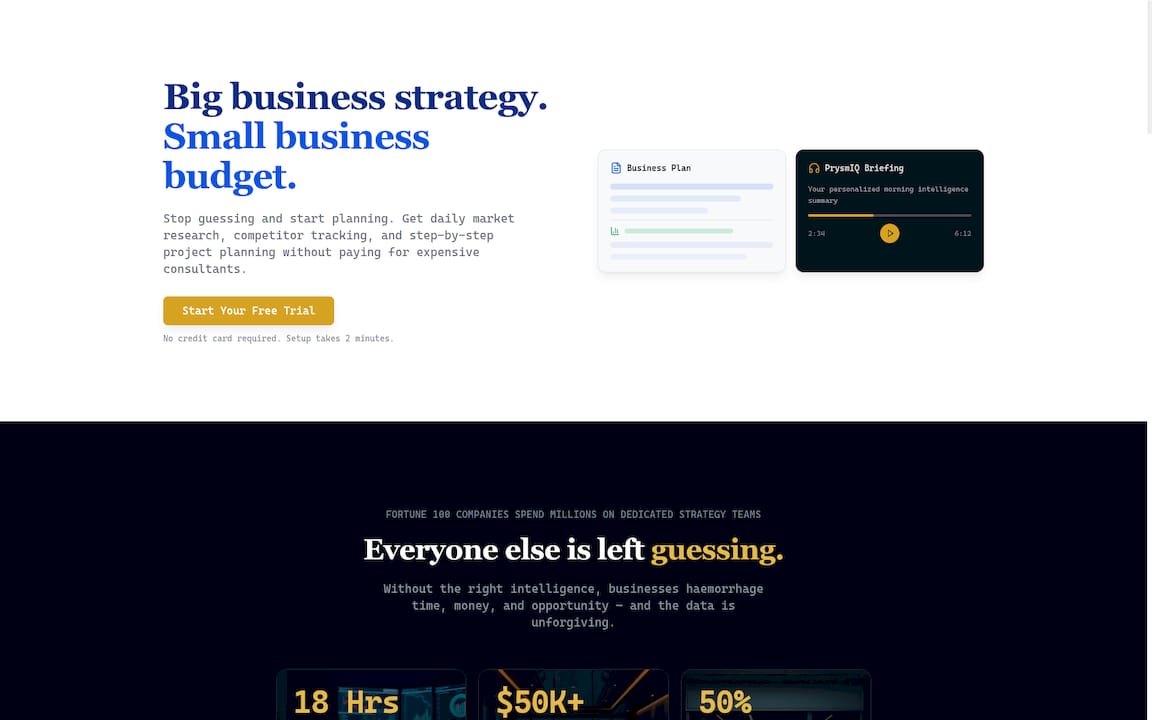
Blue Prysm’s AI-powered workflow tools help business decision-makers move from raw threat data to prioritized, actionable intelligence without needing a Fortune 500 security budget. The platform integrates competitive monitoring, market threat signals, and strategic planning into a single, AI-driven interface. You get the visibility you need to act fast and the structure to act smart. For new initiatives and ventures, the AI venture assessment tool validates strategic decisions against real market and threat data before you commit resources. This is how modern SMEs compete on intelligence.
Frequently asked questions
What is a threat analysis workflow for business decision-makers?
It’s a structured process that aligns business goals, technical scope, and risk appetite, then identifies, prioritizes, and addresses threats for strategic benefit. It connects security posture directly to business outcomes rather than treating threats as purely technical problems.
How can AI improve threat analysis workflows for small businesses?
AI enhances threat detection, automates routine updates, and routes novel cases for human review, saving analyst time and increasing detection effectiveness. The key is pairing automation with human-on-the-loop governance so low-confidence threats still get proper attention.
What is MITRE ATT&CK, and why is it useful in threat analysis?
MITRE ATT&CK is a framework for mapping attacker techniques and identifying control gaps, enabling repeatable validation and continuous improvement of security coverage. It transforms theoretical threat models into testable, measurable protection.
Should threat analysis workflows be automated for SMEs?
Automation is helpful, but SME workflows need human oversight for low-confidence or novel threats to prevent errors and missed risks. Full automation without governance is one of the fastest ways to create a dangerous false sense of security.
How often should threat analysis workflows be updated or reassessed?
Threat analysis should be viewed as an ongoing process with regular cycle-based reassessment and CTI integration to stay ahead of evolving risks. Treating it as a one-time compliance exercise is the single most common reason threat models fail when they’re actually needed.