


TL;DR:
- Most SMEs mistake basic data collection for strategic intelligence, which requires structured analysis and context. Building a continuous, iterative intelligence cycle across five key dimensions enables better decision-making, especially when accelerated by AI tools. Treat strategic intelligence as a discipline that combines human judgment with technology to stay ahead consistently and effectively.
Most business leaders think they’re doing strategic intelligence when they pull a competitor’s pricing page or scan a few industry headlines. They’re not. That’s data collection. Strategic intelligence is something fundamentally different, and the gap between the two is exactly where SMEs lose ground to larger, better-resourced competitors. The good news? AI-powered tools have made genuine strategic intelligence accessible to businesses of any size. This article breaks down what it actually means, how it works, and how you can use it to make decisions that move the needle.
Table of Contents
- What is strategic intelligence?
- The five dimensions of strategic intelligence
- From data to decision: The strategic intelligence cycle
- Market intelligence for SMEs: Practical use cases
- Our take: What most guides get wrong about strategic intelligence for SMEs
- Accelerate your strategic intelligence with Blue Prysm
- Frequently asked questions
Key Takeaways
| Point | Details |
|---|---|
| Structured intelligence cycle | Turning questions into actionable insights is a stepwise process, not just collecting data. |
| Framework for SMEs | A five-dimensional approach helps you capture, analyze, and apply intelligence efficiently. |
| Application drives results | Iterative decision-making processes powered by AI keep businesses agile and competitive. |
| Continuous market analysis | Maintaining ongoing market intelligence helps SMEs pivot faster and seize opportunities. |
What is strategic intelligence?
Let’s clear up the confusion right away. Strategic intelligence is not a dashboard, a news feed, or a spreadsheet full of market data. According to APUS, “strategic intelligence is the structured gathering, analysis, and application of information to support strategic decision-making.” That word structured is doing a lot of heavy lifting in that definition.
Strategic intelligence transforms raw signals from your environment into decision-ready insight. Without the structure, you just have noise.
Here’s what that looks like in practice. Raw data tells you a competitor launched a new product. Strategic intelligence tells you why they launched it, who they’re targeting, what market shift prompted it, and how you should respond. The difference is analysis and context. One is a newspaper headline. The other is the briefing a CEO actually needs before making a call.
For decision intelligence for SMEs, strategic intelligence acts as the foundation. It answers three core questions:
- What is happening? Environmental scanning identifies signals before they become obvious trends.
- Why does it matter? Contextual analysis links external signals to your specific strategic position.
- What should we do? Synthesized insights become recommendations you can act on.
Most SMEs stop after the first question. They gather data and then jump straight to gut-feeling decisions. That’s the trap. Without the middle step, structured analysis, your decisions are only marginally better than guessing. The leaders who consistently make smart calls are the ones who insist on all three layers every time.

The five dimensions of strategic intelligence
Having defined strategic intelligence, let’s look at the framework that makes it actionable for SMEs. Research published in a peer-reviewed management accounting journal shows that strategic intelligence spans five domains: competitive, market, resources, finance, and innovation intelligence. Think of these as five lenses you apply to the same business environment, each revealing something the others miss.

| Dimension | What it monitors | Why SMEs need it |
|---|---|---|
| Competitive intelligence | Rivals’ moves, positioning, pricing | Spot threats before they hit revenue |
| Market intelligence | Customer shifts, demand trends, segments | Adjust GTM strategies ahead of the curve |
| Resource intelligence | Talent, supply chain, operational capacity | Allocate resources where they generate most value |
| Financial intelligence | Unit economics, cost structures, funding signals | Make capital decisions with real data |
| Innovation intelligence | Emerging tech, new business models, patents | Avoid disruption, find new revenue streams |
Here’s what’s interesting about this framework. Most SMEs have at least one of these dimensions covered, usually competitive intelligence in a rough, informal way. The gap is in the other four. A founder who monitors competitors obsessively but ignores innovation signals is playing defense with no offense. You need all five to build a complete picture.
- Competitive intelligence is the starting point, but it shouldn’t be the only game in town. Monitoring competitive advantage steps means looking at what rivals can’t do, not just what they’re doing right now.
- Market intelligence surfaces changing customer preferences and unmet needs before they show up in your sales data.
- Resource intelligence is underrated. Understanding your supply chain vulnerabilities or talent gaps before they become crises is pure competitive leverage.
- Financial intelligence goes beyond your own P&L. It means understanding competitors’ cost structures, watching funding rounds in your space, and reading signals in public financial filings.
- Innovation intelligence is the one SMEs neglect most. If a new technology or business model is gaining traction with early adopters, you have a narrow window to respond before it reshapes your entire category.
Pro Tip: You don’t need to build a dedicated team for each dimension. Start by assigning one person to monitor one dimension consistently. Even 30 minutes per week of structured analysis per dimension beats sporadic, unfocused data collection.
From data to decision: The strategic intelligence cycle
Understanding the framework, here’s how SMEs can turn information into actionable decisions. The process isn’t magic. It’s a cycle you run repeatedly, with each iteration making your analysis sharper and your decisions more grounded.
OECD research on actionable intelligence confirms that organizations that build iterative intelligence processes consistently outperform those that rely on one-time analysis. The cycle matters as much as any single output.
Here’s how to run it:
- Define the strategic question. Before you gather anything, know what decision you’re feeding. “What’s happening in the market?” is not a question. “Should we expand into the healthcare vertical in Q3?” is a question. Specificity drives relevance.
- Source credible, diverse data. Use primary sources (customer interviews, first-party sales data) alongside secondary ones (industry reports, competitor press releases, regulatory filings). Diversity of source reduces blind spots.
- Analyze contextually. Connect what you’re seeing to your own strategic position. The same market signal means different things to a scale-up with deep pockets versus a lean startup with 18 months of runway.
- Synthesize into decision-ready insights. The output isn’t a summary. It’s a recommendation with supporting evidence. “We should delay the launch because X competitor just entered the segment with lower pricing, and our differentiation on Y isn’t sufficient yet” is actionable. “The market looks tough” is not.
- Apply and monitor. Make the decision, track the outcome, and feed those results back into the next cycle. This is where learning compounds.
Treating strategic intelligence as an end-to-end cycle means you never treat any single analysis as final. Markets shift. Assumptions erode. The businesses that win are the ones that keep feeding the loop.
| Approach | One-time analysis | Iterative intelligence cycle |
|---|---|---|
| Frequency | Quarterly or ad hoc | Continuous |
| Output | Static report | Living decision framework |
| Response time | Weeks to months | Days to weeks |
| AI integration | Batch processing | Real-time signal detection |
| Cost | High (consulting fees) | Lower with AI platforms |
This is exactly where AI strategies for advantage come in. AI tools accelerate steps two and three dramatically. They can process vastly more data than any human team, surface non-obvious correlations, and flag emerging signals in near-real time. But they require a human strategic layer. AI generates candidates for insight. You decide which ones matter to your business.
The rise of emerging AI trends means that access to this kind of analysis is no longer a Fortune 500 privilege. The barrier is no longer compute power or data access. The barrier is having the structured process to use what AI gives you.
Pro Tip: When using AI tools for analysis, always feed them a clearly framed strategic question first. The quality of AI output is directly proportional to the quality of your input prompt. Garbage in, garbage out still applies.
Market intelligence for SMEs: Practical use cases
Now, let’s see how strategic intelligence is put to work for SMEs through ongoing market intelligence and real-world applications. Market intelligence is arguably the most immediately useful dimension for resource-constrained businesses, because it directly feeds your GTM strategy, pricing, product development, and customer retention decisions.
Research confirms that market intelligence for SMEs is a continuous process of collecting, analyzing, and disseminating strategic information about the market and competitors. The continuous part is what most get wrong. They run a market analysis during the planning cycle, publish the deck, and then forget about it for 12 months. By month four, half of it is obsolete.
Here’s what continuous market intelligence looks like when it actually works:
- Trend anticipation. A mid-sized B2B software company monitors regulatory changes in their clients’ industries using structured alerts. When a new compliance requirement is announced six months before it takes effect, they accelerate a compliance feature that becomes their top sales driver that year. They didn’t react. They anticipated.
- Pricing calibration. A regional food distributor tracks competitor pricing weekly across key SKUs. When a major supplier raises raw material costs, they identify that their two biggest competitors haven’t yet passed the increase to customers. They hold their pricing for eight weeks while building customer loyalty, then adjust with full transparency. Result: zero churn during a difficult pricing period.
- Customer segment shifts. A professional services firm uses quarterly customer interview data alongside social listening to spot a shift in their primary client persona. What used to be a VP-level buyer is increasingly becoming a C-suite decision, driven by budget scrutiny post-2023. They retool their sales playbook six months before competitors notice the same shift.
The numbers matter here. SMEs that invest in ongoing market intelligence consistently report faster response to competitive threats, better product-market fit, and higher win rates in competitive deals. The investment is modest. The returns are disproportionate.
For business decision-making best practices, market intelligence provides the raw material. But it only generates value when it’s connected to a decision. Every intelligence activity should trace back to a question someone in your organization needs to answer. If it can’t, it’s research for its own sake, and that’s a luxury SMEs can’t afford.
The practical implication: build a simple “intelligence-to-decision” map. List your top five strategic decisions for the next 12 months. For each one, identify what market intelligence would most improve the quality of that decision. Then build your collection process around those specific needs. You’ll gather less, but use far more.
Our take: What most guides get wrong about strategic intelligence for SMEs
Here’s the uncomfortable truth most articles about strategic intelligence won’t tell you. The failure point isn’t data collection. Every SME we talk to is collecting something. The failure point is the analysis step, and specifically the translation step from analysis to structured recommendation.
Leaders skip it because it feels slow. There’s pressure to “just decide.” But rushing from data to action without structured analysis is like reading the first chapter of a book and then writing a review. You have some information. You don’t have understanding.
The invisible advantage that high-performing SMEs have figured out is this: they treat AI output as a draft, not a final answer. They use AI tools to surface patterns, compress research time, and generate candidate insights at speed. Then they apply strategic sense-making, connecting those insights to their specific context, competitive position, and resource constraints. That last step cannot be automated. It requires human judgment informed by the full five-dimension framework.
The other mistake we see constantly is treating strategic intelligence as a one-time exercise. You do it before a new product launch, or during annual planning, and then you’re done until next year. Markets don’t work on your planning calendar. Competitors don’t wait for your next quarterly review. The SMEs pulling ahead are running iterative loops, testing assumptions, sensing shifts, adapting, and repeating. They’re not doing more work. They’re doing better-structured work, consistently.
Staying current on decision-making trends reveals something important: the competitive advantage gap between SMEs and large enterprises is narrowing, but only for the ones who build the habit of structured intelligence. Access to AI tools is now roughly equal. The differentiator is the discipline to use them within a real strategic process.
If you take one thing from this article, make it this. Strategic intelligence is not a technology investment. It is a discipline. The technology accelerates it. The discipline is what makes it transformative.
Accelerate your strategic intelligence with Blue Prysm
You now have the framework. You understand the cycle. The real question is whether you have the infrastructure to run it consistently without burning your team out or hemorrhaging budget on consultants.
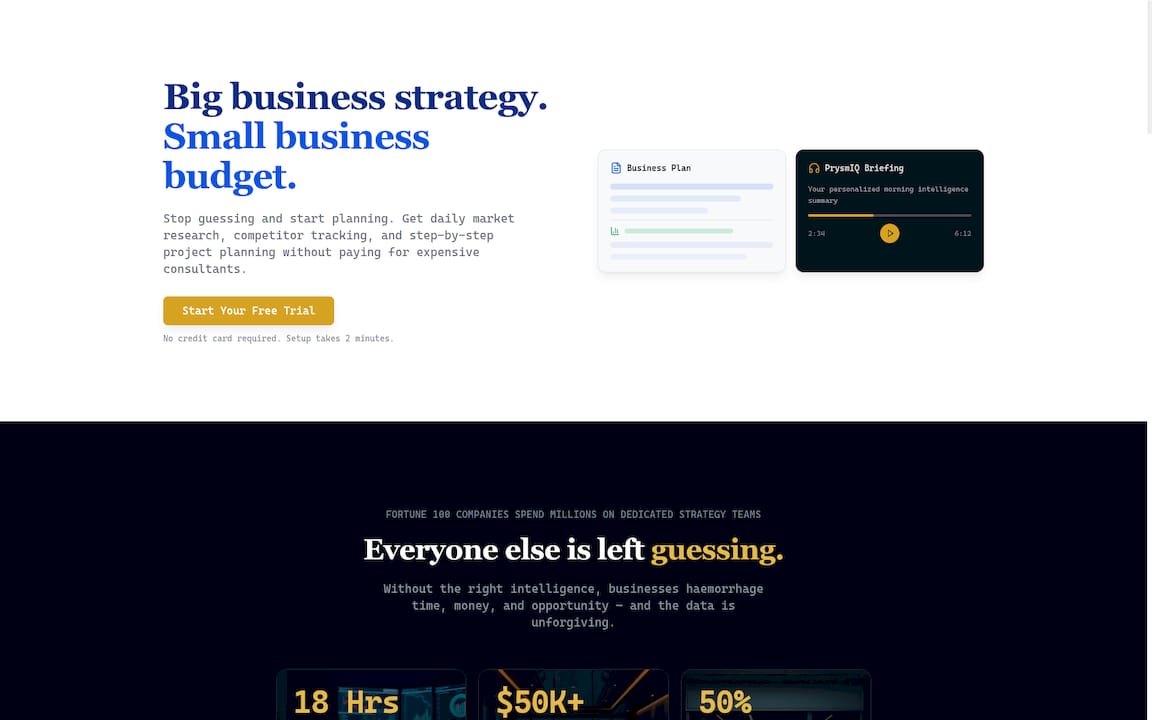
Blue Prysm is built precisely for this. The platform gives SMEs AI-powered strategic intelligence tools that operationalize everything covered in this article, from continuous market monitoring to competitor analysis and decision validation. How Blue Prysm works is straightforward: you define your strategic context, and the platform delivers structured, actionable briefings tailored to your business. Tools like the Puffery Detector cut through inflated market claims so your decisions are built on credible intelligence, not marketing spin. If you’re ready to stop reacting and start anticipating, Blue Prysm is the infrastructure that makes it possible without the Fortune 500 price tag.
Frequently asked questions
How does strategic intelligence differ from business analytics?
Strategic intelligence transforms sourced information into actionable decisions and helps leaders evaluate trends, identify opportunities, and anticipate threats, while business analytics typically interprets historical data to identify what already happened.
Which AI tools are most effective for SMEs seeking strategic intelligence?
AI tools that contextualize market information and support iterative learning, such as Blue Prysm’s Puffery Detector and Venture Quick Score, deliver the most value because they connect outputs to real strategic decisions rather than just generating generic summaries.
What role does market intelligence play in SME decision-making?
Market intelligence is a continuous process of analyzing competitors and market trends, giving SMEs the ability to adjust GTM strategies, pricing, and product direction in real time rather than reacting after the fact.
How can an SME get started with strategic intelligence?
Begin by defining your top five strategic questions for the next 12 months, then source credible data aligned to those questions. Structured gathering and application of information is most efficient when supported by AI-powered platforms that compress research time and deliver decision-ready outputs.