


TL;DR:
- Effective market briefings are decision-oriented, concise documents that provide structured intelligence to inform leadership actions. They should start from a specific decision, include clear sections on market signals, competitors, customers, finances, implications, and recommendations, and be integrated into recurring leadership meetings to drive timely decisions. Avoid common pitfalls like data dumps, mixing financial categories, or inconsistent formats; instead, focus on interpretive clarity and tailored templates to enhance decision-making speed and confidence.
A market briefing is a concise, decision-focused document that delivers actionable intelligence to leadership, cutting through data noise to drive faster, smarter strategy. Most professionals treat briefings as reporting exercises. That’s the wrong instinct entirely. The best briefings start from a decision that needs to be made, then work backward to gather only the intelligence that informs it. This market briefing tutorial walks you through the structure, process, tools, and pitfalls that separate a brief executives trust from one they ignore.
What a market briefing tutorial actually teaches you first
The most important lesson in any market briefing tutorial is this: start from the decision, not the methodology. Eris Strategy’s framework defines a market research brief as a short document that establishes business need, objectives, target market, deliverables, timing, budget, and background context. That sequence matters. When you anchor a briefing to a specific knowledge gap or decision, you prevent scope drift and give any research agency or internal analyst a clear mandate to work from.

Think of it this way: if your leadership team is deciding whether to enter a new geographic market, your brief should not open with a 400-word history of the industry. It should open with the decision on the table, what you already know, and what you need to know to move forward. Everything else is noise. The intelligence briefing guide at Blue Prysm reinforces this point: decision-makers need structured, prioritized intelligence, not research dumps dressed up as strategy.
This framing also protects your budget. When the brief is vague, agencies propose expensive, wide-scope studies. When it is specific, you get realistic study designs that deliver relevant insights on time and within cost.
What essential elements should a market briefing contain?
A decision-ready briefing has a predictable anatomy. Effective briefing sheets from Legacy Advisors include six core sections, each written in brief, scannable statements:
- Market signals: Recent shifts in pricing, demand, regulation, or technology that affect your position
- Competitor intelligence: Moves by direct and adjacent competitors, including product launches, pricing changes, and hiring patterns
- Customer intelligence: Shifts in buyer behavior, sentiment, or needs drawn from surveys, reviews, or sales data
- Financial indicators: Revenue trends, margin movements, and cost pressures relevant to the decision
- Strategic implications: What the signals mean for your business objectives, not just what they say
- Recommended actions: Specific next steps with owners and timelines attached
The financial section deserves special attention. Mixing financial categories is one of the fastest ways to lose leadership trust. PM Resource Hub’s Executive Briefing Pack template separates approved budget, actuals to date, committed costs, estimate at completion, and variance into distinct table columns. When these categories blur together, executives cannot assess project health accurately, and the briefing becomes a liability instead of an asset.
| Section | What to include | Length |
|---|---|---|
| Decision context | The specific choice or question driving the brief | 2-3 sentences |
| Market signals | Quantified shifts in market conditions | 3-5 bullet points |
| Competitor and customer intelligence | Named moves and behavioral changes | 3-5 bullet points |
| Financial indicators | Budget, actuals, commitments in separate columns | One table |
| Strategic implications and actions | Interpretation plus owner-assigned next steps | 3-5 bullet points |
Pro Tip: Keep each section to one half-page maximum. Legacy Advisors recommends the entire briefing sheet stay within one to three pages. Brevity signals respect for the reader’s time and forces you to prioritize what actually matters.
How do you design a recurring briefing process that drives decisions?
A single well-crafted briefing is useful. A recurring, standardized briefing process is a competitive weapon. The difference is discipline. Embedding briefings into leadership cadence transforms them from passive reports into behavioral contracts. When your weekly executive review always opens with a five-minute market signals scan and a twenty-minute strategic implications discussion, the briefing stops being optional reading and starts shaping decisions in real time.
Here is how to build that process from scratch:
- Anchor to a meeting. Attach your briefing to an existing leadership rhythm, whether that is a weekly leadership standup, a monthly board review, or a quarterly planning session. Briefings without a meeting home get skipped.
- Timebox the review. Legacy Advisors recommends five minutes for signals and twenty minutes for implications. This forces prioritization and prevents the briefing from becoming a two-hour discussion that resolves nothing.
- Assign a briefing owner. One person is responsible for compiling, distributing, and facilitating the briefing review. Shared ownership means no ownership.
- Use a priority labeling system. Tag each item as monitor (watch but no action needed), investigate (gather more data before deciding), or decide (requires a leadership call this cycle). This turns the briefing into a decision queue, not a reading list.
- Build in a feedback loop. After each review, note which signals led to decisions and which were ignored. Over time, this calibrates what belongs in the briefing and what should be cut.
StockCharts’ approach to translating news into scenarios offers a useful model here. Their method identifies drivers, marks key levels and scenarios, and compares signals to competitors and broader market conditions. That scenario-mapping habit, applied to your briefing process, means every signal comes with a “what happens if this plays out” framing that leadership can act on immediately.
Pro Tip: Treat your briefing template as a living document. Review its structure every quarter and remove sections that consistently produce no decisions. A leaner template gets read more carefully than a comprehensive one that gets skimmed.
What tools and templates can help you create effective market briefings?
You do not need to build your briefing structure from scratch. Several well-tested templates exist, each suited to different contexts and audiences.
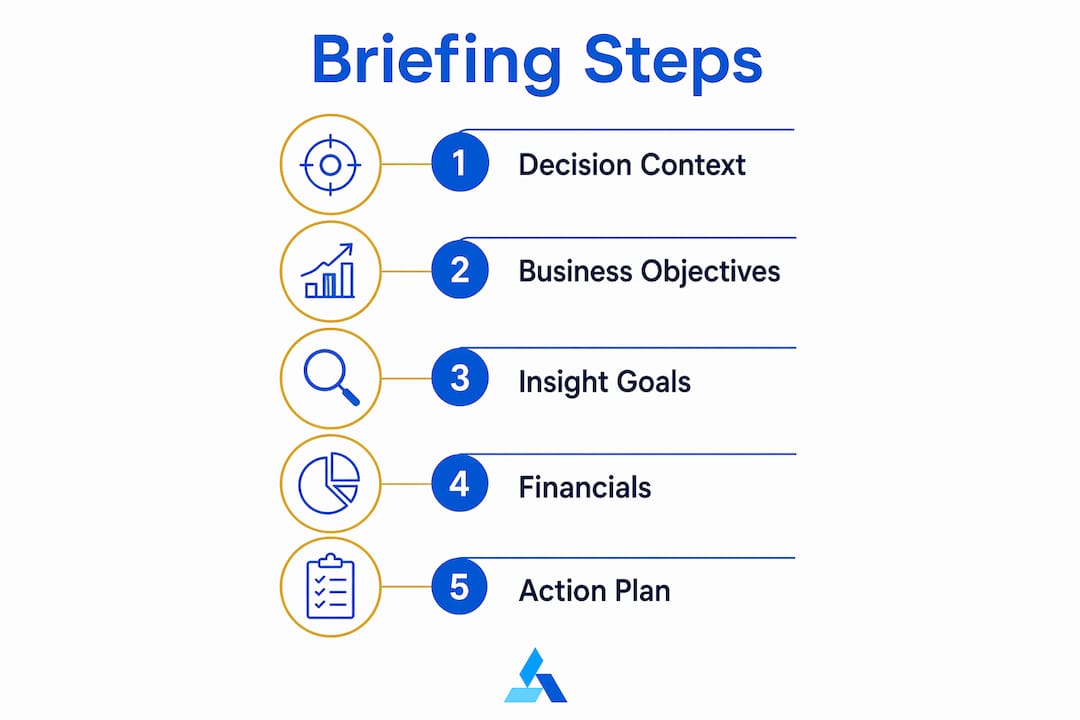
Eris Strategy’s market research brief template covers eight elements: decision context, business objectives, insight objectives, target market, deliverables, timing, budget, and background information. It is designed primarily for commissioning external research, but its logic applies equally to internal briefings. The ask-first structure reduces scope creep and aligns everyone on what success looks like before a single data point is collected.
PM Resource Hub’s Executive Briefing Pack takes a Bottom Line Up Front approach, meaning the decision request and key recommendation appear on page one before any supporting data. The pack includes financial tables with clearly separated budget categories and a dedicated “decisions required” section that tells leadership exactly what they need to approve, reject, or defer. Clear upfront asks reduce the cognitive load on executives and speed up the decision cycle significantly.
GOV.UK’s Green Book 2026 provides a governance-level model. It mandates that appraisal be preceded by a preparatory phase that engages decision-makers to align rationale and objectives before any analysis begins. For organizations operating in regulated industries or managing large capital decisions, this structured, evidence-based approach sets a high bar for briefing rigor.
| Template | Best use case | Key strength |
|---|---|---|
| Eris Strategy brief | Commissioning research or scoping studies | Decision-anchored structure prevents scope drift |
| PM Resource Hub pack | Executive project or investment reviews | Financial clarity and upfront decision request |
| GOV.UK Green Book | Regulated or public sector decisions | Governance rigor and stakeholder alignment |
| Legacy Advisors sheet | Recurring founder or leadership intelligence reviews | Concise, cadence-driven format for ongoing use |
Pro Tip: Tailor your template to your audience’s decision-making style. A founder running weekly reviews needs a one-page signal sheet. A CFO approving a capital allocation needs a full financial table with variance analysis. The same intelligence, packaged differently, lands very differently in the room.
What are common pitfalls in market briefing creation and how to avoid them?
Most briefings fail not because the data is wrong but because the framing is. Here are the mistakes we see most often, and what to do instead.
Treating the briefing as a research dump. Starting from methodology instead of the decision is the root cause of bloated, ignored briefings. When you lead with “here is everything we found,” you force the reader to do the interpretive work you should have done. Lead with the decision, then present only the intelligence that informs it.
Mixing financial categories. Approved budget, actuals to date, committed costs, and estimates at completion are four different numbers. Conflating these categories in a single “financials” row destroys leadership confidence in your numbers. Use separate columns, always.
Inconsistent structure across briefing cycles. When each briefing looks different, executives spend cognitive energy orienting themselves instead of processing the intelligence. Standardized briefing structures make trend spotting faster and reduce the friction of recurring reviews.
Accumulating intelligence without executing on it. Legacy Advisors’ “signal, interpretation, implication, action” framework exists precisely to prevent this trap. Every signal in your briefing should map to an interpretation of what it means, an implication for your strategy, and a specific action with an owner. Intelligence without execution is just expensive reading.
Burying the ask. If leadership has to read to page three to find out what you need from them, you have already lost the room. The ask belongs on page one, in plain language, before any supporting context.
The discipline that separates useful briefings from forgettable ones
I have reviewed hundreds of briefings across industries, and the pattern is consistent: the ones that drive decisions share one quality that has nothing to do with data quality or template choice. They are written by someone who was willing to make a call.
Most briefing authors hedge. They present signals without interpretation. They list implications without recommending actions. They are afraid to be wrong, so they leave the hard thinking to the executive. That is a mistake. Executives are not paying for raw data. They are paying for judgment. When you write “this competitor’s pricing move signals a margin squeeze in Q3, and we recommend accelerating our enterprise tier launch by six weeks,” you are doing the job. When you write “competitor pricing has changed, which may have implications for our strategy,” you are not.
The market intelligence guide at Blue Prysm makes this point well: the value of intelligence is not in its volume but in its interpretive clarity. I would add that the discipline to maintain a consistent briefing cadence, even when nothing dramatic is happening in the market, is what builds the organizational muscle to act fast when something does.
Integrating competitor intelligence into your briefing is not optional if you are serious about competitive advantage. But it only works if you interpret it. A competitor’s new hire in enterprise sales is a signal. What it means for your pipeline next quarter is the intelligence.
— Colin Bowdery
How Blue Prysm makes market briefings faster and sharper
Building a decision-ready briefing from scratch takes time most leadership teams do not have. Blue Prysm’s AI-powered platform removes the manual bottleneck by delivering structured daily market briefings that cover competitor moves, market signals, and strategic implications in a format your leadership team can act on immediately.
Blue Prysm gives small and mid-sized businesses access to the kind of intelligence infrastructure that Fortune 100 companies build with entire analyst teams. No expensive consultants. No hours spent aggregating data from a dozen sources. The platform handles the signal collection, you handle the decisions. If you want to see how it fits into your existing leadership rhythm, the how it works page walks through the full process in under five minutes.
Key takeaways
Effective market briefings require decision orientation, financial clarity, and a recurring process to convert intelligence into leadership action.
| Point | Details |
|---|---|
| Start from the decision | Anchor every briefing to a specific knowledge gap or choice, not a methodology. |
| Separate financial categories | Keep budget, actuals, commitments, and estimates in distinct columns to maintain leadership trust. |
| Build a recurring cadence | Tie briefings to existing leadership meetings and timebox the review to prevent passive reporting. |
| Use the signal-to-action framework | Every signal needs an interpretation, implication, and owner-assigned action to drive execution. |
| Match template to audience | A founder’s weekly sheet and a CFO’s capital review require different formats, even with the same underlying data. |
FAQ
What is a market briefing?
A market briefing is a concise, decision-focused document that summarizes market signals, competitor intelligence, financial indicators, and strategic implications to inform leadership decisions. It is typically one to three pages and tied to a specific decision or leadership review cycle.
How long should a market briefing be?
Legacy Advisors recommends keeping briefing sheets to one to three pages. Brevity forces prioritization and makes the document more likely to be read and acted on by busy executives.
What is the most common mistake in market briefings?
Starting from methodology instead of the decision is the most common error, according to Eris Strategy. This produces data-heavy documents that force executives to do the interpretive work themselves, reducing trust and slowing decisions.
How often should market briefings be produced?
Briefing frequency should match your leadership cadence. Weekly briefings work well for fast-moving markets or founder-led teams. Monthly briefings suit board-level or strategic planning reviews. The key is consistency, not frequency.
What financial information belongs in a market briefing?
PM Resource Hub’s Executive Briefing Pack template recommends including approved budget, actuals to date, committed costs, estimate at completion, and variance as separate line items. Mixing these categories into a single figure is a leading cause of leadership distrust in briefing financials.