


TL;DR:
- Strategic market research is a systematic process that gathers and analyzes data to support long-term business decisions and competitive advantage. Most organizations fail to connect research findings to decisions because they treat it as a one-time deliverable rather than an ongoing process. Effective research hinges on clear strategic questions, continuous monitoring, ownership of insights, and integrating findings into operational strategies.
Strategic market research is the systematic process of collecting and analyzing market data to inform critical business decisions and drive competitive advantage. The global market research industry reached $76.4 billion in 2026, with 85% of Fortune 500 companies using it as a core strategic tool. The ROI averages 3.5x by reducing risk and aligning decisions with evidence rather than gut feeling. If you are making pricing calls, market entry bets, or competitive moves without a structured research process behind them, you are flying blind in a storm that your competitors are navigating with instruments.
What is a strategic market research guide and why does it matter?
Strategic market research is the formal discipline of gathering, analyzing, and applying market intelligence to long-term business decisions. It is distinct from tactical research, which solves immediate problems. Think of it this way: tactical research tells you why last quarter’s campaign underperformed. Strategic research tells you whether the market you are targeting will still exist in three years.
Defining a clear strategic question is the single most important step in the entire process. Without it, research sprawls into a collection of interesting but disconnected facts. Anne Beall, a recognized authority on research methodology, champions what practitioners call the Strategic Question Approach: every study must be anchored to a specific business issue the organization needs to resolve. The difference between “What do customers think of us?” and “What would cause our top 20% of customers to switch to a competitor in the next 18 months?” is the difference between a report that sits on a shelf and one that drives a board decision.
Good strategic questions share three characteristics. They are specific enough to be answerable. They connect directly to a decision the business needs to make. And they have a named owner who is accountable for acting on the findings.
- Market entry: “Is there sufficient unmet demand in the mid-market segment to justify a GTM investment of $2M over 24 months?”
- Pricing: “What is the price ceiling our Ideal Customer Profile will accept before switching to a lower-cost alternative?”
- Competitor response: “How will our two largest competitors likely respond if we drop price by 15%?”
Pro Tip: Before commissioning any research, write the strategic question on a whiteboard and ask: if we get the answer, what decision changes? If nothing changes, the question is wrong.
What are the core components of effective market analysis?
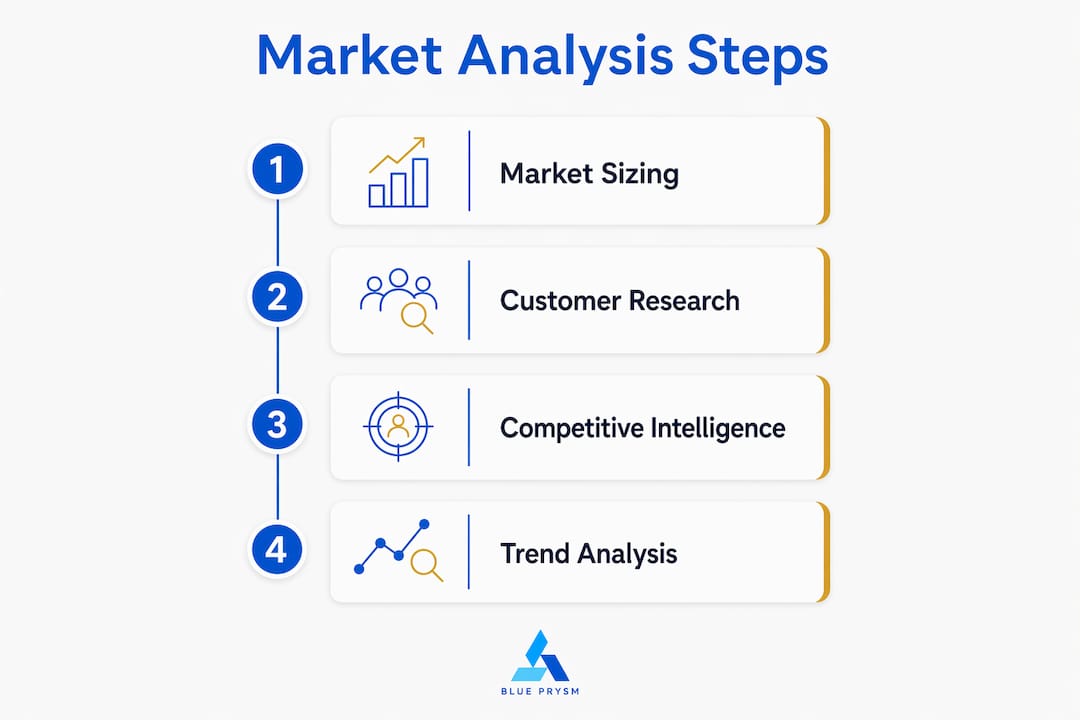
Effective market analysis rests on four pillars: market sizing, customer research, competitive intelligence, and trend analysis. Each feeds the others, and skipping one creates blind spots that surface at the worst possible moment.

Market sizing done right
Most business leaders default to top-down market sizing: take the Total Addressable Market (TAM), apply a percentage, and call it the Serviceable Addressable Market (SAM). This is almost always wrong. Bottom-up market sizing multiplies your Ideal Customer Profile count by your average contract value to produce a SAM that is realistic and defensible in front of investors or a board. TAM tells you the ceiling. Bottom-up SAM tells you what you can actually reach.
Customer and competitive research
Primary research methods include structured interviews, surveys, CRM log analysis, and ethnographic observation. Secondary research draws on industry reports, government data, and platforms like G2 and Capterra. Overreliance on secondary data creates blind spots that primary research exposes. The two must work together.
For competitive intelligence, the standard is focused rather than exhaustive. Spending 2 to 3 hours per competitor per cycle, updated quarterly, produces more usable intelligence than a 200-page annual deep-dive that is outdated before it is printed. Map each competitor’s positioning, pricing, primary customer segments, and known weaknesses. Platforms like G2 and Capterra surface customer complaints that competitors cannot hide.
- Define the competitive set (direct, indirect, and emerging substitutes).
- Map positioning and pricing for each player.
- Identify gaps where no competitor is serving a segment well.
- Assess weaknesses using public reviews, win/loss data, and customer interviews.
- Update quarterly, with a deeper annual review tied to your strategic planning cycle.
Pro Tip: Separate your strategic and tactical research workflows. Strategic research runs on a 12 to 60 month horizon. Tactical research runs on 1 to 6 months. Running them as parallel tracks prevents short-term urgency from cannibalizing long-term insight.
| Research type | Time horizon | Primary purpose |
|---|---|---|
| Strategic market research | 12 to 60 months | Long-term positioning and market entry |
| Tactical market research | 1 to 6 months | Campaign optimization and near-term decisions |
| Competitive intelligence | Quarterly refresh | Gap identification and response planning |
| Market sizing | Annual deep review | SAM/SOM validation and investment planning |
How do you turn research findings into business strategy?
Research that does not change a decision is an expensive hobby. The trap most organizations fall into is designing research to confirm what leadership already believes, then filing the report when it does. Action-oriented research design starts at the end: what decision will this inform, and what does each possible finding imply for that decision?
Transforming data into prioritized recommendations requires a structured synthesis process. Group findings by theme, rank themes by strategic impact, and assign a recommended action to each. Do not present 47 findings and ask leadership to figure out the priorities. Present three to five strategic implications with clear ownership.
Dashboards and monitoring tools keep research alive between major studies. Continuous market analysis separates agile organizations from those blindsided by competition. Real-time briefings on competitor moves, regulatory shifts, and customer sentiment changes allow leaders to adjust without waiting for the next annual review cycle.
Execution is where most strategic plans collapse. Most strategic plans fail due to lack of ownership, poor communication, and insufficient buy-in. Assigning a named owner to each strategic insight, with a deadline and a defined success metric, is the difference between a research report and a strategic asset. Only about one in eight strategic initiatives completes successfully without these practices in place.
- Assign one owner per strategic recommendation, not a committee.
- Set a 30-day review checkpoint after research delivery to assess adoption.
- Tie research findings directly to OKRs or quarterly business reviews.
- Use decision-ready briefs to communicate findings to leadership without burying the headline.
What are the most common market research mistakes to avoid?
The most damaging mistake is unfocused research. Without a strategic question, teams collect data that feels thorough but produces no clear direction. The second most common mistake is treating secondary data as sufficient. Industry reports give you the market’s shape. Primary research gives you its texture.
Only 26% of firms consider themselves truly data-driven, yet data-driven firms achieve 5 to 6% higher productivity. The gap between knowing this and acting on it is usually a culture problem, not a data problem. Leaders who treat research as a one-time event rather than an ongoing practice are the ones most likely to be surprised by a competitor’s move.
Best practices for sustained research impact include:
- Refresh competitive monitoring monthly, win/loss analysis quarterly, and deep market sizing annually. Industry standards recommend this cadence specifically.
- Triangulate findings across at least two data sources before treating any insight as confirmed.
- Avoid research ownership by committee. One person must be accountable for each insight reaching a decision.
- Keep reports between 15 and 40 pages. Longer reports get skimmed; shorter ones lack the evidence base to drive confidence.
Pro Tip: Triangulation is your quality control. If your survey data, your customer interviews, and your CRM logs all point to the same conclusion, you have a finding. If only one source supports it, you have a hypothesis worth testing.
Key takeaways
Strategic market research produces its highest ROI when anchored to a specific business question, executed across both primary and secondary sources, and connected to named owners who drive decisions from findings.
| Point | Details |
|---|---|
| Start with a strategic question | Every research project must link to a specific business decision to avoid unfocused, unusable outputs. |
| Use bottom-up market sizing | Multiply ICP count by average contract value for a defensible SAM rather than relying on top-down percentages. |
| Refresh research on a cadence | Monitor competitors monthly, review win/loss quarterly, and conduct deep market sizing annually. |
| Assign ownership to every insight | Named owners with deadlines convert research findings into executed strategy rather than archived reports. |
| Run strategic and tactical research in parallel | Separating the two time horizons prevents short-term urgency from eroding long-term market intelligence. |
Why most leaders are still getting market research wrong
I have reviewed research programs at dozens of organizations, and the pattern is almost always the same. The research is technically competent. The methodology is sound. The report is well-formatted. And then it sits in a shared drive for six months while the leadership team makes decisions based on the same assumptions they held before the study began.
The problem is not the research. It is the absence of a forcing function that connects findings to decisions. Most organizations treat research as a deliverable rather than a process. They commission a study, receive a report, and consider the job done. The firms that actually benefit from market research treat it as a continuous intelligence function, not a project with a start and end date.
What I find genuinely encouraging in 2026 is the emergence of platforms that make this continuous model accessible to organizations that cannot afford a dedicated research team. The competitor benchmarking and real-time monitoring capabilities now available to mid-market firms would have required a six-figure consulting engagement five years ago. The barrier is no longer budget. It is discipline. The leaders who commit to asking better strategic questions and building research into their operating rhythm will outpace those who treat it as an occasional exercise.
— Colin Bowdery
See how Blue Prysm puts this into practice
Blue Prysm is built for exactly the scenario this article describes: business leaders who need elite-level market intelligence without the consulting overhead. The platform supports strategic question formulation, real-time competitor monitoring, and structured reporting that produces decision-ready outputs rather than data dumps. You can explore how it works to see how Blue Prysm translates the methodologies in this guide into a repeatable, AI-assisted workflow. For leaders who want to understand how market intelligence fits into a broader strategic planning system, Blue Prysm’s platform connects research directly to the decisions that drive growth.
FAQ
What is strategic market research?
Strategic market research is the structured process of gathering and analyzing market data to inform long-term business decisions. It focuses on trends, competitive positioning, and customer behavior over a 12 to 60 month horizon.
How do you formulate a good strategic research question?
A strong strategic question is specific, tied to a decision the business must make, and has a named owner accountable for acting on the answer. Anne Beall’s Strategic Question Approach is the recognized framework for this practice.
What is the difference between TAM, SAM, and SOM?
TAM is the Total Addressable Market representing the full demand for a product. SAM is the Serviceable Addressable Market your business can realistically reach. SOM is the share you can capture. Bottom-up SAM calculations using ICP counts and average contract value produce the most defensible estimates.
How often should competitive intelligence be updated?
Competitive monitoring should refresh monthly, win/loss analysis quarterly, and deep market sizing annually. This cadence keeps intelligence current without creating unsustainable research overhead.
Why do most strategic plans fail to use research effectively?
Most strategic plans fail due to lack of ownership, poor communication, and insufficient organizational buy-in. Assigning a named owner to each research insight with a defined deadline is the most reliable fix.