


TL;DR:
- Effective objection handling involves diagnosing buyer concerns before responding, using frameworks like LAER and LARC. Most objections stem from four root causes—price, timing, authority, and fit—and recognizing the real concern leads to more precise, trust-building responses. Modern sales leverage AI-driven insights and structured dialogue to address objections confidently within 60 to 90 seconds, increasing deal success.
Objection handling is the structured skill of diagnosing and addressing buyer concerns to advance deals with confidence and precision. Most sales professionals treat it as a script library. The top performers treat it as a diagnostic conversation. Objections are buying signals that indicate engagement and a buyer’s need for added certainty before committing. Frameworks like LAER (Listen, Acknowledge, Explore, Respond) and LARC (Listen, Acknowledge, Respond, Confirm) give sales teams a repeatable process that replaces gut-feel rebuttals with structured, trust-building dialogue. Gong Labs, Sybill AI, and SyncGTM all point to the same conclusion: the reps who win are the ones who diagnose before they respond.
What are the most common objections in sales?
Price and timing objections account for 63% of all B2B objections. That single number reframes how you should prepare. Rather than building a response library for every possible scenario, focus your preparation on four root causes: price, timing, authority, and fit. Every objection you will ever hear maps back to one of these four.
The trap most reps fall into is answering the surface statement instead of the underlying concern. A buyer who says “your price is too high” may actually be signaling that they cannot justify the ROI to their CFO. A buyer who says “now isn’t the right time” may be protecting themselves from a decision they don’t have authority to make. The words are a starting point, not the full picture.
| Objection type | Surface statement | Likely hidden concern |
|---|---|---|
| Price | “It’s too expensive.” | Cannot justify ROI internally or lacks budget authority |
| Timing | “We’re not ready yet.” | Risk aversion or competing internal priorities |
| Authority | “I need to check with my team.” | Not the decision maker, or fears internal pushback |
| Fit | “I don’t think this is right for us.” | Unclear on how the solution maps to their specific problem |
Recognizing which root cause sits beneath a surface objection is what separates a precise response from a generic one. When you know the real concern, you can address it directly instead of talking past it.
How do LAER and LARC frameworks improve objection handling?
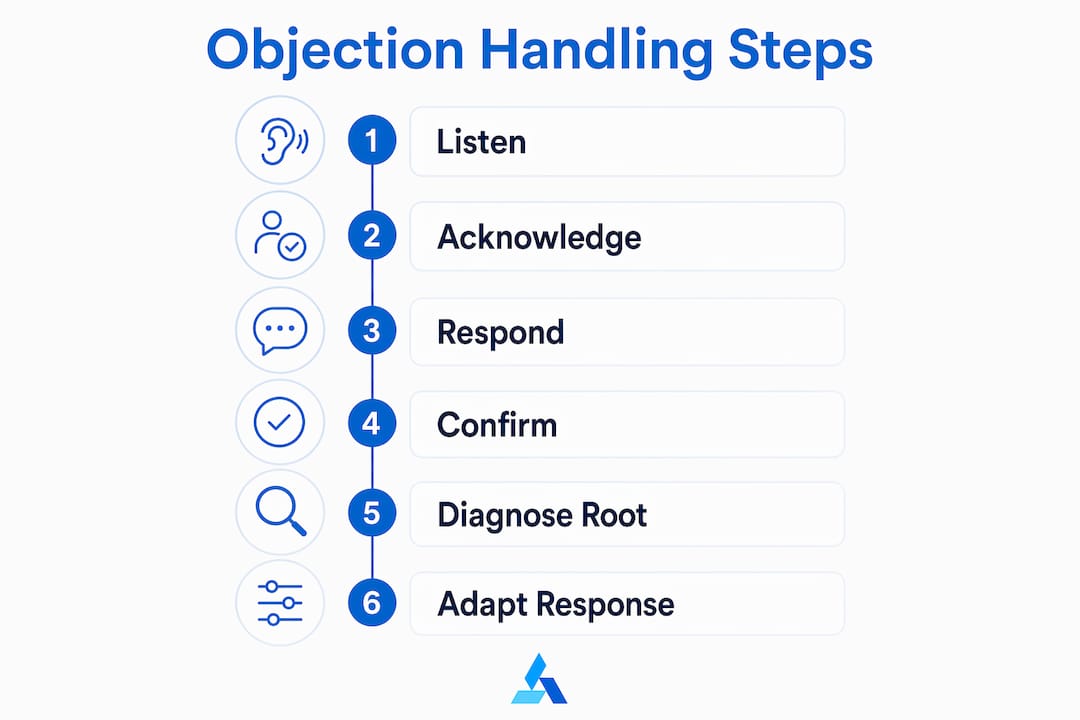
Proven frameworks like LAER and LARC replace improvised rebuttals with a structured 60 to 90 second process that keeps the conversation moving forward. Both frameworks share the same first two steps and diverge at the third. Here is how each one works in practice.
LAER: Listen, Acknowledge, Explore, Respond
- Listen fully before saying anything. Resist the reflex to jump in. Let the buyer complete their thought without interruption.
- Acknowledge the concern without agreeing with it. “That’s a fair point” or “I hear you on that” signals respect without conceding ground.
- Explore the concern with a diagnostic question. “Can you help me understand what’s driving that?” or “What would need to be true for timing to work?” This is the step most reps skip, and it is the most important one.
- Respond only after you understand the real concern. Your answer should address the root cause, not the surface statement.
LARC: Listen, Acknowledge, Respond, Confirm
LARC is faster and works well when the objection is straightforward and the root cause is already clear. After acknowledging, you respond directly and then confirm resolution: “Does that address your concern?” or “Are we good to move forward on that?”
Pro Tip: Pause for two to three seconds after an objection is voiced before saying anything. That pause signals confidence, not hesitation. Buyers read an immediate rebuttal as defensiveness. A brief pause reads as authority.
The choice between LAER and LARC depends on how well you understand the objection. When in doubt, use LAER. The exploration step costs you 20 seconds and can save the entire deal.
How to diagnose the real objection behind the surface statement
Skipping the exploration phase is the single most common reason deals stall after an objection. Reps answer what was said instead of what was meant. Diagnosis requires asking one or two targeted questions before you respond.

The first distinction to make is whether you are dealing with a genuine objection or an obstruction. Obstructions are defensive dismissals, not requests for information. “Just send me an email” or “We’re all set for now” are obstructions. They signal disengagement, not concern. Genuine objections signal that the buyer is still in the conversation but needs more to move forward.
For genuine objections, use diagnostic questions that probe the root cause:
- “What’s the biggest risk you see in moving forward?”
- “When you say the timing isn’t right, what would need to change?”
- “Who else would need to be involved in this decision?”
- “What does success look like for your team in the next six months?”
These questions do two things simultaneously. They surface the real concern, and they demonstrate that you are solving a problem rather than pushing a product. That shift in dynamic is what builds buyer trust during the most tense moments of a sales conversation.
Pro Tip: Never treat the first objection statement as the complete picture. Ask one diagnostic question, then listen for the answer before forming your response. The second thing a buyer says is almost always more honest than the first.
How to respond with empathy, evidence, and confirmation
Once you understand the real concern, your response has three jobs: reframe the objection, provide evidence, and confirm resolution. Generic responses fail because they address the category of concern rather than the specific situation. Personalized proof points close that gap.
Effective responses share four characteristics:
- They address the root cause, not the surface statement. If the real concern is ROI justification, lead with a case study or metric that speaks directly to that fear.
- They use concrete evidence. Numbers, customer examples, and specific outcomes outperform abstract reassurances every time.
- They avoid defensiveness. Phrases like “Actually, our price is competitive because…” signal that you feel attacked. Reframe instead: “Let me show you how other teams in your position have thought about the return.”
- They confirm resolution before moving on. Ask “Does that address what you were concerned about?” before advancing the conversation. Skipping this step means you may be building on an unresolved foundation.
AI-driven insights now allow sales teams to anticipate which objections are most likely based on buyer profile, deal stage, and industry. Top reps in 2026 are not memorizing scripts. They are using data to prepare personalized responses before the conversation even starts.
Key takeaways
Effective objection handling is a diagnostic process: listen, identify the root cause, and respond with specific evidence before confirming resolution.
| Point | Details |
|---|---|
| Objections signal engagement | Buyers who object are still in the conversation and need more certainty to move forward. |
| Four root causes cover most objections | Price, timing, authority, and fit account for the vast majority of B2B objections. |
| Exploration is non-negotiable | Skipping the explore step in LAER leads to answering the wrong concern and losing the deal. |
| Pause before responding | A two to three second pause after an objection signals authority and opens deeper buyer disclosure. |
| Confirm resolution explicitly | Always ask if the concern is resolved before advancing. Unconfirmed objections resurface at close. |
Why objections are invitations, not attacks
I have watched hundreds of sales conversations fall apart at the objection stage, and the pattern is almost always the same. The rep hears “your price is too high” and immediately goes into defense mode. They start justifying, explaining, discounting. The buyer feels the pressure and retreats. The deal dies not because of the price, but because of the response to the price.
The mindset shift that changes everything is treating every objection as an invitation to solve a problem. Surfacing objections early during discovery is even better. When you ask “What concerns do you have about making a change like this?” in the first meeting, you defuse late-stage pushbacks before they become deal killers. That is prevention, and it is far more effective than any rebuttal technique.
Modern buyers in 2026 are more informed than ever. They have done their research, read the reviews, and compared your pricing against three alternatives before they got on the call with you. They do not need a pitch. They need a partner who can help them solve the internal problem of justifying a decision. Your job is to give them the ammunition to do that. Stay calm, stay curious, and stay focused on their problem rather than your quota. The reps who do that consistently are the ones who close.
— Colin Bowdery
How Blue Prysm helps you handle objections with real evidence
When a buyer pushes back on price, timing, or fit, the fastest way to resolve the objection is with credible, specific evidence. The problem is that most sales teams are working from generic talking points that buyers can see through immediately.
Blue Prysm’s Puffery Detector gives sales teams an AI-powered credibility check on the claims they are making in conversations and proposals. If your proof points are fluffy, it flags them before the buyer does. Pair that with Blue Prysm’s AI-driven strategic intelligence platform, and your team can walk into every conversation with objection-ready data, competitor context, and personalized evidence. That is the difference between hoping the buyer believes you and giving them a reason to.
FAQ
What is objection handling in sales?
Objection handling in sales is the structured process of diagnosing and addressing buyer concerns to keep deals moving forward. It relies on frameworks like LAER and LARC rather than scripted rebuttals.
What are the most common sales objections?
Price and timing objections account for 63% of B2B objections, with authority and fit rounding out the four primary root causes.
What is the difference between an objection and an obstruction?
An objection is a genuine concern that invites a response. An obstruction is a brush-off that signals disengagement and requires re-qualification rather than a standard objection response.
How long should objection handling take on a live call?
The LAER and LARC frameworks are designed to resolve most objections in 60 to 90 seconds during a live conversation, keeping the deal moving without derailing the call’s momentum.
How can AI improve objection handling?
AI tools analyze buyer profiles, deal stage, and conversation data to anticipate likely objections and surface personalized proof points before the conversation starts, replacing generic scripts with context-specific responses.