


TL;DR:
- Scenario planning develops multiple plausible futures to help organizations make resilient decisions under uncertainty. It requires a clear question, reliable data, and continuous updates, focusing on few well-structured scenarios with vivid narratives and signposts. Success depends on executive involvement, simple frameworks, and integrating the process into regular strategy cycles.
The scenario planning process is a structured method for building and analyzing multiple plausible futures so your organization can make decisions that hold up regardless of what actually happens. Unlike gut-feel forecasting or static risk registers, scenario planning forces you to stress-test your strategy against conditions you cannot predict. It draws on PESTLE analysis, driver mapping, and narrative construction to produce a set of credible futures. Done right, it replaces reactive scrambling with proactive positioning.
What are the key prerequisites for effective scenario planning?
Before you build a single scenario, you need three things locked down: a clear strategic question, a defined time horizon, and reliable external data. Without these, your scenarios will drift into speculation rather than analysis.

Define your focus area first. A question like “What happens to our revenue if interest rates stay elevated for three years?” is far more useful than “What does the future look like?” Vague questions produce vague scenarios. Your time horizon should match your decision cycle. A manufacturer evaluating capital investment needs a five-to-ten year view. A software company assessing a product launch may only need eighteen months.
Gather structured external data using PESTLE analysis, which covers Political, Economic, Social, Technological, Legal, and Environmental factors. This framework stops teams from fixating on internal assumptions and forces attention outward. SMBs achieve efficient scenario planning by focusing on three material uncertainties tied to their specific context. That focus balances foresight with operational efficiency.
Pro Tip: Assign a scenario owner for each uncertainty driver. One person tracks the economic variable, another tracks the regulatory environment. Distributed ownership prevents blind spots.
Your planning team should include a facilitator, a financial modeler, a market analyst, and at least one senior decision-maker. Without executive presence in the room, the outputs rarely influence real decisions.
| Input | Purpose |
|---|---|
| Strategic question | Anchors all scenario development |
| PESTLE analysis | Identifies external drivers and uncertainties |
| Time horizon | Scopes scenario relevance to decision cycles |
| Financial model | Quantifies scenario impacts on key metrics |
| Executive sponsor | Ensures outputs connect to real decisions |
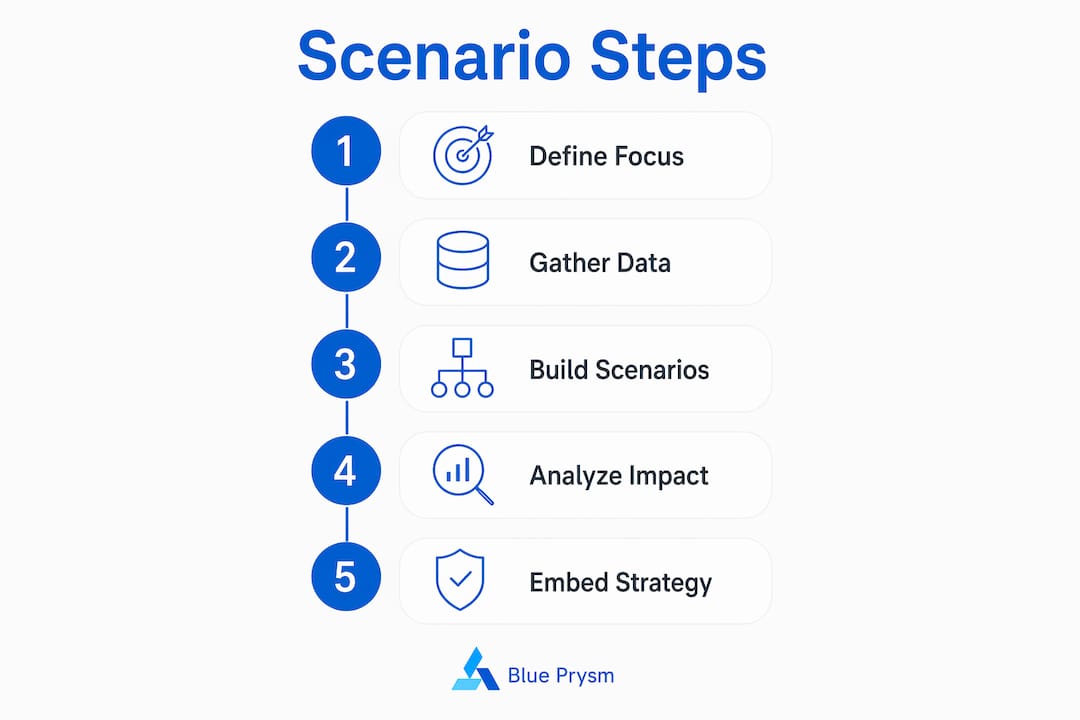
How to build and analyze scenarios step by step
The scenario analysis process has six distinct steps. Skipping any one of them produces scenarios that feel plausible on paper but fail under scrutiny.
-
Define your strategic question and time horizon. Write it as a single sentence. If you cannot summarize it in one sentence, the question is too broad.
-
Analyze external environment trends and drivers. Use your PESTLE data to map forces that could shift your operating conditions. Rank them by impact and uncertainty.
-
Identify and prioritize critical uncertainties. Pick the two or three drivers with the highest impact and the lowest predictability. These become the axes of your scenario matrix.
-
Develop 3 to 5 scenario narratives. Optimal scenario count is 3 to 5, typically including a base case, an upside, a downside, and an optional stress case. Base case probability runs 50–60%, upside and downside each carry 15–20%, and a stress case sits at roughly 5%. Each scenario needs a name, a narrative, and a set of quantified key variables.
-
Analyze strategic implications. Test your current plan against each scenario. Where does it break? Where does it hold? This is where you identify your “No-Regret Moves,” which are actions that pay off across all scenarios, versus your “Big Bets,” which are scenario-specific actions that only make sense if a particular future unfolds.
-
Define signposts and monitoring triggers. Early indicators called signposts signal which scenario is beginning to materialize. Assign a metric to each signpost and set a threshold that triggers a strategic review.
Pro Tip: Name your scenarios with vivid, memorable titles rather than labels like “Scenario A.” A name like “Frozen Credit Markets” sticks in an executive’s memory and makes scenario discussions far more concrete.
Effective scenario narratives combine qualitative stories with quantitative variable ranges. A scenario that pairs high revenue growth with low capital expenditure is internally inconsistent and will lose credibility with your board fast.
| Scenario type | Probability | Core assumption |
|---|---|---|
| Base case | 50–60% | Conditions evolve as currently expected |
| Upside | 15–20% | Key drivers shift favorably |
| Downside | 15–20% | Key drivers deteriorate moderately |
| Stress case | ~5% | Severe disruption across multiple drivers |
Common challenges and best practices in scenario planning
The biggest failure mode in scenario planning is trying to predict the future rather than keeping strategic options open. Organizations that treat scenarios as forecasts rather than as planning tools end up anchoring decisions to a single expected outcome. That is exactly the trap scenario planning is designed to avoid.
“Scenario planning is not about predicting what will happen. It is about being prepared for what could happen.”
Watch for these common pitfalls:
- Building more than four scenarios. Exceeding four scenarios creates unmanageable narratives and kills leadership engagement. Keep it tight.
- Treating scenario planning as a one-time event. Scenario planning is a continuous process embedded in planning and risk management cycles, not a workshop you run once every three years.
- Confusing scenario planning with a risk register. Risk registers list risks with probabilities. Scenario planning builds story-driven frameworks that enable better strategy alignment. They serve different purposes.
- Letting teams focus only on goal-specific questions. Broader exploratory scenarios reveal early warning conditions that narrow questions miss entirely.
Pro Tip: Run a “pre-mortem” on each scenario before finalizing it. Ask the team: if this future unfolds and we fail, what went wrong? The answers expose hidden assumptions.
Executive buy-in is the single most critical success factor. Without leadership adoption, scenario outputs sit in a deck and never touch a real budget decision. Get a C-suite sponsor before you start, not after you finish.
How to embed scenario planning into ongoing strategy
Scenario planning delivers lasting value only when it becomes part of your regular operating rhythm, not a standalone project. Integrating scenario planning into annual strategy reviews and risk management cycles is what connects it to real investments and priorities.
Here is how to make it stick:
- Tie scenarios to your budget cycle. Review scenario assumptions every time you update your annual plan. If a signpost has moved, adjust your financial model accordingly.
- Build a stakeholder communication plan. Executives, board members, and operational leads each need a different version of the scenario story. A one-page summary for the board and a detailed model for the finance team are not the same document.
- Use rolling forecasts with scenario updates to maintain planning relevance beyond annual cycles. Static annual plans go stale. Rolling forecasts that incorporate scenario shifts keep your strategy current.
- Connect scenario outputs to competitive intelligence. Real-time market signals feed directly into your signpost monitoring. Platforms that track market shifts give you the early data you need to know which scenario is unfolding before your competitors do.
- Link scenario decisions to capital allocation. Every “Big Bet” investment should map to a specific scenario. If that scenario’s probability drops, the investment rationale needs to be revisited.
The strategic planning best practices that separate high-performing organizations from reactive ones all share one trait: they treat uncertainty as a design input, not a surprise.
Key takeaways
The scenario planning process works because it forces you to make decisions that are resilient across multiple futures, not just the one you expect.
| Point | Details |
|---|---|
| Limit scenario count | Build 3 to 5 scenarios maximum to maintain leadership focus and avoid analysis paralysis. |
| Use signposts | Define measurable triggers ahead of time so you can respond to emerging conditions before they become crises. |
| Separate No-Regret Moves from Big Bets | Categorize every strategic action by which scenarios it serves to clarify your risk exposure. |
| Embed in annual cycles | Integrate scenario reviews into budgeting and strategy processes so outputs influence real decisions. |
| Require executive sponsorship | Without C-suite adoption, scenario planning never moves from the deck to the decision table. |
Why most scenario planning efforts fall flat
I have sat in a lot of scenario planning sessions over the years. The ones that produce real strategic change share a common trait: someone in the room has the authority to act on what they learn. The sessions that produce nothing share a different trait: the scenarios are built by analysts and presented to executives who were not part of the process.
That gap is the real problem. When leadership is not in the room during scenario construction, they do not feel the weight of the uncertainties. They see a polished slide and move on. The scenarios that stick are the ones where a CFO or CEO personally wrestled with the assumptions and felt uncomfortable. Discomfort is the signal that the scenario is doing its job.
The other mistake I see constantly is treating scenario planning as a complexity exercise. Teams build six or seven scenarios with elaborate variable matrices and then wonder why no one uses them. Simplicity is a feature, not a shortcut. Three well-constructed scenarios with clear signposts will outperform seven elaborate ones every time. The goal is not to cover every possibility. The goal is to make better decisions faster when conditions shift.
Scenario planning is also where AI-powered scenario testing is changing the game for smaller organizations. What used to require a strategy consulting firm can now be run with the right platform and a focused team. The methodology has not changed. The access to it has.
— Colin Bowdery
How Blue Prysm supports your scenario planning work
Blue Prysm gives business professionals the market intelligence and analytical tools that scenario planning depends on, without the consulting firm price tag.
The Blue Prysm market analysis platform delivers real-time industry signals that feed directly into your PESTLE analysis and signpost monitoring. The competitive intelligence tools track market shifts as they happen, so you know which scenario is materializing before your competitors do. Blue Prysm’s strategy library includes 95+ frameworks that integrate with scenario analysis, and the strategy training and workshops give your team the skills to run this process internally. For organizations that want hands-on support, AI strategy consulting is available to guide the full scenario planning cycle.
FAQ
What is the scenario planning process?
The scenario planning process is a structured method for developing multiple plausible futures and testing your strategy against each one. It uses driver analysis, narrative construction, and signpost monitoring to support decisions under uncertainty.
How many scenarios should you build?
Build 3 to 5 scenarios. Exceeding four scenarios reduces leadership engagement and produces narratives too complex to act on.
How does scenario planning differ from a risk register?
A risk register lists risks with assigned probabilities. Scenario planning builds story-driven frameworks that connect multiple uncertainties into coherent futures, enabling better strategy alignment than a static risk inventory.
How often should you update your scenarios?
Update scenarios at least annually as part of your strategy and budgeting cycle. Rolling forecasts with scenario updates keep your planning relevant beyond fixed annual reviews.
What makes a scenario internally consistent?
A consistent scenario pairs assumptions that logically reinforce each other. Combining high revenue growth with minimal capital expenditure, for example, breaks internal logic and destroys stakeholder credibility.