


TL;DR:
- Effective idea validation relies on testing assumptions through customer interviews and landing page experiments. Strong demand signals come from behavioral commitments like deposits or pre-orders, not just positive feedback. Using affordable tools and setting clear kill criteria minimizes risk and ensures reliable market validation.
Ideas validation tips are methods entrepreneurs use to test whether a business idea has real market demand before investing significant time or money. The formal term for this process is market validation, and it sits at the heart of every sound go-to-market strategy. Most founders skip it or do it badly, confusing polite feedback with proof. The result is wasted capital and a product nobody buys. The tips below treat validation as a risk audit, not a confidence check, and that distinction changes everything.
1. What are the best ideas validation tips for customer discovery interviews?
Customer discovery interviews are the fastest way to learn whether a real problem exists. The Founder Institute recommends interviewing 20–30 target customers, focusing on past behavior rather than opinions about your idea. That number matters because patterns only emerge after enough conversations.
Structure every interview around three questions: When did this problem last occur? What did you do to fix it? How much did that workaround cost you in time or money? These questions surface real pain and real spending, not hypothetical enthusiasm.
- Ask about specific past events, not future intentions.
- Record sessions (with permission) and review for repeated phrases.
- Note what customers do, not just what they say.
- Avoid describing your solution until the interview ends.
Pro Tip: If a customer asks “when can I sign up?” before you finish explaining the problem, that is a stronger signal than any survey score.
2. How do landing page tests measure real demand?

A landing page test is the fastest quantitative method for measuring willingness to pay. Build a single page that describes the problem, outlines your solution in plain language, and includes one clear call to action: join a waitlist, pre-order, or book a demo. Then drive targeted traffic to it.
A conversion rate above 5% signals strong demand. Below 2% means your positioning needs adjustment before you write a single line of code. These numbers give you a decision point, not a feeling.
- Keep the page under 400 words with one headline and one button.
- Use paid social or search ads to reach your exact target customer.
- Run the test for 7–14 days before drawing conclusions.
- Track click-through rate, sign-up rate, and cost per lead separately.
The entire experiment is achievable for well under $200. Landing page tests typically cost $50–$100 in ad spend. That is a cheap price for a go/no-go signal.
Pro Tip: If you collect pre-orders, state your refund policy and delivery timeline clearly. Transparency reduces customer risk and increases conversion honesty.
3. What critical assumptions should you audit during validation?
Validation is a risk audit, not a search for reassurance. Every idea rests on a stack of assumptions, and any one of them can be fatal if wrong. The seven dimensions worth testing are: problem severity, target customer definition, demand size, differentiation, execution feasibility, distribution, and monetization.
Most founders test the first two and ignore the last three. Skipping pricing or distribution is a common fatal error that kills otherwise promising ideas after launch.
Validation should be designed to kill your idea cheaply. If your experiments cannot prove the idea wrong, they are not rigorous enough. Set hard kill criteria before you run a single test, and commit to stopping if the evidence says stop.
Use a bottom-up Total Addressable Market estimate, not a top-down percentage of a giant industry. Clear kill criteria and realistic TAM are the two most overlooked elements in early-stage validation. Define what “good enough” looks like before you start, so confirmation bias cannot move the goalposts.
- Write down every assumption your idea depends on.
- Rank assumptions by how fatal they would be if wrong.
- Design one cheap experiment per high-risk assumption.
- Set a pass/fail threshold before running each test.
- Review results against criteria, not against hope.
4. How do you tell real demand from polite interest?
Most validation failures happen because founders mistake compliments for commitments. A friend saying “that sounds great” is not a customer. A stranger paying a $50 deposit is.
The signals that indicate real demand are specific and behavioral. Watch for customers who describe the problem unprompted, ask how to sign up without being prompted, or refer a colleague before the product exists. These are behavioral proof points, not opinions.
- Weak signals: survey responses, verbal enthusiasm, social media likes.
- Strong signals: deposits, pre-orders, signed letters of intent, referrals.
- Strongest signal: a customer who pays and then tells someone else.
Advance payments or signed pilots beat any amount of positive feedback. Very few paid commitments mean no validated market demand, regardless of how warm the conversations felt.
Pro Tip: Run a “shadow test.” Tell prospects the product is available now and ask for payment. Their response tells you more than six months of interviews.
5. Which affordable tools support idea validation in 2026?
Validation under $200 is realistic when you use the right combination of free and low-cost resources. The goal is to run qualitative and quantitative tests in parallel so you get depth and speed at the same time.
| Method | Estimated Cost | What It Tests |
|---|---|---|
| Customer interviews (20–30) | $0–$50 | Problem severity, behavior |
| Landing page + ad spend | $50–$100 | Demand, positioning |
| Community testing (Reddit, forums) | $0 | Resonance, language fit |
| Pre-order or deposit campaign | $0–$30 | Willingness to pay |
| AI market research tools | $0–$50/month | Competitive positioning |
AI-powered market research tools now give solo founders access to competitive intelligence that used to require a consulting budget. Blue Prysm’s platform, for example, provides real-time market briefings and competitor monitoring that help founders validate their differentiation before building. Running a Venture Quick Score early in the process surfaces structural risks you might not think to test on your own.
Use personal networks strategically for your first 10 interviews, then move to cold outreach for the next 20. Cold contacts give you cleaner, less biased data.
Key Takeaways
Effective market validation treats every idea as a set of testable assumptions, and the fastest path to a good decision is behavioral evidence over opinions.
| Point | Details |
|---|---|
| Interview for behavior, not opinions | Ask what customers did last time, not what they would do next time. |
| Set kill criteria before testing | Define pass/fail thresholds upfront so confirmation bias cannot move the goalposts. |
| Measure commitment, not enthusiasm | Deposits and pre-orders outweigh any amount of positive verbal feedback. |
| Validate under $200 | Landing page tests and customer interviews together cost less than a single consulting hour. |
| Test one assumption at a time | Skipping pricing or distribution is the most common fatal error in early validation. |
Why most founders validate wrong (and what actually works)
By Colin Bowdery
I’ve watched founders spend six months building a product, then spend another six months wondering why nobody buys it. Almost every time, the root cause is the same: they validated their enthusiasm, not their idea.
The trap is subtle. You talk to 10 people who say “I’d totally use that.” You feel good. You build. Then you launch and discover that “I’d totally use that” and “I will pay $49 a month for that” are completely different statements. The gap between those two sentences is where most startups die.
What actually works is treating validation like a stress test, not a pep talk. You are not trying to prove your idea is good. You are trying to find the fastest, cheapest way to prove it is wrong. If you cannot kill it, you have something worth building.
The other thing I’d push back on is the idea that validation is a phase. It is not. It is a habit. The founders who build durable businesses keep asking “what would have to be true for this to fail?” long after launch. That question is more useful than any framework.
— Colin Bowdery
How Blue Prysm supports your validation process
Knowing what to test is half the battle. Getting reliable data to test against is the other half.
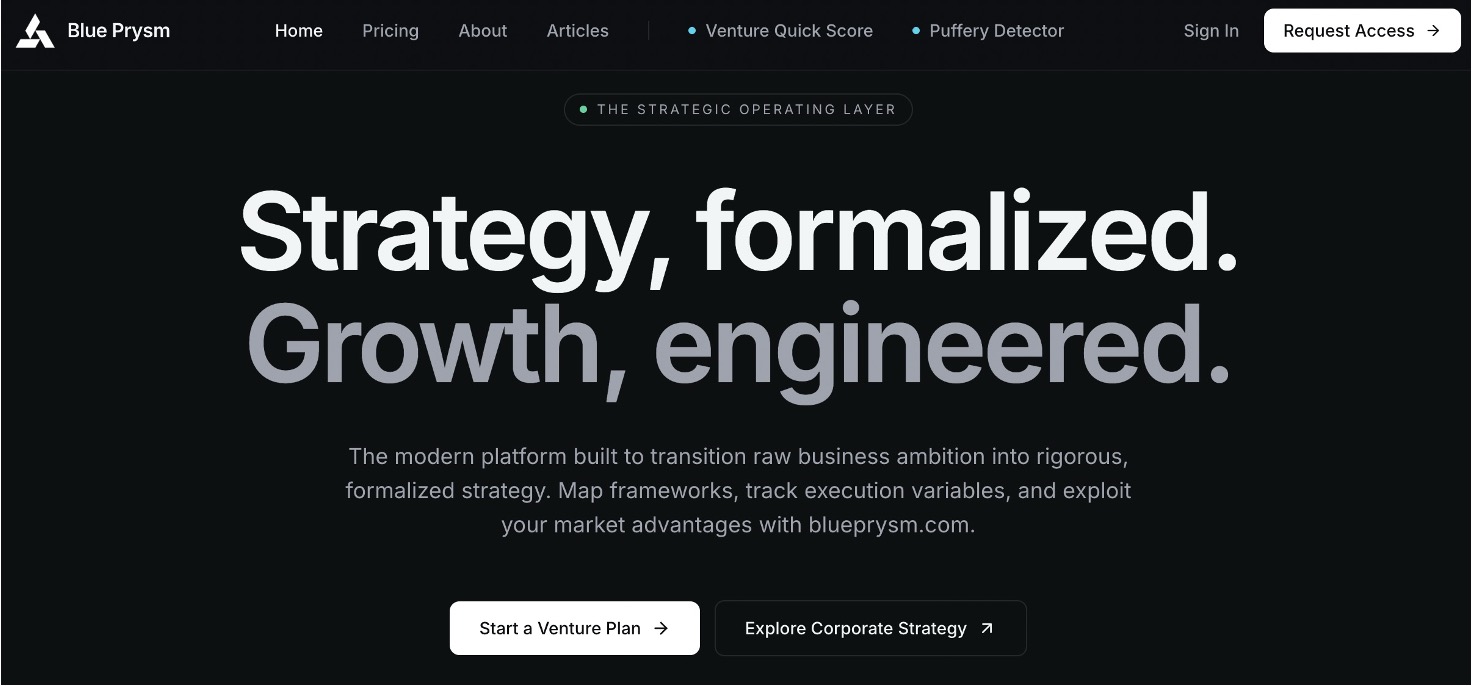
Blue Prysm’s market analysis platform gives entrepreneurs real-time competitive intelligence and market briefings without the consulting fees. You can assess your differentiation, monitor competitor moves, and pressure-test your positioning before you spend a dollar on ads or development. The AI-powered market research tools are built specifically for founders and strategy teams who need fast, credible answers, not generic reports. If you are serious about validating your idea with real data, Blue Prysm is where that work gets done efficiently.
FAQ
What is the first step in validating a business idea?
Define your target customer and the specific problem they face before running any test. If you cannot name 10 potential customers, you are not ready to validate.
How many customer interviews do you need for idea validation?
The Founder Institute recommends 20–30 interviews focused on past behavior. Fewer than 15 rarely produces reliable patterns.
What is a kill criterion in idea validation?
A kill criterion is a pre-defined threshold that tells you to stop or pivot. For example: “If fewer than 3 of 30 prospects offer a deposit, we do not build.”
How much does idea validation cost?
Thorough validation typically costs under $200, combining customer interviews with a landing page test running $50–$100 in ad spend.
What is the difference between interest and validated demand?
Interest is verbal enthusiasm. Validated demand is a financial commitment, such as a deposit, pre-order, or signed letter of intent, from someone outside your personal network.