


TL;DR:
- Most SME owners believe competitive intelligence is only for large companies with extensive resources, but it offers a crucial strategic advantage. An effective, right-sized CI program focuses on competitor analysis, market monitoring, and self-assessment to inform decision-making rather than data collection. Regular, targeted insights drive actions that improve market positioning, product development, and sales performance.
Most small and medium-sized business owners assume competitive intelligence is a luxury reserved for companies with dedicated research teams and six-figure consulting budgets. That assumption is costing them deals, market share, and strategic clarity every single quarter. The reality is that a well-structured CI program, sized appropriately for your resources, is one of the most asymmetric advantages available to an SME today. This guide breaks down exactly what competitive intelligence looks like for smaller businesses, how to build a practical program without drowning in data, and how to turn raw market signals into the kind of decisions that actually move the needle.
Table of Contents
- What is competitive intelligence and why should SMEs care?
- Key components of a right-sized competitive intelligence program
- The competitive intelligence cycle: From capturing data to smarter decisions
- Benchmarking and market positioning: Turning CI findings into strategy
- Why most SMEs fail at competitive intelligence—and what to do instead
- Accelerate your competitive intelligence with Blue Prysm
- Frequently asked questions
Key Takeaways
| Point | Details |
|---|---|
| Right-size your CI | Prioritize a focused, actionable approach to competitive intelligence tailored to SME resources. |
| Follow a proven CI cycle | Use a capture, interpret, activate, and learn loop to turn market data into better decisions. |
| Turn insights into action | Deliver findings as practical decision briefs that drive benchmarking, positioning, and team alignment. |
| Avoid CI pitfalls | Measure outcomes, manage scope, and shape analysis for business impact—not just information gathering. |
What is competitive intelligence and why should SMEs care?
After establishing the urgency, we need to ground this conversation in what competitive intelligence really means, because most definitions either overcomplicate it or strip it down to “just Google your competitors.”
Competitive intelligence (CI) is the systematic process of gathering, analyzing, and applying information about competitors, market trends, and external forces to improve your strategic decisions. It is not corporate espionage. It is not a one-time market study. And it is absolutely not something only Fortune 500 companies can afford to run effectively.
The persistent myth that CI belongs in enterprise boardrooms is one of the most damaging misconceptions in the SME space. The truth is that large companies have the resources to survive bad decisions. You often do not. That makes rigorous, timely competitive intelligence more critical for a 50-person company than for a 50,000-person one.
CI for SMEs should be grounded in market research that clarifies the competitive landscape and links findings to sustainable advantage. What does a practical CI scope actually cover for an SME? Here is a working list:
- Direct competitor pricing, positioning, and product changes
- Indirect competitors and adjacent market entrants
- Customer sentiment shifts and emerging demand signals
- Regulatory changes and economic headwinds relevant to your sector
- Your own strengths, weaknesses, and strategic vulnerabilities
That last item is often overlooked. SME-specific CI includes ongoing market monitoring and self-assessment while focusing scope to match limited resources. Self-assessment is not navel-gazing. It is knowing where you are exposed before a competitor exploits it.
“Competitive intelligence is not about knowing everything. It is about knowing the right things at the right time to make the right call.”
If you want to go deeper on how to translate CI findings into practical advantage steps or explore AI strategies for advantage, those are logical extensions of what we cover here.
Key components of a right-sized competitive intelligence program
Once you know why CI is crucial, it is time to break down what elements a focused SME intelligence program must include and how to tailor them for smaller teams.

The trap most SMEs fall into is trying to replicate an enterprise CI function with a fraction of the resources. The result is either analysis paralysis or, worse, a pile of reports that nobody reads. The fix is not to do less. It is to do less of the wrong things and more of the right ones.
A well-functioning SME CI program has three core dimensions: competitor analysis, market monitoring, and internal self-assessment. Each dimension should feed directly into your planning and decision cycles, not sit in a folder somewhere.
| Activity | SME approach | Enterprise approach | Resource note |
|---|---|---|---|
| Competitor tracking | 3-5 key rivals, monthly cadence | Full competitive landscape, weekly | Manageable with 2-4 hours/week |
| Market monitoring | Industry news, customer signals | Dedicated analyst team | Automatable with AI tools |
| Internal benchmarking | Quarterly self-assessment | Continuous performance dashboards | Align with OKR cycles |
| Economic trend analysis | Sector-specific scanning | Macro and micro analysis | Focus on 2-3 relevant drivers |
| Customer intelligence | Periodic win/loss reviews | Structured VoC programs | Start with sales call debrief |
Scope management is essential; limit analysis to optimize resources but cover core areas including competitors, market monitoring, and economic trends. If you try to track everything, you will act on nothing.
The SBA recommends assessing market share, barriers, strengths and weaknesses, and indirect competition to build a sustainable edge. That framework is genuinely useful because it forces you to think about the competitive landscape in terms of strategic implications, not just raw data.
Pro Tip: Set a quarterly scope review. Ask yourself: “Which three competitors are most likely to affect our revenue in the next 90 days?” Track those closely and let the rest sit on a lower-frequency watch list. This single habit will cut your information overload by 60% while sharpening the relevance of what you actually analyze.
Understanding these components also connects naturally to decision-making trends reshaping how SMEs plan, and to the broader concept of decision intelligence for SMEs as a strategic capability.
The competitive intelligence cycle: From capturing data to smarter decisions
Now that we have detailed the building blocks, let us see how to activate a practical CI process that actually drives decisions instead of sitting in inboxes.

A lot of SMEs collect competitive data but never act on it. They build a spreadsheet, fill it in for two months, and then abandon it when things get busy. That is not a CI program. That is a graveyard of good intentions.
A practical CI operating model is a continuous cycle: capture signals, interpret them, activate by delivering insights, and then learn and adjust. Here is how that translates into practice for an SME:
- Capture. Collect signals from structured sources (competitor websites, earnings calls, job postings, pricing pages) and unstructured ones (social media, review sites, sales rep feedback, customer churn conversations).
- Interpret. Filter noise from signal. Ask: “Does this data point change a decision we are currently facing or planning?” If no, log it and move on. If yes, escalate it immediately.
- Activate. Deliver the insight in a format decision-makers can use. Not a 40-slide deck. A one-page decision brief that frames the finding, the implication, and the recommended action.
- Learn. After acting on a CI insight, track the outcome. Did the repositioning work? Did the pricing adjustment hold? Feed that feedback back into your capture criteria.
Here is what that looks like mapped to actual tools and outputs:
| CI cycle step | Example tools | Key actions | Output |
|---|---|---|---|
| Capture | RSS feeds, review trackers, job boards | Monitor competitor job posts, pricing, product updates | Raw signal log |
| Interpret | Spreadsheet, AI summarization tools | Filter by decision relevance, identify patterns | Prioritized insight list |
| Activate | Email brief, Slack message, planning doc | Share with relevant team leads | Decision brief |
| Learn | CRM data, revenue reports, pipeline data | Compare predicted vs. actual outcomes | Adjusted CI criteria |
Pro Tip: Format matters enormously. Decision-makers at SMEs are pressed for time, so deliver insights as decision briefs, not comprehensive reports. A brief answers three questions: What happened? What does it mean for us? What should we do? Keep it under one page.
Benchmarking and market positioning: Turning CI findings into strategy
With strong CI processes in place, the big question is how to translate findings into meaningful, differentiated strategy. This is where many SMEs stop short. They gather solid intelligence and then never operationalize it.
The most effective SMEs use their CI outputs across four specific applications:
- Competitive benchmarking: Systematically comparing your product, pricing, and customer experience against key rivals to identify gaps and opportunities
- Positioning refinement: Using competitor messaging analysis to find whitespace in how you differentiate and where their narratives fall short
- Action plans: Converting CI findings into 30 to 90 day sprint priorities for product, sales, or marketing teams
- Cross-team alignment: Sharing validated CI findings in regular team syncs so everyone is working from the same strategic picture
The benchmarking piece is particularly powerful. CI frameworks enable benchmarking of competitor capabilities and strategies, mapping the competitive landscape, and aligning teams, while validated findings create clear opportunities.
The case for benchmarking is not just theoretical. An AI platform company used structured CI to map competitor GTM strategies and uncover a positioning gap their rivals had missed entirely. They refined their own messaging and repositioned their primary product tier within 60 days of completing the benchmarking analysis. The result was a measurable improvement in qualified pipeline from segments they had previously struggled to enter.
“You do not need perfect intelligence. You need better intelligence than your competitors are acting on. That is the whole game.”
The key is regularity. A quarterly CI review that feeds directly into your strategy cycle is worth ten sporadic deep dives that never connect to planning. Build the cadence, protect the time, and use emerging AI trends to automate the collection layer so your team can focus on interpretation and action.
Why most SMEs fail at competitive intelligence—and what to do instead
Here is the uncomfortable truth we have seen play out repeatedly: most SME CI programs fail not because of a lack of data, but because of a lack of discipline about what data is for.
Teams fall into what we call the “collection trap.” They subscribe to industry newsletters, set up Google Alerts, bookmark competitor blog posts, and build elaborate tracking spreadsheets. Then they look up six months later and have a mountain of information that has never once influenced a pricing decision, a product roadmap, or a hiring plan. That is not competitive intelligence. That is competitive anxiety dressed up as rigor.
CI programs can fail when analysis is not shaped for the point of decision; measuring outcomes and focusing on material changes are critical. The fix requires a mindset shift. Stop asking “What is our competitor doing?” and start asking “What decision do we need to make in the next 30 days, and what do we need to know to make it well?”
Three failure patterns show up most often in SME CI efforts:
Analysis for analysis’ sake. The team produces thorough, well-researched reports that circulate, get acknowledged, and then collect digital dust. Nobody is accountable for acting on them.
Information overload. Tracking too many competitors across too many channels creates noise that buries the genuinely important signals. The analyst spends their time curating rather than interpreting.
Misaligned delivery. Even good insights fail if they reach the wrong person at the wrong time in the wrong format. A detailed SWOT analysis emailed to a sales team the week before quarter close is not CI. It is clutter.
The solution is to tie every CI activity back to a live business decision. What are you deciding in the next 60 days? Map your CI scope to those decisions and let everything else wait. Use short-format decision briefs instead of long reports. Assign an owner to every insight, not just the collection process.
How do you know when CI is actually working? Watch for these signals: leadership starts citing competitive context in planning meetings without being prompted. Sales reps reference competitor positioning in deal notes. Product discussions begin with market framing, not just internal preferences. Those are the indicators that CI has moved from a reporting exercise to a decision-making muscle. You can deepen this shift by studying business decision-making trends that reflect how high-performing SMEs are integrating intelligence into everyday planning.
CI is not a competitive advantage when it lives in a database. It is a competitive advantage when it changes what you do on Monday morning.
Accelerate your competitive intelligence with Blue Prysm
Building a right-sized CI program from scratch is one of the highest-leverage investments an SME can make, but it does not have to mean months of setup or expensive consulting retainers.
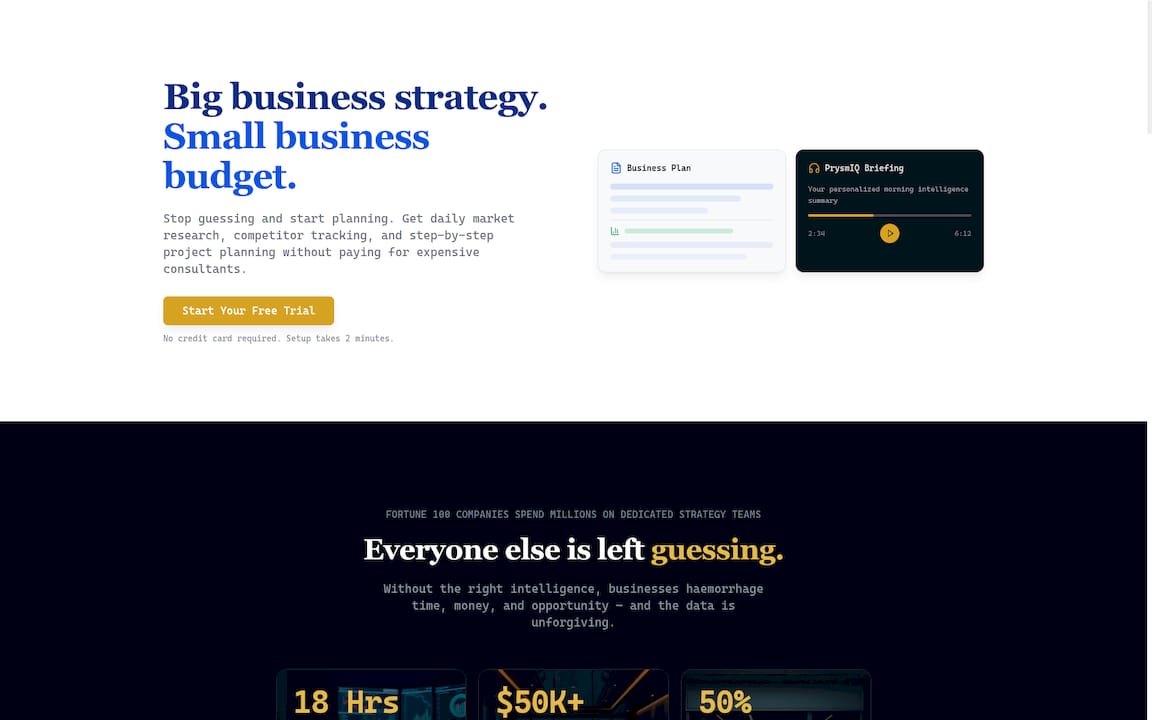
Blue Prysm is purpose-built for exactly this challenge. The platform delivers AI-powered market briefings, competitor monitoring, and strategic planning tools that SMEs can activate immediately without needing a dedicated analyst on staff. Whether you are just starting to formalize your CI process or looking to scale what you already have, understanding how Blue Prysm works will show you how fast intelligent CI can move from concept to action. If you want to validate a new market opportunity or benchmark a competitor strategy before your next planning cycle, the Venture Quick Score tool gives you structured, data-backed assessment in minutes. Explore Blue Prysm’s pricing to find the tier that fits your team size and intelligence needs.
Frequently asked questions
What are the most important components of SME competitive intelligence?
SME-specific CI includes market monitoring and economic context analysis with focused scope, so the most important components are analyzing direct and indirect competitors, monitoring market trends, and conducting regular internal self-assessments to identify strategic gaps.
How do SMEs get started with competitive intelligence?
Start by identifying your three to five most relevant competitors and the two or three market forces most likely to affect your revenue in the next quarter. The SBA advises assessing competitor characteristics and focusing on practical analysis for a sustainable competitive edge, so build a simple, repeatable process before adding complexity.
What pitfalls should SMEs avoid in their CI programs?
Avoid tracking too many sources and producing analysis that never reaches the people making decisions. CI programs fail when not shaped for the moment of decision, so measuring whether insights actually change outcomes is just as important as producing them.
How does CI deliver actual business impact for SMEs?
Benchmarking competitors, identifying market positioning gaps, and aligning your team around validated findings are the core impact mechanisms. CI frameworks support benchmarking, validate findings, and help refine positioning for stronger strategic impact over time.
Recommended
- Assess competitive advantage: practical steps for business leaders – Blue Prysm – Articles & Blogs
- Unlock the power of decision intelligence for SMEs – Blue Prysm – Articles & Blogs
- AI strategies that actually build competitive advantage – Blue Prysm – Articles & Blogs
- Top business decision-making trends for a competitive edge – Blue Prysm – Articles & Blogs