


TL;DR:
- Most SMBs lack a systematic, ongoing approach to market intelligence, leading to reactive decisions. Building a repeatable process around specific questions, regular reviews, and cross-team collaboration creates sustainable competitive advantage. Tools support this process, but discipline and consistency are crucial for turning raw data into actionable insights.
You missed the competitor’s price drop. Or you heard about a market shift three weeks after it mattered. Sound familiar? For most small and medium-sized businesses, market intelligence is either an afterthought or a fire drill. The companies winning today aren’t necessarily bigger or better funded. They’re simply more systematic about how they collect, process, and act on information. This guide walks you through a practical, AI-enabled intelligence process that turns raw market noise into clear business moves, without the budget of a Fortune 100 research team.
Table of Contents
- What you need to get started with actionable intelligence
- A five-step actionable intelligence process
- Common mistakes and troubleshooting tips
- What results to expect and how to measure impact
- Why a simple, repeatable process beats fancy tools
- Take your intelligence process further with Blue Prysm
- Frequently asked questions
Key Takeaways
| Point | Details |
|---|---|
| Process beats tools | Establishing a consistent, repeatable intelligence process delivers better results than relying on new technology alone. |
| Five-step workflow | Systematically collect, process, analyze, and activate insights with an AI-enabled step-by-step plan. |
| Avoid common mistakes | Regular reviews and a focus on action, not just data, prevent wasted effort and improve decisions. |
| Measurable outcomes | Set KPIs and track improvements in speed, visibility, and competitive edge as you update your intelligence routine. |
| Start simple, scale up | Begin with clear questions and basic frameworks, then add automation and AI as your needs grow. |
What you need to get started with actionable intelligence
Before you buy another tool subscription or hire a research consultant, stop. The most common trap SMBs fall into is confusing data access with intelligence capability. More dashboards don’t equal better decisions. What you actually need is a system: a repeatable, structured process that your team runs consistently, not just when the quarterly board meeting is three days away.
The foundational mindset shift is this: intelligence is ongoing, not episodic. Think of it like maintaining a vehicle. You don’t change the oil once and call it done. You build a schedule, you track what was done, and you stay ahead of problems. Market intelligence works exactly the same way.
Framework-heavy, tool-light approaches emphasize that the bottleneck is not access to information but a systematic process. Most SMBs already have access to enough data. Google Alerts, LinkedIn, industry publications, customer conversations. The gap is almost never the raw material. It’s the lack of a structured approach to turn that material into something you can actually act on.
So what does your organization need before you start? A few foundational capabilities:
- A defined list of business questions you want intelligence to answer (not vague goals like “understand the market,” but specific questions like “which competitors are targeting our top customer segment this quarter?”)
- Commitment to regular review cycles, even if it’s just 45 minutes per month
- Cross-team cooperation, because sales, product, and marketing each hold pieces of the picture
- Basic data hygiene, meaning you track what you find, where you found it, and when
Here’s a clear-eyed comparison to help you decide where you are right now:
| Approach | Pros | Cons | Best for |
|---|---|---|---|
| Framework-heavy, tool-light | Low cost, builds analytical muscle, highly customizable | Time-intensive, depends on team discipline | Early-stage SMBs, lean teams |
| Tool-centric, low process | Fast data collection, automated alerts | Data overload, unclear actions, high churn | Teams with no analytical bandwidth |
| Process-first, AI-augmented | Scalable, actionable outputs, sustainable | Requires initial setup investment | Growing SMBs ready to scale intelligence |
The third option is where systematic intelligence generation creates lasting competitive advantage. Process first, tools second. Always.
Pro Tip: Before you evaluate any new intelligence tool, write down your top five business questions. If the tool can’t help answer them specifically, it’s not the right fit yet.
A five-step actionable intelligence process
With the right mindset and frameworks in place, let’s walk through the actual process. This is the core engine. Think of it as five interlocking gears: when each one turns cleanly, the whole machine produces insight you can use.
A practical AI buyer intelligence stack can be implemented as layered stages: sources, collection, processing, analysis, and activation. Each stage has a specific job and a specific set of failure modes. Skipping a stage, or doing it sloppily, degrades every stage that follows.
The five steps:
-
Sources: Identify where your market signal actually lives. This includes competitor websites, review platforms, job postings, regulatory filings, social media, industry reports, and customer interviews. Don’t try to cover everything at once. Start with three to five high-signal sources.
-
Collection: Establish a consistent cadence for pulling from those sources. Weekly for fast-moving markets, bi-weekly for slower ones. Automate where you can using RSS feeds, Google Alerts, or AI monitoring tools. Manual beats nothing, but automation beats manual.
-
Processing: This is where most teams drop the ball. Raw data is not intelligence. Processing means tagging, categorizing, and filtering. Ask: is this signal relevant to one of our defined business questions? If not, set it aside. If yes, note the source, date, and potential impact.
-
Analysis: Now you make sense of it. Look for patterns. Is a competitor consistently hiring sales engineers in a new region? That’s a market expansion signal. Are customer reviews for a rival suddenly mentioning slow delivery? That’s a potential opportunity. This stage requires judgment, not just data.
-
Activation: Intelligence that doesn’t change a decision is waste. Activation means taking your analysis into a meeting, a product roadmap, a pricing review, or a GTM adjustment. Document what action was taken and why. This creates a feedback loop you can learn from.
Here’s how the five stages map to real outputs:
| Stage | Goal | AI-enabled methods | Common pitfalls |
|---|---|---|---|
| Sources | Define signal channels | AI-assisted source discovery | Too many sources, no prioritization |
| Collection | Gather relevant raw data | Automated scrapers, alert tools | Inconsistent cadence, data gaps |
| Processing | Filter and tag data | NLP classification, tagging tools | No clear criteria for relevance |
| Analysis | Identify patterns and meaning | AI summarization, trend detection | Analysis paralysis, no clear output |
| Activation | Drive a business decision | Briefing docs, strategy tools | Insights shared but never acted on |
The beauty of this process is that it scales. You can run a lean version manually, and gradually automate each stage as your volume grows. Real-world AI-powered strategy follows exactly this pattern: small, consistent inputs compounding into meaningful strategic advantage over time.

Building the cadence is the hardest part. The analysis and activation stages feel rewarding. The collection and processing stages feel like chores. Stick with them anyway. That’s where the competitive edge is built.
Common mistakes and troubleshooting tips
Once the process is defined, execution is where things go sideways. This section covers the mistakes we see most often, and more importantly, how to fix them.
The classic mistakes:
- Treating intelligence as a one-time project. You run a competitor analysis before a product launch, then don’t touch it for 18 months. By then it’s archaeology, not intelligence.
- Vague intelligence questions. “What’s happening in our market?” is not a question intelligence can answer. “Which competitors are expanding into our core geography this year?” is.
- Trying to track everything. This leads to a 200-row spreadsheet that no one maintains after week three. Focus beats coverage every time.
- No owner for the process. If everyone is responsible, no one is. Assign one person to manage the intelligence cadence, even if it’s part-time.
- Ignoring internal signals. Sales lost a deal last week. Did you debrief why? Customer churned. Did you capture the reason? Internal signals are intelligence too.
- Not closing the loop. You did the analysis. You shared the briefing. But did anyone actually change a decision because of it? Track activation, not just output.
“Competitor analysis should be reviewed regularly, not as a one-time activity.” Keeping your intelligence current is not optional. It’s the foundation of every informed decision your business makes.
For troubleshooting, here are the most common failure modes and practical fixes:
Low insight quality: Usually a processing problem. Go back and tighten your relevance criteria. You’re likely letting too much irrelevant noise through. Ask: “Does this directly relate to one of our top five business questions?”
Internal resistance: This happens when intelligence outputs don’t look useful to the people receiving them. Fix this by involving your sales or product leads in defining the questions at the start. When people help design the process, they use the outputs.
Update fatigue: If your team dreads the monthly intelligence review, the format is probably too heavy. Shift to a one-page briefing with three bullets, three risks, and three opportunities. Simple formats get read. Long reports get skipped.
Pro Tip: Set a recurring calendar block for intelligence reviews and tie them directly to your planning cycles. A review that happens quarterly before budget planning gets acted on. A review that floats in the calendar gets rescheduled indefinitely.
Strong decision-making best practices are built on consistent information inputs, and staying current on business decision-making trends helps you adapt the process as your market evolves.
What results to expect and how to measure impact
After working out the kinks in execution, it’s time to talk about what you’re actually working toward. Setting clear expectations upfront keeps the process honest and gives your team a reason to stay engaged.

Regular review cycles help SMBs respond quickly and identify opportunity windows before competitors do. Here’s what that looks like in practice across four core outcome areas:
Better, faster competitive moves: Instead of reacting to a competitor’s product launch six weeks after the fact, you spot the signal early, usually through job postings, beta user reviews, or pricing page changes, and adjust your GTM strategy before the impact hits your pipeline.
Targeted product changes: Customer sentiment analysis and competitive feature tracking point directly to product gaps. You stop guessing what to build and start responding to documented demand signals.
Improved deal win/loss ratios: When your sales team has fresh, accurate competitive intelligence in hand, they position more effectively. They know the rival’s weaknesses and they can speak to them honestly without overselling.
Smarter resource allocation: Intelligence tells you which bets to double down on and which to deprioritize. That’s how you stop spreading a limited budget across ten initiatives and start concentrating it on the three that actually matter.
Here’s the before-and-after picture most SMBs experience:
| Dimension | Before systematic intelligence | After systematic intelligence |
|---|---|---|
| Competitive visibility | Reactive, spotty, anecdotal | Proactive, structured, evidence-based |
| Decision speed | Weeks to respond to market shifts | Days, sometimes hours |
| Decision quality | Gut-driven, inconsistent | Data-informed, repeatable |
| Team alignment | Siloed, conflicting narratives | Shared context, unified direction |
KPIs worth tracking:
- Number of new opportunities identified per quarter through intelligence reviews
- Time to respond to a competitive threat (measure from signal detection to business action)
- Percentage of strategic decisions supported by documented intelligence
- Adoption rate of intelligence outputs across teams (are people actually reading and using the briefings?)
- Win rate change on deals where competitive intelligence was actively used
Building competitive advantage with AI isn’t a sprint. But SMBs that track these KPIs consistently see compounding returns. Each cycle, the process gets tighter. Each quarter, the signal-to-noise ratio improves. That’s how you close the gap with better-resourced competitors without matching their budget.
Why a simple, repeatable process beats fancy tools
Here’s an uncomfortable truth: the intelligence gap for most SMBs isn’t a technology problem. It’s a discipline problem. We’ve seen founders spend thousands on market research platforms, only to log in twice before the subscription quietly lapses. The tool wasn’t wrong. The process wasn’t there to support it.
There’s a seductive logic to the tool-first approach. You buy a new platform, you feel like you’ve made progress, and the problem feels temporarily solved. But buying a CRM doesn’t make you better at sales relationships. Buying an analytics tool doesn’t make you better at reading data. And buying an intelligence platform doesn’t automatically make you better at strategic thinking.
What actually works? A boring, consistent cadence. A shared vocabulary for what questions matter. A culture where someone looks at the briefing and says, “Based on this, we should change our pricing on the enterprise tier.” That’s it. That’s the whole game.
The teams that get the most from decision intelligence for SMEs aren’t the ones with the most sophisticated tech stacks. They’re the ones who run a 45-minute intelligence review every month without fail and hold each other accountable to acting on what they find.
Our honest recommendation: build your process manually first. Run two or three cycles. Find where it breaks. Then, and only then, invest in tools that automate the parts that are actually slowing you down. Adding AI to a broken process just makes the mess happen faster.
Take your intelligence process further with Blue Prysm
Everything we’ve covered in this guide, from defining your business questions to running activation reviews, requires consistency and structure that’s hard to maintain manually at scale.
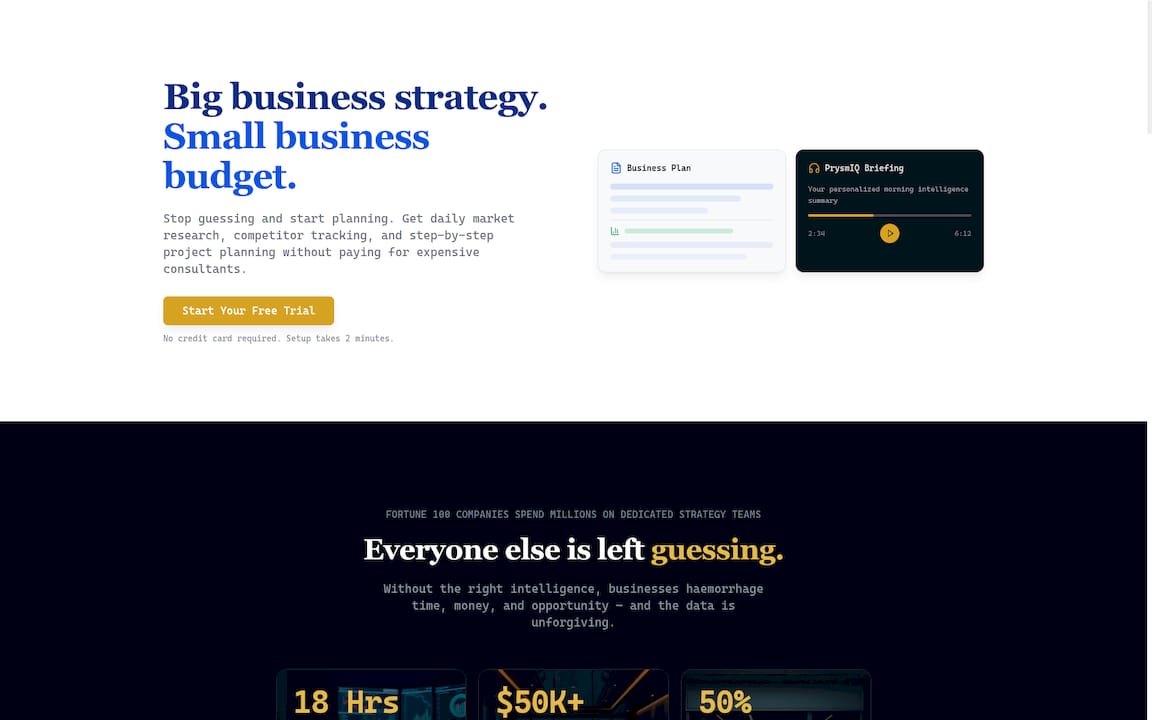
Blue Prysm is built specifically to help SMBs operationalize this kind of systematic intelligence. The platform handles daily market briefings, competitor monitoring, and strategic framework development in a single place, so your team spends less time gathering and more time acting. You can explore how Blue Prysm works and see exactly how the five-step process maps to real platform features. Whether you’re just getting started or looking to sharpen an existing process, Blue Prysm gives you the structure without the consulting price tag. Check out Blue Prysm pricing to find the right plan for your team’s stage and size.
Frequently asked questions
What is actionable intelligence for SMBs?
Actionable intelligence is the process of systematically collecting and analyzing data on buyers, competitors, and markets to generate clear business decisions that drive competitive advantage for SMBs.
How often should we update our market intelligence?
Best practice is at least quarterly, but markets that move fast demand monthly or even weekly updates. The SBA recommends ongoing cadences rather than treating competitor analysis as a one-time activity.
What tools do SMBs need to start with actionable intelligence?
You can start with spreadsheets and simple frameworks. Process-first approaches consistently outperform tool-heavy setups that lack a repeatable structure, so build the habit before you invest in automation.
What KPIs show my intelligence process works?
Track opportunity identification rate, decision speed from signal to action, and team adoption of intelligence outputs. Regular review cycles that tie directly to strategic planning are the strongest indicator that intelligence is generating real business value.
How do I tie intelligence to real business results?
Start with specific, answerable business questions, run consistent update cycles, and document which decisions changed because of what you learned. Concrete links between findings and actions, like a product pivot or a pricing adjustment, are the clearest proof that your process is working.