


TL;DR:
- AI-powered strategic insights are now accessible and affordable for small and medium-sized enterprises, enabling faster, more predictive decision-making.
- Operationalizing these insights through real-time workflows and narrative summaries ensures they are actionable and contextually clear, giving SMEs a competitive advantage.
Most small business owners assume AI-powered strategic intelligence is a Fortune 500 luxury, something that requires a dedicated data science team, a seven-figure analytics budget, and months of implementation. That assumption is flat-out wrong, and clinging to it is costing you competitive ground every single quarter. The reality is that AI-driven business insights are now accessible, affordable, and operationally practical for SMEs. This guide walks through the mechanics, the workflows, and the governance principles you need to turn raw data into decisions that actually move your business forward.
Table of Contents
- What are business insights and how are they powered by AI?
- Making business insights actionable: connecting analysis to decisions
- GenAI-powered narrative summaries: Context and clarity
- Integrating internal and external data for market-driven strategy
- Competitive analysis: Unlocking actionable market intelligence
- Governing AI business insights: Edge cases, rule conflicts, and risk management
- A smarter SME approach: Insights that actually move the needle
- How Blue Prysm empowers SME decision-makers
- Frequently asked questions
Key Takeaways
| Point | Details |
|---|---|
| AI insights power SMEs | AI-driven tools empower small businesses to compete using predictive and actionable intelligence. |
| Connect analysis to action | Real-time workflow integration turns business insights into decisions rapidly and effectively. |
| Narrative summaries add context | GenAI-generated summaries help decision-makers understand the drivers and implications of insights. |
| Competitive analysis leveraged by AI | AI agents help SMEs synthesize market intelligence for practical competitive advantage. |
| Governance prevents insight errors | Edge-case management and rule oversight ensure AI business insights stay reliable and relevant. |
What are business insights and how are they powered by AI?
Let’s start with a definition that actually matters in practice. A business insight is not a report. It is not a dashboard metric sitting in a spreadsheet that someone reviews once a month. A genuine business insight is a specific, actionable finding that connects a pattern in your data to a decision you need to make right now.
Traditional business intelligence (BI) has historically been descriptive, meaning it answers “what happened?” Modern AI goes further into predictive territory (“what is likely to happen?”) and prescriptive territory (“what should we do about it?”). That shift is massive. It is the difference between looking in the rearview mirror and having a GPS.
Here is what AI actually does under the hood that traditional reporting cannot match:
- Anomaly detection: AI flags when a KPI drifts outside its normal range, often before a human analyst would notice. For example, if your customer acquisition cost spikes 18% in a single week, an AI system alerts you immediately rather than waiting for the monthly review.
- Pattern recognition: AI identifies correlations across large datasets that no human team could manually surface. Seasonal demand shifts, customer churn signals, supply chain delays. These patterns become visible at scale.
- Forecasting: AI models generate forward-looking projections based on historical trends, market signals, and external variables, giving you a probabilistic view of future performance rather than a guess.
“AI-driven business insights detect patterns and anomalies in large volumes of data to provide predictive guidance, enabling faster and more confident decisions.”
The AI strategies that build advantage for SMEs are not about deploying complex infrastructure. They are about choosing the right tools that surface the right signals at the right moment. Platforms built around decision intelligence for SMEs are specifically designed to deliver this without requiring a dedicated analytics team. The real proof is in data-driven strategy wins that show SMEs outperforming competitors not by outspending them, but by out-thinking them with better information.
Making business insights actionable: connecting analysis to decisions
Understanding the mechanics of AI is useful. But the harder challenge for most SME leaders is operationalizing insights, getting the right information to the right person at the right moment so that a decision can actually be made. This is what separates organizations that use data from organizations that benefit from it.
Operational intelligence is the discipline of routing insights directly into decision workflows. Think of it as the last mile of analytics. You can have the most sophisticated AI model in the world, but if the output sits in a dashboard that your sales manager checks once a week, you have a lag problem. Real-time operational intelligence means insights reach decision-makers with minimal delay, enabling responses that are measured in hours rather than weeks.
Here is a repeatable workflow for decision-ready insights:
- Define the decision first. Before you build any analytics workflow, identify the specific decisions it will support. Pricing adjustments? Inventory reorders? Campaign budget shifts? The decision drives the data requirement, not the other way around.
- Map the data sources. Identify which internal systems (CRM, ERP, POS) and external sources (market reports, competitor pricing, news feeds) feed the decision.
- Set trigger thresholds. Establish the conditions under which an alert is generated. A 10% drop in conversion rate. A competitor price change. A shift in customer sentiment score.
- Route to the owner. Assign each insight type to a specific decision-maker. No ambiguity about who acts on what.
- Capture the outcome. Log decisions made from AI-generated insights so you can assess accuracy and refine thresholds over time.
This is exactly the kind of workflow that connecting analytics to workflows makes possible without custom engineering. Smarter decision-making at the SME level is almost always a process problem, not a technology problem.
Pro Tip: Monitor your AI models for drift. If your market conditions shift significantly, older models may generate recommendations that no longer fit reality. Build a quarterly review of model performance into your workflow and adjust inputs as your business evolves. Keep an eye on decision-making trends to know when the landscape demands a recalibration.

GenAI-powered narrative summaries: Context and clarity
Numbers tell you what happened. Narrative tells you why it matters. This is where generative AI becomes genuinely powerful for SME decision-makers who do not have analysts to interpret data outputs for them.
GenAI tools do not just apply rule-based templates to your data. They generate narrative summaries and aggregate insights across parent and child hierarchies, giving you contextual explanations that surface contributing factors rather than isolated data points. In plain terms, instead of seeing “revenue down 12%,” you see “revenue declined 12% in the Northeast region, driven primarily by a 30% drop in enterprise deal closures, which correlates with a competitor’s aggressive promotional campaign launched in week 3.”
That context changes everything about how you respond.
Here is how SMEs can apply GenAI narrative summaries in practice:
- Select a specific insight from your analytics dashboard, such as a KPI that has moved outside its normal range.
- Trigger the ‘Summarize’ function available in GenAI-enabled platforms to generate a plain-language explanation of the contributing factors.
- Review the hierarchy aggregation, meaning the system will show how different product lines, regions, or customer segments contribute to the top-level movement.
- Use the narrative as a briefing document for decision-makers who need context without needing to dig through raw data themselves.
Pro Tip: Use GenAI summaries specifically when complex decisions involve multiple contributing factors. The narrative format forces the AI to surface the “why” behind a number, which is where strategic clarity actually lives. When reviewing AI strategies for SMEs, you will consistently find that the organizations winning with AI are those treating narrative output as a strategic asset, not just a convenience feature. Browse strategy examples for SMEs to see this in action across different industries.
Integrating internal and external data for market-driven strategy
Here is a trap that many SMEs fall into. They build excellent internal analytics, tracking sales performance, customer lifetime value, and operational efficiency with precision, but they make strategic decisions in a vacuum. They are optimizing for yesterday’s market conditions while their competitors are reacting to today’s signals.

Robust strategic planning requires blending your internal performance data with external market intelligence. Integrating internal and external data creates execution-ready decisions that account for both where you stand and where the market is heading.
The following comparison shows why repeatable, structured methods outperform ad hoc research:
| Approach | Frequency | Data sources | Output quality | Decision speed |
|---|---|---|---|---|
| Repeatable workflow | Daily or weekly | Internal + external, automated | Consistent, comparable | Fast, trigger-based |
| Ad hoc research | As needed | Manual, variable | Inconsistent, context-dependent | Slow, reactive |
The case for repeatable over ad hoc is overwhelming once you experience it. Ad hoc research feels thorough in the moment but creates gaps and inconsistencies that erode confidence in the conclusions.
Steps to build an execution-ready strategy using integrated data:
- Define the external signals that matter most to your market: competitor pricing, regulatory changes, supply chain disruptions, and consumer sentiment shifts.
- Establish scenario assumptions you will monitor continuously, not just review annually.
- Combine internal performance trends with external signals in a shared dashboard or briefing format.
- Review integrated data on a fixed cadence so that strategic decisions are informed by current conditions.
For SMEs pursuing structured strategic intelligence, the integration layer is often the highest-value investment because it is where context transforms data into strategy.
Competitive analysis: Unlocking actionable market intelligence
You cannot win a race you are not watching. Competitive analysis is not a one-time exercise you do at launch. It is an ongoing intelligence function that should feed directly into your pricing, positioning, product, and GTM strategies.
The SBA recommends explicit steps for competitive analysis: identify competitors by segment, assess strengths and weaknesses, evaluate market share, and map barriers to entry alongside opportunity windows. This framework is sound, but it needs to be automated and repeatable to be useful in real time.
Here is a structured process for AI-assisted competitive analysis:
- Segment your competitive landscape. Separate direct competitors (same product, same customer) from indirect competitors (different product, same need) and emerging entrants.
- Define the assessment dimensions. Pricing, product features, customer reviews, share of voice, geographic reach, and recent funding or partnership activity.
- Set up automated monitoring. Use AI tools to track news mentions, product changes, and pricing updates continuously rather than manually.
- Synthesize into a comparison view. A structured competitor table gives your team an at-a-glance read on where you are differentiated and where you are exposed.
Example competitor comparison:
| Dimension | Your business | Competitor A | Competitor B |
|---|---|---|---|
| Pricing tier | Mid-market | Premium | Budget |
| Core differentiator | Speed of delivery | Brand recognition | Price point |
| Customer rating | 4.6 | 4.2 | 3.9 |
| Recent activity | New product launch | Market expansion | Pricing adjustment |
AI agents executing multi-source research can extract and synthesize competitive intelligence from public filings, news sources, and market histories simultaneously, something no manual process can match for speed or consistency.
Pro Tip: Do not limit your competitive analysis to obvious rivals. Include indirect competitors and emerging entrants who are targeting adjacent customer segments. They often signal where your market is heading before your direct competitors do. AI-powered competitive battle cards are a practical tool for keeping this intelligence organized and actionable.
Governing AI business insights: Edge cases, rule conflicts, and risk management
Let’s talk about the part most AI guides skip. Governance. Not the compliance checkbox version, but the practical discipline of making sure your AI systems do not quietly generate wrong answers that no one catches until a bad decision has already been made.
Edge cases multiply with format changes, language variations, policy drift, and data noise. A model that performs beautifully in controlled conditions can fail in predictable ways when real-world messiness enters the picture.
“Edge cases multiply with format, language, noise, and policy changes. A governance loop and error-budget mindset are not optional for scaling AI systems. They are the cost of operating responsibly.”
Beyond edge cases, conflicting decision rules can produce plausible-sounding but fundamentally incorrect recommendations. An AI system might simultaneously recommend expanding into a new market and cutting operational costs, recommendations that are logically incompatible given your actual resource constraints. Domain understanding is essential for catching these conflicts before they damage real decisions.
Governance steps every SME should implement:
- Version your decision rules and taxonomy. When rules change, document why and what the old version was, so drift is detectable.
- Build a human-in-the-loop (HITL) fallback for high-stakes decisions. AI recommends, a human confirms.
- Establish an error-budget framework. Accept that some AI recommendations will be wrong, define an acceptable error rate, and build processes to catch and learn from failures.
- Run quarterly governance audits to review model performance, rule conflicts, and edge-case logs.
An efficient AI threat analysis workflow incorporates governance by design, not as an afterthought. The SMEs that scale AI successfully treat governance as a competitive asset, not a bureaucratic burden.
A smarter SME approach: Insights that actually move the needle
Here is an uncomfortable truth most AI vendor content will not tell you. The majority of SMEs that invest in analytics tools fail to generate consistent strategic value from them. Not because the technology is bad, but because they underestimate the process discipline required to make insights operational.
Generic advice about “becoming data-driven” glosses over the real SME challenge, which is right-sizing your methods. A solo founder does not need the same analytical infrastructure as a 200-person organization. The fastest wins come from a focused combination of repeatable data workflows, narrative summaries that eliminate interpretation guesswork, and clear ownership of who acts on what.
We have seen this pattern repeatedly. Organizations that treat AI insights as a process discipline consistently outperform those that treat it as a technology project. The proven AI strategies are not about the fanciest tools. They are about matching the right insight type to the right decision at the right frequency.
The hard-won lesson on governance is this: most SME AI failures are silent. The model drifts, the recommendations slowly diverge from reality, and no one notices because there is no governance loop to catch it. Plan for governance from day one, not after the first costly mistake. The real-world data-driven wins consistently share one trait: they were built on disciplined process, not just powerful technology.
How Blue Prysm empowers SME decision-makers
Translating these frameworks into real operational practice is where many SMEs get stuck. The theory is clear. The execution requires tools that are actually built for how SMEs work, not how enterprise IT departments think.
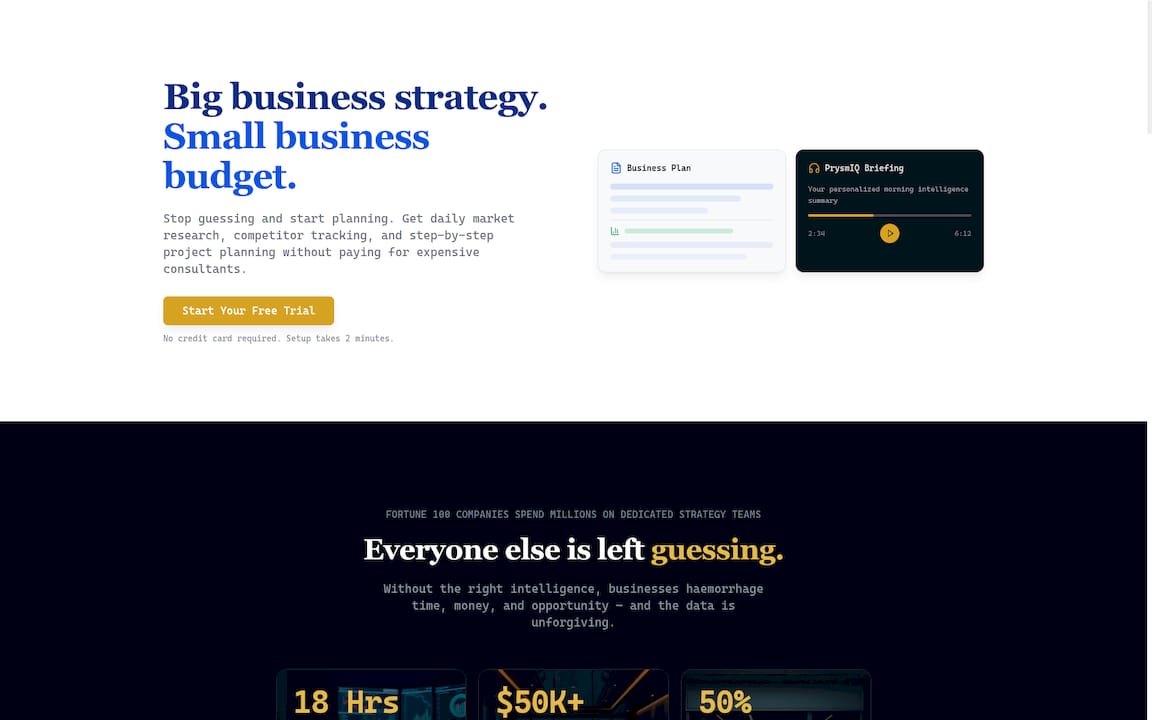
Blue Prysm delivers AI-powered strategic intelligence specifically designed for SME decision-makers. From daily market briefings and competitor monitoring to business planning tools and scenario testing, how Blue Prysm works is built around the principle that actionable insights should take minutes to surface, not weeks to build. Explore SME solutions from Blue Prysm to see how the platform integrates internal and external intelligence into decision-ready briefings. Start with a free AI credibility assessment to immediately benchmark your current strategic approach against what is actually possible.
Frequently asked questions
How does AI differ from traditional business intelligence?
AI generates predictive and prescriptive insights by detecting patterns in data, unlike traditional BI which focuses on historical reporting and answers only “what happened.”
What is model drift and why does it matter for SMEs?
Model drift occurs when business or market conditions change, causing AI recommendations to become less accurate. Scenario and assumption management prevents silent drift that can quietly degrade decision quality.
Can GenAI summaries be trusted for decision-making?
When built on sound data and reviewed with SME context, GenAI narrative summaries provide valuable explanations of contributing factors but should always be validated against domain knowledge before acting.
What are the first steps to implement actionable insights in my business?
Begin by defining the specific decisions you need to support, then integrate internal and market data around those decisions and set up real-time monitoring workflows with clear ownership.
How can I ensure AI business insights are reliable?
Implement governance processes, monitor for edge cases, and regularly version your rules and taxonomy so that errors are caught early before they influence high-stakes business decisions.
Recommended
- Data-Driven Strategy Examples for SMEs: Real-World Wins – Blue Prysm – Articles & Blogs
- Unlock the power of decision intelligence for SMEs – Blue Prysm – Articles & Blogs
- Strategic intelligence: Unlock smarter decisions for SMEs – Articles & Blogs
- AI strategies that actually build competitive advantage – Blue Prysm – Articles & Blogs