


TL;DR:
- Many SME leaders mistakenly believe that subscribing to the latest AI platforms alone creates a competitive advantage, but the true value lies in unique data and strategic judgment. Contextual, proprietary data combined with AI amplifies your business’s distinctive activities, making your advantage difficult to imitate and more sustainable. Small, focused AI pilots leveraging existing data can generate quick wins, fueling ongoing improvements and building a durable market moat over time.
Many SME leaders make the same costly assumption: that subscribing to the latest AI platform is enough to outpace the competition. It feels logical. Powerful tools are now accessible at a fraction of their previous cost, so why wouldn’t access translate directly into advantage? The uncomfortable truth is that when AI models are commoditized, the tool itself stops being the differentiator. What separates winners from the rest is the unique context, data, and strategic judgment they bring to those tools. This article breaks down exactly what competitive advantage means for SMEs in 2026, how AI genuinely accelerates it, and the concrete steps you can take starting this week.
Table of Contents
- What is competitive advantage? Core concepts for SMEs
- AI as a force multiplier: How context and data create a moat
- Competitive advantage examples: Real SME wins with AI
- Turning theory into action: Five practical steps for your SME
- Why speed-to-skill beats size: A fresh look at AI and SME advantage
- Grow your SME’s advantage with Blue Prysm
- Frequently asked questions
Key Takeaways
| Point | Details |
|---|---|
| True advantage is unique | Sustainable edge comes from activities and context your rivals cannot easily copy. |
| AI is only part of the equation | Without proprietary data and tailored context, AI tools rarely yield lasting advantage. |
| SME wins are practical | Real examples show data-driven use cases such as cost savings and automated insights deliver measurable gains. |
| Quick wins build momentum | Starting small with focused pilots lets SMEs capture early ROI and grow competitive moats. |
| Speed-to-skill matters most | The fastest learners and adapters—not just the biggest firms—exploit new AI market opportunities. |
What is competitive advantage? Core concepts for SMEs
With that misconception about AI-driven advantage clarified, let’s dig into the fundamentals of what actually sets high-performing SMEs apart.
Competitive advantage sounds impressive in board decks, but most definitions stay fluffy. Here’s a more precise framing: advantage comes from configuring a firm to perform unique, valuable activities across its value chain that rivals cannot perfectly replicate, leading to superior returns. That’s the gold standard, and it’s surprisingly achievable for smaller businesses when applied with discipline.
Michael Porter gave us the foundational tools to analyze this. Porter’s Five Forces and Generic Strategies including cost leadership, differentiation, and focus give executives a structured lens to examine industry dynamics and choose where to compete rather than just how hard to compete. For SMEs, that distinction matters enormously.
The three generic strategies, made real for SMEs
| Strategy | What it means | SME example |
|---|---|---|
| Cost leadership | Deliver similar value at lower cost than rivals | Regional distributor using AI to slash logistics spend |
| Differentiation | Offer something rivals cannot easily copy | Boutique consultancy with proprietary client data models |
| Focus | Serve a narrow segment better than broad competitors | Specialty food brand targeting allergen-free households |

None of these strategies is inherently better. The trap is trying to do all three simultaneously, which Porter called “stuck in the middle.” SMEs need to pick a lane and go deep.
Here’s today’s critical twist. In 2026, context and proprietary data have become just as important as the strategic positioning itself. A generic AI tool pointed at a generic market produces generic output. But an AI tool fed with your customer purchase history, your supplier pricing data, and your operational workflows? That produces insights your competitors simply cannot replicate because they don’t have your data.
The practical steps for assessing advantage matter as much as the theory. Start by mapping where your business creates value that others don’t. Not where you think you create value. Where the data actually shows customers choosing you over alternatives, paying a premium, or staying longer.
Key factors that determine whether an SME’s advantage is real and durable:
- It’s hard to imitate. A competitor can copy your price. They cannot easily copy your 10 years of customer behavioral data.
- It creates measurable value. Advantage that doesn’t translate to better margins, retention, or growth isn’t actually an advantage.
- It’s built on unique activities. Not just unique marketing, but unique processes, relationships, or knowledge.
- It aligns with shifting decision-making trends. The environment evolves, and static advantage erodes.
Understanding these fundamentals is not academic. It’s the difference between spending on AI tools that actually sharpen your position and spending on tools that give every competitor the same capabilities.
AI as a force multiplier: How context and data create a moat
Now that we know the theoretical foundation, let’s see how AI is reshaping these competitive dynamics, especially for resource-constrained SMEs.
Here’s the honest picture. If your team buys an AI market intelligence platform and your three closest competitors buy the same platform, nobody has gained a structural edge. You’ve all raised the floor, but the ceiling stays level. This is the commoditization trap many SMEs fall into.
“When every company can access the same AI models, context becomes the competitive advantage. Firms that integrate proprietary data and unique business context into AI workflows are the ones that pull ahead.”
The research backs this up. High AI performers achieve 3x greater cost reductions and 1.6x higher EBIT margins compared to laggards. But what separates these leaders from the pack isn’t which AI model they use. It’s how many well-scoped use cases they deploy. Growth winners average 4.5 distinct AI use cases versus 3.3 for laggards, and they achieve 2x greater efficiencies. That’s not a technology gap. That’s a strategy gap.
How proprietary context changes the output

Consider two retail businesses. Both use an AI tool to analyze market trends. Business A feeds it publicly available industry reports and generic competitor data. Business B feeds it the same public data, plus three years of its own sales transactions, supplier contracts, and customer churn signals. Business B doesn’t just get information. It gets insight calibrated specifically to its situation.
This is the data moat concept in practice. Your internal data is something a competitor cannot purchase, scrape, or replicate quickly. When you layer AI on top of that proprietary context, the gap widens with every passing quarter.
| AI input | Output quality | Replicable by competitors? |
|---|---|---|
| Generic public data only | Broad market trends | Easily |
| Public data plus internal sales history | Specific demand signals | Difficult |
| Full value chain data plus customer behavior | Personalized strategic actions | Very hard |
The real AI strategies for SMEs that consistently produce ROI share one trait: they pair AI with something proprietary. Whether that’s your supplier relationships, your customer knowledge, or your operational processes, the AI amplifies what’s already unique about your business.
Pro Tip: Don’t start with the flashiest AI use case. Start with the one where you already have the richest data. If you have deep cost data, begin with cost analysis. If you have granular customer segmentation data, start there. The richest data produces the most defensible insights.
It’s also worth examining emerging AI trends that are reshaping how SMEs can build these moats faster. Automated data pipelines, real-time market monitoring, and AI-generated scenario analysis are lowering the barrier to building data-driven advantages without requiring enterprise-level IT infrastructure.
Competitive advantage examples: Real SME wins with AI
Understanding that context and data unlock real power, it helps to look at tangible examples of SMEs already succeeding with these strategies.
These aren’t hypothetical scenarios. These are documented results from businesses that decided to pair AI with their specific operational data rather than waiting for the perfect conditions.
Three standout cases
-
Sunnyland and data-driven rate negotiation. Sunnyland, a specialty food retailer, used AI-powered data visualization to analyze its shipping patterns and carrier performance. The result was a clear, evidence-backed negotiating position when approaching carriers for better rates. SMEs using AI for shipping analysis achieved measurable cost savings simply by making their own data visible and actionable. The competitive edge here wasn’t exotic technology. It was using AI to turn raw logistics data into negotiating leverage.
-
Rebel Cheese and the $250,000 recovery. Rebel Cheese, a plant-based specialty food company, used AI to audit its shipping invoices and carrier charges. The analysis uncovered $250,000 in shipping overcharges that had gone unnoticed through manual processes. This is exactly the kind of compound advantage that builds over time. The savings don’t just improve margins once. They fund further investment in data infrastructure, which creates the next layer of advantage.
-
Singapore SMEs and scaled transformation. Across Singapore’s SME sector, AI adoption benchmarks show a median 52% cost reduction for businesses that went through structured AI adoption programs, with some reporting 90% workload automation in specific operational areas. These weren’t large enterprises with data science teams. These were resource-constrained businesses that chose focused use cases and built from there.
Why small wins compound into lasting advantage
The pattern across these examples is consistent. None of these businesses attempted a full digital transformation on day one. Each started with a single, high-impact use case where they already had usable data.
That’s the compounding logic of data-driven SME wins. The first use case generates savings. Those savings fund a better data infrastructure. Better infrastructure makes the second use case more powerful. By the time competitors catch up to your first move, you’re already executing your third.
Decision intelligence frameworks help formalize this cycle, turning ad hoc AI experiments into repeatable strategic processes.
Pro Tip: Your first AI win should be demonstrable to your team within 90 days. A quick, visible win builds internal buy-in and creates the organizational momentum needed to scale. Don’t begin with a multi-year transformation. Begin with a focused pilot that produces a number everyone understands, like cost savings or time recovered.
You can also accelerate how you present these insights to stakeholders by learning how to build battle cards with AI, turning raw AI output into decision-ready intelligence.
Turning theory into action: Five practical steps for your SME
Inspired by these real results, let’s break down the process so you can start building your own competitive advantage with confidence.
Knowing the theory is one thing. Having a clear sequence of actions is another. Here are five concrete steps that work for SMEs regardless of sector or current data maturity.
-
Map your value chain with fresh eyes. Before choosing any AI tool, document where your business creates value that customers actually pay for. Identify the activities your competitors cannot replicate easily. This is your foundation. AI should amplify these unique activities, not just automate generic ones.
-
Identify your richest data assets. You almost certainly have more usable data than you think. Customer purchase histories, supplier pricing records, service ticket logs, and operational costs are all potential moats. Catalog what you have. High-impact AI use cases like market analysis or cost auditing are ideal starting points because they leverage data you already own.
-
Select one high-impact pilot use case. Don’t try to automate your entire operation at once. Choose one area where the data is clean enough to be useful and the potential ROI is measurable within a quarter. Cost analysis and customer segmentation consistently produce the fastest returns for SMEs.
-
Measure ROI explicitly and visibly. Set a specific metric before you start. Cost per order. Time to resolve a customer issue. Margin on a specific product category. After 90 days, compare the before and after. This isn’t just about proving ROI to stakeholders. It’s about building the measurement discipline that makes every subsequent use case smarter.
-
Scale what works and build from there. Once your pilot produces a documented win, use that evidence to fund the next use case. SMEs without data infrastructure can access grants and structured training programs to bridge the gap, but the most consistent results come from businesses that treat each pilot as a building block rather than a one-off experiment.
Common barriers that derail SMEs at this stage include:
- Lack of clean data. Messy data produces unreliable insights. Invest in basic data hygiene before scaling.
- Talent gaps. You don’t need a data science team, but you do need at least one person who owns the AI strategy and can translate outputs into decisions.
- Scope creep. The temptation to expand the pilot into a broader transformation before the first use case is proven is real and dangerous.
- Skipping decision-making best practices. AI generates insight, but humans still need structured processes to act on it correctly.
Why speed-to-skill beats size: A fresh look at AI and SME advantage
Having laid out the process, it’s worth addressing a critical myth and a new SME superpower that very few people are talking about openly.
The myth goes like this: large, well-funded companies will always win the AI race because they have more data, more engineers, and more budget. It sounds intuitive. It’s largely wrong.
The businesses pulling ahead right now are not necessarily the biggest. They’re the fastest learners. Speed-to-skill in AI now differentiates more than scale. An SME that runs four focused AI pilots in twelve months, learns from each, and refines its data processes accordingly is building a more durable edge than an enterprise that spends eighteen months on a comprehensive rollout.
Here’s the service sector twist that often gets overlooked. Many SMEs operate in sectors where human relationships, trust, and personal service remain core to the customer experience. These are sectors where a large competitor’s efficiency gains from AI don’t fully translate because the product itself is the relationship. An SME that combines rapid AI iteration with genuine human connection has a hybrid advantage that is extremely difficult to commoditize.
The practical lesson is this. Stop measuring your AI strategy against what a Fortune 500 competitor is doing. Measure it against your own learning cycles. Are you getting smarter about your customers, your costs, and your market faster this quarter than last quarter? That compounding rate of learning is your actual competitive moat.
Explore how contrarian AI strategies can help SMEs use this learning speed as a structural advantage rather than treating it as a consolation prize for not having enterprise resources.
Grow your SME’s advantage with Blue Prysm
If you’re ready to move from strategy to action, here’s how to accelerate your SME’s competitive edge.
The frameworks and examples in this article are only as powerful as the tools you use to execute them. Blue Prysm was built specifically for SME leaders who need Fortune 100-level strategic intelligence without the consulting fees or the 12-month implementation timelines. From daily competitor monitoring to AI-powered market briefings, how Blue Prysm works is designed around your actual decision-making cycle, not a generic enterprise workflow.
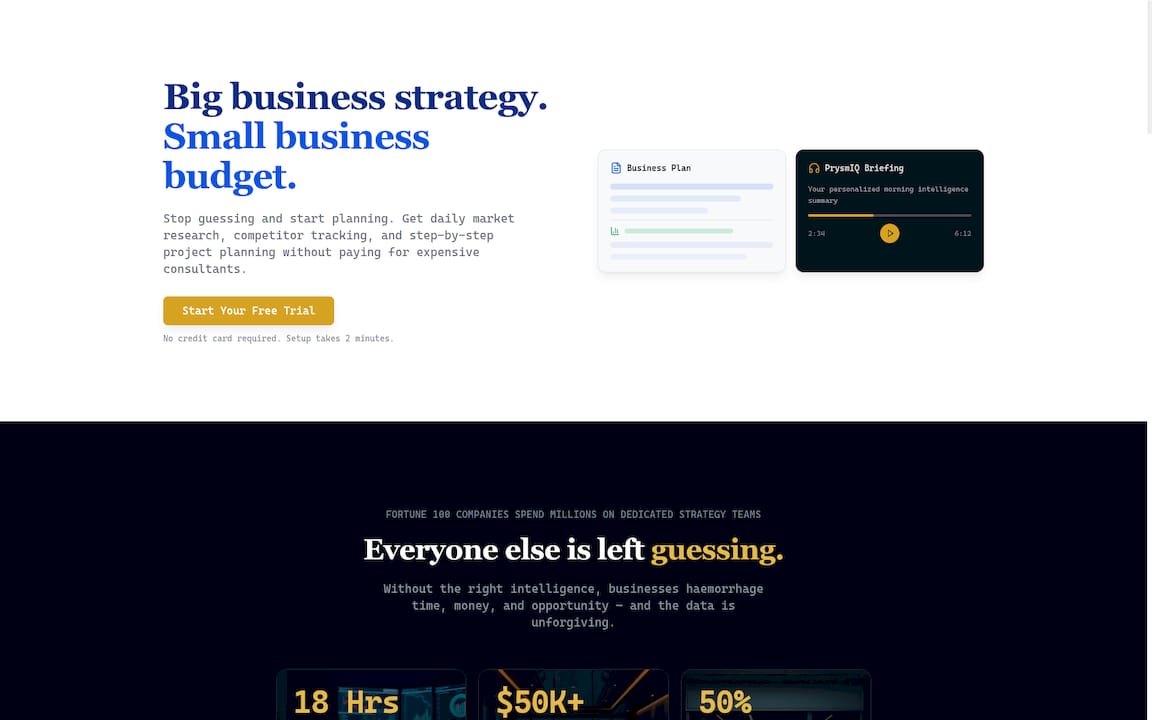
Start with a free AI venture assessment to identify where your highest-ROI AI use cases are right now. And if you’re ready to commit, SME-friendly pricing means you can get access to enterprise-grade market intelligence at a fraction of the cost of a traditional analyst retainer.
Frequently asked questions
What is a simple example of competitive advantage for an SME?
An SME negotiating better shipping rates using AI-powered data analysis is a clear example. As documented cases show, AI-powered shipping analysis helped businesses like Rebel Cheese recover $250,000 in overcharges by making their own operational data visible and actionable.
How do data and context give an edge with AI over competitors?
Unique business data and context help AI generate insights that rivals cannot easily replicate, turning a commodity tool into a genuine moat. When proprietary context drives AI, the outputs are calibrated to your specific situation rather than generic market conditions.
What high-impact AI use cases should SMEs start with?
Market analysis, customer segmentation, and cost auditing consistently deliver fast ROI and build foundational data advantages. High-impact use cases work best when they leverage data you already own rather than requiring new data collection infrastructure.
What if my SME lacks strong data infrastructure for AI?
Structured grant programs and specialist partnerships can bridge the gap. SMEs lacking data infrastructure have still achieved median cost savings of 52% by pairing targeted AI pilots with available funding and training support rather than waiting for perfect conditions.
Recommended
- AI strategies that actually build competitive advantage – Blue Prysm – Articles & Blogs
- Unlocking competitive advantage with emerging AI trends – Blue Prysm – Articles & Blogs
- Data-Driven Strategy Examples for SMEs: Real-World Wins – Blue Prysm – Articles & Blogs
- Unlock the power of decision intelligence for SMEs – Blue Prysm – Articles & Blogs