


TL;DR:
- A data foundry in AI unifies data lifecycle management with built-in governance and traceability to produce trustworthy insights.
- Most SMEs need an AI data foundry, not just a physical data center, to enable scalable, repeatable, and compliant AI-driven decisions.
Search “data foundry” and you will find something disorienting: a mix of AI lifecycle platforms, scientific research tools, and physical data centers all using the same label. For business leaders trying to allocate budget and build AI-driven strategy, that confusion is not just academic — it is expensive. The right data foundry can transform how your organization produces market intelligence, governs AI decisions, and iterates on strategy. The wrong one wastes months and money on infrastructure that does not move the needle. This guide cuts through the noise.
Table of Contents
- What is a data foundry and why does it matter?
- How AI data foundries unify and govern the AI lifecycle
- Industrializing data production for repeatable AI success
- The role of semantics and governance in data foundries
- Orchestrating AI for dependable business execution
- Leveraging data foundries to drive smarter business decisions
- Rethinking data foundries: What most business leaders miss
- How Blue Prysm supports strategic intelligence with data foundry principles
- Frequently asked questions
Key Takeaways
| Point | Details |
|---|---|
| Multiple meanings | Data foundry can refer to AI platforms, scientific data systems, or physical data centers, so clarity is essential. |
| Unified AI lifecycle | Effective data foundries integrate data collection, modeling, deployment, and governance into one platform. |
| Industrialized data production | Repeatable, adaptable data pipelines replace one-off engineering efforts to keep AI agile and scalable. |
| Governance & semantics | Standardized AI-native schemas and governance ensure data reuse, audit readiness, and vendor neutrality. |
| Operational orchestration | Control-plane orchestration layers coordinate and monitor AI workflows for reliable, secure execution at scale. |
What is a data foundry and why does it matter?
The term gets used three different ways in practice, and conflating them leads to some genuinely costly procurement mistakes.
The three distinct meanings of “data foundry”:
- AI data foundry: A platform that unifies the entire AI lifecycle, including data collection, annotation, model training, deployment, and governance, into a single auditable system. This is the type most relevant to SMEs pursuing AI-driven market intelligence.
- Scientific data foundry: A framework that deconstructs unstructured research or scientific data into standardized, machine-interpretable schemas and ontologies. Common in life sciences and research organizations.
- Data center/colocation provider: A physical infrastructure business offering server hosting and network services. Data Foundry Inc., for example, is a colocation data center provider based in Austin, Texas, with no connection to AI lifecycle management.
That third category is where many CIOs and operations leaders stumble. They search “data foundry,” find a provider, and assume it addresses AI governance needs. It does not. The word “foundry” simply evokes the idea of processing raw material into something useful — which is why vendors across wildly different sectors have adopted it.
For SMEs specifically, the category you care about is the AI data foundry. These platforms act as a production system for AI, not just a storage layer. They track where data comes from, how it was transformed, and what models used it. Think of it as the difference between a kitchen and a commercial food production facility: both make food, but only one can guarantee consistency, traceability, and scale.
Understanding which meaning applies is foundational to any strategic investment decision. If you are evaluating tools against emerging AI trends in your industry, you need to start with the right category.
How AI data foundries unify and govern the AI lifecycle
An AI data foundry is not just a data warehouse with a governance layer bolted on. It is an integrated system where governance, lineage, and observability are built in from the start — not added as afterthoughts.
Centific’s AI Data Foundry unifies the end-to-end AI lifecycle: data collection, annotation, training, deployment, and governance, with immutable audit trails and complete lineage from data to decisions. That phrase “immutable audit trail” matters more than it sounds. It means that when an AI model produces a market recommendation or flags a competitor move, you can trace exactly which data fed that output and when. That traceability is what turns AI from a black box into a defensible business tool.
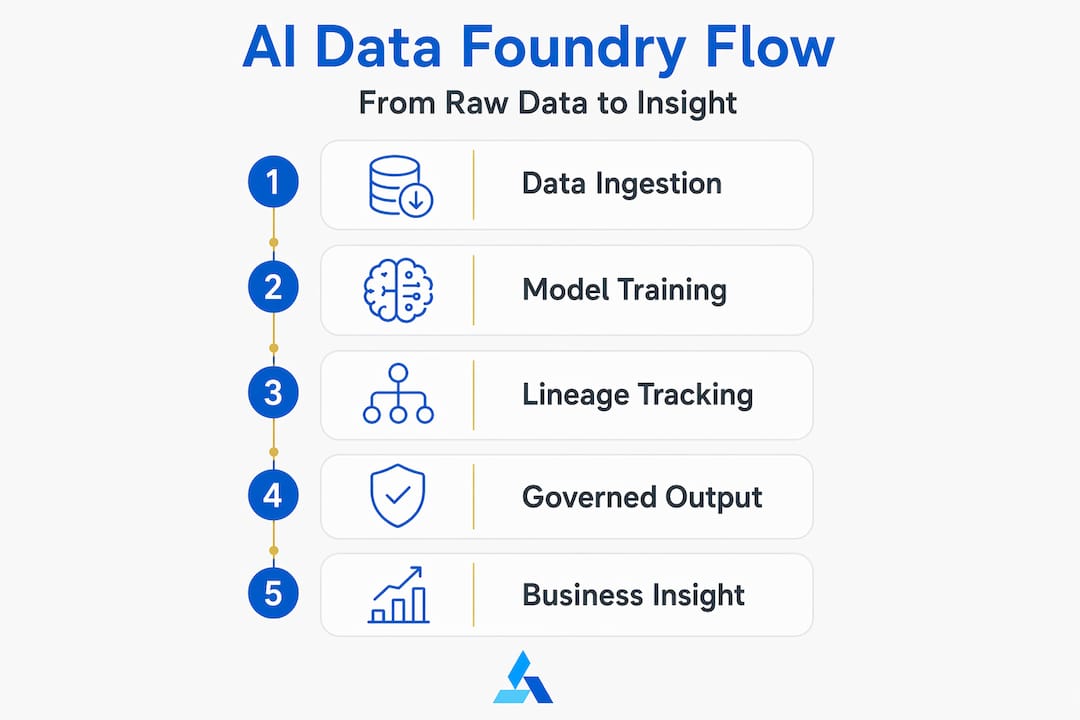
Here is how a well-structured AI data foundry works in practice:
- Data ingestion: Raw inputs — market feeds, competitor data, customer signals — are pulled in and tagged with source metadata.
- Annotation and preparation: Data is labeled, cleaned, and transformed according to governed rules that are recorded, not improvised.
- Model training: Models are trained on prepared data with versioning, so you can always identify which model version produced which insight.
- Deployment: Models are pushed into production with monitoring in place, not just released and forgotten.
- Governance review: Every step is logged. Compliance teams, analysts, or executives can audit any decision back to its source without a forensic data science project.
This is fundamentally different from the fragmented toolchains most SMEs currently use, where your data pipeline tools, modeling environment, and deployment infrastructure are separate products stitched together with manual processes. Fragmented systems fail quietly. They drift. They produce insights nobody can trace, defend, or trust.
Pro Tip: Before evaluating any AI platform, ask the vendor one question: “Can you show me the complete lineage of a single AI-generated insight from raw data to output?” If they hesitate, that is your answer.

Governed AI data workflows also directly support better AI strategies for SMEs by removing the guesswork from business decision making and replacing it with verifiable intelligence.
Industrializing data production for repeatable AI success
Most SMEs treat data preparation as a one-time project. Someone builds a pipeline, it works for a while, and then business needs shift, the pipeline breaks, and the whole thing gets rebuilt from scratch. That cycle is expensive, slow, and unnecessary.
Thomson Reuters describes the adaptable AI data foundry as shifting organizations from bespoke data pipelines to industrialized, repeatable data production to meet evolving AI needs. The word “industrialized” is deliberate. It signals a fundamental change in how data work is organized — from craft to process.
| Approach | One-off data prep | Industrialized data foundry |
|---|---|---|
| Repeatability | Low — rebuilt each time | High — templates and standards |
| Data quality | Inconsistent | Governed and auditable |
| Time to insight | Weeks to months | Days to weeks |
| Scalability | Breaks under volume | Designed for growth |
| AI model agility | Slow to iterate | Fast to adapt and redeploy |
The practical benefits for SMEs are concrete:
- You can respond to a new competitor move or market signal without waiting for a data team to rebuild infrastructure.
- You maintain consistent AI output quality even as your underlying data sources change.
- New team members or tools slot into established workflows instead of reinventing them.
- You reduce the risk of “model rot” — where AI insights degrade over time because nobody maintained the data feeding them.
Pro Tip: Map your current data workflows and identify which steps are manual and undocumented. Those are your foundry gaps. Every manual handoff is a place where lineage breaks and governance fails.
Applying this thinking to data-driven strategy examples shows how repeatable data production translates directly into faster, more confident strategic moves.
The role of semantics and governance in data foundries
Here is a concept most business leaders skip over because it sounds technical: data semantics. But ignoring it is precisely why so many AI initiatives produce insights that cannot be reused, audited, or shared across tools.
Semantics, in data terms, means standardizing the meaning of data at the point of creation. Not just the format, but the interpretation. A field labeled “revenue” in one system means something different from “revenue” in another unless both are mapped to a shared ontology — a structured vocabulary that defines the concept unambiguously.
The Scientific Data Foundry approach deconstructs unstructured data into AI-native schemas and ontologies, promoting vendor neutrality, governance, lineage, and compliance readiness. That architecture has direct implications for business AI, not just research labs.
Why semantics matter for your strategic intelligence:
- Vendor neutrality: When your data is defined in standard schemas, you can swap analytics tools without rebuilding meaning from scratch. No lock-in.
- Machine interpretability: AI models can read and reuse data correctly across different workflows without human correction.
- Audit readiness: Standardized definitions make compliance reviews faster and less painful.
- Cross-tool composability: Your market intelligence feeds, CRM data, and competitor signals can all speak the same language.
- Higher insight fidelity: When data means the same thing everywhere, AI recommendations are more accurate and less prone to hallucination.
The payoff here is not just technical cleanliness. It is real governance capacity and data governance and AI credibility that protects you when decisions are questioned internally or externally.
Orchestrating AI for dependable business execution
Building a governed, semantically sound data foundry is half the job. The other half is making sure AI insights actually run reliably in your business workflows, day in and day out. That is where orchestration comes in.
Think of orchestration as the operating system sitting on top of your AI capabilities. Without it, you have powerful but disconnected tools — models that produce insights nobody acts on, workflows that break when inputs change, and approvals that never get logged.
Datafi’s Orchestrate layer coordinates models, tools, data access, workflows, guardrails, approvals, and monitoring to turn AI intent into dependable enterprise execution. That phrase “turn intent into execution” is the crux of the matter.
Five functions a well-designed orchestration layer delivers:
- Unified governance: Security rules, access permissions, and compliance checks apply consistently across all AI workflows.
- Model coordination: Multiple AI models and tools work together on a task without manual handoffs between them.
- Guardrails at runtime: The system enforces boundaries on what AI agents can and cannot do, preventing drift before it causes damage.
- Approval workflows: High-stakes outputs, like resource allocation recommendations or market entry decisions, route through human review before acting.
- Continuous monitoring: Every AI action is logged and observable, enabling rapid diagnosis when something behaves unexpectedly.
For SMEs, the promise here is reducing the overhead of managing AI at scale. You should not need a dedicated AI ops team to keep models running correctly. Good orchestration builds that reliability into the system. This directly supports decision intelligence as a practice, not a one-off exercise.
Leveraging data foundries to drive smarter business decisions
Governance, semantics, and orchestration are the machinery. The output you actually care about is better, faster, more defensible decisions.
Governed AI data foundations enable SMEs to scale market intelligence and strategic insights with greater trust and agility. Here is what that looks like in practice across common SME use cases:
- Threat analysis: A governed data foundry pulls competitor signals, news feeds, and pricing changes through a standardized pipeline. The output is not just an alert — it is a traceable, timestamped insight with source attribution.
- Market trend spotting: Real-time data processing feeds continuously updated trend models, giving strategic teams a live view rather than a monthly report.
- Resource allocation: AI recommendations on where to deploy budget or headcount carry lineage metadata, so finance teams can interrogate the recommendation, not just accept it.
- Competitor intelligence: Repeatable workflows mean competitive battle cards stay current without manual researcher effort.
- Scenario testing: Because data pipelines are standardized, running “what if” scenarios on new markets or product ideas is a structured exercise, not an improvised one.
Pro Tip: Start with one high-value use case, such as competitive monitoring, and build your foundry architecture around it first. Proving ROI in a narrow context builds internal confidence faster than attempting a full transformation all at once.
Connecting these use cases to data-driven strategy wins and decision-making best practices shows how foundry thinking elevates the entire strategic planning function, including tools like competitive battle cards built on trusted, traceable data.
Rethinking data foundries: What most business leaders miss
Let us be direct about something the vendor literature glosses over. Most “foundry” platforms differ substantially in where governance is operationalized. Some govern at the pipeline layer. Others at the semantic layer. A few at the orchestration layer. Almost none do all three well by default.
Choosing a platform focused on lineage and reuse is key for quick business impact. That sounds like vendor advice, but the reasoning behind it is practical: if your AI insights cannot be traced and reused, you are building on sand. Every new question requires a new data project. That is not intelligence. That is busywork.
Here is the uncomfortable truth: most SMEs buy the wrong category of product because nobody aligned on terminology before the purchase. A CIO searches “data foundry,” a vendor sells them colocation infrastructure, and six months later, the AI initiative has not started because the team thought they were getting a platform and got a server rack. Implementation planning should start with terminology alignment across all stakeholders to avoid exactly this trap.
The second thing leaders miss is the danger of tool sprawl. Many organizations assemble five or six point solutions — a data pipeline tool here, a visualization layer there, a separate governance module — and assume the sum equals a foundry. It does not. Without an orchestration layer binding them together, you get inconsistency, gaps in lineage, and governance that only applies when someone remembers to check. Real enterprise AI readiness means stopping that accumulation and investing in architecture that connects everything.
The third blind spot is timing. Leaders often treat governance and semantics as Phase 2 items to add once AI is “working.” But retrofitting governance into a running AI system is significantly harder and more disruptive than building it in from the start. Think of it like adding fire safety systems to a building that is already occupied — technically possible, but expensive, disruptive, and never quite complete.
The SMEs who will pull ahead are those currently engaging with emerging AI trends from a position of architectural clarity, not those reacting to hype.
How Blue Prysm supports strategic intelligence with data foundry principles
If this guide has surfaced a gap between where your AI-driven decision-making is today and where it needs to be, you are not alone. Most SMEs are sitting on valuable market data with no governed, repeatable system to turn it into strategic intelligence.
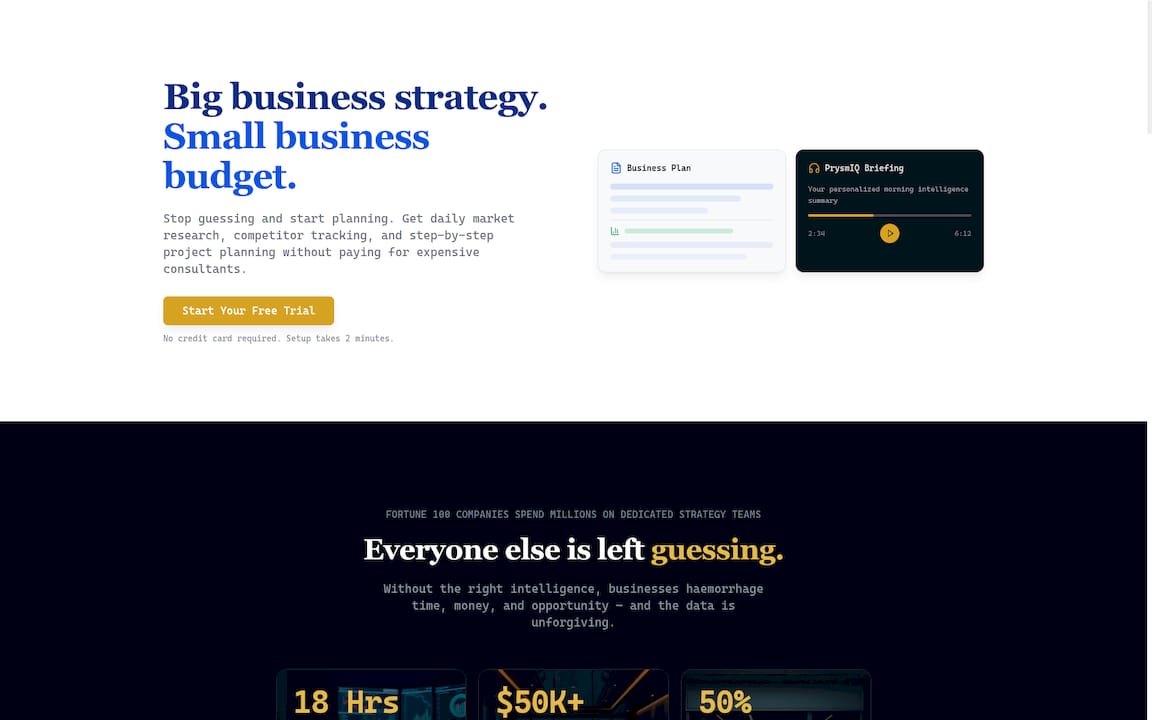
Blue Prysm is built around the core principles of the AI data foundry: traceable insights, governed workflows, and adaptable intelligence pipelines designed for business decision-makers, not data scientists. The platform delivers daily market briefings, competitor monitoring, and business planning tools with secure data storage and privacy controls that meet enterprise compliance requirements. You get the strategic intelligence capacity of a Fortune 100 research team at a fraction of the cost, with flexible pricing tailored for SME budgets. See how it works and take the first step toward AI-driven strategy you can actually trust and defend.
Frequently asked questions
What exactly does “data foundry” mean in AI contexts?
In AI, “data foundry” describes platforms that unify data ingestion, modeling, deployment, and governance to produce trustworthy AI insights with traceable lineage. AI Data Foundry platforms specifically provide complete lineage and governance controls across the entire AI lifecycle.
How does an AI data foundry help small and medium businesses?
It provides repeatable, governed workflows that turn raw data into reliable AI-driven market insights, reducing risk and accelerating strategic decisions. Adaptable AI data foundry approaches support evolving business needs without constant pipeline rebuilding.
Can a data foundry be just a data center or colocation service?
Yes, and that distinction matters. Data Foundry Inc. is a colocation data center provider, entirely distinct from AI data platforms — business leaders must clarify intent before purchasing to avoid costly category errors.
What makes governance and lineage critical in data foundries?
They ensure every AI decision can be traced to its data and model source, which strengthens trust, compliance, and audit readiness. Complete lineage and immutable audit trails make AI-generated recommendations provable and defensible to stakeholders.
How do orchestration layers improve AI execution in enterprises?
Orchestration coordinates AI models, tools, workflows, and approvals so AI-driven operations run consistently and securely at scale. Datafi’s Orchestrate layer provides the operational control plane that turns AI intent into dependable, monitored enterprise execution.