


TL;DR:
- AI-driven strategy enables rapid, precise decision-making and continuous market sensing that outpace human capabilities.
- Embedding AI into governance, workflows, and management rhythms transforms it from a tool into a strategic multiplier.
AI-powered strategic planning is defined as the continuous integration of machine learning, predictive analytics, and automation into core business decision-making processes. The advantages of AI in strategy are not theoretical. Over 60% of organizations now have generative AI in production, and those with clear enterprise strategies are realizing measurable returns. MIT Sloan and BCG both confirm that coordinated AI strategy, not scattered pilots, drives scalable competitive advantage. The difference between leaders and laggards comes down to one thing: whether AI is embedded into how the business actually makes decisions, or just bolted on as a productivity tool.
1. Advantages of AI in strategy: faster, sharper decision-making
The most direct benefit of AI in strategic decision-making is speed combined with accuracy at a scale no human team can match. AI systems process thousands of data signals simultaneously, filtering noise and surfacing the patterns that matter to your specific competitive context. Where a traditional strategy team might spend weeks gathering market intelligence, an AI-powered system delivers that synthesis in hours.
The role of AI in decision making goes beyond raw speed. It improves the quality of the decisions themselves by removing the cognitive biases that creep into gut-feel analysis. L’Oréal’s TrendSpotter platform scans social media, search data, and retail signals to detect emerging beauty trends 6 to 18 months before they peak. JPMorgan Chase equips analysts with internal generative AI tools that compress research cycles and surface risk signals that would otherwise be buried in unstructured data.
- AI identifies weak signals in market data that human analysts routinely miss
- Predictive models flag churn risk, supply disruptions, and competitive moves before they materialize
- Frontline business units gain access to strategic analytics tools previously reserved for central strategy teams
Pro Tip: Don’t treat AI decision support as a replacement for human judgment. Use it to expand the range of options your team considers before committing to a course of action.
2. Always-on strategy: the end of the annual planning cycle

Traditional strategy runs on an annual cycle. You gather data, build a plan, present it in Q4, and execute for twelve months regardless of what the market does in between. AI breaks that model entirely.
BCG describes this as “always-on strategy”, where continuous monitoring removes the information-gathering lag that forces companies to react rather than anticipate. The practical implication is significant. When a 15% churn risk spike appears in your customer data, an AI-integrated system can trigger a sales force reallocation within days rather than waiting for the next quarterly review. That kind of response speed is a genuine competitive weapon.
The role of AI in strategic planning shifts from periodic analysis to continuous sensing. Market conditions, competitor moves, and customer behavior feed into a living strategy that adjusts in near real time. This is not about replacing your strategy team. It is about giving them a persistent intelligence layer that keeps the plan current between formal review cycles.
3. Competitive advantage beyond productivity gains
Here is where most organizations get the story wrong. They deploy AI to cut costs, reduce headcount, or speed up existing workflows, then wonder why competitors are pulling ahead. McKinsey’s 2026 analysis is direct on this point: productivity gains alone do not create sustainable advantage. Durable value comes from AI enabling new offerings and entirely new business models.
The advantages of AI for business compound when leaders ask a different question. Instead of “how do we do what we already do faster?”, the right question is “what can we now offer that was previously impossible?” Consider what this means in practice:
- New product categories built on proprietary AI-analyzed data sets
- Personalized service delivery at scale that was previously cost-prohibitive
- Dynamic pricing models that respond to real-time demand signals
- Predictive maintenance offerings layered onto physical products
- Risk-adjusted resource allocation that shifts capital toward highest-return opportunities automatically
The operating model implications are real. Capturing these advantages requires redesigning workflows, decision rights, and incentive structures. AI does not deliver new business models by itself. It gives you the analytical foundation to build them.
4. Governance and data infrastructure: the non-negotiable foundation
Fragmented AI pilots are the most common trap in enterprise AI strategy. A marketing team runs one model, finance runs another, and operations builds a third. None of them share data. None of them connect to the same strategic goals. The result is a collection of expensive experiments that never add up to competitive advantage.
MIT Sloan is explicit that scaling AI value enterprise-wide requires governance, shared data infrastructure, and operating principles that prevent rogue projects from proliferating. This is not bureaucracy for its own sake. It is the architecture that allows AI outputs to be trusted, audited, and acted upon at speed.
| Governance element | Why it matters |
|---|---|
| Shared data infrastructure | Prevents siloed models from producing contradictory strategic signals |
| Input/output logging | Creates traceability so leaders can audit AI recommendations and build trust over time |
| Defined decision rights | Clarifies which AI outputs trigger automatic action versus human review |
| Bias and privacy controls | Reduces legal and reputational risk from AI-driven decisions |
Roger L. Martin’s framework adds a critical layer: AI advantage stalls when companies fail to redesign management systems to incorporate AI trust and rapid iteration cycles. Logging inputs and outputs is not just a compliance measure. It is how organizations learn which AI recommendations are reliable and which need recalibration.
Pro Tip: Before scaling any AI tool across your strategy function, map the data flows it depends on. If those data sources are inconsistent or ungoverned, the AI output will be too.
5. Embedding AI into management rhythms, not just tech stacks
The role of automation in decision making is most powerful when it is woven into the actual cadence of how leaders meet, review, and act. An AI tool that sits outside your management system is a toy. An AI tool that feeds your weekly leadership review, your quarterly strategy sessions, and your real-time KPI dashboards is a structural advantage.
SAP’s analysis makes the point clearly: AI without operational context amplifies risk. Context-aware AI agents that understand your business workflows, your customer segments, and your competitive position deliver far more value than generic models applied to isolated problems. The integration is the advantage, not the algorithm itself.
This is why the role of AI in business strategy is fundamentally an organizational design question, not just a technology question. Leaders who treat AI deployment as an IT project consistently underperform those who treat it as a management redesign initiative.
6. Real-world examples that prove the strategic case
Case studies matter here because they replace abstract claims with evidence. These four examples show AI reinforcing and extending existing winning strategies rather than replacing them.
- John Deere’s See & Spray system uses AI integrated with proprietary agronomic data to target herbicide application with precision, reducing chemical use while improving yield. The competitive moat is not the AI model alone. It is the combination of AI with decades of proprietary field data that competitors cannot replicate.
- Netflix’s recommendation engine drives over 80% of content watched on the platform. The AI does not just suggest shows. It shapes content investment decisions, thumbnail design, and release timing based on predicted viewer behavior.
- L’Oréal’s TrendSpotter gives the company a 6 to 18 month head start on emerging beauty trends, allowing product development and marketing to align before competitors even recognize the shift.
- JPMorgan Chase deploys internal generative AI tools that allow analysts to process regulatory filings, earnings calls, and market data at a speed that fundamentally changes the scope of analysis a single team can perform.
“The companies winning with AI are not the ones with the most sophisticated models. They are the ones that connected AI to the decisions that actually move their business.” — BCG, The Corporate Strategy Function in an AI-First World
Each of these examples shares a common structure. AI amplifies an existing strategic asset, whether that is proprietary data, customer relationships, or analytical talent. The AI alone is not the strategy. It is the multiplier applied to what the organization already does well.
7. Cascading strategic goals through AI-aligned KPIs
One of the underappreciated advantages of AI in business planning is its ability to translate high-level strategic goals into specific, measurable initiatives at every level of the organization. Most strategy execution fails not because the strategy is wrong, but because the connection between the boardroom goal and the frontline action is too loose.
AI-powered planning tools can map strategic objectives to operational KPIs, flag when leading indicators suggest a goal is at risk, and recommend resource reallocation before a miss becomes a crisis. The role of AI in business planning at this level transforms strategy from a document into a living system. Teams see how their work connects to the broader goal. Leaders see where execution is drifting before it shows up in quarterly results.
This cascading function also supports better accountability. When AI surfaces the specific operational signals that predict strategic outcomes, it becomes much harder to hide underperformance behind lagging indicators. That transparency, while uncomfortable for some, is exactly what high-performance organizations need.
Key takeaways
AI’s strategic advantage is realized only when it is embedded into governance structures, management rhythms, and business model design rather than deployed as a standalone productivity tool.
| Point | Details |
|---|---|
| Always-on strategy | AI removes information-gathering lag, enabling trend detection and resource reallocation in days rather than quarters. |
| Beyond productivity | Durable advantage comes from AI enabling new offerings and business models, not just faster execution of existing ones. |
| Governance is foundational | Shared data infrastructure and input/output traceability are prerequisites for trusted, scalable AI strategy. |
| Context beats algorithms | AI integrated with actual business workflows and proprietary data outperforms generic models applied in isolation. |
| Cascade to execution | AI-aligned KPIs connect boardroom strategy to frontline action, reducing the gap between planning and performance. |
Why most AI strategies stall before they deliver
I have watched organizations invest heavily in AI tools and walk away with nothing to show for it strategically. The pattern is almost always the same. The technology works. The organizational system around it does not change.
The uncomfortable truth about the role of AI in business strategy is that it exposes every weakness in your management infrastructure. If your data is inconsistent, AI will produce inconsistent recommendations. If your decision rights are unclear, AI outputs will sit in inboxes without triggering action. If your leadership team does not trust the models, they will override them with gut instinct every time it matters.
What I have seen work is treating AI deployment as a management redesign project from day one. That means defining which decisions AI will inform, who acts on those recommendations, and how you will log and review AI outputs over time. It means starting with one high-stakes decision process, proving the model works, and building trust before scaling. The governance failure stories are not about bad technology. They are about organizations that skipped the hard organizational work.
The future of strategy is continuous, context-driven, and AI-augmented. But it only gets there through deliberate management design, not through software procurement.
— Colin Bowdery
How Blue Prysm puts these advantages to work for you
Blue Prysm is built specifically for business leaders who want the strategic intelligence capabilities of a Fortune 100 strategy team without the consulting fees or the six-month implementation timeline.
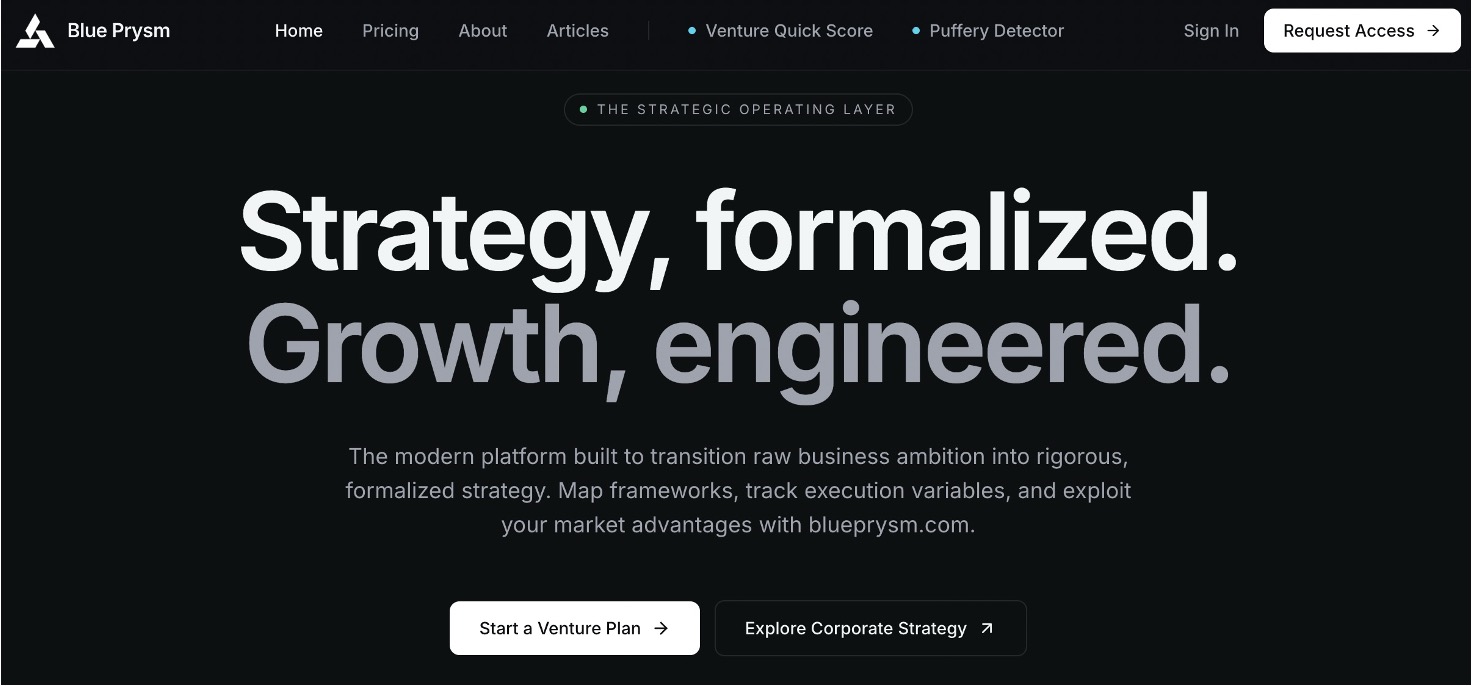
The platform delivers daily market briefings, competitor monitoring, and scenario testing through AI-driven processes that connect directly to your strategic priorities. Where most organizations struggle to move from fragmented AI pilots to coordinated strategy, Blue Prysm provides the structured intelligence layer that makes continuous strategic planning practical. Explore how it works to see how AI-powered strategic intelligence can sharpen your decision-making from day one. For leaders ready to act, Blue Prysm’s platform is designed to deliver the kind of always-on strategic advantage that BCG and McKinsey describe, at a price point built for growing businesses.
FAQ
What are the main advantages of AI in strategy?
AI enables faster, more accurate decision-making by processing large data sets continuously, detecting market trends months in advance, and aligning operational KPIs with strategic goals. The core advantage is the shift from periodic planning to always-on strategy that adapts in near real time.
Why use AI in business strategy rather than traditional analysis?
Traditional analysis is constrained by human bandwidth and periodic review cycles. AI removes the information-gathering lag, surfaces weak signals before competitors act on them, and scales strategic analytics across the entire organization rather than concentrating it in a central team.
How does AI support strategic planning at the enterprise level?
MIT Sloan emphasizes that enterprise-wide AI strategy requires shared data infrastructure and governance to avoid fragmented pilots. When those foundations are in place, AI cascades strategic goals into aligned KPIs and flags execution drift before it affects results.
What role does governance play in AI’s strategic advantages?
Governance determines whether AI outputs are trusted and acted upon or ignored. Logging inputs and outputs, defining decision rights, and embedding AI into management systems are what separate organizations that realize AI’s strategic value from those that accumulate expensive experiments.
Can small and mid-sized businesses access the same AI strategic advantages as large enterprises?
Yes. Platforms like Blue Prysm are designed to give SMEs access to the same quality of strategic intelligence that Fortune 100 companies build with large internal teams. The practical implementation steps differ in scale, but the strategic principles are identical.