


China’s domestic social stack is not a localized version of what you already know. Facebook, Instagram, YouTube, and WhatsApp do not operate in mainland China. The platforms that actually reach Chinese consumers are WeChat, Douyin, Xiaohongshu (RED), Weibo, Kuaishou, Bilibili, QQ, Zhihu, and Baidu Tieba — and each one plays a specific role in the path from discovery to purchase. You cannot simply port a Western campaign into this ecosystem. You have to build for it.
Here is the quick-reference stack every marketing team should know before planning a single creative brief:
- WeChat — retention, CRM, loyalty programs, and mini-program commerce (the super-app layer)
- Douyin — short-video discovery, algorithm-driven reach, and live-stream shopping
- Xiaohongshu (RED) — lifestyle search, product discovery, KOC-driven notes, premium brand entry
- Weibo — public microblogging, PR, trending topics, and crisis response
- Kuaishou — short video for lower-tier cities and rural audiences, strong community loyalty
- Bilibili — long-form video, Gen Z niche communities, brand storytelling
- QQ — messaging and social for teens and younger users, gaming-adjacent
- Zhihu — Q&A and thought leadership, B2B credibility, high-intent research audiences
- Baidu Tieba — interest-based forums, niche communities, grassroots brand seeding
Statista’s October 2025 data puts WeChat at roughly 90.3% of Chinese internet users. Those two numbers alone tell you where mass reach lives. The rest of the stack is where you find precision.
Key Takeaways
China’s social media ecosystem requires a purpose-built platform funnel — WeChat for retention, Douyin for discovery, and Xiaohongshu for premium brand entry — not a localized version of a Western campaign.
| Point | Details |
|---|---|
| WeChat dominates reach | At ~90.3% of internet users, WeChat is the non-negotiable retention and CRM layer for any brand in China. |
| Douyin drives discovery | With ~81.8% reach and deep live-commerce integration, Douyin is the primary short-video and sales channel. |
| Xiaohongshu for premium entry | 300M+ MAU and a UGC-first culture make it the default discovery path for foreign and premium brands. |
| Build inside the ecosystem | Chinese consumers do not click off-platform; mini-programs, in-stream stores, and WeChat Pay are the conversion infrastructure. |
| Blue Prysm shortens the cycle | Blue Prysm’s market analysis platform maps platform reach signals and KPI dashboards so teams prioritize faster and measure smarter. |
How big are China’s social media platforms, really?
Scale is the first thing that trips up Western marketers. The numbers here are not comparable to any other single market on earth.
DataReportal’s Digital 2026 report, summarized by Silkdrive, estimates approximately 1.28 billion social media user identities in China, against an internet penetration rate of roughly 91.6%. That is not a niche opportunity. That is the largest connected social audience on the planet, concentrated inside a closed domestic ecosystem.
Daily time spent on apps runs high, with Chinese users spending significant time each day across social platforms, especially short-video apps like Douyin. Statcounter’s monthly market-share snapshots show that platform share does shift month to month — which means a platform prioritization decision made in Q1 may look different by Q4.
WeChat reaches ~90.3% of Chinese internet users — making it the single highest-reach platform in the country and the default retention layer for any brand operating in China. (Statista, Oct 2025)
Douyin reaches ~81.8% of internet users — the dominant short-video and live-commerce channel, and the primary discovery engine for younger demographics.
Academic research published in ScienceDirect confirms that social media use and brand engagement concentrate in Chinese megacities — Beijing, Shanghai, Shenzhen, Guangzhou — with measurable differences in platform frequency and Douyin use tied to socioeconomic and geographic factors. For U.S. teams planning city-tier targeting, this matters: a Tier 1 city campaign and a Tier 3 city campaign are not the same brief.
MAU figures for Weibo, Kuaishou, Bilibili, QQ, Zhihu, and Baidu Tieba reflect platform-reported or industry-cited estimates; confirm current figures via platform advertiser docs before campaign planning.
What each platform actually does for your campaign
Understanding the mechanics of each platform is what separates a well-funded failure from a campaign that compounds.
WeChat is not a social media platform in the Western sense. It is the operating system of Chinese digital life — messaging, payments, mini-programs, official accounts, and Moments (a friends-only feed) all live inside one app. For marketers, the official account is the CRM layer: brands publish articles, push notifications, and run loyalty programs here. Mini-programs are the commerce layer: a fully functional e-commerce store, booking system, or loyalty card lives inside WeChat without the user ever leaving the app. The best practice is to drive discovery elsewhere and convert inside WeChat.

Best practices: Build your official account before any paid campaign. Use mini-programs for repeat purchase and loyalty. Segment your follower base by behavior, not just demographics.
Douyin
Douyin is TikTok’s Chinese sibling — same parent company (ByteDance), entirely separate app, entirely separate algorithm. The algorithm rewards content quality and completion rate, not follower count, which means a brand with zero followers can go viral on day one. Live-stream commerce is deeply embedded: hosts sell products in real time, viewers purchase without leaving the stream, and conversion happens in minutes.
Best practices: Invest in native-format creative (vertical, fast-paced, sound-on). Test organic content before scaling paid. Use Douyin for Business for in-feed ads and search ads.
Xiaohongshu (RED)
Xiaohongshu functions like a lifestyle search engine crossed with a product review platform. Users search for product recommendations, read “notes” (short posts combining images and text), and make purchase decisions based on peer content rather than brand advertising. Platform-reported monthly active users exceed 300 million, with a user base skewing toward urban women aged 18–35. For premium foreign brands, it is often the default discovery path. ValueChina documents how UGC-driven notes and KOL/KOC activity directly shape purchase intent on the platform — a brand with 50 authentic notes from real users outperforms one with a single polished campaign post.
Best practices: Seed KOC content before launching paid ads. Optimize your brand’s search presence on the platform (it functions as a search engine). Use the in-app store for direct conversion.
Weibo is China’s public square — the closest domestic equivalent to X (formerly Twitter). It is where news breaks, where celebrities post, and where brand crises either get managed or spiral. Weibo’s advertiser resources cover fan-tunnel ads, trending-topic takeovers, and KOL partnership formats. For PR-heavy campaigns and product launches that need public visibility, Weibo is the right channel. For retention, it is not.
Best practices: Use Weibo for launch moments and trending-topic participation. Monitor brand mentions daily. Pair with WeChat for the follow-up retention flow.
Kuaishou
Kuaishou is Douyin’s main short-video competitor, but the audience profile is meaningfully different. Kuaishou skews toward lower-tier cities and rural users, with a community dynamic that rewards authenticity and long-term creator relationships over viral moments. Brands selling everyday consumer goods, agricultural products, or value-positioned items find stronger ROI here than on Douyin. The platform’s live-stream commerce is mature and generates significant gross merchandise value (GMV).
Best practices: Prioritize creator partnerships over brand-produced content. Match product positioning to the platform’s value-conscious audience. Track live-stream GMV as the primary KPI.
Bilibili
Bilibili is where Gen Z goes for long-form video — think YouTube with a strong anime, gaming, and niche-interest culture. The platform’s “danmaku” (scrolling comment overlay) creates a participatory viewing experience that brands can tap into for community building. Statista tracks Bilibili’s average monthly active users over time, and the trend shows consistent growth among the 18–25 demographic. Branded content here needs to earn its place in the community — hard-sell ads get rejected fast.
Best practices: Commission long-form branded content from established Bilibili creators (UP主). Focus on storytelling and education, not promotion. Use the platform for brand-building, not direct response.
QQ, Zhihu, and Baidu Tieba
These three serve distinct niches. QQ remains the dominant messaging platform for teenagers and gaming communities, with group chats and interest channels that brands can seed. Zhihu is China’s Quora — a Q&A platform where professionals research decisions, making it valuable for B2B brands and high-consideration consumer categories. Baidu Tieba is a forum network organized by interest topic, useful for grassroots seeding and community monitoring. None of the three are primary paid-media channels for most campaigns, but all three matter for brand presence and organic credibility.
Pro Tip: Design your platform funnel before you design your creative. A typical high-performing flow looks like this: Xiaohongshu or Douyin for discovery → Weibo for social proof and PR → WeChat official account for follow and CRM → mini-program for purchase and loyalty. Each platform has one job. Don’t ask it to do two.
How social commerce and live-streaming actually drive sales
Western marketers often expect Chinese consumers to click through to an external website. They won’t. The entire purchase path is designed to stay inside the platform, and that is not a limitation, it is the mechanic you need to build for.
Here is the typical social-commerce funnel on Chinese platforms:
- Discovery — A user encounters a Douyin short video or a Xiaohongshu note featuring your product. The content is peer-generated or KOC-seeded, not a polished brand ad.
- Engagement — The user saves the note, follows the creator, or searches your brand name on Xiaohongshu. This is the research phase.
- Live-stream event — A KOL or brand host runs a live-stream on Douyin or Kuaishou. Products are demonstrated in real time, limited-time pricing creates urgency, and viewers purchase directly through the in-stream store.
- Mini-program conversion — Repeat buyers are directed to the brand’s WeChat mini-program for loyalty rewards, subscription purchases, or exclusive drops.
- CRM retention — The WeChat official account nurtures the relationship with content, offers, and service — turning a one-time buyer into a repeat customer.
The influencer ecosystem breaks into two tiers that serve different functions:
- KOLs (Key Opinion Leaders) — High-follower creators with broad reach. Use them for launch moments, brand awareness, and credibility transfer. Expensive, but they move volume fast.
- KOCs (Key Opinion Consumers) — Micro-influencers with smaller but highly engaged audiences. They post authentic reviews and notes that read as peer recommendations. Lower cost per post, higher trust per impression, and they compound over time as their content stays searchable on Xiaohongshu.
For commerce campaigns, track these KPIs: live-stream GMV, conversion rate inside the mini-program, live-stream engagement rate (comments, shares, purchases per viewer), and average order value. On the integration side, confirm that WeChat Pay and Alipay are enabled in your store, that your logistics partner can fulfill from within China, and that your platform accounts comply with current advertising policy — which changes more frequently than most Western teams expect.
What U.S. teams actually need to do before going live
The operational reality of entering Chinese social platforms is more complex than most briefs acknowledge. Here is the honest checklist.
Account setup and access: Most major platforms require a Chinese business license or a registered local entity to open an official brand account. WeChat official accounts, Douyin for Business, and Xiaohongshu’s brand accounts all have verification requirements that take weeks to complete. U.S. teams typically work through a local agency or a China-based partner who holds the account on behalf of the brand — this is standard practice, not a workaround.
Ad buying routes: Self-serve ad platforms exist on Douyin for Business and Weibo, but the interfaces are in Mandarin and require a Chinese bank account or a verified ad account. Most U.S. teams buy through a certified reseller or a local agency with direct platform relationships. This adds a layer of cost and communication, but it also adds local expertise that is genuinely hard to replicate remotely.
Localization checklist:
- Translate all creative into Simplified Chinese — not Traditional, which is used in Taiwan and Hong Kong
- Adapt naming conventions (brand names often need a Chinese phonetic or semantic equivalent)
- Use local payment methods (WeChat Pay and Alipay are non-negotiable; credit cards are not the default)
- Design for mobile-first vertical formats across every platform
- Avoid imagery, colors, or references that carry unintended cultural meaning
Measurement and attribution: Platform analytics are available but siloed. Each platform reports its own metrics, and cross-platform attribution requires either a local data partner or server-side tracking that complies with China’s Personal Information Protection Law (PIPL). Privacy-first measurement approaches — including data clean rooms — are increasingly relevant here, given the regulatory constraints on cross-platform data sharing.
Most brands get this backwards and wonder why they have reach but no repeat revenue.*
| KPI | Platform | What it measures | Why it matters |
|---|---|---|---|
| Video completion rate | Douyin, Kuaishou | % of viewers who watch to end | Predicts algorithm amplification |
| Note engagement rate | Xiaohongshu | Likes, saves, comments per note | Signals purchase intent and search rank |
| Mini-program CVR | Conversion rate inside mini-program | Direct revenue attribution | |
| Live-stream GMV | Douyin, Kuaishou | Gross merchandise value per stream | Commerce campaign ROI |
| Follower growth rate | WeChat, Weibo | Net new followers per period | Audience building health |
| Share of voice | Brand mentions vs. competitors | PR and launch effectiveness |
Why younger Chinese users are rejecting polished brand content
This is the trend that most Western briefs miss entirely, and it is reshaping creative strategy across every platform.
Practitioners and researchers tracking younger Chinese consumers consistently find that Gen Z users favor interest-based communities and peer validation over brand-produced content. On Douyin and Xiaohongshu, authentic UGC outperforms polished advertising — not marginally, but significantly. A note written by a real user who bought your product and described their honest experience will generate more saves, more searches, and more purchase intent than a brand-produced campaign post.
The implication for creative strategy is direct:
- Write copy that sounds like a person, not a press release
- Seed KOC content before you run paid ads — the organic credibility base makes paid spend more efficient
- Use short, aggregated social proof (collections of real user notes, comment highlights) rather than single hero testimonials
- Let creators adapt your brief rather than scripting them word-for-word
A practical 4-step A/B test plan for validating messaging with younger audiences:
- Creative format test — Run the same message as a polished brand video vs. a lo-fi creator-style video. Measure completion rate and save rate.
- Tone test — Test conversational, first-person copy against formal brand language. Track comment sentiment and share rate.
- Influencer scale test — Compare one mid-tier KOL post against five KOC posts with equivalent total reach. Measure cost per save and cost per note search.
- Commerce integration test — Test a direct in-stream purchase CTA against a “search us on Xiaohongshu” CTA. Track which drives more qualified traffic to your mini-program.
Pro Tip: The best-performing KOC content on Xiaohongshu reads like a friend’s recommendation, not a sponsored post. Brief your KOCs on the product’s genuine differentiators and let them find their own angle. The notes that convert best are the ones that acknowledge a small flaw alongside the benefits — that specificity is what makes them credible.
Where to start: three experiments worth running first
The honest answer to “which platform should we start on?” is almost always: Xiaohongshu for discovery, Douyin for reach, and WeChat for everything that happens after the first sale. But the sequence matters as much as the selection.
Here is the starter portfolio worth testing before committing to a full-platform build:
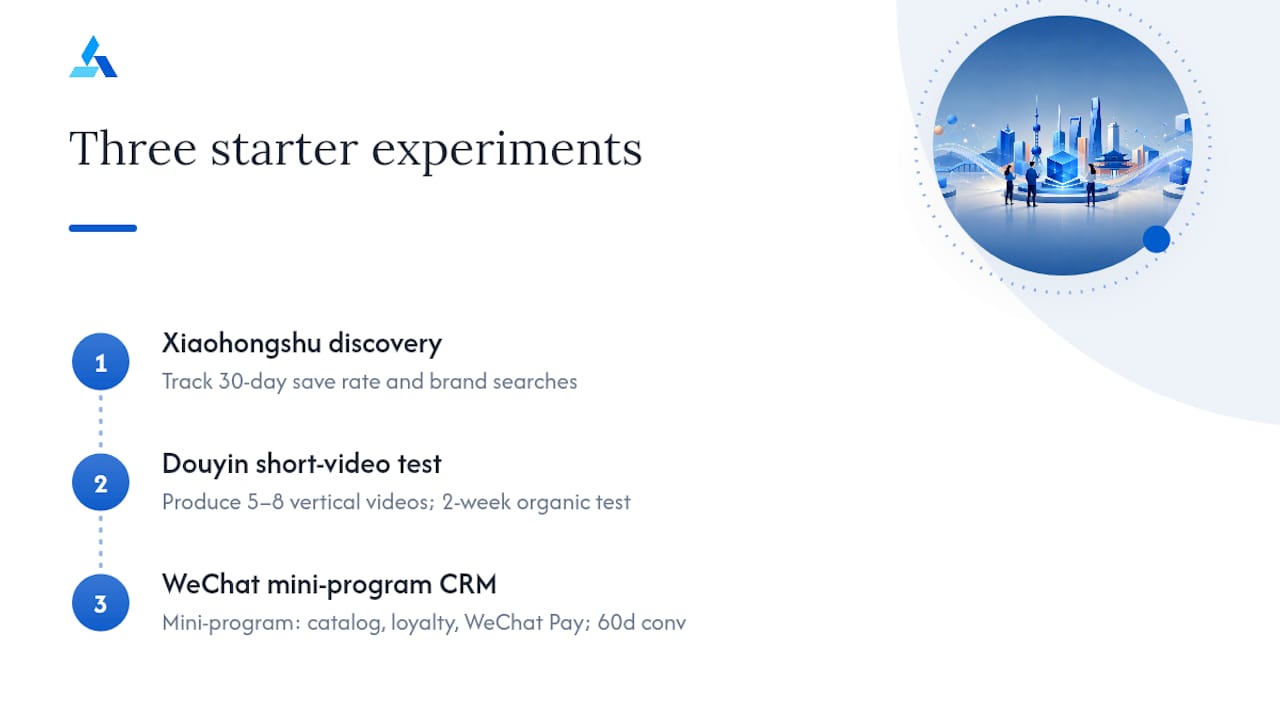
Experiment 1 — Audience discovery on Xiaohongshu. Seed 10–20 KOC notes across relevant interest categories. Measure save rate and search volume for your brand name over 30 days. If neither moves, the product-market fit or the brief needs work before you scale spend.
Experiment 2 — Short-video test on Douyin. Produce five to eight pieces of native-format content (vertical, 15–60 seconds, sound-on). Run them organically for two weeks before touching paid. Watch completion rate and comment quality. Below that, the creative needs iteration.
Experiment 3 — CRM flow on WeChat mini-program. Build a minimal mini-program with a product catalog, a loyalty mechanism (points, exclusive content, or early access), and a WeChat Pay checkout. Drive traffic from your Douyin and Xiaohongshu content to your official account, then into the mini-program. Track mini-program conversion rate and repeat purchase rate over 60 days. This is where you find out whether your brand has staying power in the market.
These three experiments give you real data on discovery efficiency, content resonance, and retention economics before you commit to a full-year media plan. That is a smarter use of a test budget than spreading thin across all nine platforms at once.
Real-time market intelligence cuts your China planning cycle in half
Choosing the right platforms, sequencing your funnel, and tracking performance across a closed ecosystem is genuinely hard without the right intelligence infrastructure. Most U.S. teams spend weeks on research that should take days.

Blue Prysm’s market analysis platform gives strategy and marketing teams real-time reach and engagement signals across markets — so platform prioritization decisions are grounded in current data, not last quarter’s report. The platform’s campaign playbooks and KPI dashboards let you map Douyin completion rates, Xiaohongshu save rates, and WeChat mini-program CVR into a single view, rather than toggling between siloed platform analytics. For teams evaluating whether China is worth the investment, the competitive intelligence tools track competitor activity and platform share shifts automatically — the kind of monitoring that otherwise requires a dedicated analyst. Start with a trial at Blueprysm and run your first platform prioritization brief in under an hour.
Sources
Use these resources to verify platform figures, pull ad specs, and stay current on policy changes:
- China: most popular social media platforms 2025| Statista
- Social Media in China: Usage Statistics (2026) | Silkdrive Blog
- Social Media Stats China | Statcounter Global Stats
- Social media access and purposeful use in China: Geospatial patterns and socioeconomic and COVID-19 influences (ScienceDirect)
For ad specs and developer documentation, go directly to each platform’s official advertiser portal. Douyin for Business, Xiaohongshu’s brand partner pages, and Weibo’s advertiser hub are the authoritative sources for current format requirements and policy rules — third-party summaries go stale fast.
FAQ
What is China’s most popular social media platform?
It functions as a super-app covering messaging, payments, mini-programs, and brand official accounts.
Can Americans use WeChat?
Yes. WeChat is available for download outside China and can be used by non-Chinese users for messaging. However, accessing certain features — including mini-programs and official brand accounts — may require a Chinese phone number for verification, and some functionality differs for accounts registered outside mainland China.
Can foreigners market on Chinese social platforms?
Foreign brands can run campaigns on Chinese social platforms, but most require a registered Chinese business entity or a local agency partner to open official accounts and access paid advertising. Self-serve ad buying is available on some platforms but operates in Mandarin and requires a Chinese bank account.
What do Chinese users use instead of Instagram?
Xiaohongshu (RED) is the closest functional equivalent to Instagram for lifestyle discovery and product research, with 300M+ monthly active users and a UGC-driven notes format. Douyin serves the short-video discovery role that Instagram Reels fills in Western markets.