


TL;DR:
- Marketing teams must be structured around specialized roles to produce measurable impact. Proper organization and clear ownership are essential for success at every company stage.
Marketing teams are specialized groups organized to execute a company’s go-to-market strategy through clearly defined roles, structured collaboration, and measurable output. Most companies get the headcount wrong before they get the structure wrong. They hire a generalist, call it a “marketing team,” and wonder why nothing compounds. The truth is that 82% of marketers report stronger alignment and better proof of impact when they follow a documented strategy. Structure is not a luxury. It is the engine.
What are the essential roles in marketing teams?
High-performing marketing teams are built around specialization, not headcount. The core role categories are demand generation, content, marketing operations, brand, product marketing, and leadership. Each category serves a distinct function, and confusing them is how budgets disappear without results.
The roles you need depend heavily on your revenue band and company maturity. A seed-stage startup does not need a VP of Brand. It needs someone who can run paid acquisition and write copy that converts. A Series B company needs a dedicated marketing operations manager to own the CRM, attribution, and reporting stack. Getting this sequencing wrong is one of the most expensive mistakes a founder can make.
Fractional specialists are the underused answer for teams that cannot yet justify full-time hires. A fractional CMO from a firm like TouchZen Media or a contract SEO strategist gives you depth without the overhead. The key is treating fractional roles as a bridge to full-time, not a permanent workaround.
- Demand generation: Owns pipeline creation through paid, organic, and email channels
- Content: Manages blog, video, social, and SEO-driven assets
- Marketing operations: Controls CRM, automation, attribution, and data integrity
- Brand: Maintains visual identity, messaging, and positioning consistency
- Product marketing: Connects product features to customer value and sales enablement
- Leadership: Sets strategy, manages budget, and aligns marketing to company goals
Pro Tip: Avoid hiring two generalists when you need one specialist. A single strong demand generation hire will outperform three “marketing coordinators” at the same total cost.
How should marketing team structure evolve as companies scale?
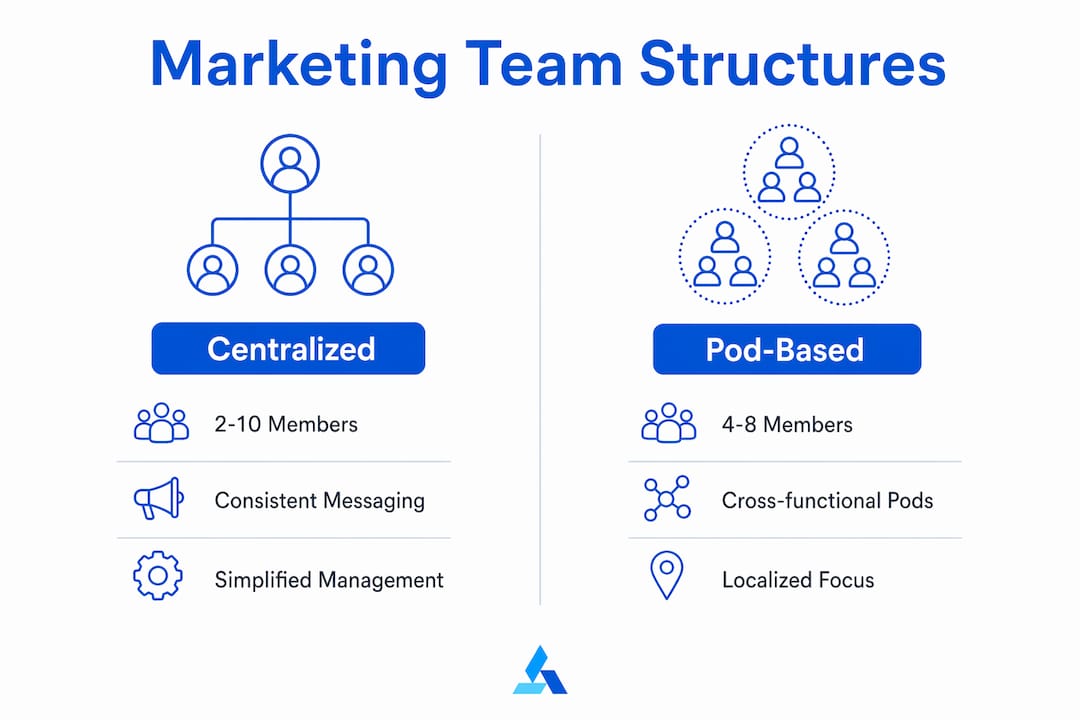
The three dominant team structure models are centralized, pod-based, and hybrid. Centralized teams report to one marketing leader and share resources across the company. Pod-based teams organize into small, cross-functional squads aligned to a product line, customer segment, or channel. Hybrid models blend both.

The data shows 37% of teams use hybrid, 35% use pod-based, and 28% use centralized structures. That distribution reflects a real tension: centralized teams are efficient but slow, while pod-based teams move fast but risk duplication. Hybrid structures try to capture both, but they require clear ownership rules to avoid becoming neither.
The leadership shift that most founders miss happens around 10–15 team members. Below that threshold, the marketing leader is a player-coach, doing the work and directing it. Above it, the role becomes purely managerial. Leaders who cannot make that psychological shift become the bottleneck. The team stalls not because of structure, but because the person at the top is still writing copy instead of setting direction.
| Structure | Ideal team size | Strengths | Weaknesses |
|---|---|---|---|
| Centralized | 2–10 members | Consistent messaging, easy budget control | Slow to respond to market changes |
| Pod-based | 10–30 members | Speed, ownership, cross-functional agility | Risk of duplicated tools and fragmented data |
| Hybrid | 15+ members | Balances efficiency and agility | Requires strong ops and clear decision rights |
Pro Tip: When your team crosses 10 people, write a one-page ownership map. List every channel and campaign type, then assign one named owner. Ambiguity at this stage costs you months.
What is the right hiring model mix at each growth stage?
The hiring model is where most companies bleed money quietly. Seed and Series A startups should target roughly 70% fractional and 30% full-time marketers. That ratio keeps fixed costs low while giving you access to senior expertise in channels you have not yet proven. You are not building a department yet. You are running experiments.
Scale-stage companies at $30M ARR and above should flip that ratio. The right target is approximately 80% full-time, 20% fractional or agency. By that point, your core channels are proven, your ICP is defined, and you need people who live inside the business to execute with context and speed.
The conversion trigger from fractional to full-time is channel maturation. When a channel consistently drives more than 20% of your pipeline and requires daily management, it is time to hire a full-time owner. Keeping it fractional past that point creates a ceiling on performance. The fractional specialist is optimizing for their portfolio, not your growth.
- Convert fractional roles to full-time when a channel becomes a primary pipeline driver
- Use agencies for overflow campaigns, not core channel ownership
- Avoid building a full team before product-market fit is confirmed
- Reference B2B SaaS scaling checklists to pressure-test your hiring sequence against revenue milestones
How does a documented strategy improve team alignment?
A documented marketing strategy is the difference between a team that executes and a team that guesses. 82% of marketers report better decision-making and clearer proof of impact when strategy is written down and shared. That is not a soft benefit. It directly reduces the number of meetings, approvals, and course corrections your team needs each quarter.
Tools like HubSpot Marketing Hub centralize campaign management, track performance against KPIs, and keep the whole team working from the same data. Without a central source of truth, you get three people running three versions of the same campaign with no way to compare results. Frameworks like Ansoff’s Matrix help teams make faster channel and product decisions by forcing explicit choices about growth direction. You can explore 95+ strategy frameworks to find the right fit for your current stage.
Strategy documentation also prevents drift. A team that documented its GTM strategy in january and never revisited it by june is operating on assumptions that no longer match the market. Regular quarterly reviews, tied to KPI performance and channel data, keep the strategy honest.
- Tie every channel to a documented KPI with a named owner
- Review strategy quarterly, not annually
- Use HubSpot Marketing Hub or equivalent tools for centralized campaign tracking
- Connect content planning directly to demand generation goals, not vanity metrics
What operational frameworks help teams scale past 15 members?
Adding headcount past 15 without shifting to pod-based structures creates coordination overhead that kills output. The symptom is a team that is busy but not productive. Everyone is in meetings. No one owns anything. Decisions require five approvals. The fix is not more people. It is a structural reset.
Pod-based squads solve this by giving small groups full ownership of a channel or segment. A demand generation pod might include a paid media specialist, a content writer, and a marketing ops analyst. They operate with a shared OKR and report results weekly. The rest of the organization does not need to be involved in their day-to-day decisions.
Centralized marketing operations prevent the duplication that pod structures can create. One team owns the CRM, the attribution model, the reporting dashboards, and the technology stack. Every pod pulls from the same data layer. This is how you get agility without fragmentation.
- Audit your current tool stack for duplication before adding headcount
- Assign one marketing ops lead to own data, CRM, and reporting across all pods
- Define pod OKRs that connect directly to company revenue targets
- Track multi-layered ROI metrics: business outcomes, channel efficiency, and creative performance
- Review pod structure every six months as team size and channel mix evolve
Pro Tip: The most common scaling mistake is not over-hiring. It is under-investing in marketing operations. One strong ops hire at the 15-person mark saves you from six months of data chaos.
Key Takeaways
High-performing marketing teams require structure, clear ownership, and a hiring model calibrated to company stage, not gut feeling.
| Point | Details |
|---|---|
| Structure drives output | Choose centralized, pod-based, or hybrid based on team size and growth stage. |
| Hiring ratios matter | Use 70% fractional at seed stage; shift to 80% full-time at scale stage. |
| Documentation aligns teams | Documented strategies produce stronger alignment and measurable ROI. |
| Ops prevents chaos | Centralized marketing operations eliminate duplicated tools and fragmented data. |
| Ownership beats headcount | Unclear ownership causes more marketing failures than lack of roles or budget. |
What I have learned about building marketing teams that actually work
Most marketing leaders I have spoken with make the same mistake: they build the team they wish they had, not the team their current revenue stage demands. A $5M ARR company does not need a six-person brand team. It needs two people who can generate pipeline and one person who can measure it.
The psychological shift from doing to managing is genuinely hard. I have watched talented marketers become terrible managers because they could not let go of execution. They kept rewriting copy, jumping into campaigns, and second-guessing their team. The result was a group of people who stopped taking initiative because they knew the boss would redo it anyway.
The other trap is mistaking activity for strategy. A team that publishes 20 blog posts a month without a documented content strategy tied to demand generation is producing noise. The data-driven approach wins every time, not because it is more creative, but because it is accountable. Every channel, every campaign, every hire should connect to a number someone owns.
AI tools are genuinely changing what small marketing teams can produce. A three-person team with the right AI-assisted research, content, and analytics stack can now outperform a ten-person team from five years ago. That is not hype. That is a structural shift in what is possible. The teams that recognize this early will build leaner, faster, and with far less waste.
— Colin Bowdery
Blue Prysm’s tools for marketing leaders who want real answers
Marketing leaders at SMBs rarely lack ambition. They lack the intelligence layer that tells them where to focus. Blue Prysm gives you AI-powered market research tools built specifically for teams that need elite-level insight without a consulting budget.
Blue Prysm’s competitive intelligence platform tracks competitor moves in real time, so your team is never reacting blind. The strategy library gives you access to 95+ proven frameworks to structure your GTM decisions, channel priorities, and team planning. If you are building or restructuring a marketing function right now, Blue Prysm cuts the guesswork out of the process and replaces it with data your team can act on immediately.
FAQ
What is the ideal size for a marketing team?
B2B companies with £10–50M revenue typically operate with a median of 11 marketers; those over £50M need around 26. Team size should match revenue stage and channel complexity, not headcount benchmarks.
What are the core roles in a marketing team?
The core roles are demand generation, content, marketing operations, brand, product marketing, and leadership. Each role serves a distinct function, and combining too many into one person limits depth and output.
How do you manage a marketing team effectively?
Clear ownership and minimal coordination overhead are the two most reliable drivers of marketing team performance. Assign one named owner to every channel and review results against documented KPIs on a regular cadence.
When should a startup hire full-time marketers vs. fractional?
Seed-stage startups should use roughly 70% fractional and 30% full-time staff. Convert a fractional role to full-time when that channel consistently drives more than 20% of pipeline and requires daily management.
What tools do high-performing marketing teams use?
HubSpot Marketing Hub is the most widely used platform for centralized campaign management and KPI tracking. Teams also use Grammarly for content quality control and AI-powered analytics platforms for real-time performance data.