


Marketing drives action. Public relations builds trust. Run them in silos and you’re paying twice for half the results. The Public Relations Society of America puts it plainly: PR builds reputation through earned media and relationships; marketing drives sales through paid and owned channels. Both are required. Neither is optional.
Here are the working definitions you need:
- Marketing: The paid and owned effort to move a specific audience toward a specific action, typically a purchase, sign-up, or demo request. Channels include paid ads, email, SEO, and content. Timeline to impact: days to weeks for paid; months for organic.
- Public relations: The earned-media and relationship effort to shape how stakeholders, press, and the public perceive your organization. Channels include media coverage, analyst briefings, executive thought leadership, and crisis communications. Timeline to impact: months to years.
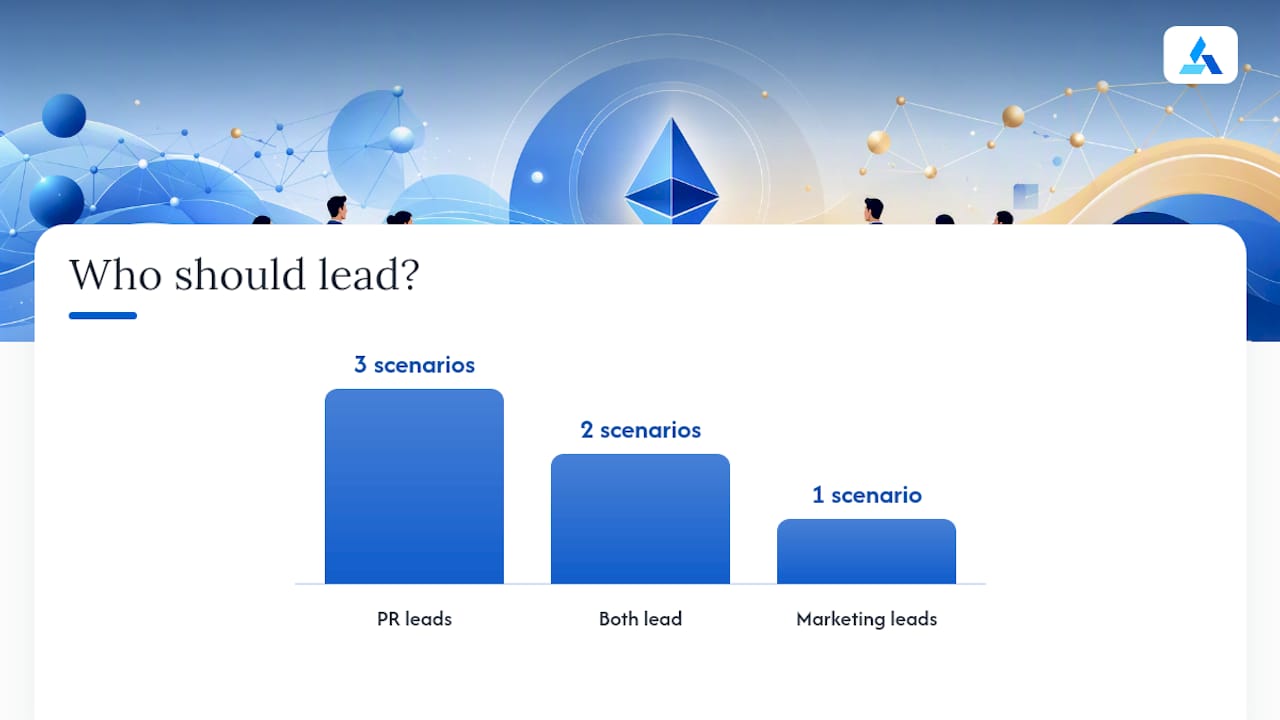
One-line recommendation: If your brand is early-stage or unknown, start with PR to build the credibility that makes every marketing dollar work harder. If you have product-market fit and proven demand, run marketing-first with PR amplifying. If you’re launching something significant, do both simultaneously with a shared brief.
Key Takeaways
Integrated PR and marketing consistently outperform siloed approaches because PR builds the trust capital that makes every marketing dollar work harder and reduces customer acquisition costs over time.
| Point | Details |
|---|---|
| PR and marketing serve different goals | PR builds reputation through earned media; marketing drives conversions through paid and owned channels. |
| PESO model aligns both functions | Map every channel to Paid, Earned, Shared, or Owned to clarify ownership and amplification responsibilities. |
| Sequence matters by scenario | Lead with PR for early-stage brands and crises; lead with marketing when product-market fit is proven. |
| Shared KPIs prevent attribution failure | Track branded search volume, referral traffic from earned placements, and assisted conversions across both teams. |
| Blue Prysm operationalizes the integration | Real-time competitor tracking and share-of-voice signals close the measurement gap between PR wins and marketing response. |
How marketing and PR actually differ at a glance
Most teams argue about who owns what. The real problem is they’re measuring the wrong things against the wrong timelines. Here’s the comparison that ends that argument.
| Dimension | Marketing | Public Relations |
|---|---|---|
| Primary goal | Drive conversions and revenue | Build reputation and trust |
| Typical KPIs | CPA, conversion rate, LTV, ROAS | Share of voice, sentiment, media mentions, domain referrals |
| Channels / media | Paid (ads), owned (blog, email, SEO) | Earned (press, analysts), shared (social, influencers) |
| Timeline to impact | Days to weeks (paid); months (SEO/content) | Months to years |
| Budget drivers | Media spend, creative production, tool subscriptions | Agency/retainer fees, content production, event costs |
| Typical ownership | Marketing director, demand-gen team | PR director, communications team |
The single biggest operational difference: marketing controls its distribution; PR earns it. You can turn a paid campaign on or off with a budget change. You cannot turn a journalist’s trust on or off. That asymmetry is why the two functions need each other.
Three reference points worth bookmarking:
- The American Marketing Association defines marketing as the activity of creating, communicating, and delivering value to customers.
- The Public Relations Society of America defines PR as a strategic communication process that builds mutually beneficial relationships between organizations and their publics.
- The PESO model (Paid, Earned, Shared, Owned) is the framework that maps every channel to its media type, making it the clearest tool for aligning both functions.
What is the PESO model and why does it matter for alignment?
PESO stands for Paid, Earned, Shared, and Owned. It’s the most practical framework for getting PR and marketing teams to stop fighting over channels and start coordinating them. West Virginia University’s integrated marketing communications program notes that PR-generated earned media can improve SEO and referral traffic when repurposed into owned and paid channels.
Here’s how each quadrant maps to real channels:
- Paid: Display ads, paid social, sponsored content, SEM, influencer payments. Owned by marketing.
- Earned: Press coverage, analyst mentions, podcast appearances, award placements, organic backlinks. Owned by PR.
- Shared: Social media posts, community forums, user-generated content, co-marketing. Shared ownership.
- Owned: Blog, email list, website, whitepapers, video library. Primarily marketing, with PR contributing thought leadership content.
The coordination point most teams miss is the amplification loop. A PR win (earned) is not the finish line. It’s the starting gun for marketing. When a journalist publishes a favorable story, that’s the moment to:
- Push the story link through owned email and social channels.
- Run paid amplification targeting the same audience segment the journalist reached.
- Repurpose the coverage into a case study, testimonial, or landing page asset.
The reverse loop works too. A high-performing owned piece (a blog post ranking on page one) is a credibility signal PR can pitch to journalists as proof of audience interest. Cision’s integration guide describes this as Marketing PR (MPR): using digital tracking and shared calendars to make the amplification cycle measurable rather than accidental.
When should you lead with PR vs. marketing?
The answer depends on what you’re trying to accomplish and what you already have. Run through this checklist before committing budget.
Decision checklist (answer yes or no):
- Does your audience already know your brand exists? If no, PR first.
- Do you have a proven offer with measurable conversion data? If no, PR first to build credibility.
- Are you managing a reputation crisis or negative press? PR leads, marketing pauses.
- Do you need revenue within 30 days? Marketing leads, PR supports.
- Are you entering a new market or category? Both simultaneously, with PR setting the narrative.
Scenario guidance:
- Product launch (early-stage brand): PR first. Secure two or three credible media placements before spending on paid ads. Buyers who see a paid ad after reading an editorial mention convert at a meaningfully higher rate because the trust work is already done.
- Demand generation (established brand): Marketing leads. PR supports with thought leadership content that feeds the SEO funnel and reinforces the paid message.
- Crisis response: PR owns the response entirely. Marketing goes dark on promotional messaging until the narrative is stabilized. Pushing sales content during a crisis accelerates reputational damage.
- Investor communications: PR leads with narrative; marketing provides data assets (case studies, growth metrics) that PR packages for analyst and media briefings.
- Brand-building (long-term): Run both. The U.S. Chamber of Commerce notes that integrated efforts reduce customer acquisition costs over time because PR creates credibility that amplifies the effectiveness of paid marketing.
The University of Iowa’s strategic communication program frames this well: strategic communication is the discipline of choosing the right vehicle (PR, marketing, advertising) for the organizational goal, rather than defaulting to whichever function has the loudest voice in the room.
How to build a PR and marketing integration playbook
This is where most guides go vague. Here’s a practitioner-ready sequence you can run in the next 30 days.
-
Hold a shared annual planning session. Both teams present their goals, budgets, and campaign calendars in the same room. The output is one master calendar showing every campaign, launch, and PR push on a single timeline. No surprises, no conflicting messages.
-
Write a unified campaign brief. Every campaign, regardless of whether PR or marketing initiated it, uses the same brief template. Required fields: campaign objective, target audience segments, PESO mix (which channels, which team owns each), core messages (three maximum), approval owner, KPIs for each channel, and amplification windows (when marketing will boost earned coverage with paid spend).
-
Sync calendars weekly. A 30-minute weekly sync between the PR lead and the marketing lead prevents the most common failure mode: marketing launching a paid campaign the same week PR is pitching a story that contradicts the ad’s message.
-
Define shared KPIs. Agree on two or three metrics that both teams are accountable for. Branded search volume, organic referral traffic from earned placements, and assisted conversions from PR-sourced traffic are good candidates. Cision’s research shows that shared KPIs reduce siloed goals and make integration measurable.
-
Build an amplification plan for every PR win. Before pitching a story, PR and marketing agree on what happens if it lands. Which email segment gets the link? What’s the paid budget to boost the coverage? Which owned page gets updated with the quote?
Pro Tip: Time your paid amplification to launch within 24–48 hours of a major earned placement going live. The journalist’s audience and your paid audience overlap most in that window, and the social proof from the coverage increases ad click-through rates.
Blue Prysm’s competitive intelligence tools can operationalize this loop by surfacing earned-coverage signals and competitor share-of-voice changes in real time, so your team knows exactly when a competitor’s PR win warrants a paid response.

Who owns what? Roles, responsibilities, and a sample RACI
The fastest way to kill integration is to leave ownership ambiguous. Here’s how to divide it cleanly.
PR owns:
- Media and analyst relationships
- Crisis communications and spokesperson preparation
- Executive thought leadership content
- Award submissions and speaking opportunities
- Earned coverage monitoring and reporting
Marketing owns:
- Paid media planning and execution
- Email marketing and marketing automation
- SEO and content production
- Conversion rate optimization
- Paid social and SEM
Shared (requires explicit agreement on lead):
- Brand voice and messaging guidelines
- Social media (PR drafts; marketing schedules and pays for amplification)
- Content repurposing (PR sources the quote; marketing publishes the case study)
- Campaign briefs and editorial calendars
- Analytics and attribution reporting
Sample RACI for a product launch campaign:
| Task | PR | Marketing | Leadership |
|---|---|---|---|
| Campaign brief | Consulted | Responsible | Approver |
| Press outreach and media list | Responsible | Informed | Informed |
| Paid ad setup and targeting | Informed | Responsible | Informed |
| Messaging and brand voice | Responsible | Consulted | Approver |
| Analytics and attribution | Consulted | Responsible | Informed |
| Post-campaign retro | Responsible | Responsible | Informed |
Collaboration rituals that actually work:
- Weekly 30-minute PR/marketing sync (standing agenda: upcoming pitches, live campaigns, shared KPI check).
- Shared dashboard visible to both teams (more on this in the next section).
- Post-campaign retro within two weeks of every major campaign, with both teams present. The retro question that matters most: “Which PR win did we fail to amplify, and why?”
How do you measure PR and marketing together?
Attribution is where integrated campaigns fall apart. PR’s contribution is real but indirect, and most marketing attribution models ignore it entirely.
KPIs by discipline:
- PR: Share of voice, media mention volume, sentiment score, domain authority of placements, spokesperson visibility index.
- Marketing: Cost per acquisition, conversion rate, customer lifetime value, return on ad spend, email open and click rates.
Shared dashboard metrics (track these for both teams):
- Organic search lift following earned coverage (compare 30-day windows before and after a major placement).
- Branded search volume trends (a PR campaign that works shows up as a spike in branded queries).
- Referral traffic from earned placements (track in Google Analytics 4 under source/medium).
- Assisted conversions from PR-sourced sessions (use multi-touch attribution windows of 30–90 days).
A simple method to estimate PR’s lift on conversions: Pull a before/after cohort for the 30 days preceding and following a major media placement. Isolate referral traffic from the earned source. Measure the conversion rate of that traffic against your baseline. The delta is a defensible estimate of PR’s contribution to pipeline.
The honest constraint: most SMBs don’t have the attribution infrastructure to do this cleanly. The PRSA’s guidance on PR measurement acknowledges that reputation metrics are inherently longer-cycle than marketing metrics, which is why shared dashboards with both short-term and long-term KPIs are necessary. Blue Prysm’s market research tools can feed share-of-voice signals and competitor tracking data directly into this kind of dashboard, closing the gap between what PR does and what the numbers show.
What do PR and marketing campaigns actually cost?
Budget misalignment is one of the most common reasons integration fails. PR leaders expect months of runway; marketing leaders expect weekly performance data. Both are right for their discipline.
Timeline to impact by activity:
| Activity | Expected time to impact |
|---|---|
| Paid search / display ads | 3–14 days |
| Paid social campaigns | days to weeks |
| Press outreach and media relations | 1–4 months |
| Content marketing and SEO | months |
| Thought leadership and executive PR | months to years |
| Brand reputation (sustained PR) | months to years |
Budget drivers to plan for:
- PR: Agency retainer or in-house PR salary, media monitoring tools (Meltwater, Cision), event and travel costs for press briefings, content production for thought leadership.
- Marketing: Paid media spend (the largest variable), creative production, marketing automation platform, analytics tools, agency fees for specialized work.
Directional budget bands (U.S. market):
- Small business / startup: $2,000–$8,000/month total. Allocate roughly 60–70% to marketing (paid + owned) and 30–40% to PR (owned thought leadership, local media outreach). The U.S. Chamber of Commerce notes that small businesses can start PR with owned-media tactics like LinkedIn thought leadership and local reporter outreach at relatively low cost.
- Mid-market: $15,000–$50,000/month. A more even split becomes viable: 50–60% marketing, 40–50% PR, with a dedicated agency relationship on the PR side.
- Enterprise: $100,000+/month. Dedicated in-house teams for both functions, supplemented by specialist agencies for earned media, paid media, and analytics.
The key planning principle: never set a 90-day KPI for a PR investment that takes six months to move the needle. Mismatched timelines are how PR gets cut from budgets prematurely.
What skills do PR and marketing professionals actually need?
The functions are distinct enough that hiring the wrong person for the wrong role is a real risk. Here’s where the skill sets diverge and where they overlap.
Skills that belong primarily to PR:
- Media relations and journalist outreach
- Crisis communications and issues management
- Executive narrative and spokesperson coaching
- Analyst relations
- Reputation monitoring and sentiment analysis
Skills that belong primarily to marketing:
- Paid media buying and optimization
- Marketing funnel design and conversion rate optimization
- Email automation and segmentation
- SEO and technical content strategy
- Performance analytics and attribution modeling
Skills both functions need:
- Audience research and persona development
- Messaging and copywriting
- Content production (articles, video scripts, social copy)
- Data interpretation and reporting
- Project management and cross-functional collaboration
The U.S. Bureau of Labor Statistics profiles PR specialists and marketing managers as distinct occupations with different day-to-day duties and outlooks. The BLS advertising and marketing managers page shows a different set of responsibilities centered on campaign planning, media buying, and performance management.
Cross-training suggestions to close the gap quickly:
- PR professionals: take Google Analytics 4 certification (free) and a paid social fundamentals course (Meta Blueprint). Understanding attribution makes you a better partner to marketing.
- Marketing professionals: take PRSA’s APR preparation materials or a media relations workshop. Understanding how journalists think makes your content pitchable, not just rankable.
- Both: learn the PESO model formally. Gini Dietrich’s Spin Sucks book and the associated PESO model certification are the clearest entry points.
Two scenarios where integrated PR and marketing actually worked
Abstract frameworks are useful. Concrete scenarios are more useful. Here are two you can adapt.
Case A: Early-stage SaaS product launch
Situation: A B2B SaaS company launching a new workflow tool with no brand recognition and a moderate monthly budget.
Timeline and PESO mix:
- Months 1–2 (PR leads): Founder writes two bylined articles for industry publications. PR team secures three podcast appearances and one trade press feature. No paid spend.
- Month 3 (marketing activates): Paid social campaigns launch using the earned coverage as social proof in ad creative. Email campaign to waitlist references the press mentions. Conversion rate on paid ads improves after the trust work is done, reflecting better efficiency.
- Month 4–6 (both sustain): PR continues media outreach. Marketing scales paid spend on the highest-converting segments. Shared dashboard tracks branded search volume (up), referral traffic from earned placements (growing), and CPA (declining).
One-sentence lesson: PR built the credibility that made the marketing spend efficient; without the earned coverage, the paid ads would have been fighting cold skepticism.
Case B: Mid-market brand in a reputation crisis
Situation: A consumer brand faces a negative viral social media story about product quality.
Timeline and response:
- Day 1–3 (PR owns entirely): PR team drafts and publishes a transparent response statement. Marketing pauses all promotional campaigns. Spokesperson is briefed and available for media inquiries.
- Day 4–14 (PR stabilizes, marketing monitors): PR monitors sentiment daily. Marketing holds paid spend but prepares updated messaging that acknowledges the issue and highlights corrective action.
- Week 3–6 (coordinated re-entry): PR secures a follow-up story showing the corrective action taken. Marketing resumes paid campaigns using the updated messaging, with the earned follow-up story as a credibility anchor.
One-sentence lesson: Marketing that re-enters too early during a crisis amplifies the negative narrative; waiting for PR to stabilize the story first means every marketing dollar works with the current rather than against it.
Immediate first steps for both cases: Assign a single integration owner (not two co-owners), write a one-page brief before any spend is committed, and agree on the amplification plan before the PR pitch goes out.
Why most teams get the integration sequence backwards
The conventional wisdom says: build your marketing engine first, then add PR when you can afford it. That sequence is backwards for most SMBs, and the data supports it.
PR’s job is to make your audience predisposed to believe you before they see your ad. When you run paid campaigns into a cold, skeptical audience with no earned credibility, you’re paying a premium to overcome distrust. When you run the same campaigns into an audience that has already read a credible third-party story about you, the conversion economics shift. The U.S. Chamber of Commerce’s analysis frames this directly: integrated PR and marketing reduce customer acquisition costs over time because PR creates trust capital that amplifies paid marketing.
What most teams also underestimate is the measurement problem. PR’s contribution doesn’t show up in last-click attribution. It shows up in branded search volume, in the conversion rate lift on paid campaigns that run after a major placement, in the shortened sales cycle for prospects who came in through earned media. If your attribution model only counts the last touch, you’ll systematically undervalue PR and overspend on paid channels to compensate.
The teams that get this right treat PR and marketing as a single communication system with two different time horizons, not two separate departments with two separate budgets. Agentic AI tools like Blue Prysm’s market analysis platform make this practical by surfacing share-of-voice changes and competitor earned-coverage signals in real time, so both teams can see the same picture and respond together.
Blue Prysm closes the gap between PR wins and marketing results
The hardest part of integrated PR and marketing isn’t the strategy. It’s the operational gap between a PR win and a marketing response. By the time the data surfaces, the amplification window has closed.
Blue Prysm’s AI-powered market research tools give strategy, marketing, and PR teams a single source of truth: real-time competitor tracking, share-of-voice signals, and automated competitive intelligence briefings that tell you when a competitor’s earned coverage warrants a paid response, and when your own PR win is ready to amplify. No more waiting for a monthly agency report. No more guessing whether the press hit moved the needle.
The platform also includes 50+ strategy and campaign brief templates, OKR and KPI tracking, and execution dashboards that keep both teams aligned on the same metrics. If you’re ready to stop running PR and marketing as parallel monologues, see how Blue Prysm works and request a demo.
Sources
- PR vs Marketing: Key Differences Every Business Owner Should Know | Public Relations Society of America
- Strategic communication, public relations, and marketing: What’s the difference? | University of Iowa
- The Role of Public Relations in Integrated Marketing Campaigns | West Virginia University
- Public Relations Specialists | U.S. Bureau of Labor Statistics
FAQ
What is the difference between PR and marketing?
PR focuses on building reputation and trust through earned media and relationships, while marketing drives sales and conversions through paid and owned channels. Both are necessary; they operate on different timelines and measure different outcomes.
Is PR considered part of marketing?
PR and marketing are related but distinct disciplines. The University of Iowa’s strategic communication program describes them as complementary functions within the broader field of strategic communication, each best suited to different organizational goals.
Which pays more, PR or marketing?
The U.S. Bureau of Labor Statistics profiles PR specialists and advertising and marketing managers as distinct occupations with different salary bands; marketing management roles generally carry higher median compensation, though senior PR and communications directors at large organizations are competitive.
Is PR being replaced by AI?
AI is changing how PR teams monitor coverage, draft pitches, and track share of voice, but the core of PR, building genuine relationships with journalists, analysts, and stakeholders, remains a human function. Tools like Blue Prysm’s competitive intelligence platform augment PR by surfacing signals faster, not by replacing the relationship work.
How do you measure PR’s impact on marketing results?
Track branded search volume, referral traffic from earned placements, and assisted conversions using a 30–90 day multi-touch attribution window. Compare conversion rates on paid campaigns that run after a major earned placement against your baseline to estimate PR’s lift on marketing performance.