


Marketers who only watch their direct rivals are playing defense with one eye closed. The four types of competitors you need to track are direct, indirect, replacement/substitute, and potential/emerging — and each one demands a different response from your marketing and product teams. Get the classification right and you stop wasting budget reacting to the wrong threats.
Here is the quick-reference breakdown, per HubSpot’s competitor taxonomy:
- Direct competitors sell the same product to the same buyer. Monitor them regularly: pricing, feature launches, ad creative, and landing page changes.
- Indirect competitors solve the same customer job with a different product. Detect them through customer interviews, keyword gaps, and share-of-voice shifts.
- Replacement/substitute competitors make your entire category less necessary. Defend against them by reframing your value proposition and demonstrating ROI that the substitute cannot match.
- Potential/emerging competitors have not entered your market yet but are moving toward it. Track hiring signals, funding rounds, and adjacent product launches quarterly.
Quick action: Add one competitor from each category to your CI board this week. If you cannot name a replacement threat, that is the gap to fill first.
Key Takeaways
Classifying competitors by type — direct, indirect, replacement, and potential — is the foundation of any CI program that actually moves marketing decisions.
| Point | Details |
|---|---|
| Four canonical competitor types | Direct, indirect, replacement/substitute, and potential/emerging each require a different monitoring and response strategy. |
| Cadence varies by type | Monitor direct competitors weekly, indirect monthly, and replacement or potential competitors quarterly unless a trigger fires. |
| JTBD unlocks indirect threats | Framing competitors by the job they complete for the buyer surfaces non-obvious rivals that lost-deal reports miss entirely. |
| The template drives decisions | Every field in your CI board should map to a named decision; fields that do not drive action should be removed. |
| Blue Prysm automates the workflow | Blue Prysm’s competitive intelligence platform tracks the template fields in real time, replacing manual spreadsheet upkeep. |
What are direct competitors in marketing, and what should you monitor?
Direct competitors are companies selling a functionally equivalent product to the same buyer segment, competing for the same budget line in the same purchase decision. They are the rivals your sales team names on lost-deal reports and the brands your prospects compare you against in demo calls.
The marketing implication is immediate: every positioning claim you make will be tested against what your direct competitors say. If they drop price, your conversion rate feels it within weeks. If they launch a feature you lack, your churn rate tells you before your product team does.
US-relevant examples by category
Consider the US project-management software space, where multiple platforms target the same “team coordination” job with near-identical feature sets. Or the US meal-kit delivery category, where providers compete on the same weekly subscription model for the same household budget. In both cases, the buyer is choosing between functionally similar offers, which means your messaging, pricing, and channel mix are in direct comparison at the moment of decision.
What to monitor weekly
- Pricing pages: changes to tier structure, free-trial length, or annual-discount framing
- Feature announcements: product changelog pages, press releases, and app-store release notes
- Ad creative: Meta Ad Library and Google Ads Transparency Center show live creative and copy angles
- Landing page copy: headline and value-proposition shifts signal a repositioning attempt
- Share of voice: branded search volume trends in Google Search Console or a keyword tool
Pro Tip: White-label and reseller bundles are disguised direct competitors. If a customer mentions a product name you do not recognize, search for its underlying technology. You may find a reseller packaging your direct rival’s core product under a new brand, targeting the same buyer with a lower-friction pitch.
How do indirect competitors win your customers without selling what you sell?
Indirect competitors sell a different product that completes the same customer job. The buyer does not switch to a like-for-like alternative — they solve the problem a different way entirely. That distinction matters because indirect competitors rarely show up on your lost-deal reports, yet they quietly drain your addressable market.

The Jobs-to-be-Done framework from the Christensen Institute is the clearest lens here. JTBD reframes competitors as any solution that gets the customer’s job done, regardless of product category. A US small business owner who needs “to understand what competitors are doing” might hire a freelance analyst, subscribe to a newsletter, or run manual Google searches — none of which are the same product category as a CI platform, but all of which compete for the same budget and attention.
Four JTBD-framed examples
- A B2B SaaS company selling sales enablement software competes indirectly with sales training programs — same job (close more deals), different solution.
- A US accounting software provider competes indirectly with outsourced bookkeeping services — same job (accurate books), different delivery.
- A project-management platform competes indirectly with shared spreadsheets and email threads — same job (coordinate work), zero subscription cost.
- A market research platform competes indirectly with hiring a strategy intern — same job (gather competitive data), different cost structure and timeline.
Detection tactics
- Customer exit interviews: ask “what did you consider before choosing us?” and “what would you do if we did not exist?” The answers name your indirect competitors.
- Review site mining: read one-star reviews on your own product pages and three-star reviews on adjacent category pages. Buyers describe workarounds that reveal indirect substitutes.
- Keyword research: search for the job-to-be-done phrase, not your product category. “How to track competitor pricing” surfaces different results than “competitor tracking software.”
- Social listening: monitor the job-to-be-done phrase on LinkedIn and Reddit. You will find communities recommending non-obvious solutions.
Pro Tip: Set a Google Alert for your top three job-to-be-done phrases. When a new content piece ranks for those terms from an unexpected domain, check whether it is an indirect competitor building share of voice in your buyer’s research journey before you even enter the picture.
When a competitor makes your whole category unnecessary
Replacement competitors do not just take your customers — they make the buyer question whether your category is worth paying for at all. This is the most strategically dangerous threat because it does not show up in standard competitive analysis until the displacement is already underway.
The mechanism is usually a technology shift or a behavioral change that lowers the cost of the alternative below the threshold where your category’s value is obvious. US newspaper classified advertising did not lose to a better classified ad product — it lost to a free, searchable, always-on alternative that made the paid format feel absurd. The category did not shrink; it collapsed.

A more recent US example: the corporate travel management category has faced pressure from self-serve booking platforms that give employees direct access to airline and hotel inventory. The job (book business travel) still exists, but the argument for a managed travel program requires a much stronger ROI case than it did a decade ago.
Action checklist for product and positioning teams
- Reframe the job-to-be-done: articulate what your product does that the replacement cannot, at the level of outcome, not feature.
- Bundle to raise switching costs: add adjacent value that the replacement does not offer, making the comparison less clean.
- Demonstrate ROI explicitly: if the replacement is cheaper, quantify what the buyer loses by choosing it — compliance risk, time cost, quality gap.
- Invest in the moat: build data, network effects, or integrations that the replacement cannot replicate quickly.
Pro Tip: Early indicators that a replacement is taking hold include a spike in “do I need X?” search queries, a rise in DIY tutorial content in your category, and a shift in where your buyers are spending time online. When a YouTube channel teaching people to do manually what your product automates starts growing fast, that is a signal worth logging.
How do you spot competitors who have not entered your market yet?
Potential and emerging competitors are companies that do not yet sell in your market but have the capability, the customer relationships, or the strategic incentive to enter. They deserve a different tracking posture than incumbents — you are not reacting to their moves yet, you are reading signals that predict when they will move.
The most common origin points for new entrants in US B2B markets:
- Adjacent category players who already serve your buyer and need to expand revenue per account
- Enterprise vendors adding features that creep into the mid-market or SMB segment
- Platform companies (marketplaces, operating systems, ecosystems) that can bundle a competing capability at near-zero marginal cost
- Well-funded startups in adjacent categories that have just closed a Series A or B and are looking for the next beachhead
Porter’s Five Forces treats the threat of new entrants as a structural force, not a one-time event. The lower the barriers to entry in your category, the more continuously you need to scan the horizon.
Early-warning signals to track
- Hiring signals: a company posting for a product manager with your category’s keywords in the job description is building toward your market.
- Funding announcements: a Series B in an adjacent category with overlapping buyer personas is a 12–18 month warning.
- Product roadmap signals: beta features, changelog entries, and developer API documentation that extend into your territory.
- Platform integrations: a new native integration with a tool your buyers use daily can be a distribution play that bypasses your GTM entirely.
- MVP launches in adjacent categories: a company testing a stripped-down version of your core feature as a free add-on to their existing product.
Pro Tip: Set up a lightweight trigger system: a Slack channel that aggregates Google Alerts for “[adjacent category] + [your buyer persona],” LinkedIn job alerts for key roles, and a monthly Crunchbase filter for funding rounds in adjacent verticals. Review it monthly; escalate to weekly if a trigger fires.
How do you identify and map competitors this week?
The trap most marketing teams fall into is treating competitor identification as a one-time research project. It is a workflow. Here is a repeatable four-step process you can run in a week and then maintain on a rolling basis.
Step 1 — Search (Day 1–2): Run your core job-to-be-done phrases and product category terms in Google, then check the first two pages. Log every domain that appears in organic results, paid ads, and featured snippets. Cross-reference with the Meta Ad Library and Google Ads Transparency Center for paid competitors who may not rank organically.
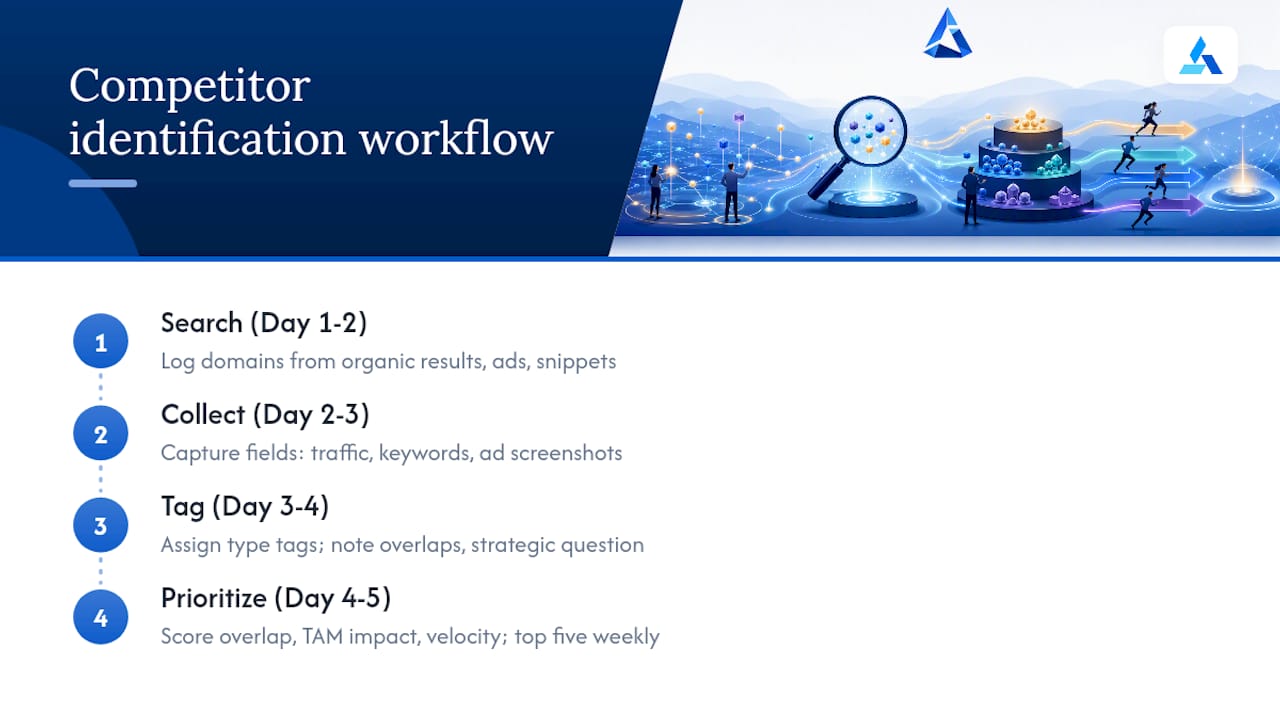
Step 2 — Collect (Day 2–3): For each domain, capture the data fields below. Use a shared spreadsheet or a CI platform. Pull traffic estimates from SimilarWeb’s free tier, keyword overlap from a tool like Ahrefs or SEMrush, and ad creative screenshots from the ad libraries. Check G2, Capterra, or Trustpilot for positioning language straight from buyer reviews.
Step 3 — Tag (Day 3–4): Assign each competitor to one of the four types. Some will fit two categories — tag both and note the overlap. A structured competitor brand analysis tailors the comparison fields to the specific question you are answering, so note the strategic question driving each profile (prelaunch assessment, pricing re-evaluation, messaging audit).
Step 4 — Prioritize (Day 4–5): Score each competitor on deal overlap (how often they appear in your pipeline), TAM impact (how much of your addressable market they could capture), and velocity (how fast they are moving). The top five by combined score get weekly monitoring; the rest go monthly or quarterly.
Data fields to capture for each competitor profile
| Field | What to capture |
|---|---|
| Competitor name and type | Direct / indirect / replacement / potential |
| Job-to-be-done | One sentence: what job does the buyer hire them to do? |
| Positioning statement | Their headline value claim (from homepage H1) |
| Pricing tiers | Named tiers and public price points |
| Primary channels | Organic, paid, social, email, events |
| Sample creative | Screenshot or link to a live ad or landing page |
| Share-of-voice estimate | Keyword overlap % or traffic estimate |
| Watch triggers | The specific signal that would escalate monitoring |
Analyzing a competitor’s marketing strategy means inspecting their target audience, messaging, content types, channels, and tech stack — tools like Ahrefs, SEMrush, and ad libraries give you the data layer; human judgment gives you the interpretation. You can also reverse-engineer competitor marketing strategies using free tools and AI-assisted analysis, but the competitive advantage comes from adapting what you find to your own proof points, not copying the mechanism.
How should you prioritize which competitors to track, and how often?
Not every competitor deserves the same attention. Spreading monitoring effort evenly across 20 names is how CI boards become graveyards of stale data nobody reads.
Prioritization criteria
Score each competitor on four dimensions (1–3 scale, 3 = highest impact):
- Deal overlap: how frequently does this competitor appear in your CRM’s lost-deal or competitive-mention fields?
- TAM impact: what share of your Total Addressable Market could they realistically capture?
- Velocity: how fast are they moving — funding, hiring, feature releases, ad spend growth?
- Intent signals: have they made a public statement, partnership, or product move that signals they are targeting your segment?
Add the scores. Competitors scoring 10–12 are Tier 1 (weekly). Scores of 6–9 are Tier 2 (monthly). Below 6 are Tier 3 (quarterly, or trigger-based).
Recommended monitoring cadence by competitor type
A repeatable competitive analysis framework recommends refreshing CI quarterly with a full deep dive annually — but cadence should vary by type, not just by calendar. Per HubSpot’s guidance:
| Competitor type | Default cadence | Escalation trigger |
|---|---|---|
| Direct | Weekly | Pricing change, major feature launch, new campaign |
| Indirect | Monthly | Share-of-voice shift, new JTBD-adjacent content ranking |
| Replacement/substitute | Quarterly | Adoption spike, category search volume decline |
| Potential/emerging | Quarterly | Funding round, key hire, adjacent product launch |
What to track in your CI board
- Product launches and changelog updates
- Ad spend spikes (detectable via ad library activity volume)
- Pricing page changes
- Key executive hires (especially VP of Sales, CMO, or product leads)
- Major partnerships or integrations
- Press coverage and analyst mentions
Fast-growing challengers often reveal exploitable positioning gaps before market leaders do. Studying challengers alongside leaders gives you a fuller picture of where the market is moving, not just where it currently sits.
How do you turn competitor types into real marketing moves?
Classification is worthless without execution. Here is how each competitor type maps to a specific marketing or product response.
-
Direct competitor response: Close feature gaps that appear in lost-deal analysis, then differentiate on the dimension where you genuinely win. Do not match every feature — pick the two or three where you have a defensible advantage and build your messaging around them. Building brand authority through content and SEO is one of the most durable plays against a direct rival who is outspending you on paid channels.
-
Indirect competitor response: Educate the buyer on the JTBD. If they are solving the job with a spreadsheet, your content strategy should make the cost of that workaround visible — time lost, errors made, scale ceiling hit. The goal is not to attack the spreadsheet; it is to make the buyer feel the friction before they feel it themselves.
-
Replacement competitor response: Reframe your value proposition at the outcome level, not the feature level. If a replacement is cheaper, your argument is not “we have more features” — it is “here is what you lose when you choose the cheaper path.” Quantify that loss in terms the buyer’s CFO cares about.
-
Potential competitor response: Build defensible assets now. AI strategies that build competitive advantage include proprietary data, deep integrations, and network effects that a new entrant cannot replicate in 12 months. The time to build the moat is before the entrant arrives.
Three short playbooks
Win-back campaign (direct competitor): When a direct rival launches a major feature or cuts price, activate a win-back sequence targeting churned accounts from the past 90 days. Lead with a specific counter-claim tied to the feature or price move. High-intent targeting on branded competitor search terms amplifies reach. Time to impact: 30–45 days. Owner: demand gen + product marketing.
Launch-response playbook (direct or potential competitor): When a competitor announces a new product, publish a comparison landing page within 72 hours. Capture the search intent before their PR cycle peaks. Include a third-party review link and a free trial CTA. Time to impact: 7–14 days. Owner: content + web team.
Content/SEO gap play (indirect competitor): Identify the job-to-be-done search queries your indirect competitors rank for but you do not. Build a content cluster around those queries, framing your product as the upgrade path from the workaround. Time to impact: 60–90 days. Owner: SEO + content. See competitive product strategy examples for worked cases across industries.
A one-page competitor-mapping template you can use right now
The template below gives you the exact CSV columns to build a CI board that is actually useful. Every field maps to a decision — if a field does not drive a decision, it does not belong in the template.
Template columns (CSV field names)
Worked example row (generic/anonymous)
- competitor_id: COMP-004
- competitor_type: Indirect
- jtbd: “Help our marketing team understand what competitors are doing without hiring an analyst.”
- positioning_phrase: “Market intelligence, simplified.”
- price_tiers: Free tier (limited reports); Pro at $149/month; Team at $399/month
- primary_channels: Organic search (est. 60%), LinkedIn paid (est. 25%), email nurture (est. 15%)
- creative_examples: [Ad Library link dated current quarter]
- evidence_score: 2 (pricing from public page; traffic from SimilarWeb estimate)
- watch_triggers: New feature announcement targeting “SMB strategy teams”; funding round above $5M
Validation checklist
- Every competitor has a named type (no “TBD” entries).
- The JTBD field uses buyer language, not product category language.
- Evidence score is 2 or higher for Tier 1 competitors.
- Watch triggers are specific enough that a team member could set an automated alert for them.
- The template is reviewed and updated on the cadence set in your prioritization matrix.
This template structure maps directly to the fields Blue Prysm’s competitive intelligence platform tracks automatically — so if you outgrow the spreadsheet, the migration is clean.
The CI practitioner’s honest take on what actually works
Most competitive intelligence programs fail not because teams lack data, but because they collect too much of it and act on none of it. The CI board becomes a monument to effort rather than a tool for decisions.
Here is what actually keeps a CI practice useful without burning out the team:
- Tie every competitor entry to a decision. If you cannot name the decision a data field informs, delete the field.
- Set watch triggers before you need them. A trigger defined in advance (“if Competitor X raises a Series B, escalate to weekly monitoring”) removes the judgment call in the moment.
- Review on a fixed cadence, not when someone asks. Ad hoc CI requests are a symptom of a program that has not earned trust. A monthly CI brief that lands in the leadership inbox on the first Monday of the month builds the habit.
- Validate with customers, not just search data. Search data tells you what competitors say; customer interviews tell you what buyers actually believe. Run at least four customer interviews per quarter with competitive questions embedded.
- Kill stale entries. A competitor that has not triggered a watch signal in six months and does not appear in deal data gets downgraded or removed. Pruning is as important as adding.
Blue Prysm cuts the hours you spend building and maintaining this manually
Mapping four competitor types across a living spreadsheet, setting alerts, pulling ad library screenshots, and writing a monthly CI brief is a real job. For most SMB marketing teams, it is a job nobody has time to do well.
Blue Prysm’s market analysis platform automates the fields in the template above: real-time competitor tracking, automated CI briefings, a strategy library with 50+ frameworks, and Agentic AI workflows that surface signals before you think to look for them. The platform maps directly to the competitor_type, jtbd, positioning_phrase, and watch_trigger columns — so your team spends time on interpretation and response, not on data collection.
If your current CI process lives in a shared Google Sheet that nobody updates consistently, that is the problem Blue Prysm solves. Start a trial or request a demo at Blueprysm and see how the template fields map to automated tracking in the platform.
Sources
These are the primary frameworks and tools referenced throughout this guide. Each one maps to a specific step in the identification and monitoring workflow.
- The five forces — Harvard Business School
- Jobs to be Done — Christensen Institute
- How to do a competitor brand analysis — Shopify
- How to reverse-engineer any competitor’s marketing strategy using AI — Lilach Bullock
- Types of competitors in business — HubSpot
FAQ
What are the four types of competition in marketing?
The four types are direct (same product, same buyer), indirect (different product, same job-to-be-done), replacement/substitute (makes the category less necessary), and potential/emerging (not yet in the market but capable of entering). Each type requires a different monitoring cadence and a different strategic response.
What are five examples of competition in business?
Two project-management platforms targeting the same team-coordination job are direct competitors. A sales training program and a sales enablement platform are indirect competitors for the same “close more deals” job. A free self-serve booking tool competing with a managed travel program is a replacement competitor. A well-funded startup in an adjacent category eyeing your buyer segment is a potential competitor. A platform company bundling a competing feature into its existing product is an emerging entrant.
What are the types of competitive strategies in marketing?
The four core competitive strategies map to competitor type: feature parity plus differentiation against direct rivals; JTBD education and content to counter indirect competitors; ROI reframing and bundling to defend against replacements; and building defensible assets (data, integrations, network effects) to deter potential entrants before they arrive.
How often should you refresh your competitive analysis?
Monitor direct competitors weekly, indirect competitors monthly, and replacement or potential competitors quarterly — unless a watch trigger fires, which escalates any type to immediate review. A repeatable competitive analysis framework recommends a full deep dive annually alongside the rolling quarterly refresh.
How does Blue Prysm help with competitor tracking?
Blue Prysm’s competitive intelligence platform automates the data collection fields in the competitor-mapping template — real-time tracking, automated CI briefings, and Agentic AI workflows — so marketing teams spend time on strategic response rather than manual data gathering.