


TL;DR:
- AI-powered intelligence integrates organizational context into a continuous, adaptive system, unlike standalone AI tools. Its adoption boosts productivity, transforms jobs, and offers a strategic advantage, but requires organizational redesign and data integration. Leaders who prioritize early adoption and governance avoid falling behind in global competitiveness and build harder-to-copy organizational muscle.
Most business leaders assume AI is either too expensive for their scale or a threat to their workforce. Both assumptions are costing them more than they realize. The real question isn’t whether AI will reshape your competitive position. It already is. The question is whether you’re directing that shift or reacting to it. This article cuts through the noise around why choose AI-powered intelligence as a strategic capability, not just a technology purchase, and gives you the framework to act decisively.
Table of Contents
- Key takeaways
- Why choose AI-powered intelligence over standard AI tools
- The measurable advantages for business leaders
- Challenges leaders must stop underestimating
- How to integrate AI intelligence into your strategy
- Why falling behind on AI adoption is a strategic risk
- My honest take on why most leaders get this wrong
- How Blue Prysm puts this into practice for you
- FAQ
Key takeaways
| Point | Details |
|---|---|
| AI intelligence vs. AI tools | AI-powered intelligence integrates context, workflows, and data into a continuously learning system, unlike standalone AI tools. |
| Productivity gains are real | Skilled workers see up to 40% performance increases with AI support, with measurable gains across industries. |
| Jobs transform, not disappear | AI automates routine tasks so your team can focus on strategic, higher-value work. |
| Governance is non-negotiable | Human-in-the-loop oversight prevents false certainty and keeps AI outputs accountable and auditable. |
| Adoption gaps create risk | Only 28.3% of US workers regularly use AI tools, meaning early movers gain a significant competitive edge. |
Why choose AI-powered intelligence over standard AI tools
There’s a trap most leaders fall into. They buy an AI tool, plug it into one workflow, and call it a strategy. Six months later, they’re underwhelmed. The problem isn’t the AI. The problem is treating AI like a point solution rather than an intelligence layer that runs through the entire organization.
AI-powered intelligence is fundamentally different from deploying a standalone chatbot or an automation script. Think of it as an Intelligent Digital Brain that connects data, knowledge, and decisions across your enterprise, enabling continuous learning and organizational agility. It’s not just about processing speed. It’s about context.
Generic AI models are trained on general data. They don’t know your supplier relationships, your market positioning, your three-year GTM strategy, or the institutional knowledge that lives in your senior team’s heads. That context is the real competitive asset. According to research on enterprise AI architecture, proprietary context and workflows represent the next true moat. Generic models cannot replicate it.
The key distinctions of AI-powered intelligence at the enterprise level include:
- Context-awareness: It learns from your specific data, not just public training sets.
- Workflow integration: It embeds into how decisions are actually made, not bolted on afterward.
- Continuous learning: It improves as your business evolves, rather than becoming stale.
- Human-in-the-loop design: Human oversight is built into the system, not added as an afterthought.
Pro Tip: Before evaluating any AI platform, map where proprietary knowledge lives in your organization. Customer conversations, competitor analysis, pricing decisions. That map tells you exactly where AI-powered intelligence will generate the most leverage.
The measurable advantages for business leaders
Let’s talk numbers, because the business case for AI-powered intelligence doesn’t rest on theory.
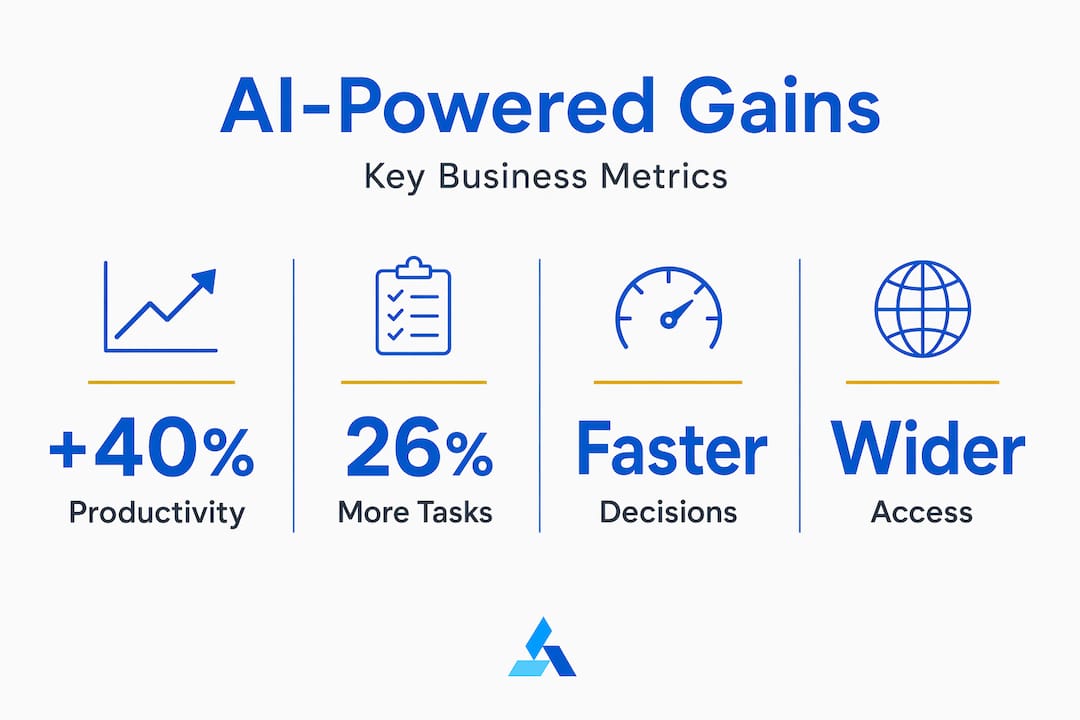
Generative AI boosts skilled worker performance by nearly 40%, and software developers complete around 26% more tasks with AI support. These aren’t projections. They’re measured outcomes from real work environments. For a leadership team making resource allocation decisions, that kind of productivity differential is the difference between hitting your annual plan and missing it by a quarter.
| Benefit | What it means for leaders |
|---|---|
| Up to 40% productivity gain | Skilled teams output more without headcount increases |
| Faster decision cycles | Real-time intelligence replaces slow manual research |
| Lower operational costs | Automation of repetitive tasks reduces unit costs |
| Higher innovation throughput | Human talent redirected from routine to creative work |
| Competitive positioning | Early adopters build advantages that are hard to replicate |
The job displacement fear is the most persistent myth in this conversation. The evidence points elsewhere. AI transforms jobs rather than eliminating them, automating routine tasks and enabling workers to take on more complex, higher-value projects. A marketing analyst who spent 60% of their week pulling data can now spend 60% of their week interpreting it and making recommendations. That’s not a job loss. It’s a job upgrade.
The advantages go beyond individual performance:
- Decision speed: AI-powered decision making compresses the time between data availability and strategic response from weeks to hours.
- Cost structure: AI permanently lowers operational costs and supports higher wages while easing inflationary pressures over the long term.
- Cross-industry applicability: The productivity correlation between AI adoption and output holds across manufacturing, services, and knowledge work, with correlation coefficients between 0.32 and 0.72 depending on sector.
For small and mid-sized businesses, this is particularly significant. The advantages of AI technology were once exclusive to enterprises with nine-figure analytics budgets. That gap is closing fast.
Challenges leaders must stop underestimating
Honest conversation time. AI-powered intelligence adoption comes with real friction, and most of it isn’t technical.

The most common obstacles aren’t about algorithm quality or computing power. Data accessibility and integration are the primary barriers to scaling AI effectively in enterprises. You can have the best model in the world running on siloed, inconsistent data, and it will generate confident-sounding nonsense. That’s a data governance problem, not an AI problem.
Here’s what leaders genuinely need to work through:
- Data silos: When customer data lives in CRM, financial data in ERP, and market intelligence in someone’s inbox, AI can’t connect the dots. Integration comes before intelligence.
- False certainty: This one is dangerous. AI outputs look authoritative. They’re presented with precision. But human-in-the-loop governance is non-negotiable to prevent over-reliance on outputs that haven’t been stress-tested by human judgment.
- Organizational resistance: Your team’s willingness to adopt, adapt, and experiment matters more than the platform you buy. Culture moves slower than software.
- Ethical accountability: AI decisions in hiring, pricing, or customer segmentation carry real consequences. Responsibility doesn’t transfer to the algorithm.
The cost objection deserves a direct response. Yes, enterprise AI implementations can be expensive. But scalable platforms, particularly those designed for SMBs, have changed the math considerably. The question isn’t whether you can afford AI-powered intelligence. It’s whether you can afford the productivity gap that opens between you and competitors who adopt it.
Pro Tip: Start with one high-impact, data-rich use case. Competitor monitoring, market briefing synthesis, or pricing analysis. Demonstrate ROI on that beachhead before expanding. It builds internal confidence and surfaces integration issues early.
How to integrate AI intelligence into your strategy
There’s a practical framework for this, and it starts with a counterintuitive premise. Successful AI integration is primarily an organizational design challenge, not a technology deployment project.
-
Redesign workflows before deploying tools. Map your current decision-making processes end to end. Where does information bottleneck? Where is judgment inconsistent? AI should fill those gaps. If you drop AI into a broken workflow, it automates the broken process.
-
Build your proprietary context layer. Feed your AI systems with institutional knowledge. Historical market analyses, customer feedback, internal strategy documents, and competitive intelligence. The AI strategies that build competitive advantage are the ones trained on what only your organization knows.
-
Establish human-in-the-loop governance. Define which AI outputs require human review before acting. Strategic decisions, customer-facing communications, financial projections. Not every output, but the ones where false certainty carries real downside risk. Redesigning workflows with responsible AI governance is how organizations scale impact without scaling risk.
-
Invest in workforce skill alignment. Your team needs to know how to prompt, interpret, challenge, and apply AI outputs. That’s a training investment, not a technical one. People who can work effectively with AI will outperform those who can’t by a significant margin.
-
Measure continuously and adapt. AI-powered intelligence isn’t a one-time deployment. Set KPIs tied to decision quality, cycle time, and cost reduction. Review them quarterly and adjust.
-
Open new business models. When your team is freed from research and data aggregation, they have cognitive bandwidth for innovation. Use that. The leaders who gain the most from AI aren’t just doing old things faster. They’re doing new things that weren’t possible before.
Why falling behind on AI adoption is a strategic risk
Here’s the uncomfortable reality. Only 28.3% of US working-age people regularly used AI tools in 2025. Meanwhile, South Korea increased its adoption rate from 25.9% to 30.7% in just six months. If the US business community doesn’t close that gap, the productivity differential compounds over time, and it shows up in global competitiveness.
“Countries with higher AI adoption show measurably higher GDP per hour worked. The correlation is not coincidental. It’s directional.”
| Adoption posture | Short-term position | Long-term risk |
|---|---|---|
| Early adopter | Higher productivity, faster decisions | Low: builds compounding advantage |
| Late adopter | Status quo maintained | Medium: catch-up costs increase over time |
| Non-adopter | Competitive gap widens | High: structural disadvantage becomes permanent |
The businesses that treat AI-powered intelligence as a future concern rather than a present priority are making a bet that the competitive gap won’t widen before they’re ready. That bet is getting harder to justify. Emerging AI trends aren’t slowing down to wait for organizational readiness.
The shift toward intelligent, adaptive enterprises is already underway. The leaders who act now aren’t just gaining tools. They’re building organizational muscle memory around AI-augmented decision making that competitors will spend years trying to replicate.
My honest take on why most leaders get this wrong
I’ve watched a lot of organizations buy AI platforms and then wonder why nothing changed. The pattern is almost always the same. The technology works fine. The strategy around it doesn’t exist.
In my experience, the leaders who succeed with AI-powered intelligence stop treating it as a technology initiative and start treating it as a fundamental redesign of how their organization thinks and decides. That mental shift is harder than it sounds, because it requires admitting that existing workflows, org structures, and decision hierarchies were built for a pre-AI world.
The siloed initiatives are the biggest trap. One team runs AI experiments over here, another team does something different over there, and nobody integrates the outputs into actual strategy. You end up with a collection of impressive demos and no competitive advantage.
What I’ve seen actually work is when leadership makes AI-powered intelligence a board-level priority, assigns accountability clearly, and commits to the messy work of data integration before expecting outputs. The decision intelligence process only pays off when the inputs are trustworthy and the governance is real.
My take is this: view AI as a living ecosystem embedded in your organization’s nervous system, not a product you purchased. Organizations that internalize that framing move faster, adapt better, and build advantages that are genuinely hard to copy.
— Colin Bowdery
How Blue Prysm puts this into practice for you
If this article has raised more questions than it answered about where to start, that’s by design. Strategy without specificity is just ambition.
Blue Prysm was built precisely for this moment. The platform gives business leaders access to daily market briefings, competitor monitoring, strategic planning tools, and idea validation, all AI-powered and structured for decision-makers who don’t have Fortune 100 budgets but face Fortune 100 competition. You can explore how it works in detail, or check platform pricing to find a plan scaled to your needs. The intelligence gap between you and your best-resourced competitors is closable. Blue Prysm is how you close it.
FAQ
What makes AI-powered intelligence different from regular AI?
AI-powered intelligence integrates your organization’s proprietary context, workflows, and data into a continuously learning system. Regular AI tools operate on general training data without that organizational knowledge layer.
How much productivity gain can businesses realistically expect?
Research shows skilled workers improve performance by up to 40% with generative AI support, and software developers complete around 26% more tasks. Gains vary by function and adoption quality.
Will AI-powered intelligence replace jobs in my organization?
The evidence is clear: AI transforms jobs rather than eliminating them. Routine tasks get automated, freeing your team for higher-value strategic and creative work.
What’s the biggest barrier to AI intelligence adoption?
Data accessibility and integration, not algorithm quality, is the primary barrier for most enterprises. Siloed, inconsistent data produces unreliable outputs regardless of how good the underlying model is.
How do I govern AI outputs to avoid bad decisions?
Build human-in-the-loop review into your workflows for high-stakes decisions. Define which outputs require human sign-off before action, and treat AI as a highly capable analyst, not a final authority.
Recommended
- AI strategies that actually build competitive advantage – Blue Prysm – Articles & Blogs
- AI-driven business insights for SME strategy and growth – Articles & Blogs
- Unlock the power of decision intelligence for SMEs – Blue Prysm – Articles & Blogs
- Data-Driven Strategy Examples for SMEs: Real-World Wins – Blue Prysm – Articles & Blogs