


TL;DR:
- Many organizations overlook the importance of structured intelligence briefings, which are essential for informed decision-making.
- By focusing on tailored, timely communication that supports specific decisions, businesses can improve agility and strategic insight.
Most professionals assume intelligence briefings belong exclusively to spy agencies and war rooms. That assumption is costing them. An intelligence briefing is a structured communication that distills complex, often fast-moving information into clear findings for a specific decision-maker or group. The format originated in government, but the logic behind it applies directly to any business context where you need accurate, timely information to act. This guide breaks down what an intelligence briefing is, how it works, and why it matters for strategy, market analysis, and competitive planning.
Table of Contents
- Key takeaways
- What an intelligence briefing actually is
- The core purpose of intelligence briefings
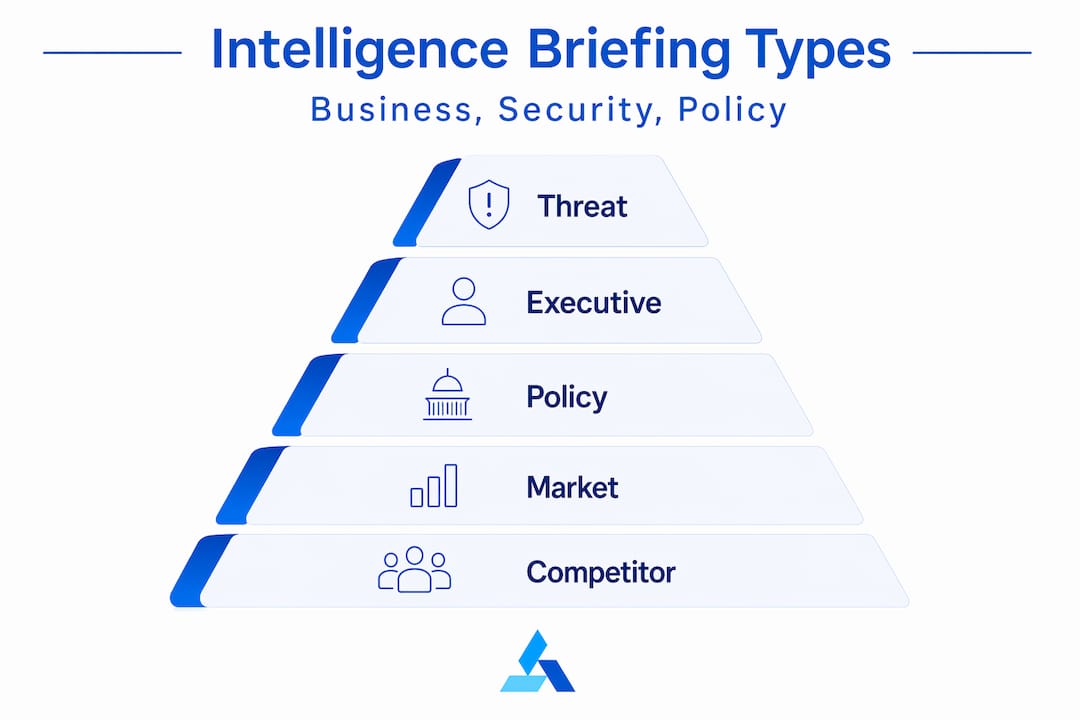
- Types of intelligence briefings you need to know
- Preparing and delivering briefings that actually get used
- Applying intelligence briefings to business strategy
- My take: intelligence briefings are a leadership discipline, not a format
- See how Blue Prysm structures intelligence for your business
- FAQ
Key takeaways
| Point | Details |
|---|---|
| Intelligence briefings are not just for governments | Any business leader or analyst can use briefing formats to cut through noise and support faster decisions. |
| Purpose drives format | The best briefings are built around specific questions, not general information dumps. |
| Tactical vs. strategic briefings serve different needs | Short-term situation updates and long-term strategic analysis require different structures and delivery styles. |
| AI dramatically speeds up briefing production | Automation reduces hours of manual data collection to minutes, making timely briefings achievable for smaller teams. |
| Tailoring is the difference between read and ignored | Format, length, and narrative style must match the consumer’s habits and decision context. |
What an intelligence briefing actually is
An intelligence briefing is a focused, curated communication designed to give a decision-maker the information they need, when they need it, in a form they can actually use. That last part is where most attempts fail. The goal is not to share everything you know. It is to share the right things, at the right level of detail, for the right person.
The most well-known example is the President’s Daily Brief, a classified summary coordinated by the U.S. Intelligence Community to inform top officials. It reads more like a sharp executive summary than a research paper. That design choice is deliberate. Decision-makers do not have time for long-form documentation. They need judgment, context, and implications.
Briefings come in multiple formats depending on context:
- Oral briefings delivered in person or via video, often interactive and question-driven
- Written briefings such as reports, memos, or structured summaries sent in advance
- Interactive sessions where analysts field real-time questions from executives or policy leads
Here is a quick comparison of how intelligence briefing attributes vary across common contexts:
| Attribute | Government | Cybersecurity | Business/Market |
|---|---|---|---|
| Audience | Senior officials, policymakers | CISOs, security analysts | C-suite, product, strategy teams |
| Format | Classified written brief with oral follow-up | Threat report with risk mapping | Market summary, competitor brief |
| Frequency | Daily | As-needed or continuous | Weekly, monthly, or event-triggered |
| Key focus | National security, geopolitical risk | Threat actors, vulnerabilities | Market shifts, competitor moves |
| Primary output | Decision support for policy | Incident response prioritization | Strategic or GTM decisions |
The format shifts, but the underlying discipline stays constant. Strip out irrelevant information, synthesize what matters, and frame it around decisions rather than facts.
The core purpose of intelligence briefings
The point of a briefing is not simply to inform. It is to shape how a decision-maker thinks about a situation. There is a meaningful difference between those two things. Raw information updates you. A well-constructed briefing tells you what to do with what you know.

Effective briefings separate immediate news from longer-term analysis to actively influence decision-making, not just document events. This distinction between tactical and strategic intelligence is critical for business professionals to understand.
Tactical intelligence covers immediate, time-sensitive situations. A competitor drops pricing by 20% overnight. A regulatory change takes effect next quarter. A key supplier signals disruption. Tactical briefings answer: what is happening right now and what do we do about it?
Strategic intelligence looks further out. It analyzes trajectories, second-order effects, and market-level shifts that will matter 12 to 36 months from now. Think Total Addressable Market expansion signals, shifts in competitor positioning, or supply chain vulnerabilities with long lead times.
The benefits of running formal intelligence briefings in a business context include:
- Faster, better-grounded decisions because leaders are not starting from scratch each time
- Reduced cognitive load at the leadership level by filtering the relevant from the irrelevant
- Shared situational awareness across teams working on connected problems
- Earlier warning of market threats or opportunities before they become crises
- Clearer accountability for who owns specific intelligence questions and when they need answers
Pro Tip: Before building any briefing, write down the three decisions it needs to support. If the content does not serve those decisions, cut it. Briefings built around decisions are used. Briefings built around information collection are filed and forgotten.
Question-driven briefings built around participant priorities are consistently more engaging and more useful than broadcast-style information dumps. That principle applies whether you are briefing a head of state or a VP of product.
Types of intelligence briefings you need to know
Not every briefing serves the same function. Knowing which type fits your context prevents the trap of applying the wrong format to the wrong situation.
-
Threat intelligence briefings focus on identifying, assessing, and prioritizing risks to an organization. In cybersecurity, this means tracking threat actors, vulnerabilities, and attack patterns. In a business context, it means monitoring competitive threats, regulatory risks, or supply chain exposure. Preparation involves collecting diverse inputs, correlating them, and filtering down to what is relevant. Without automation, briefing production can take hours or days before a single narrative sentence is written.
-
Executive briefings are designed for C-suite audiences who need the headline judgments, not the underlying data. These are short, visually clean, and lead with implications. An executive briefing on a new market entrant might be two pages: who they are, what threat they pose, and what response options exist.
-
Policy intelligence briefings are highly interactive and participant-driven. Modeled on formats like those used by POLITICO Pro, these sessions are built around specific questions the audience brings. They conclude with takeaways and curated resources, not just a one-way data transfer.
-
Market intelligence briefings synthesize competitor activity, customer behavior shifts, pricing trends, and sector movements into a regular cadence report. This is the format most directly applicable to strategy and growth teams in mid-market and SME companies.
-
Situational briefings are event-triggered and time-compressed. A merger announcement, a major customer churn event, a regulatory ruling. These briefings are assembled quickly and prioritize speed and clarity over depth.
The emergence of AI-powered tools has changed the production timeline for all of these types. Microsoft’s AI briefing agent can generate up-to-date threat reports in minutes, prioritizing and translating complex data for specific audience roles like CISOs and analysts. That same logic is now being applied in business intelligence platforms to produce market briefings on demand.
Preparing and delivering briefings that actually get used
Most briefings fail not because the underlying intelligence is wrong, but because of delivery. The content gets buried in a 40-slide deck, the format does not match how the audience absorbs information, or the findings arrive two days after the decision was already made.
Here is what a disciplined briefing process looks like in practice:
- Collect broadly, filter aggressively. Pull from multiple sources, then cut ruthlessly. The goal is signal, not coverage.
- Correlate before narrating. Cross-reference data points to find patterns before you write a single sentence. A briefing built on isolated facts misleads more often than it helps.
- Match format to consumer habits. The PDB adapts its presentation style based on the sitting president’s reading preferences, including more graphics and less text for easier digestion. Business briefings should apply the same logic.
- Lead with implications, not facts. The opening sentence of any briefing should answer “so what?” not “here is what happened.”
- Time the delivery. A briefing that lands in an inbox on Friday afternoon at 5 PM will not shape Monday’s decision. Know when your audience makes key calls and get there first.
“Briefings are only as useful as the discipline around their handoff and consumption. Tailored narrative length and format matter as much as the intelligence content itself.” NBC News
The pitfalls are equally instructive. Stale information presented as current undermines credibility fast. Overloading the audience with detail in an attempt to appear thorough does the opposite of what you intend. And briefing preparation that skips proper upstream filtering risks sending noise to the people who most need signal.
Pro Tip: Run a 60-second test after drafting any briefing. Read only the first sentence of each section. If you cannot reconstruct the core narrative from those sentences alone, rewrite your headers and leads before distributing.
Applying intelligence briefings to business strategy
Translating briefing discipline into a business workflow does not require a dedicated intelligence team. It requires a framework, a cadence, and the right tools.
Here is a practical starting structure for business professionals implementing or improving a briefing workflow:
- Define the intelligence questions that matter to your strategy. What decisions are coming in the next 90 days? Who is making them? What information gaps exist right now?
- Assign ownership. Someone needs to own each briefing type, its schedule, and its delivery. Without ownership, briefings become ad hoc and eventually disappear.
- Build a sourcing pipeline. Identify your primary sources: market data providers, competitor monitoring tools, regulatory feeds, and internal sales intelligence. Diversify your inputs.
- Set a cadence that matches your decision rhythm. Weekly briefings for tactical market updates. Monthly briefings for strategic review. Event-triggered briefings for breaking developments.
- Review and iterate. After each briefing cycle, ask what changed because of the briefing. If the answer is nothing, the format or focus needs revision.
Platforms like Blue Prysm are built specifically to support this workflow. Rather than manually assembling briefings from scattered sources, you can use AI-driven business insights to generate structured market summaries and competitor profiles on demand.
| Business briefing type | Frequency | Primary audience | Decision supported |
|---|---|---|---|
| Competitor monitoring brief | Weekly | Strategy, product, sales | Positioning, pricing, GTM |
| Market movement summary | Monthly | C-suite, board | Resource allocation, expansion |
| Regulatory watch brief | As-needed | Legal, compliance, operations | Risk mitigation, policy response |
| Scenario planning brief | Quarterly | Executive team | Long-range planning, investment |
The goal is not to generate more reports. It is to run smarter conversations backed by current, curated intelligence. That is the shift from gut-feeling decisions to decisions grounded in structured analysis.
My take: intelligence briefings are a leadership discipline, not a format
I’ve watched organizations invest heavily in data tools and still make bad calls because no one structured the intelligence flow to leadership. The briefing format existed for decades in government precisely because raw intelligence without curation is just noise with a classification stamp.
What I’ve learned from working across business intelligence contexts is that the leaders who make the sharpest calls are almost always the ones who have built some form of briefing discipline into their rhythm, whether formal or informal. They know their priority questions. They know where their information gaps are. And they get regular, structured inputs that help them think forward rather than just react.
My strong view is that most mid-market companies are sitting on enough market data to build meaningful briefings today. The problem is not access to information. It is the absence of a structured process to turn that information into decisions. AI is changing the production side of that equation fast. But the discipline of asking the right questions first? That one is still on you.
Future briefing workflows will increasingly blend AI-generated drafts with human editorial judgment. That is not a threat to analysts. It is an upgrade. The analysts who adapt will spend less time collecting and more time interpreting, which is where the real value has always been. If you have not yet formalized how intelligence flows to your leadership team, now is the time to build that habit.
— Colin Bowdery
See how Blue Prysm structures intelligence for your business
The intelligence briefing discipline that once required a full analyst team is now accessible to any business with the right platform. Blue Prysm brings strategic intelligence tools to founders, analysts, and executives who need structured market insight without the consulting price tag.
Blue Prysm’s AI-powered platform generates daily market briefings, competitor monitoring reports, and scenario-ready intelligence summaries built around your specific business questions. You define the priorities. The platform handles the collection, filtering, and formatting. The result is a briefing your leadership team will actually use, delivered at the speed your market demands. Explore what smarter intelligence looks like for your business.
FAQ
What is an intelligence briefing in simple terms?
An intelligence briefing is a structured communication that delivers analyzed, curated information to a decision-maker in a clear, usable format. The goal is to support specific decisions, not to share everything that is known.
What is the difference between a tactical and a strategic intelligence briefing?
A tactical briefing covers immediate, time-sensitive situations requiring near-term action. A strategic briefing analyzes longer-term trajectories and implications for future planning, often looking 12 to 36 months out.
How long should an intelligence briefing be?
Length depends on audience and context. Executive briefings typically run one to three pages. The President’s Daily Brief is intentionally shorter than a newspaper to maximize consumption by a high-demand audience. Lead with implications and cut everything that does not serve the core decisions.
What are the main types of intelligence briefings?
The main types include threat intelligence briefings, executive briefings, policy intelligence briefings, market intelligence briefings, and situational briefings. Each serves a different decision context and requires a different format and cadence.
Can small businesses benefit from intelligence briefings?
Absolutely. Any business facing competitive threats, market shifts, or strategic decisions can benefit from structured intelligence briefings. AI-powered platforms have made briefing production accessible without a dedicated analyst team.