


TL;DR:
- Many businesses approach competitor analysis reactively and infrequently, resulting in outdated data and poor strategic decisions.
- A structured, continuous process of competitor benchmarking turns scattered observations into a sustained strategic advantage, grounded in current insights.
- Effective benchmarking involves defining clear objectives, monitoring a focused set of competitors regularly, and translating findings into actionable strategic moves.
Most businesses treat competitor analysis like a fire drill: they do it once, usually in a panic, and then forget about it until the next crisis. The result is stale data, missed shifts, and strategic decisions built on gut feeling rather than evidence. Step by step competitor benchmarking, done properly, is the formal discipline of competitive intelligence — a structured, repeatable process that turns scattered observations into a genuine strategic edge. This guide walks you through exactly how to build that process, from initial setup through continuous monitoring and analysis, so your positioning decisions are always grounded in current reality.
Table of Contents
- Key Takeaways
- Step by step competitor benchmarking: planning and preparation
- Collecting and monitoring competitor data systematically
- Analyzing competitor data for strategic insight
- From insights to strategy and continuous monitoring
- My honest take on where benchmarking goes wrong
- How Blue Prysm turns benchmarking into a daily advantage
- FAQ
Key Takeaways
| Point | Details |
|---|---|
| Start with clear purpose | Define what business question benchmarking must answer before identifying a single competitor. |
| Limit your competitor set | Monitoring 3 to 5 focused competitors produces more signal and less noise than tracking twenty. |
| Monitor strategically, not broadly | Target specific page sections and update types to reduce alert fatigue and stay focused on meaningful changes. |
| Turn data into decisions | Every observation needs a “so what” implication tied to a specific business choice or positioning move. |
| Build a living system | One-time snapshots decay fast. A defined cadence of daily, weekly, and quarterly reviews sustains ongoing advantage. |
Step by step competitor benchmarking: planning and preparation
Before you open a single competitor website, you need to answer one question: what decision is this benchmarking meant to inform? That sounds obvious, but most teams skip it. They start collecting data with no clear purpose, generate enormous spreadsheets, and then struggle to translate any of it into a strategic move. The framing matters enormously.
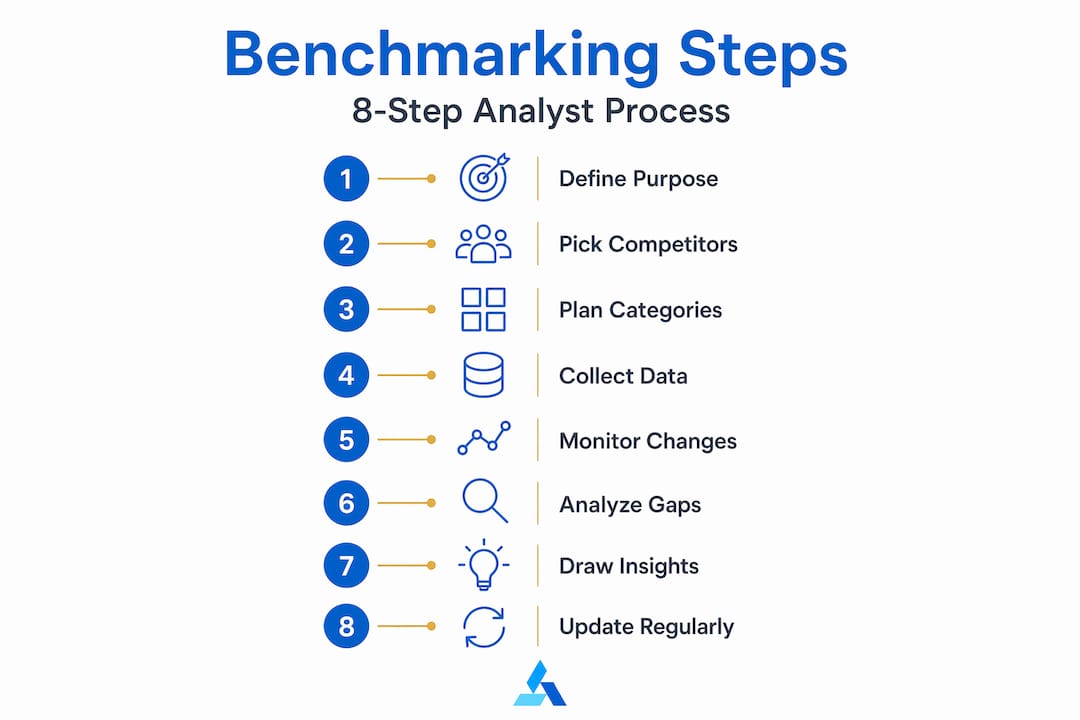
The 8-step benchmarking structure most analysts use starts exactly here. Defining your purpose and scope is not administrative housework. It determines which competitors matter, which data types are worth collecting, and what analysis you will actually use.
Identifying the right competitors
The U.S. Small Business Administration recommends evaluating not just direct competitors but indirect competitors, barriers to entry, and new entrant threats when building your competitive picture. In practice, start with 3 to 5 direct competitors — companies targeting the same customer segment with a similar solution — plus one or two adjacent players whose moves could affect your market.
One underused method: identify SEO competitors by actual keyword results, not assumptions. A brand you have never heard of may be outranking you on your highest-intent search terms. That is a competitor worth watching, even if they do not feel like one yet.
What to collect and how to organize it
The core data categories for any competitor benchmarking effort are:
- Products and services: Features, packaging, pricing tiers, and recent launches
- Marketing channels: SEO presence, paid ads, social activity, and content velocity
- Sales process: Trial offers, onboarding flows, pricing page structure, and objection handling
- Customer feedback: Reviews, support forum threads, public complaints, and sentiment patterns
- Brand identity: Positioning language, tone, visual identity, and value proposition messaging
Build a comparison matrix before you start collecting. A simple spreadsheet with competitors as columns and data categories as rows gives you a consistent structure and prevents the classic trap of comparing apples in one column to oranges in another. You can find competitive mapping frameworks that accelerate this setup considerably.
Pro Tip: Start with a tight competitor set of three before expanding. Depth of analysis on three competitors beats surface-level data on ten, every time.
Collecting and monitoring competitor data systematically
Once your framework is in place, the collection phase begins. This is where most analyst workflows break down, not because the data is hard to find, but because teams monitor too broadly and too inconsistently. The discipline here is specificity.
Effective competitor website monitoring focuses on specific page sections with frequencies matched to content type, not entire pages. Here is a practical numbered sequence to build that system:
- Map the critical pages. For each competitor, identify pricing pages, product or feature pages, careers pages, and homepage copy. These are the highest-signal locations for strategic moves.
- Set monitoring frequencies by page type. Pricing and product pages warrant daily or every-other-day checks. Content pages and job listings can be monitored every two to three days. Homepages make sense on a weekly cadence.
- Collect product and service details. Document feature sets, pricing tiers, trial structures, and any changes over time. Timestamp every entry. Context collapses fast without dates.
- Track marketing channels. Note which platforms each competitor is active on, what content types they publish, how frequently, and which posts generate the most engagement. Tools that track ad creative over time are particularly useful here.
- Capture sales process signals. Run through competitors’ free trials or demo flows yourself. Note friction points, messaging emphasis, and how they handle objections. This qualitative data is consistently undervalued.
- Pull customer feedback from public sources. Review platforms, app stores, community forums, and social comments. Pattern recognition across dozens of reviews reveals far more than any single data point.
- Diversify your sources. Competitive intelligence collection that relies solely on one source type creates blind spots. Digital dashboards, sales team input, customer conversations, and third-party analyst reports each catch different signals.
Modern benchmarking also requires mapping competitor presence across multiple platforms, including Google organic, AI overviews, and local search results. A competitor gaining ground in AI-generated results while declining in traditional search rankings is executing a very different strategy than their traffic numbers might suggest.
Pro Tip: Set up monitoring on pricing table sections and feature lists specifically, not full pages. Monitoring entire pages creates noise that buries the signals you actually care about.
Analyzing competitor data for strategic insight
Raw data is inert. The analysis phase is where competitive intelligence earns its name. A detailed competitor assessment is not a list of observations. It is a structured argument about what those observations mean for your positioning.

Building your analytical framework
Start with a SWOT analysis for each competitor. This is familiar territory, but most analysts execute it poorly. The common mistake is writing generic strengths like “strong brand” without specifying what that strength actually enables. Force yourself toward precision: “strong brand recognition in the enterprise segment creates switching cost advantage with IT buyers” is useful. “Strong brand” is not.
The full benchmarking workflow includes mapping value propositions, marketing channel strategy, brand identity audits, customer journey analysis, and audience engagement patterns before synthesizing into SWOT. Most teams skip directly to SWOT and miss two-thirds of the picture.
Competitive gap analysis in practice
Once you have individual competitor profiles, build a competitive matrix across your entire set. Plot competitors against dimensions that matter to your buyers: price, ease of use, depth of features, customer support quality, integration breadth. The gaps in that matrix are your market windows.
Here is an example of what a simplified matrix looks like for a SaaS product competing on four attributes:
| Competitor | Price positioning | Feature depth | Onboarding ease | Customer support |
|---|---|---|---|---|
| Competitor A | Premium | High | Low | Strong |
| Competitor B | Mid-market | Medium | High | Weak |
| Competitor C | Budget | Low | High | Medium |
| Your brand | Mid-market | High | Medium | Strong |
The strategic implication from this example is immediate: no competitor combines high feature depth with strong onboarding ease. That gap is a product positioning opportunity worth testing.
Interpreting trends over time matters as much as point-in-time comparisons. Comparing customer engagement patterns across competitors over several months reveals which brands are accelerating in relevance and which are losing ground. A competitor consistently adding headcount in sales while cutting content investment is making a bet on direct outbound. That tells you something important about how they see the market evolving.
Pro Tip: After every observation, ask “so what?” explicitly. If you cannot answer that question with a concrete implication for your positioning or roadmap, the observation belongs in an archive, not your active analysis.
From insights to strategy and continuous monitoring
Analysis without execution is just an expensive intellectual exercise. The final leg of effective competitor benchmarking is converting your findings into positioning decisions and then building the system that keeps those decisions current.
Use your SWOT outputs and gap analysis to define or sharpen your unique value proposition. Where competitors are weak on onboarding and your product is strong there, that is the language your GTM strategies should amplify. Where you have genuine feature gaps, those feed directly into product roadmap prioritization, not marketing spin.
Building a sustainable cadence
Continuous competitive intelligence works best with a structured cadence:
- Daily: Automated alerts on high-priority page sections. Pricing changes, feature announcements, major new content.
- Weekly: Review and triage alerts. Identify which changes warrant deeper investigation. Update your comparison matrix entries.
- Monthly: Full competitor deep dives on two or three priority players. Review customer feedback trends and marketing channel shifts.
- Quarterly: Full landscape reassessment. Re-evaluate whether your competitor set is still the right one. Update positioning based on cumulative findings.
Distributing intelligence effectively is as important as generating it. Findings about competitor pricing should reach the sales team before they lose a deal to that information gap, not three weeks later in a quarterly strategy document. Tie your competitive intelligence distribution to decision moments: contract renewals, product sprint planning, campaign launches.
Best practices for sustaining benchmarking as a discipline:
- Assign clear ownership. Benchmarking done by everyone gets done by no one.
- Keep your competitor set to a manageable number. Expand it only when a new entrant demonstrably affects your win/loss rate.
- Document changes with timestamps and context, not just current state snapshots.
- Create a feedback loop with sales and customer success. They hear competitor mentions in the field before any monitoring tool picks them up.
Pro Tip: Tie intelligence distribution to specific decision moments rather than fixed calendar schedules. The most useful competitive data arrives exactly when a team is about to make a call that it can influence.
My honest take on where benchmarking goes wrong
I’ve watched smart teams build impressive-looking benchmarking programs that produce almost nothing useful. The single most common failure mode is treating it as a project with a start and end date. One-time competitive snapshots decay within weeks. A competitor can reposition, cut prices, or double their content output in the time it takes to publish a static analysis deck.
The second failure I’ve seen repeatedly is confusing data volume with intelligence. Teams collect everything and analyze nothing. A 50-tab spreadsheet with no “so what” column is not competitive intelligence. It is organized ignorance.
What actually works, in my experience, is building the smallest system that reliably answers the questions your business actually makes decisions on. That usually means fewer competitors monitored more carefully, with clear owners and a defined distribution path to the people who can act on it.
The qualitative signals matter more than most analysts give them credit for. Customer review patterns, support forum complaints, and even the language a competitor uses in job postings reveal strategic intent that no pricing table will ever show you. Ignore those signals and you are only seeing half the picture.
The living benchmarking system is not glamorous to maintain. But it is the only kind that compounds over time, and compounding is how you build a durable position in a market that will not stop moving.
— Colin Bowdery
How Blue Prysm turns benchmarking into a daily advantage
Building a manual benchmarking system is possible, but it is slow and fragile. The moment the analyst who owns it gets pulled onto another project, the whole thing goes dark. Blue Prysm was built specifically to solve that problem for businesses that cannot afford a full-time competitive intelligence function.
The platform delivers daily market briefings, automated competitor monitoring, and structured analysis frameworks that mirror the stepwise process in this guide. You get alerts on meaningful competitor changes, not noise. You get structured outputs that feed directly into positioning decisions. If you want to see exactly how it works, the platform walkthrough maps every feature to a specific intelligence need. For teams ready to move from ad hoc research to a real competitive intelligence system, Blue Prysm removes the infrastructure burden entirely.
FAQ
What is competitor benchmarking?
Competitor benchmarking is the structured process of comparing your business’s performance, positioning, and capabilities against direct and adjacent competitors to identify gaps and strategic opportunities.
How many competitors should I benchmark?
Start with 3 to 5 direct competitors. Monitoring fewer competitors with greater depth produces more useful intelligence than shallow tracking across a large field.
How often should I run competitor benchmarking?
A sustainable cadence combines daily automated monitoring, weekly alert review, monthly deep dives, and a full quarterly landscape reassessment to keep your analysis current.
What data should I collect in a competitor analysis?
Collect product and pricing details, marketing channel activity, sales process structure, customer feedback from public sources, and brand positioning language. Diversifying your data sources reduces blind spots.
What is the difference between a competitive matrix and a SWOT analysis?
A competitive matrix compares multiple competitors across shared attributes side by side. A SWOT analysis evaluates a single competitor’s internal strengths and weaknesses alongside external opportunities and threats. Both tools are used together in a full benchmarking workflow for the most complete picture.