


TL;DR:
- Cost-effective intelligence focuses on generating strategic insights that deliver measurable outcomes relative to spending, rather than just minimizing costs. Technological innovations like lightweight AI, hybrid models, and portable data formats make high-quality analysis more affordable for businesses. Selecting platforms based on total cost of ownership, defining decision-driven tools, and measuring cost per effect are essential for successful implementation and long-term value.
Most business professionals assume cost-effective intelligence simply means buying the cheapest analytics tool available. That assumption is expensive. What is cost-effective intelligence, really? It is the practice of generating strategic insights that produce measurable business outcomes relative to every dollar spent, not the practice of spending as little as possible. The difference between those two definitions can determine whether your decisions move the needle or just move money around. This guide unpacks the real meaning, the technology behind it, how to evaluate your options, and how to implement it without burning your budget on the wrong things.
Table of Contents
- Key takeaways
- What cost-effective intelligence actually means
- Technologies that make intelligence more affordable
- Comparing your intelligence platform options
- How to implement cost-effective intelligence
- Benefits, challenges, and what most leaders miss
- My take: stop buying price tags and start buying outcomes
- How Blue Prysm delivers intelligence that pays for itself
- FAQ
Key takeaways
| Point | Details |
|---|---|
| Not just about low cost | Cost-effective intelligence prioritizes strategic outcomes per dollar spent, not minimum spend. |
| Technology drives efficiency | Hybrid AI models and portable storage formats can reduce compute costs by up to 70%. |
| Total cost of ownership matters | Focusing only on upfront licensing hides integration, maintenance, and scaling fees. |
| Implementation needs a framework | Scenario modeling, A/B testing, and cost-per-effect analysis validate intelligence investments before you scale. |
| Hidden costs kill ROI | Integration and ongoing maintenance are the most frequently underestimated line items in any intelligence budget. |
What cost-effective intelligence actually means
Let’s clear something up immediately. Cost-effective intelligence is not a synonym for cheap analytics. It sits at the intersection of two distinct business concepts that get conflated constantly.
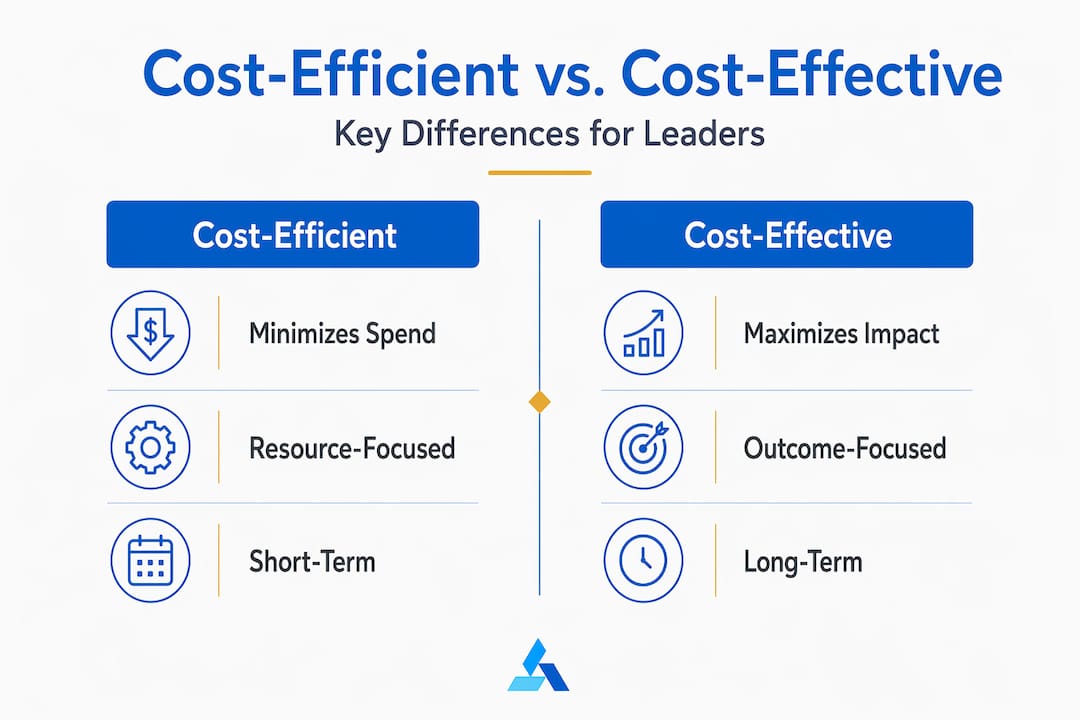
Cost-efficiency minimizes resource use while cost-effectiveness maximizes impact regardless of the volume of resources involved. A business running on gut feeling and spreadsheets might be cost-efficient in the narrowest sense. But if those spreadsheets produce decisions that miss market shifts, you have not been cost-effective at all.
Cost-effective intelligence means deploying the right data, analysis, and insight tools to achieve specific strategic outcomes, at the lowest resource cost that still delivers that outcome reliably. Think of it as optimizing the ratio of insight quality to investment, not simply minimizing the denominator.
Here is what that looks like in practice:
- Outcome-linked spending: Every intelligence tool or process is tied to a specific decision type, whether that is market entry, competitor tracking, or pricing adjustments.
- Affordable intelligence solutions at the right tier: You are not paying enterprise rates for insights a mid-market AI platform can deliver at a fraction of the price.
- Cost-efficient data analysis without redundancy: Duplicate data pipelines, overlapping subscriptions, and unused dashboards are waste, not investment.
- Measurable returns: If you cannot measure how an intelligence investment changed a decision or outcome, it is not cost-effective. It is just an expense.
Pro Tip: Before purchasing any analytics tool, write down the three decisions it will directly influence. If you cannot name them, you are not ready to buy it.
The broader point here is that cost-effective intelligence requires strategic clarity before budget conversations even begin. Without knowing what decisions you need to make, no price point is the right one.
Technologies that make intelligence more affordable
The good news for budget-conscious executives is that the technology curve is working in your favor. The cost of generating high-quality strategic intelligence has dropped sharply in recent years, driven by several architectural shifts that are worth understanding.
-
Lightweight AI models. AI models trained on far fewer tokens can reduce training costs to roughly $1,000 compared to millions for large language models, while still handling specialized business intelligence tasks with precision.
-
Hybrid model architectures. Tiered AI model selection uses inexpensive models for high-volume, routine tasks like data classification or summarization, and reserves more powerful models for complex meta-analysis. This approach can reduce compute consumption by up to 70%.
-
Portable data storage formats. Compressed universal storage formats like Parquet on S3 allow businesses to swap analytical engines without costly data migrations. You avoid vendor lock-in and retain flexibility as your needs evolve.
-
Batch processing and deduplication. Rather than running continuous real-time queries on expensive infrastructure, batch processing routes lower-priority analyses off-peak and deduplication removes redundant data pulls that inflate cloud costs.
Here is a quick comparison of how these technologies affect the cost side of your intelligence stack:
| Technology | Primary cost reduction | Best suited for |
|---|---|---|
| Lightweight AI models | Training and inference costs | Specialized, repeatable analysis tasks |
| Hybrid model tiering | Compute consumption (up to 70%) | Mixed-complexity intelligence workloads |
| Parquet/portable storage | Migration and lock-in costs | Businesses expecting platform changes |
| Batch processing | Real-time infrastructure fees | Non-urgent, high-volume data pipelines |
Understanding these technologies does not mean you need to build them yourself. The more practical takeaway is that any platform you evaluate for cost-efficient data analysis should be leveraging at least some of these efficiencies under the hood.

Comparing your intelligence platform options
Choosing the right intelligence platform is where most businesses make their most expensive mistakes. The trap is evaluating options based on the licensing fee on page one of the proposal, rather than the total cost of ownership across three to five years.
Transparent cost-per-query pricing tends to be more sustainable than low headline license fees, because license creep and infrastructure charges frequently inflate the true cost of “affordable” platforms. A $200 per month subscription that requires $50,000 in integration work and a dedicated data engineer is not a budget-friendly analytics tool. It is a financial anchor.
Here is the framework you should apply before signing anything:
| Evaluation factor | SaaS AI platform | Sovereign/custom-built platform |
|---|---|---|
| Upfront cost | Low | High |
| Integration complexity | Moderate | High |
| Data privacy control | Shared environment | Full control |
| Long-term scalability cost | Variable | Lower with maturity |
| Time to first insight | Days | Months |
| Vendor lock-in risk | Moderate to high | Low |
Sovereign intelligence platforms offer full control, enhanced privacy, and lower subscription costs over time, but the implementation burden is significant. For most small and mid-sized businesses, a well-structured SaaS platform with transparent pricing and clear data handling policies offers the better ratio of cost to strategic value.
Common pitfalls to watch for when evaluating platforms:
- Integration costs buried in fine print. API development, data mapping, and testing are rarely included in base pricing.
- Underestimating maintenance. Dashboards, models, and data pipelines all require ongoing care. Hidden costs like maintenance and integration are the most common reason AI intelligence projects run over budget.
- Paying for breadth you will never use. A platform with 47 modules is only cost-effective if you use more than three of them.
Pro Tip: Run a Net Present Value analysis over 36 months before committing to any intelligence platform. Include integration, training, and maintenance line items. The cheapest license rarely wins that calculation.
How to implement cost-effective intelligence
Knowing what cost-effective intelligence is and actually building it inside your organization are two different challenges. Here is a practical methodology you can follow without a PhD in data science or a seven-figure technology budget.
-
Audit your current intelligence spend. List every subscription, tool, consultant, and analyst hour that feeds into your decision-making. Most organizations discover significant redundancy at this stage. That redundancy is your starting capital for reallocation.
-
Define decisions, not data needs. Start with the ten decisions your business makes most frequently or most consequentially. What information would have made the last version of each decision 20% better? That is your intelligence requirement list.
-
Match tools to decision tiers. Routine decisions like weekly pricing adjustments need fast, lightweight intelligence. Strategic decisions like market entry or product pivots need deeper analysis. Match your tool investment to the decision weight.
-
Run scenario modeling before full deployment. Rapid A/B testing and scenario modeling are among the most reliable ways to validate whether an intelligence investment will generate the expected return before you scale it. One livelihoods program using this approach achieved a 14.7x social return on investment by identifying the highest ROI opportunities through data-driven validation.
-
Adopt flexible infrastructure. Avoid platforms or architectures that lock you in. Use portable data formats and modular tool stacks so you can swap components as the market and your needs evolve.
-
Measure cost per effect, not cost per report. The metric that matters is not how many dashboards your platform generates. It is how much each meaningful decision improvement costs you. Cost-per-effect models link intelligence investments directly to strategic outcomes, giving you a defensible way to evaluate ROI.
For a practical starting point on making this work in a smaller organization, the step-by-step guide for SMBs is worth reviewing alongside this framework.
Benefits, challenges, and what most leaders miss
The benefits of getting cost-effective intelligence right are real and well-documented: faster decisions, better resource allocation, sharper competitive positioning. But the path there has honest obstacles that most articles gloss over.
On the benefit side, you gain:
- Improved decision quality without requiring expensive external consultants for every strategic question.
- Budget efficiency through eliminating redundant data infrastructure and reallocating those savings toward higher-value analysis.
- Competitive advantage from accessing the kind of strategic intelligence for SMEs that used to be exclusive to Fortune 100 companies with research teams.
On the challenge side, the most commonly missed issues are indirect costs. Integration is not free. Training your team to actually use intelligence outputs takes time. And the expectation that an AI platform will pay for itself within 90 days is, in most cases, wildly optimistic.
Organizations that treat intelligence spending purely as a cost center rather than a strategic investment consistently underestimate the compounding value of better decisions made consistently over time.
Plan for long-term returns. Evaluate your intelligence program quarterly, not just at contract renewal. The platforms and practices that feel expensive at month three often look like obvious investments at month eighteen.
My take: stop buying price tags and start buying outcomes
I have watched too many smart executives make the same mistake. They see a $99 per month analytics tool and feel disciplined. Then they spend six months trying to make it answer questions it was never designed to answer, and by the time they switch, they have lost a year of competitive ground.
The real cost of intelligence is not what you pay. It is what you miss when your intelligence is wrong, slow, or simply not built for the decision in front of you. In my experience, the organizations that get the best return from their intelligence spend are not the ones that found the lowest price. They are the ones that defined what “good intelligence” meant for their specific decisions before they opened a browser tab.
Shifting to a cost-per-effect mindset is genuinely hard. It requires discipline to not get distracted by feature lists and requires courage to say “we do not need that.” But every dollar saved on redundant data infrastructure is a dollar you can redirect toward analysis that actually changes how you compete. That is the only math that matters. Do not optimize for cheap. Optimize for effective.
— Colin Bowdery
How Blue Prysm delivers intelligence that pays for itself
If the framework in this article resonates with how you want to think about intelligence spending, Blue Prysm was built exactly for this. The platform delivers AI-powered market briefings, competitor monitoring, and strategic planning tools at a price point that does not assume you have a research team standing by.
Blue Prysm’s transparent pricing model avoids the license creep and hidden infrastructure costs that plague most enterprise platforms. You get daily briefings, scenario testing, and idea validation tools built specifically for executives and entrepreneurs making real decisions on real budgets. If you want to see how it works before committing, the platform walkthrough gives you a clear picture of what you are actually getting. For a broader view of what intelligent decision-making on a budget can look like for your organization, start at the homepage and work from there.
FAQ
What is cost-effective intelligence in business?
Cost-effective intelligence is the practice of generating strategic business insights that produce measurable outcomes relative to the resources invested. It is not simply about minimizing cost, but about optimizing the ratio of decision quality to dollars spent.
How is cost-effective intelligence different from cost efficiency?
Cost efficiency focuses on minimizing resource use, while cost-effectiveness focuses on maximizing strategic impact. Cost-effective intelligence requires both: spending less while still driving decisions that produce real business results.
What are the hidden costs of intelligence platforms?
Integration, maintenance, and training costs are the most frequently underestimated expenses. A Net Present Value analysis over 36 months is the most reliable way to assess true total cost of ownership.
How do I start implementing cost-effective intelligence?
Begin by auditing your current intelligence spend, then define the specific decisions your intelligence needs to inform. Match tools to decision tiers, run scenario modeling before scaling, and measure success using cost-per-effect rather than cost per report.
Can small businesses access cost-effective intelligence solutions?
Yes. AI-powered SaaS platforms have made affordable intelligence solutions accessible to small and mid-sized businesses, providing market analysis and competitor monitoring that previously required dedicated research teams and consulting budgets.