


TL;DR:
- AI significantly reduces manual research time by automating data collection from hundreds of sources in competitor monitoring. It enhances insights with structured summaries, predictive signals, and real-time alerts, improving strategic decision-making. However, human interpretation remains essential to ensure AI-generated outputs lead to meaningful business actions.
AI is defined as the primary force reshaping competitor monitoring, transforming what once took analysts 10+ hours weekly into a process that runs in 1–2 hours with ten times the source coverage. The role of AI in competitor monitoring goes beyond speed. Platforms like Klue and Crayon now automate data collection across pricing pages, job postings, product reviews, and messaging shifts, then synthesize those signals into structured intelligence your team can act on. This guide breaks down how that automation works, which features matter most, and how to build it into your workflow without losing the human judgment that makes insights actually useful.
How does AI automate data collection in competitor monitoring?
AI-driven competitor monitoring works by crawling hundreds of data sources simultaneously, something no human team can replicate at scale. Where a manual process might cover 5–10 competitor sources per week, AI-augmented workflows expand that to over 100 sources while cutting monitoring time from 10+ hours to 1–2 hours. That is not an incremental improvement. It is a structural shift in what your team can know and when.

The underlying technology combines Large Language Models (LLMs) with machine learning to do more than collect data. These systems synthesize it. LLMs and machine learning reduce manual competitive research time by 85–95% while accelerating evidence synthesis by over 50%. That means your team stops drowning in raw data and starts receiving structured summaries they can interrogate.
Here is what AI monitors across competitor profiles:
- Pricing tables and feature matrices extracted directly from competitor URLs
- Job postings that signal product roadmap priorities or market expansion plans
- Customer reviews on platforms like G2 and Capterra that reveal product weaknesses
- Messaging shifts across landing pages, ads, and press releases
- Patent filings that forecast R&D direction months before a launch
Pro Tip: Treat AI-generated summaries the way you would treat a report from a junior analyst. Push back. Ask specific follow-up questions. The iterative questioning approach is what separates vague AI outputs from genuinely useful intelligence.
What AI-driven features differentiate leading competitor monitoring tools?
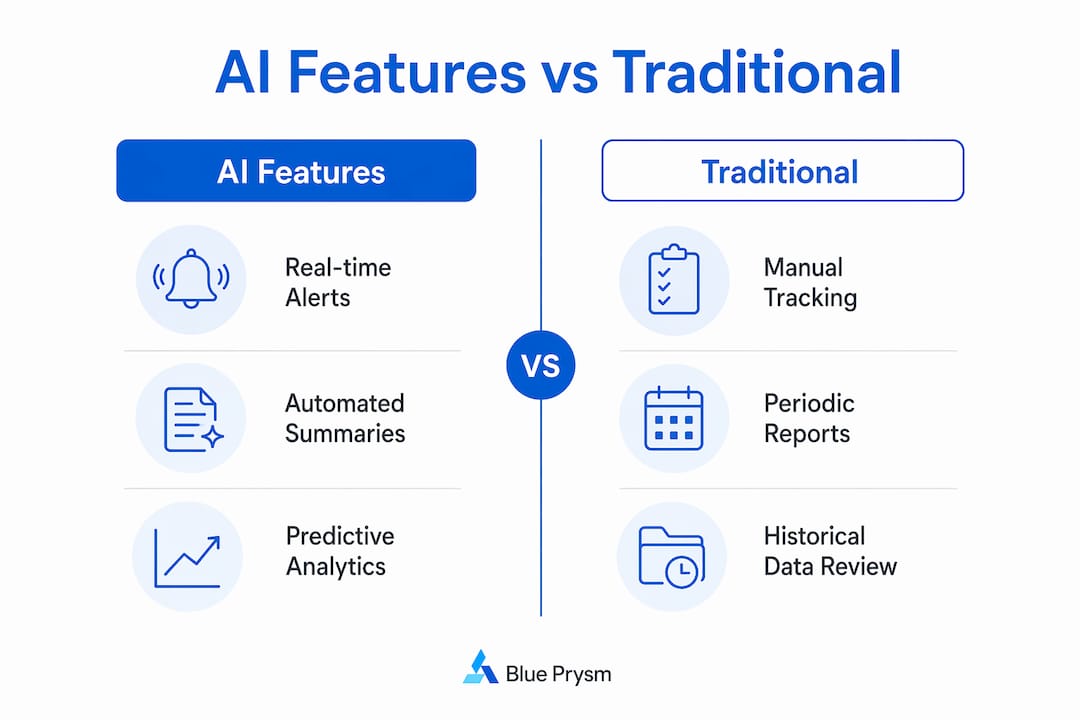
Not all AI tools for competitor analysis are built the same. The features that separate the top platforms from the rest come down to depth of extraction, signal prioritization, and how well they connect to your existing sales and marketing workflows.
Real-time AI monitoring tracks pricing changes, feature launches, and messaging shifts, then flags high-priority updates before your team would have noticed them manually. That early warning function is what moves competitor intelligence from reactive to predictive. Platforms like Seeto go further by extracting multi-layer competitor data from single URLs, pulling pricing tables, feature comparisons, and positioning language in one pass.
| Feature | Benefit | Typical use case |
|---|---|---|
| Automated battlecards | Saves sales prep time | Reps entering competitive deals |
| SWOT auto-generation | Structures raw data fast | Quarterly strategy reviews |
| Signal prioritization | Cuts noise from high-volume feeds | Marketing and product teams |
| CRM integration | Connects intelligence to pipeline | Sales and revenue operations |
| Multi-source synthesis | Covers 100+ sources at once | Analyst-led research programs |
Beyond the table, the integration angle matters more than most buyers realize. Tools that connect to CRM platforms like Salesforce or HubSpot, or that ingest sales call recordings via Gong or Chorus, give revenue teams deal-specific competitor context at the moment they need it. That is a different category of value than a weekly briefing email.
How to integrate AI competitor monitoring into your workflow
The biggest mistake teams make is treating AI as a data dump rather than a decision support system. The shift you need to make is structural. Stop asking your analysts to gather data. Start asking them to interpret it.
Here is a practical four-step integration model:
- Audit your current sources. List every competitor you track and every source you check manually. This baseline tells you where AI will create the most immediate relief.
- Select a platform that fits your stack. If your team lives in Salesforce, prioritize tools with native CRM integration. If content strategy is your focus, look for platforms with messaging and SEO signal tracking.
- Set up automated alerts for high-priority signals. Pricing changes and product launches deserve real-time alerts. Broader trend analysis can run on a weekly cadence.
- Build a review ritual. Assign a standing agenda item in your weekly team meeting to discuss AI-generated competitor summaries. This is where human interpretation turns data into decisions.
Shifting data collection to AI frees analysts to focus on the strategic questions that actually drive competitive advantage. The teams that win are not the ones with the most data. They are the ones who ask sharper questions with the data they have.
Pro Tip: When you receive an AI-generated competitor summary, do not accept the first output. Ask the system: “What does this pricing change suggest about their target segment?” or “Which of our product features does this messaging shift undermine?” Specific questions produce specific answers.
Success with AI in competitive intelligence depends heavily on human managerial interpretation and operational integration of insights. The tool does not replace your judgment. It gives your judgment better raw material.
What are the strategic benefits and limitations of AI in competitor monitoring?
AI-enabled competitive intelligence creates economic value through four pathways: revenue acceleration, cost relief, improved resource allocation, and strategic speed. Each of these is real, but each is also conditional on data quality and human oversight. That conditionality is the part most vendors skip over in their pitch decks.
The benefits are substantial:
- Revenue acceleration: Sales teams armed with real-time battlecards close competitive deals faster because they know the objections before the prospect raises them.
- Cost relief: Replacing 10+ hours of weekly manual research with automated monitoring frees budget and headcount for higher-value work.
- Resource allocation: 60% of competitive intelligence teams now use AI daily, achieving a 45% reduction in data processing time. That freed capacity goes back into strategy.
- Strategic speed: Decisions that once waited for a monthly competitive review can now be made in days.
The limitations are equally real. AI does not catch what it is not trained to look for. If your monitoring setup misses a key competitor channel, the AI will miss it too. Generic prompts produce generic outputs. And over-reliance on automation without critical review creates a false sense of coverage. You think you know what your competitors are doing. You actually know what your AI tool was configured to find.
What are real-world examples of AI transforming competitor monitoring?
The most compelling applications of AI-driven competitor intelligence are not the obvious ones. Everyone expects AI to track pricing. The interesting use cases are predictive. Predictive AI models analyze weak signals like job postings and patent filings to forecast competitor product launches 3–6 months in advance. A competitor hiring ten machine learning engineers in a new geography is not a pricing story. It is a product roadmap story, and AI catches it before the press release.
Marketing teams use AI to detect shifts in competitor content strategy weeks before those shifts show up in search rankings. If a competitor starts publishing heavily around a keyword cluster you own, that is a signal worth acting on immediately, not after your next quarterly review.
Sales teams get the most direct value. AI alerts reps with customized, deal-specific competitor context before discovery calls. Instead of a generic battlecard, the rep gets a summary of what that specific competitor has changed in the last 30 days, tailored to the prospect’s industry.
“The biggest gain is not the data. It is the clarity. When AI handles the collection, I finally have time to think about what the data means.” — Susan Ferrari, competitive intelligence practitioner
Key takeaways
AI-driven competitor monitoring delivers its highest value when human judgment shapes the questions and interprets the answers, not when automation runs unchecked.
| Point | Details |
|---|---|
| AI scales source coverage dramatically | Automated monitoring covers 100+ sources versus the 5–10 a manual process manages weekly. |
| LLMs cut research time by up to 95% | That freed capacity should go into strategic interpretation, not more data collection. |
| Tool selection depends on your stack | Prioritize platforms that integrate with your CRM and sales call tools for maximum impact. |
| Predictive signals are the real edge | Job postings and patent filings forecast competitor moves 3–6 months before public announcements. |
| Human oversight is non-negotiable | AI outputs require iterative questioning and managerial review to produce genuinely useful intelligence. |
Why I think most teams are using AI competitor monitoring wrong
I have seen a lot of teams adopt AI monitoring tools with genuine enthusiasm, then quietly stop using them six months later. The pattern is almost always the same. They set up the platform, configure the alerts, and then treat the weekly digest like a newspaper they skim over coffee. Nothing changes in how they make decisions.
The trap is treating AI as a reporting tool rather than a thinking partner. The advantages of AI-driven insights only materialize when someone in the room is willing to say, “This signal suggests our competitor is repositioning upmarket. What does that mean for our pricing conversation next quarter?” That question does not come from the AI. It comes from you.
My honest advice: before you evaluate any AI monitoring platform, define the three strategic questions your team is trying to answer about your competitors. Then test whether the tool helps you answer those questions faster and with more confidence. If it does not, the feature list does not matter. You are buying a dashboard, not intelligence.
The teams I have seen get real value from AI in market analysis are the ones who use it to get to the right question faster, not the ones who use it to generate more slides. There is a meaningful difference between those two outcomes, and it is worth being honest with yourself about which one you are actually pursuing.
— Colin Bowdery
See how Blue Prysm automates your competitor tracking
If you are spending more than two hours a week manually checking competitor websites, pricing pages, and industry news, you are paying a tax that AI can eliminate. Blue Prysm’s competitor tracking software monitors rivals automatically, surfaces high-priority signals in real time, and connects those insights to structured strategy frameworks your team can act on immediately.
Blue Prysm also gives you access to AI-powered market research tools built specifically for strategy teams at small and mid-sized businesses. You get the intelligence capabilities that enterprise firms pay consulting firms to deliver, without the six-figure retainer. If you want to see what that looks like in practice, explore a sample venture analysis and judge the depth for yourself.
FAQ
What is the role of AI in competitor monitoring?
AI automates the collection, synthesis, and prioritization of competitor data across hundreds of sources simultaneously. It reduces manual research time by up to 95% while delivering faster, more structured intelligence than traditional methods.
How does AI improve competitor analysis accuracy?
AI tools like Klue and Crayon cross-reference multiple data layers, including pricing, messaging, and job postings, to reduce blind spots. Accuracy improves further when analysts use iterative questioning to refine AI-generated outputs.
What are the best AI tools for competitor analysis?
Klue, Crayon, and Seeto are among the leading platforms for AI-driven competitor intelligence in 2026. The best choice depends on your CRM stack, team size, and whether you prioritize sales enablement or marketing signal tracking.
Can AI predict competitor moves before they happen?
Yes. Predictive AI models analyze weak signals like patent filings and hiring patterns to forecast product launches 3–6 months in advance. This lead time gives strategy teams a meaningful window to respond before competitors go public.
What are the limitations of AI in competitor monitoring?
AI only finds what it is configured to look for, and generic prompts produce generic outputs. Human oversight and specific strategic questioning are required to turn automated data collection into decisions that actually move the business forward.
Recommended
- Unlocking competitive advantage with emerging AI trends – Blue Prysm – Articles & Blogs
- AI strategies that actually build competitive advantage – Blue Prysm – Articles & Blogs
- Competitive mapping: an AI-powered guide for SMBs
- Competitive Intelligence Software — Track Competitors Automatically | Blue Prysm