


TL;DR:
- AI-powered scenario testing uses artificial intelligence to automatically create, run, and evaluate complex business and software test scenarios. It adapts to changes, detects edge cases early, and reduces QA costs by up to 40 percent while speeding up regression cycles. Business leaders should apply this approach for strategic risk management and continuous organizational resilience.
AI-powered scenario testing is defined as the use of artificial intelligence, including large language models (LLMs) and predictive analytics, to automate the creation, execution, and evaluation of complex business and software testing scenarios. Unlike traditional scripted testing, this approach adapts to changing conditions, identifies edge cases proactively, and reduces QA costs by up to 20% while shortening regression cycles. For business leaders and decision-makers, understanding scenario testing at this level is not optional. It is the difference between catching a strategic risk before it costs you and discovering it after the fact.
What is AI-powered scenario testing and how does it work?
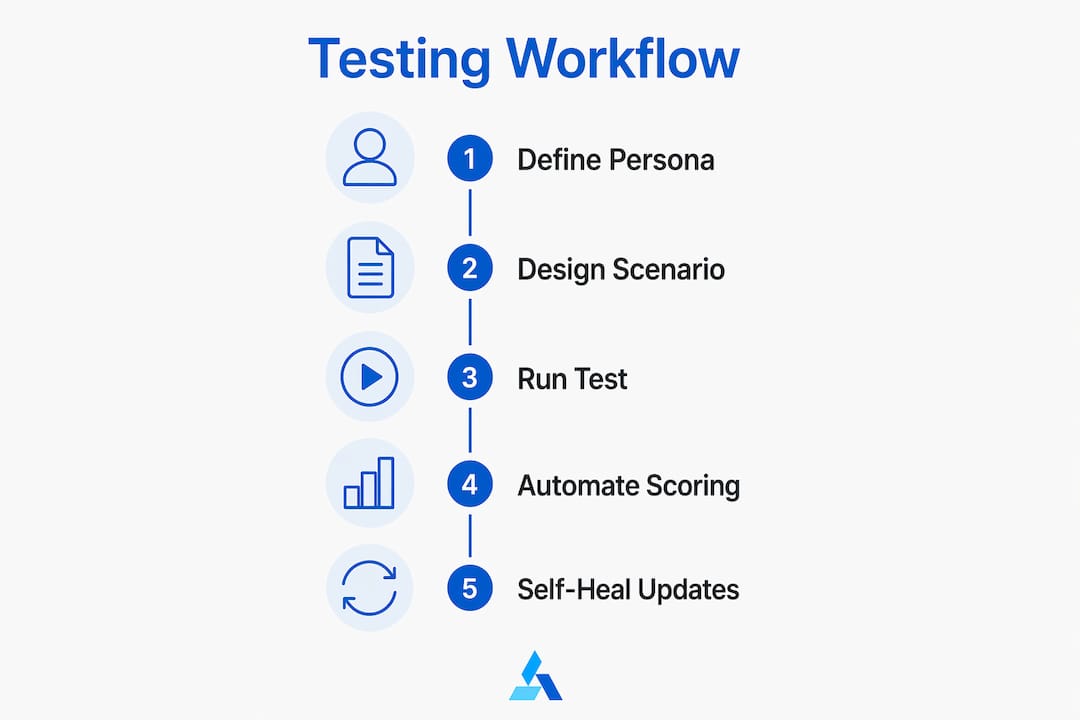
AI-powered scenario testing automates the simulation of realistic, multi-turn interactions between users and a system, then scores the results automatically. The AI does not just run a checklist. It generates behavior, evaluates responses, and flags failures that a scripted test would never catch.
Every effective AI scenario test suite is built on three components:
- Persona: A defined user type with specific goals, communication styles, and expectations. This grounds the test in real-world behavior rather than abstract inputs.
- Scenario: The sequence of interactions the persona works through. This covers not just the “happy path” where everything goes right, but also friction points, ambiguous requests, and multi-step workflows.
- Adversary: A simulated disruptive force, such as a hostile user, an edge case input, or a conflicting instruction. Skipping the adversary role causes incomplete coverage and leaves the most dangerous failure modes untested.
Once a test runs, an LLM scores the transcript automatically. It detects hallucination traps, response drift, and policy violations without a human reviewing every line. The system also integrates with CI/CD pipelines, meaning tests run continuously as your product or process changes.
Pro Tip: Treat your AI testing suite as a living document. Feed it updated user logs and product documentation regularly so the scenarios stay aligned with your actual business risk profile, not last quarter’s assumptions.

AI-driven testing methods also include self-healing. When a UI or workflow changes, the test updates itself rather than breaking. That capability alone changes the economics of quality assurance at scale.
What are the key benefits of AI testing for businesses?
The business case for AI scenario testing is concrete, not theoretical. Here are the five advantages that matter most to decision-makers:
- Lower testing costs. Self-healing tests free up 20–40% of QA engineers’ time. That time redirects to higher-value work, not maintenance.
- Faster regression cycles. Automated scenario testing shortens regression cycles by 50–70%. Faster cycles mean faster releases without proportional headcount increases.
- Proactive edge case detection. AI testing identifies untested areas and surfaces risks that rule-based automation misses. You find the problem before your customer does.
- Parallel execution at scale. AI moves QA from sequential bottlenecks to parallelized workflows. Multiple scenarios run simultaneously, compressing timelines that used to take days into hours.
- Spec-driven coverage. Test cases built from your actual product documentation and user logs produce coverage that matches your real risk profile, not a generic benchmark.
The cumulative effect is significant. A business running automated scenario testing does not just test faster. It tests smarter, with coverage that scales as the product or strategy evolves. For executives tracking AI-driven business insights, this kind of adaptive coverage is exactly what separates reactive organizations from proactive ones.
How does AI testing compare to traditional scripted testing?
Traditional scripted tests are brittle. One UI change, one updated workflow, and the script breaks. Someone has to fix it manually before the next release cycle can proceed. That maintenance cost compounds over time and becomes a real drag on velocity.
AI-powered testing is behavior-aware. It understands application context and adapts after changes rather than failing silently or requiring a rewrite. The shift is not incremental. It is a fundamentally different operating model.
| Dimension | Traditional scripted testing | AI-powered scenario testing |
|---|---|---|
| Adaptability | Breaks on UI or workflow changes | Self-heals and adapts automatically |
| Coverage | Follows predefined paths only | Generates edge cases and adversarial scenarios |
| Maintenance cost | High, requires manual updates | Low, AI handles updates autonomously |
| Execution speed | Sequential, one test at a time | Parallel, multiple scenarios simultaneously |
| Risk detection | Misses untested areas | Proactively surfaces blind spots |
AI-native platforms deliver the full benefit of this shift. They treat AI as the primary operator, not a bolt-on feature. The result is autonomous test generation, execution, and interpretation without constant human intervention.
Pro Tip: When evaluating AI testing tools, ask vendors specifically whether their platform supports adversarial scenario generation. Many tools cover happy paths well. The real value is in how they handle conflict, escalation, and edge cases.
How can business leaders implement AI scenario testing effectively?
Implementation succeeds when testing aligns with your actual strategic goals, not just your technical backlog. Here is how to approach it:
- Start with your highest-risk domains. Map your most consequential business processes first. Financial modeling, customer-facing workflows, and competitive response scenarios are natural starting points for AI-powered scenario modeling.
- Choose AI-native platforms. AI-native platforms for autonomous testing deliver compound benefits that hybrid or bolt-on tools cannot match. Autonomous generation, execution, and interpretation require a platform built for that purpose from the ground up.
- Build from real documentation. Test cases derived from specific product documentation and user logs produce coverage aligned with your actual risk profile. Generic benchmarks produce generic results.
- Connect to real-time business data. AI scenario modeling tools that connect to live business data enable what-if analysis and predictive decision-making beyond what any manual model can produce.
- Maintain human oversight. AI handles the mechanical work. Your team focuses on interpreting results, setting priorities, and making judgment calls that require domain expertise.
For business leaders building out their AI-powered decision making capabilities, scenario testing is not a QA function. It is a strategic planning function. The same logic that applies to software testing applies to market simulations, competitive response modeling, and operational risk assessment.
Key Takeaways
AI-powered scenario testing delivers its full value only when it is built on real business data, adversarial design, and AI-native platforms that operate autonomously rather than as a supplement to manual processes.
| Point | Details |
|---|---|
| Core definition | AI-powered scenario testing automates simulation, execution, and scoring of complex multi-turn scenarios using LLMs and predictive analytics. |
| Three-part test design | Every test suite needs a Persona, Scenario, and Adversary to avoid happy-path blind spots. |
| Cost and speed gains | Self-healing tests free up 20–40% of QA time; regression cycles shorten by 50–70%. |
| AI vs. scripted testing | AI testing adapts to changes automatically; scripted tests break and require costly manual fixes. |
| Strategic application | Business leaders should apply scenario testing to financial, operational, and competitive risk domains, not just software QA. |
Why I think most businesses are still testing the wrong things
I have watched organizations invest heavily in test automation and still get blindsided by failures that any decent adversarial scenario would have caught. The pattern is almost always the same. The team built thorough happy-path coverage, called it done, and skipped the adversary leg of the triangle entirely.
The uncomfortable truth is that AI acts as a multiplier, not a replacement for sound judgment. If your QA foundation is weak, AI testing amplifies the gaps rather than filling them. You get faster, more automated coverage of the wrong things.
The real shift I see in organizations that get this right is cultural, not technical. They stop treating testing as a gate before release and start treating it as a continuous intelligence function. Scenarios run in parallel, results feed back into strategy, and the team spends its time on interpretation rather than maintenance. That is the operating model that actually changes outcomes.
The other misconception worth naming: AI scenario testing is not just for software teams. Market entry simulations, competitive response modeling, and financial stress tests all follow the same Persona-Scenario-Adversary logic. Business leaders who apply this framework to strategic planning, not just product development, are the ones building genuinely resilient organizations.
— Colin Bowdery
Blue Prysm’s platform for scenario-driven strategic intelligence
Blue Prysm’s market analysis platform applies AI-powered scenario modeling directly to the strategic decisions that matter most to business leaders. Real-time market briefings, predictive analytics, and competitive monitoring give you the inputs your scenario tests need to reflect actual market conditions.
Blue Prysm also offers a strategy framework library with over 95 structured methodologies, including SWOT, Porter’s Five Forces, and Business Model Canvas, that integrate directly with scenario-driven planning. For SMBs that want elite-level strategic intelligence without the consulting fees, Blue Prysm delivers the tools and the structure to act on what the scenarios reveal.
FAQ
What is AI-powered scenario testing in simple terms?
AI-powered scenario testing uses artificial intelligence to automatically create, run, and evaluate complex test scenarios, including edge cases and adversarial interactions, without manual scripting.
How does AI scenario testing differ from regular automated testing?
Traditional automated testing follows fixed scripts that break when the application changes. AI scenario testing adapts automatically, generates new edge cases, and self-heals after updates.
What are the main benefits of AI testing for business leaders?
The primary benefits include reduced QA costs, faster regression cycles, proactive risk detection, and test coverage that scales with your product and strategy without proportional headcount increases.
What is the Persona-Scenario-Adversary framework?
It is a three-part design model for AI scenario tests. The Persona defines the user type, the Scenario defines the interaction sequence, and the Adversary introduces conflict or edge cases to prevent happy-path blind spots.
Can AI-powered scenario testing apply outside of software development?
Yes. The same framework applies to market simulations, financial stress tests, and competitive response modeling, making it a practical tool for strategic planning and risk assessment across business functions.