


TL;DR:
- Effective strategic planning requires clear priorities, accountability, and scenario-based adaptation. Organizations that regularly review progress and adjust strategies outperform those relying on annual plans and vague goals.
Strategic planning best practices are the structured methods that turn your organization’s direction into measurable results. Most leaders know they need a plan. Far fewer build one that actually survives contact with reality. Frameworks like the Balanced Scorecard, SMART goals, and the UNDP Foresight Toolkit exist precisely because good intentions without structure produce fluffy documents that gather dust. The difference between organizations that execute and those that stall is rarely intelligence. It is discipline, accountability, and the willingness to adapt when assumptions prove wrong.
1. What are the most effective strategic planning process steps?
The strongest plans start with a clear mission and vision. Before you touch a spreadsheet or a SWOT matrix, your leadership team needs to agree on what the organization exists to do and what success looks like in three to five years. Without that anchor, every priority fight becomes a values fight in disguise.

From there, structured analysis using frameworks like SWOT and PESTEL gives you an honest picture of where you stand. SWOT surfaces internal strengths and weaknesses. PESTEL maps the political, economic, social, technological, environmental, and legal forces shaping your market. Together, they replace gut feeling with evidence.
Plans with 3–5 strategic priorities consistently outperform those with a dozen competing goals. That finding matters because most leadership teams default to adding priorities rather than cutting them. Fewer priorities mean clearer ownership, faster decisions, and less organizational drag.
Set those priorities using SMART goals or OKRs (Objectives and Key Results). Both frameworks force specificity. “Grow revenue” is not a goal. “Increase recurring revenue by 20% in the next fiscal year, owned by the VP of Sales, reviewed monthly” is a goal.
Pro Tip: Assign a single named owner to each strategic priority. Committees do not execute. People do.
2. How can organizations overcome common execution challenges?
Execution problems are routinely misdiagnosed as planning problems. The plan looks fine on paper. The failure happens when strategy never connects to the weekly decisions your managers actually make. Accountability built into the planning process from day one is what separates organizations that execute from those that revisit the same slide deck every quarter.
The fix is structural, not motivational. Build these habits into your process:
- Assign priority owners with defined outcome measures, not vague responsibilities
- Connect each strategic priority to at least one operational metric reviewed monthly
- Create a communication rhythm: weekly team check-ins, monthly progress reviews, quarterly resets
- Use a single shared dashboard so progress is visible across the organization, not siloed in spreadsheets
- Treat missed milestones as data, not failures. Diagnose the cause and adjust the plan
Organizations with regular review cycles and clear ownership deliver measurably better outcomes than those relying on annual planning retreats alone. That is not a soft finding. It is the difference between a strategy that drives behavior and one that decorates a conference room wall.
Pro Tip: Run a 15-minute weekly “strategy pulse” meeting with priority owners. Ask one question: what moved this week, and what is blocked? That single habit catches drift before it becomes a crisis.
3. Why scenario-based foresight belongs in every strategic plan
Foresight is not prediction. That distinction matters more than most leaders realize. Foresight planning expands awareness of possible futures and stress-tests your assumptions rather than locking you into a single forecast. The UNDP Foresight Toolkit formalizes this approach for organizations of any size.
The practical method is scenario planning: identify three to four plausible futures, assign rough probabilities to each, and test your current strategy against all of them. If your plan only works in the best-case scenario, you do not have a strategy. You have a wish.
Effective strategic planning requires identifying future scenarios with probabilities to overcome overconfidence bias. Overconfidence is the single most common trap in executive planning sessions. Leaders who have been right before assume they will be right again.
“Moving from static annual plans to continuous scenario-based strategic planning enhances resilience.” — California Management Review, 2026
Build flexibility into your plan by identifying which decisions are reversible and which are not. Reversible bets can be made quickly. Irreversible ones deserve more scenario stress-testing before you commit.
For small business strategy, scenario planning does not require a consulting firm. A two-hour workshop with your leadership team, a whiteboard, and honest assumptions is enough to start.
4. Which strategic frameworks and tools accelerate planning?
The right framework depends on what problem you are solving. Here is a practical comparison of the most widely used tools in effective strategic planning:
| Framework | Best Used For | Key Output |
|---|---|---|
| Balanced Scorecard | Aligning strategy to operations across four perspectives | Scorecard with financial, customer, process, and learning metrics |
| SWOT Analysis | Internal and external situation assessment | Prioritized list of strengths, weaknesses, opportunities, threats |
| PESTEL Analysis | Mapping macro-environmental forces | Environmental scan for strategic context |
| SMART Goals / OKRs | Goal setting with measurable outcomes | Specific, time-bound objectives with named owners |
| Scenario Planning | Navigating uncertainty and volatility | Multiple future scenarios with probability weights |
The Balanced Scorecard remains the gold standard for connecting high-level strategy to day-to-day operations. It forces leaders to define success across four dimensions: financial performance, customer outcomes, internal processes, and organizational learning. That breadth prevents the common trap of optimizing one dimension while neglecting the others.
OKRs, popularized by Google and Intel, work best for organizations that need fast iteration cycles. They pair a qualitative objective with two to four measurable key results, reviewed on a quarterly cadence. The Blue Prysm strategy library includes over 95 frameworks, including Porter’s Five Forces, the Business Model Canvas, and scenario planning templates, giving your team a structured starting point rather than a blank page.
Key takeaways
Effective strategic planning combines clear priorities, embedded accountability, and continuous scenario-based adaptation to produce results that survive real-world conditions.
| Point | Details |
|---|---|
| Limit strategic priorities | Plans with 3–5 priorities outperform those with many competing goals. |
| Build accountability in early | Assign named owners and outcome measures before the plan is finalized. |
| Use scenario planning | Test your strategy against multiple futures, not just the most likely one. |
| Review quarterly, not annually | Quarterly reviews help organizations adjust course before small drift becomes a major miss. |
| Match framework to problem | Use Balanced Scorecard for alignment, OKRs for iteration, SWOT for situation analysis. |
What I have learned about strategy in volatile environments
The most dangerous moment in any planning cycle is when the room reaches consensus too quickly. I have sat in enough leadership off-sites to know that fast agreement usually means someone with authority spoke first and everyone else fell in line. Cultivating collaborative dissent is not a soft cultural value. It is a hard operational requirement for better decisions.
The other trap I see constantly is the gap between the strategy document and the Monday morning meeting. Leaders spend two days crafting a beautiful plan, then return to the office and run the same operational meetings they always ran. Strategy has to show up in the language of daily work, not just in a quarterly deck.
The organizations I respect most treat their strategy like a living hypothesis. They commit to it, act on it, and update it when the evidence changes. That is not weakness. That is how you plan strategically in a world that does not hold still.
— Colin Bowdery
How Blue Prysm helps executives execute on their strategy
Most small and mid-sized businesses cannot afford the consulting retainers that Fortune 500 companies use to run their planning cycles. Blue Prysm closes that gap.
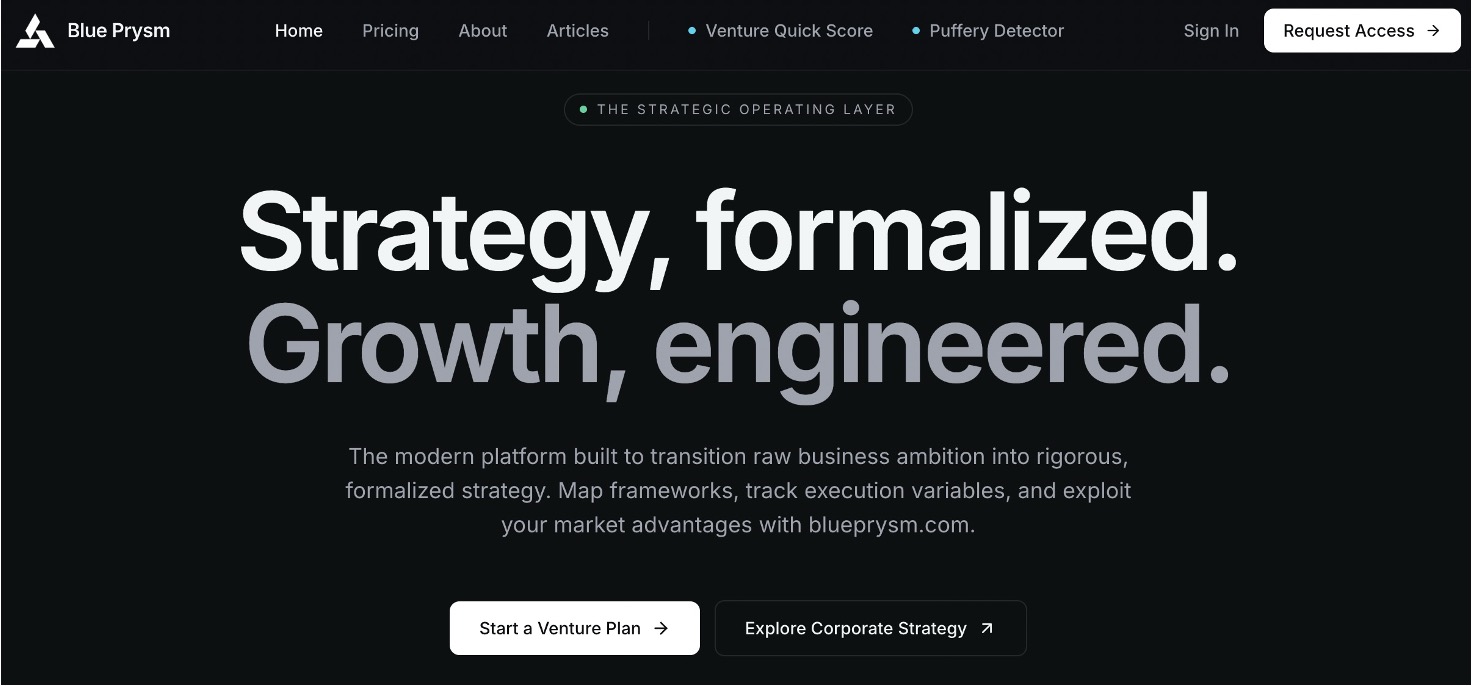
Blue Prysm’s competitor tracking tools monitor market shifts automatically, so your strategy reviews start with current intelligence rather than stale assumptions. The market analysis platform delivers real-time data your team can act on without a research department. And the strategy framework library gives you immediate access to over 95 structured methodologies, from Balanced Scorecard templates to scenario planning guides, built for executives who need to move fast without cutting corners.
FAQ
What is the most important step in the strategic planning process?
Defining 3–5 focused priorities with clear ownership is the single most critical step. Plans with fewer, well-defined priorities consistently outperform those with many competing goals.
How often should organizations review their strategic plan?
Quarterly reviews produce better outcomes than annual planning alone. Frequent check-ins allow course corrections before small problems compound into major failures.
What is the difference between strategic planning and foresight planning?
Strategic planning sets direction and priorities. Foresight planning, as defined by the UNDP Foresight Toolkit, stress-tests those priorities against multiple possible futures rather than a single forecast.
Which strategic framework is best for small businesses?
SWOT analysis and SMART goals are the most accessible starting points. For organizations ready to go deeper, the Balanced Scorecard connects strategy to operational metrics across four dimensions.
Why do most strategic plans fail in execution?
Execution failures typically trace back to missing accountability structures, not poor planning. Without named owners and regular review rhythms, even well-crafted strategies stall at the operational level.