


TL;DR:
- AI-driven market intelligence accelerates data collection and analysis, enabling faster, more frequent decisions. Human oversight remains essential to validate AI outputs, ensuring accurate insights and reducing risks. Proprietary data improves model accuracy, and continuous sensing provides a real-time competitive advantage.
AI-driven market intelligence is defined as the continuous, automated collection and analysis of consumer, competitor, and market data using machine learning and large language models. Executives who still rely on quarterly research cycles are making decisions on stale data. AI compresses market research timelines from months to days, enabling teams to test pricing, messaging, and product concepts at a speed that gut-feel and traditional panels simply cannot match. The role of AI in market research has shifted from a nice-to-have to a core competitive capability, and the gap between early adopters and laggards is widening fast.

Why use AI for market insights: the core case
The fundamental reason to use AI for market insights is speed without sacrificing depth. Generative AI compresses research timelines from months to days, according to MIT Sloan Management Review. That means a team that once waited eight weeks for a segmentation study can now get directional answers in 48 hours.
This speed advantage compounds. When you can test a hypothesis weekly instead of quarterly, you run more experiments, catch bad bets earlier, and allocate budget with more confidence. The role of AI in market analysis is not just automation. It is a structural shift in how often executives can afford to ask hard questions about their markets.
AI also unlocks data sources that traditional research ignores entirely. Customer reviews, support transcripts, social conversations, and sales call recordings contain rich behavioral signals. Most organizations collect this data and never analyze it. AI changes that equation by making unstructured data usable at scale.
How AI automates the heavy lifting in research workflows
Manual market research is full of tasks that consume analyst time without requiring analyst judgment. AI handles those tasks so your team can focus on interpretation and decisions.
The specific workflow improvements include:
- Data cleaning and categorization. AI automates cleaning and categorizing unstructured data from customer reviews, transcripts, and conversations, removing the manual bottleneck that delays insight delivery.
- Survey analysis at scale. AI can process open-ended survey responses across thousands of respondents and surface themes in minutes, a task that previously required days of manual coding.
- Social media and review mining. Sentiment analysis tools scan platforms like Reddit, G2, and Amazon reviews to identify shifting consumer attitudes before they show up in sales data.
- Competitive monitoring. AI agents track competitor pricing pages, press releases, and job postings continuously, flagging strategic moves in near real time.
The efficiency gains are real, but they come with a trap. Teams that hand off analysis entirely to AI without reviewing outputs risk acting on hallucinated conclusions. AI workflows require human oversight in framing, validation, and interpretation to maintain insight integrity.
Pro Tip: Build a human-in-the-loop checkpoint into every AI research workflow. Assign a senior analyst to review AI outputs before findings reach the executive team. One bad insight acted on at scale costs far more than the time saved.
What are synthetic panels and digital twins, and how accurate are they?
Synthetic panels are AI-generated consumer proxies trained on historical survey and behavioral data. Digital twins are more specific: they model individual consumer profiles to simulate how a defined segment would respond to pricing changes, new features, or messaging variations.
The accuracy numbers are striking. Synthetic panels predict consumer choices with around 92% accuracy for scoped pricing and product attribute decisions, according to BCG. Bain & Company reports that synthetic customers replicate about 90% of key outcomes in large-scale quantitative studies when trained on proprietary first-party data. That level of accuracy makes synthetic panels genuinely useful for go-to-market decisions, not just directional exploration.
The comparison with traditional methods is worth understanding clearly:
| Dimension | Synthetic panels | Traditional panels |
|---|---|---|
| Speed | Hours to days | Weeks to months |
| Cost | Significantly lower | High (recruitment, incentives) |
| Accuracy (scoped tasks) | ~90–92% | Benchmark standard |
| Novel innovation testing | Limited | Required |
| Regulatory or high-stakes decisions | Supplement only | Required |
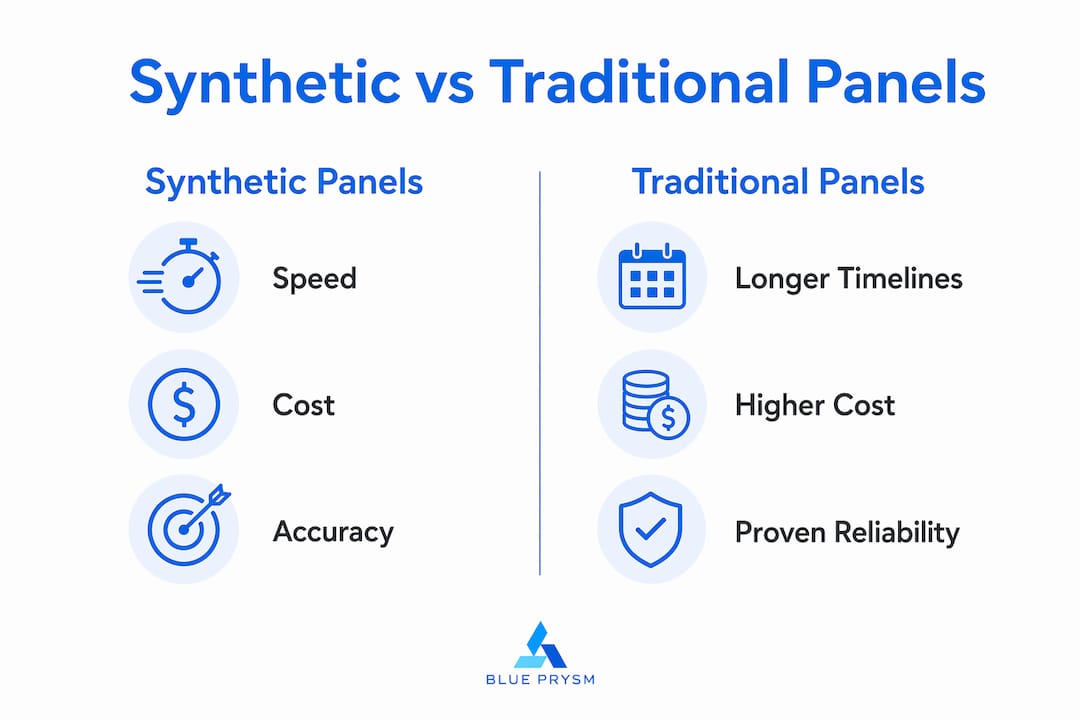
The table tells a clear story. Synthetic panels win on speed and cost for well-defined questions. Traditional research remains necessary for genuinely new product categories, high-stakes launches, and any decision where the training data does not reflect the target population.
Pro Tip: Use synthetic panels to run 10 rapid pricing scenarios before committing to a single traditional study. You will enter that study with sharper hypotheses and better questions, which improves the quality of the final output.
How does always-on AI sensing change competitive intelligence?
Traditional market research is a project. You commission it, receive a report, act on it, and then wait for the next cycle. By the time the report lands, the market has moved. AI transforms market research into an always-on sensing engine that synthesizes data from multiple studies and touchpoints continuously, according to ZS.
This shift has four concrete benefits for executives:
- Reduced insight latency. AI-enabled continuous sensing means organizations act before opportunity windows close, not after competitors have already moved.
- Scenario simulation before investment. Agentic AI can model the likely market response to a price increase, a new feature, or a channel shift before you spend a dollar on execution.
- Compounding intelligence. Each new data point refines the model. Organizations that adopt continuous AI sensing transition from discrete, underutilized studies to a living intelligence layer that grows sharper over time.
- Faster decision cycles. When your sensing engine runs continuously, weekly leadership reviews can include fresh market signals instead of month-old summaries.
The practical implication is significant. A business that acts on two-week-old intelligence while a competitor acts on two-day-old intelligence will consistently be one step behind on pricing, positioning, and product decisions.
Best practices for integrating AI with traditional market research
Adopting AI for market analysis without a governance framework is how organizations end up with confident, wrong conclusions. The advantages of AI market analysis are real, but they require deliberate management.
The practices that separate effective adopters from cautious ones include:
- Prioritize proprietary first-party data. Synthetic panels and digital twins perform best when trained on your own customer data, not generic public datasets. Reliable synthetic panel performance depends on proprietary respondent-level data and careful exclusion of test data from training sets.
- Define which tasks AI owns and which humans own. AI handles data processing, pattern detection, and scenario modeling. Humans own problem framing, strategic interpretation, and final decisions.
- Maintain traditional research for high-stakes and novel areas. AI should supplement, not replace, traditional research for radically new products or decisions with significant financial or reputational risk.
- Select tools aligned with your specific business objectives. A competitive intelligence tool like Blue Prysm’s market analysis platform serves different needs than a general-purpose LLM. Match the tool to the question.
Pro Tip: Audit your existing research budget before adding AI tools. Most organizations can redirect 30–40% of manual data processing costs toward higher-value AI-augmented analysis without increasing total spend.
Key takeaways
AI for market insights delivers the greatest value when it combines speed, continuous sensing, and human judgment into a single integrated workflow.
| Point | Details |
|---|---|
| Speed is the primary advantage | AI compresses research timelines from months to days, enabling faster and more frequent decisions. |
| Synthetic panels are accurate but scoped | BCG and Bain report 90–92% accuracy for defined tasks; traditional research remains essential for novel decisions. |
| Always-on sensing compounds advantage | Continuous AI intelligence reduces insight latency and builds a sharper competitive picture over time. |
| Human oversight is non-negotiable | AI risks hallucinated conclusions without human validation at the framing and interpretation stages. |
| First-party data drives performance | Proprietary customer data produces more reliable synthetic panels than generic public datasets. |
The uncomfortable truth about AI and market research
I have watched executives treat AI market research tools the way they treat a new hire: hand over the work, expect results, and skip the onboarding. That approach fails every time.
The real value of AI in market analysis is not that it replaces judgment. It is that it gives you more data points to exercise judgment against. When I see teams using AI-driven business insights well, they are running faster hypothesis cycles, not outsourcing their thinking. They use synthetic panels to stress-test assumptions before a board meeting, not to replace the board meeting.
The executives who get this right treat AI as a sparring partner, not an oracle. They push back on AI outputs, cross-reference findings with qualitative interviews, and keep a healthy skepticism about any insight that confirms what they already believed. Confirmation bias does not disappear because a machine generated the analysis.
My honest advice: start with one workflow, master the human-AI handoff, and then expand. The competitive advantages for executives who get this right are real and durable. The risks for those who rush it are equally real.
— Colin Bowdery
Blue Prysm gives strategy teams a real intelligence edge
Blue Prysm was built for exactly the challenge this article describes: getting elite-level market intelligence without a six-figure consulting retainer.
The platform gives executives real-time market briefings, continuous competitor monitoring, and a strategy library with 95+ frameworks including SWOT, Porter’s Five Forces, and Business Model Canvas. The AI-powered market research tools automate the data synthesis steps that typically consume analyst hours, so your team spends time on decisions, not data wrangling. For businesses that need to track competitor moves automatically, Blue Prysm’s competitive intelligence software runs continuously in the background, surfacing signals before they become surprises. If you want to see what that looks like in practice, the AI consumer insights guide from BizDev Strategy offers a useful complement to Blue Prysm’s own toolset.
FAQ
Why use AI for market insights instead of traditional research?
AI delivers faster results at lower cost for most scoped research tasks. Traditional research remains necessary for novel product categories and high-stakes decisions where AI training data is insufficient.
How accurate are AI synthetic panels compared to real consumer surveys?
BCG reports synthetic panels achieve around 92% accuracy for pricing and product attribute decisions. Accuracy depends heavily on the quality and relevance of the proprietary data used to train the model.
What is always-on market sensing in AI research?
Always-on market sensing is a continuous AI process that synthesizes data from multiple sources and studies in real time. It replaces the traditional model of discrete, periodic research projects with a living intelligence layer.
What is the biggest risk of using AI for market analysis?
The biggest risk is acting on hallucinated or biased conclusions without human validation. MIT Sloan Management Review identifies human oversight in framing and interpretation as the critical safeguard in any AI research workflow.
How should executives start integrating AI into their market research process?
Start with one high-volume, low-stakes workflow such as survey coding or competitive monitoring. Master the human-AI handoff in that workflow before expanding AI to higher-stakes analysis tasks.