

TL;DR:
- Effective strategic planning requires layering models across diagnosis, formulation, execution, and transformation to avoid failure. Leaders should commit to one primary strategy, connect analysis with actionable tracking, and prioritize genuine urgency for change. Using multiple frameworks with real-time data enhances decision-making and improves organizational outcomes.
Business strategy models are structured frameworks that guide organizations in planning, analyzing, executing, and adapting their strategic initiatives. The best ones force explicit trade-offs, not just analysis. A solid business strategy models list covers four operational stages: preparation, formulation, control, and change management. Misuse across these stages causes failure, which is why choosing the right model for the right phase matters as much as the model itself. Foundational tools like Michael Porter’s Generic Strategies, the Balanced Scorecard, and OKRs each serve distinct purposes, and layering them is what separates plans that get executed from plans that collect dust.
The business strategy models list by planning stage
Strategic planning models fall into four operational stages. Preparation models diagnose your environment. Formulation models shape your direction. Control models track execution. Change management models guide transformation. Firms that layer tools across all four stages consistently outperform those that rely on a single framework.

Here is how the core models map to each stage:
Preparation (environment analysis)
- PESTEL: scans political, economic, social, technological, environmental, and legal forces
- Porter’s Five Forces: maps competitive pressure from new entrants, suppliers, buyers, substitutes, and rivalry
- SWOT: surfaces internal strengths and weaknesses against external opportunities and threats
Formulation (direction setting)
- Ansoff Matrix: defines growth options across markets and products
- Blue Ocean Strategy: identifies uncontested market space
- VRIO Framework: audits internal resources for competitive advantage
Control (execution and tracking)
- Balanced Scorecard: links strategy to operational measures across four perspectives
- OKRs (Objectives and Key Results): translate goals into measurable, frequently updated results
- Hoshin Kanri: cascades strategic goals through every level of the organization
Change management (transformation)
- Kotter’s 8-Step Change Model: structures the full arc of organizational change
- Competing Values Framework: diagnoses organizational culture to guide transformation
Pro Tip: Pair at least one diagnostic model with one execution model. Analysis without a tracking mechanism produces insight with no follow-through.
| Stage | Model | Primary use |
|---|---|---|
| Preparation | PESTEL, Porter’s Five Forces, SWOT | Environmental and competitive diagnosis |
| Formulation | Ansoff Matrix, Blue Ocean Strategy | Growth direction and market positioning |
| Control | Balanced Scorecard, OKRs | Execution tracking and goal alignment |
| Change management | Kotter’s 8-Step, Competing Values | Transformation and cultural alignment |
1. Porter’s Generic Strategies
Porter’s 1980 model defines three primary competitive positions: Cost Leadership, Differentiation, and Focus. Cost Leadership wins on price by operating at lower cost than rivals. Differentiation wins on uniqueness, commanding a premium. Focus applies either approach to a narrow market segment.
The trap most leaders fall into is trying to pursue two at once. Porter called this “stuck in the middle,” and it dilutes resources without producing a clear market position. Pick one primary strategy and build your capabilities around it.
- Cost Leadership: requires operational efficiency, high volume, and tight cost controls
- Differentiation: requires brand investment, R&D, and customer experience
- Focus (Cost or Differentiation): requires deep knowledge of a specific segment’s needs
Pro Tip: Before choosing a generic strategy, map your current cost structure and brand perception. The data usually reveals which position you already hold, even if unintentionally.
2. Porter’s Five Forces
Porter’s Five Forces explains why some industries are structurally more profitable than others. It is not about your product quality. It is about the competitive pressure your industry architecture creates. The five forces are: threat of new entrants, bargaining power of suppliers, bargaining power of buyers, threat of substitutes, and competitive rivalry.
Use this model before entering a new market or when margins are shrinking without an obvious cause. A business with a great product in a structurally weak industry will always fight for margin. Knowing that upfront changes your strategy entirely.
3. SWOT analysis
SWOT is the most widely used preparation tool in the world, and also the most misused. Leaders fill it out as a formality, then ignore it. The model’s real value comes from forcing honest answers to uncomfortable questions: What do competitors do better? Where are we genuinely exposed?
A well-run SWOT feeds directly into your formulation stage. Strengths and opportunities point toward where to compete. Weaknesses and threats define what to defend or exit. Treat it as a living document, not a one-time exercise.
4. PESTEL analysis
PESTEL scans six macro-environmental forces that shape every market. Political shifts, economic cycles, social trends, technological disruption, environmental regulation, and legal changes all affect your strategy, whether you track them or not. Most leaders underweight the “E” and “L” dimensions until a regulation or climate event forces their hand.
Run a PESTEL analysis at the start of any annual planning cycle. It surfaces risks that internal data never captures. Pair it with Porter’s Five Forces for a complete picture of both macro and competitive context.
5. Ansoff Matrix
The Ansoff Matrix gives you four growth options organized by market and product familiarity. Market penetration (existing product, existing market) carries the lowest risk. Product development and market development carry moderate risk. Diversification (new product, new market) carries the highest risk and the highest potential reward.
The matrix forces a direct conversation about risk appetite. Most leadership teams default to market penetration because it feels safe. The matrix makes the cost of that conservatism visible, which is exactly the trade-off a good framework should surface.
6. Blue Ocean Strategy
Blue Ocean Strategy pushes firms to create uncontested market space rather than compete in crowded industries. The ERRC grid (Eliminate, Reduce, Raise, Create) is its core tool. It forces you to decide what your industry takes for granted that you could eliminate, and what you could create that no one currently offers.
True blue oceans are rare. The practical value of this model is not finding a magical untapped market. It is the discipline of questioning every assumption your industry shares. That questioning alone produces differentiation most competitors never attempt. For tech-driven strategy approaches, this model pairs well with rapid prototyping cycles.
7. VRIO Framework
VRIO asks four questions about any internal resource or capability: Is it Valuable? Is it Rare? Is it difficult to Imitate? Is it supported by the Organization? A resource that passes all four tests is a source of sustained competitive advantage. One that fails the first test should be deprioritized or outsourced.
Most leaders know their strengths in general terms. VRIO forces specificity. “We have great people” is not a competitive advantage. “We have a proprietary data pipeline that took three years to build and requires specialized expertise to operate” is.
8. Balanced Scorecard
The Balanced Scorecard links strategy to operational measures across four perspectives: financial, customer, internal processes, and learning and growth. It was designed to fix a specific problem: companies that managed only financial metrics and were blindsided by operational or customer failures.
The Balanced Scorecard works best when it is connected to your strategic goals, not just used as a reporting dashboard. Each measure should trace back to a specific strategic objective. Without that connection, it becomes another spreadsheet nobody reads.
9. OKRs (Objectives and Key Results)
OKRs translate high-level objectives into measurable key results that teams update frequently, typically quarterly. The discipline of writing a good OKR forces clarity: you cannot write a measurable key result for a vague objective. That friction is the point. Pairing OKRs with diagnostic tools prevents plans from stalling after the strategy offsite.
OKRs work at every level of an organization, from company-wide goals down to individual contributors. That vertical alignment is what makes them powerful for execution. They are not a replacement for strategy. They are the mechanism that turns strategy into daily decisions.
10. McKinsey 7-S Framework
The McKinsey 7-S Framework aligns seven internal organizational elements: strategy, structure, systems, shared values, skills, style, and staff. It is most useful when a strategy is clear but execution keeps failing. The framework reveals which of the seven elements is misaligned and blocking progress.
Shared values sit at the center of the model for a reason. Culture overrides process. If your shared values do not support the strategy, the other six elements will drift back toward the old way of working regardless of what the plan says.
11. Kotter’s 8-Step Change Model
Kotter’s 8-Step model structures organizational change from establishing urgency through anchoring new approaches in the culture. It is a process model, not an analytical one. That distinction matters. You use it to manage the human side of transformation, not to diagnose competitive position.
The most commonly skipped step is step one: establishing urgency. Leaders assume the need for change is obvious. It rarely is to the people being asked to change. Without genuine urgency, every subsequent step faces resistance that compounds over time.
12. Hoshin Kanri
Hoshin Kanri is a Japanese policy deployment method that cascades strategic goals from the executive level down to every team and individual. It uses a “catchball” process where goals are passed down, refined, and passed back up until alignment is confirmed at every level. The result is an organization where everyone understands how their daily work connects to the top-level strategy.
Most Western planning processes set goals at the top and assume they will be understood below. Hoshin Kanri treats alignment as something you build deliberately, not assume. For AI-driven strategy execution, this cascading approach pairs well with real-time performance tracking.
Key takeaways
No single strategic planning model covers every phase of strategy development and execution. Layering complementary frameworks across preparation, formulation, control, and change management is the defining practice of effective strategic planning.
| Point | Details |
|---|---|
| Layer models by stage | Match each framework to its operational stage: diagnosis, formulation, execution, or transformation. |
| Avoid “stuck in the middle” | Porter’s Generic Strategies require committing to one primary position to prevent resource dilution. |
| Pair analysis with execution | Diagnostic tools like PESTEL and SWOT must connect to execution models like OKRs or Balanced Scorecard. |
| Use VRIO for internal clarity | Test resources against Value, Rarity, Imitability, and Organization before claiming competitive advantage. |
| Change needs urgency first | Kotter’s model fails most often when leaders skip establishing genuine urgency before driving transformation. |
Why I stopped trusting any single strategy model
The most dangerous thing a leadership team can do is fall in love with one framework. I have watched smart executives run a beautiful SWOT analysis, declare the strategy “done,” and then wonder twelve months later why nothing changed. The analysis was fine. The execution model was missing entirely.
Strategy models are lenses, not checklists. The moment you treat a framework as a box-ticking exercise, it stops forcing the trade-offs it was designed to surface. The other trap I see constantly is “analysis paralysis.” Teams run PESTEL, then Porter’s Five Forces, then SWOT, then Ansoff, and never make a decision because there is always one more analysis to run. Concise strategic briefs that define the specific decision being made before any analysis begins are the fix for this. The model serves the decision. The decision does not wait for the model to be perfect.
My honest recommendation: pick two or three models that match your current phase, use them to force a real choice, and move. You can always add more rigor in the next planning cycle. You cannot recover the time lost to endless analysis.
— Colin Bowdery
How Blue Prysm puts these models to work
Knowing the right framework is one thing. Having the data to feed it is another. Blue Prysm’s AI-powered market research tools give strategy teams the real-time inputs that models like PESTEL, Porter’s Five Forces, and VRIO actually require. Without current market data, even the best framework produces outdated conclusions.
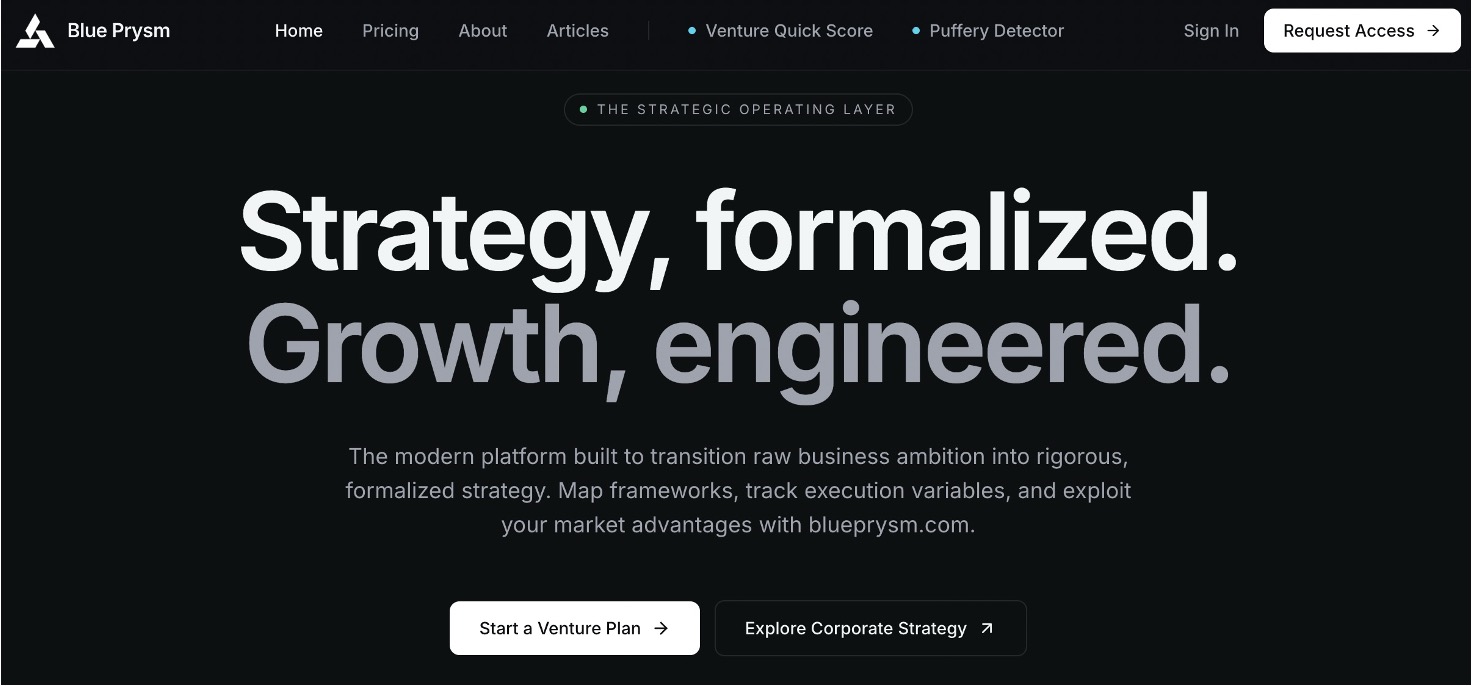
Blue Prysm connects your chosen frameworks to live competitor tracking, market signals, and a strategy library with 95+ frameworks ready to apply. For small and mid-sized businesses that cannot afford a full consulting engagement, this closes the gap between knowing which model to use and having the intelligence to use it well. The platform is built for leaders who want to run enterprise-grade strategy on a real-world budget.
FAQ
What is a business strategy model?
A business strategy model is a structured framework that guides planning, competitive analysis, execution, or organizational change. Examples include Porter’s Five Forces, the Balanced Scorecard, and the Ansoff Matrix.
How many strategy models should a business use?
Most effective strategy processes layer two to four models that address different phases: one for environmental diagnosis, one for direction setting, and one for execution tracking.
What is the difference between a process model and an analytical framework?
A process model guides the full planning journey (such as Hoshin Kanri or Kotter’s 8-Step). An analytical framework diagnoses a specific variable (such as PESTEL or SWOT). Both are needed; neither replaces the other.
When should I use OKRs vs. the Balanced Scorecard?
Use OKRs when you need fast, team-level goal alignment updated quarterly. Use the Balanced Scorecard when you need a broader strategic performance view across financial, customer, process, and learning dimensions.
What causes strategy models to fail in practice?
Models fail when treated as static checklists rather than tools for forcing explicit trade-offs. Skipping the connection between analysis and execution is the most common cause of plans that never get implemented.