


TL;DR:
- A strategic brief is a crucial document that aligns stakeholders on project objectives, audience, and constraints before work starts. It answers key questions about the problem, desired change, and success metrics to prevent scope drift and ensure clarity. Writing a concise, focused brief early builds confidence, guides decision-making, and predicts project success.
A strategic brief is a concise, written document that defines the foundational objective, target audience, and key constraints for a project before any execution begins. Its job is to align stakeholders on the “why” and “what” before a single creative decision gets made. Think of it as the north star for every trade-off, scope debate, and creative discussion that follows.
What is a strategic brief, and why does it matter?
Most teams skip the brief or treat it as a formality. That is the trap. A strategic brief is not paperwork. It is organizational alignment made visible, a single document that bridges data, business goals, and creative execution by codifying shared understanding.
At its core, a well-written brief answers five questions before work begins:
- What problem are we solving? Not the symptom, the actual problem.
- Who are we trying to influence? Audience definition goes beyond demographics into what they currently believe.
- What needs to change? The desired shift in behavior or perception, not just a list of deliverables.
- What are the constraints? Budget, timeline, legal guardrails, and non-negotiable deadlines.
- How will we know it worked? A specific, measurable definition of success.
When those five questions are answered in writing, the brief becomes the single source of truth driving every decision downstream. When they are not, teams spend weeks in verbal loops, each conversation subtly different from the last, until the project drifts off course.
Key principles for writing a brief that actually works
Good briefs are not long. They are clear. Length is a comfort blanket; clarity is the real discipline.
Here are the principles that separate a brief worth signing from one that collects dust:
- One objective, not five. A strategic brief should focus on a single, compelling point of view or outcome. Multiple competing objectives dilute focus and invite scope creep.
- Surface constraints early. The most dangerous constraints are the ones nobody mentions until week six. Known deadlines, budget ceilings, and legal requirements belong in the brief from day one.
- Define what you will not do. Effective briefs define what needs to be done and what should not be done. Removing ambiguity on both sides lets teams work decisively.
- Write it, do not say it. If you keep explaining the project verbally, it will be subtly different every time. The written brief is the only version that counts.
- Synthesis, not summary. The writer’s job is to take fragmented inputs and turn them into a coherent narrative, not to dump every stakeholder comment into a document.
Pro Tip: Watch out for “everything is important” syndrome. When a brief lists six equally weighted priorities, it is really saying the team has not made any decisions yet. Pick one core outcome and let everything else serve it.
How to create a strategic brief, step by step
Writing a brief is a process of making decisions early so the team does not have to make them under pressure later. Here is a practical framework.

Step 1: Define the problem. Start with the problem, not the solution. What is not working today, and what needs to change for this project to be considered a success?
Step 2: Gather insights. Pull together existing research, customer data, and market context. You are looking for the human truth behind the numbers. Data tells you what; empathy tells you why.
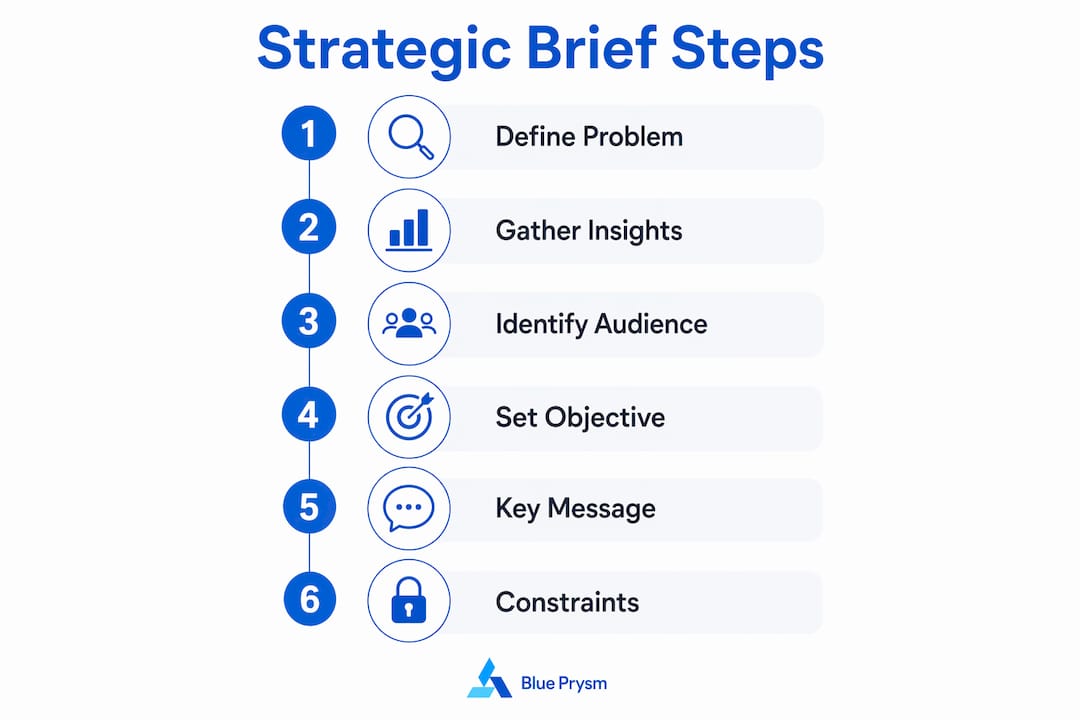
Step 3: Identify the audience. Go beyond job title or age bracket. What does this audience currently believe, and what would you need them to believe or do differently?
Step 4: Set a single objective. Write one sentence that captures the outcome this project must achieve. If you need two sentences, you have two projects.
Step 5: Define the key message. What is the central idea that every piece of work should reinforce? This is not a tagline. It is the strategic spine.
Step 6: Document constraints and approvals. Budget, timeline, revision rounds, and who has final sign-off. Setting this before work begins prevents the open-ended feedback cycles that kill timelines.
Step 7: Get it signed, then manage changes formally. Once signed, the brief becomes the baseline. Any changes after that are scope adjustments, not casual tweaks. Treat them that way.
A complete brief covers these components:
- Objective (the one thing that matters most)
- Audience (who and what they currently think)
- Problem to solve
- Desired belief or behavior change
- Key message
- Guardrails (tone, terminology, structure)
- Constraints (budget, timeline, legal)
- Channels, formats, and deliverables
- Feedback and approval process
Pro Tip: A short brief that makes each point clear will outperform a long one filled with assumptions. Aim for one page. If you cannot fit it on one page, you have not finished thinking yet.
How a strategic brief differs from a creative brief
These two documents are often confused, and that confusion costs teams real time. They serve different purposes, written for different audiences at different stages.
The strategic brief:
- Written before creative work begins
- Focused on research, business objectives, audience insight, and problem definition
- Audience: leadership, strategists, project owners
- Answers: Why are we doing this? Who are we talking to? What needs to change?
The creative brief:
- Written after the strategy is locked
- Focused on execution, messaging, tone, and creative direction
- Audience: designers, copywriters, creative teams
- Answers: What are we making? How should it feel? What does it say?
The strategic brief informs the creative brief. You cannot write a good creative brief without a solid strategy underneath it. Teams that skip the strategic layer and jump straight to creative execution usually end up with work that looks polished but misses the point entirely. A website redesign project, for example, needs both: the strategic brief to define audience goals and success metrics, and the creative brief to guide visual and copy decisions.
One practical test: if your creative brief contains the words “our goal is to increase brand awareness,” you probably skipped the strategic brief. That phrase is a placeholder, not a strategy.
Why a strong brief predicts project success
Here is the uncomfortable truth about most project failures. The problem was not execution. It was that nobody agreed on the goal before execution started.
The discipline of writing a brief is a test of organizational health. If a leader cannot clearly articulate the problem and goals in writing, execution will struggle regardless of how talented the team is. The writing process itself forces consensus, reveals hidden assumptions, and clarifies priorities before they become expensive disagreements.
Teams that rely on verbal alignment instead of a written brief are at real risk. Every conversation is slightly different. Every stakeholder walks away with a slightly different understanding. By the time the work is in review, those small differences have compounded into major rework.
A strong brief also signals something less tangible but equally important: confidence. It tells the creative team that leadership understands the challenge, believes in the direction, and respects the process enough to think it through before asking others to execute it. That confidence is contagious.
Blue Prysm’s AI-powered market research tools are built specifically to accelerate the insight-gathering phase of brief writing, pulling real-time market data and competitor intelligence so your brief is grounded in current reality, not last quarter’s gut feeling. When the research phase is faster and more thorough, the brief gets sharper, and the project gets a better start.

Key Takeaways
A strategic brief is the single most important document a project team can produce before execution begins, because it forces alignment on objectives, audience, and constraints when changes are still cheap.
| Point | Details |
|---|---|
| One objective only | A brief with multiple competing goals has made no decisions; pick one core outcome. |
| Written beats verbal | Verbal alignment shifts with every conversation; the written brief is the only version that holds. |
| Brief becomes baseline | After sign-off, changes are formal scope adjustments, not casual feedback. |
| Strategic brief precedes creative brief | Strategy defines the problem; the creative brief directs how to solve it. |
| Writing the brief is leadership | The process of writing forces consensus and surfaces assumptions before they become costly. |
FAQ
What is a strategic brief in simple terms?
A strategic brief is a short written document that defines a project’s objective, target audience, and key constraints before any work begins. Its purpose is to align everyone on the “why” and “what” so execution stays on track.
What is the difference between a strategy brief and a creative brief?
A strategic brief focuses on research, business objectives, and audience insight; a creative brief focuses on execution, messaging, and creative direction. The strategic brief comes first and informs everything in the creative brief.
When do you actually need a full strategic brief?
A full strategic brief is needed when a project requires a new idea, such as a new audience, objective, channel, or cultural context. Simpler executional tasks like resizing existing assets only need a lighter task brief.
What is a strategic brief in construction?
In construction, a strategic brief (sometimes called a strategic definition document) captures the client’s high-level needs, project scope, budget parameters, and success criteria before design work begins. It serves the same alignment function as in marketing: locking in the “what” before teams invest in the “how.”
What are the 4 P’s of strategy?
The 4 P’s of strategy are Position, Plan, Pattern, and Perspective, a framework often attributed to Henry Mintzberg for describing how organizations form and communicate strategy. A strategic brief typically captures the Plan and Position dimensions by defining objectives and audience before execution begins.