


A competitor is any business competing for the same customer dollar and the same job to be done, whether they look like you or not. Here’s what to do in the next five minutes: pick one rival you already know exists, write down one number about them (their starting price or their star rating), and put a 30-minute research block on your calendar this week.
Your first competitor record needs three things:
- Their one-line value claim (what they say they do better).
- A pricing snapshot (entry price, model, any free tier).
- One real customer quote pulled from a review site.
That’s the whole starting kit. Everything below explains how to build it out properly.
Key Takeaways
Competitor analysis works when it turns raw research into two or three specific strategic moves, scored, weighted, and revisited on a set schedule rather than left as a one-time exercise.
| Point | Details |
|---|---|
| Define competitors by job-to-be-done | A rival is anyone competing for the same purchase decision, not just a similar-looking business. |
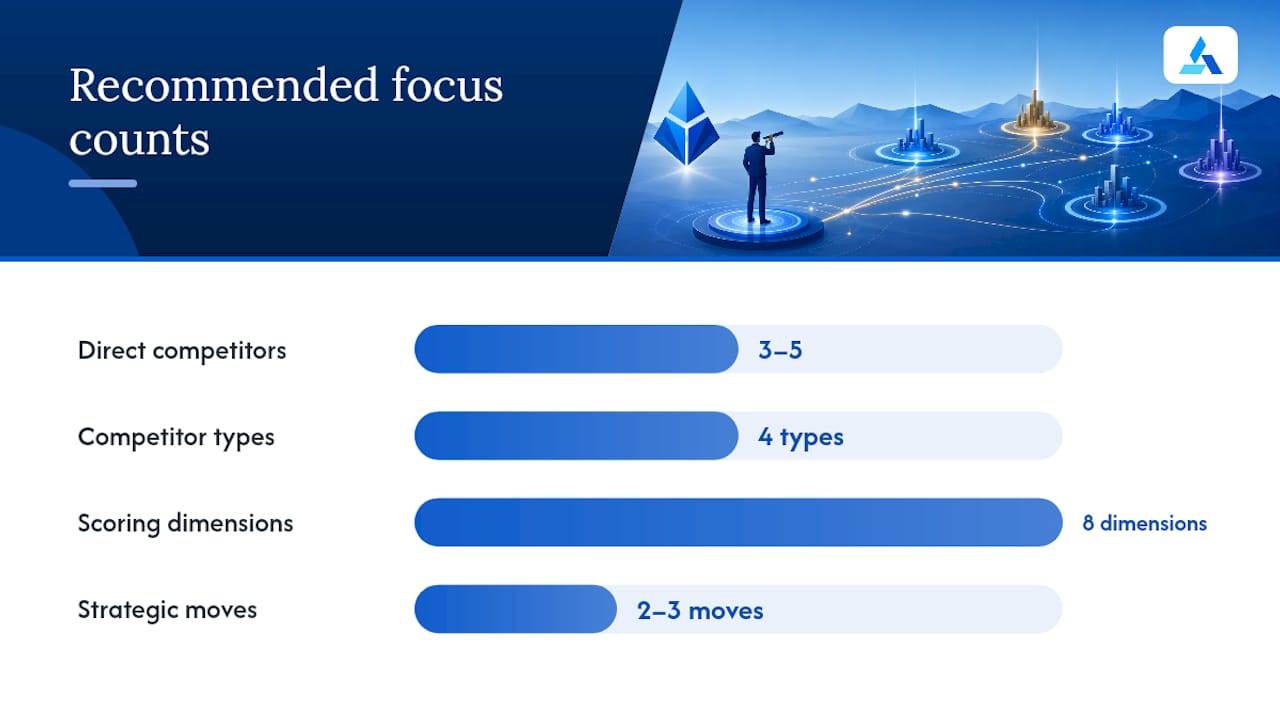
| Track four competitor types | Focus deep research on 3 to 5 direct competitors; scan indirect, substitute, and entrant threats lightly. |
| Score across eight dimensions | Weight features, pricing, customer experience, and digital presence by what actually drives your buyer’s choice. |
| Set alert governance early | Assign an alert owner and a triage window so automated signals turn into action, not noise. |
| Use Blue Prysm to compress the workflow | Blue Prysm’s market analysis and competitive intelligence tools convert scored research into roadmaps and battlecards faster than manual tracking alone. |
Where to Look First When You Start Research
SimilarWeb and keyword tools handle quick discovery, IBISWorld and company filings add depth on private competitors, and review sites verify what customers actually experience.
- SimilarWeb: fast traffic and audience estimates for initial discovery.
- IBISWorld and company filings: depth on private companies and market size.
- Review sites: verification of real customer complaints and comparisons.
- SEO tools (Ahrefs, Semrush): keyword and content overlap for digital rivals.
- Business registries: confirmation that a company legally exists and operates where you think it does.
Stick to public information, reviews, filings, published pricing, when monitoring competitors. Avoid misrepresenting yourself to obtain private data, which crosses from research into deception.
What Actually Counts as a Competitor in Your Business
A true competitor solves the same customer problem and competes for the same purchase decision, not just a company that looks similar on the surface. Two businesses can share a website layout, a target keyword, or even a logo color palette and still not be rivals, because rivalry lives in the customer’s decision, not in your industry classification.
A structured competitive analysis groups rivals into tiers based on how directly they compete for that decision, and that tiering matters more than most owners realize. Take a mid-size accounting firm. A rival accounting firm across town is a direct competitor. A bookkeeping software subscription is a substitute, since it replaces the need for a human accountant on basic tasks. A general business consultant who occasionally does tax planning is incidental overlap: same industry cluster, different job to be done. Confusing the three wastes research time on the wrong targets.
The Four Types of Competitors Every Owner Should Track
Direct, indirect, substitute, and potential entrant. Those four categories cover essentially every threat to your market position, and each one demands a different level of attention and a different strategic response.
- Direct competitors sell the same product or service to the same customer segment. A boutique fitness studio down the street competing for the same members is direct. These deserve your deepest research, because they’re fighting you on price, features, and messaging simultaneously.
- Indirect competitors solve the same underlying problem with a different approach. A meal-kit subscription and a grocery delivery app both solve “I don’t want to cook from scratch,” but they compete on different mechanics. Watch these for feature creep that could pull them into direct competition.
- Substitute competitors replace the need for your category entirely. A video conferencing tool substitutes for business travel. Substitutes rarely show up in keyword research because they don’t use your industry’s vocabulary, which is exactly why owners miss them.
- Potential or new entrants haven’t launched yet but could, often a well-funded startup or an adjacent player expanding into your space. You track these for early signals, not detailed scoring.
You don’t need equal depth on all four. Spend real analytical effort on 3 to 5 direct competitors, run a lighter scan across indirect and substitute players quarterly, and keep a watch list for potential entrants without building full profiles until they actually move.
How to Identify Competitors: A Step-by-Step Checklist
Six steps produce a defensible competitor list in a single working session: search like your customer, mine keyword overlap, ask your sales team, read reviews, check business registries, and trace the customer journey backward.
- Search the way your customer searches. Type the problem, not your brand name, into Google and note who ranks and who runs ads. This surfaces competitors your industry instincts miss entirely.
- Pull keyword overlap reports. Tools like Ahrefs or Semrews show which domains rank for your core terms. Treat this as a raw list, not a final one, since organic overlap tools produce false positives when a site ranks for your keyword but sells something else entirely.
- Ask sales and customer support. Your team hears “we’re also looking at X” on calls constantly. This is often the fastest, most accurate source you have and it costs nothing.
- Mine reviews and complaints. Read one-star and three-star reviews on G2, Google Business Profile, or Trustpilot for competitor names customers mention by comparison. This tends to surface real alternatives that never show up in ad auctions.
- Check business registries and databases. Sources like state Secretary of State filings, IBISWorld industry reports, or Mergent fill in private companies that don’t advertise or rank organically.
- Reverse-engineer the customer journey. Map every decision point a buyer hits before choosing you, and note who else appears at each fork.
Validate each name against one question: does this business actually sell to your target customer and solve the same core problem? If the answer is no, cut it from the list regardless of how well it ranks or how similar its homepage looks.
Competitive Analysis Framework: What to Compare and How to Score It
Eight dimensions cover nearly every meaningful difference between you and a rival: product features, pricing and business model, target customer, marketing and messaging, sales and distribution channels, customer experience, market position and scale, and digital presence.
- Product/service offering and feature set
- Pricing and business model
- Target customer segment
- Marketing and messaging angle
- Sales and distribution channels
- Customer experience and onboarding
- Market position, scale, and financial health
- Digital presence and SEO/PPC footprint
Score each dimension 1 to 5 for you and for each competitor, then multiply by a weight reflecting how much that dimension actually influences your buyer’s decision. A B2B software company selling to enterprise buyers might weight “market position and scale” at 3x, since enterprise buyers care deeply about vendor stability, while a local service business might weight “customer experience” highest instead.
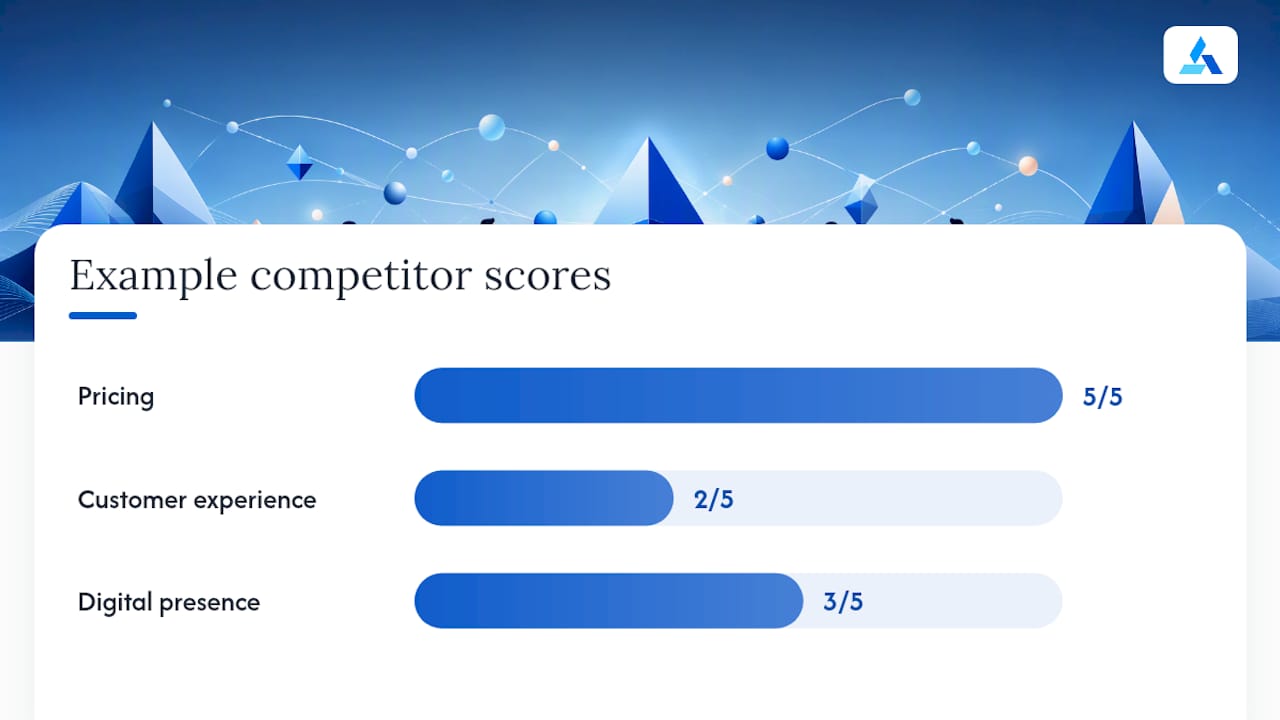
Here’s a compressed example: a competitor scores 5 on pricing (cheaper), 2 on customer experience (poor onboarding reviews), and 3 on digital presence (moderate organic traffic). Weighted toward experience because your buyers churn on bad onboarding, that competitor’s price advantage matters less than it first appears; your opening isn’t undercutting them, it’s out-onboarding them.
- Score every dimension 1 to 5 for each competitor and yourself.
- Apply weights based on what actually drives your buyer’s decision.
- Sum the weighted scores and interpret the gaps, not just the totals.
Pro Tip: Interview your last five lost deals before you finalize your weighting. Buyers who chose a competitor will tell you exactly which dimension tipped the decision, and that’s more reliable than guessing from your own priorities.
A six-dimension version of this matrix groups features, pricing, positioning, marketing channels, strengths and weaknesses, and market share, which works well if you want a lighter framework to start with. For a full spreadsheet-ready version, a step-by-step benchmarking template walks through building the matrix column by column.
Turning Competitive Analysis Into a Strategy That Works
Four responses come out of a solid competitive matrix: differentiate, compete on cost, focus on a niche, or pivot. Porter’s generic strategies still hold up as the cleanest way to frame the choice, decades after they were first published, because the underlying trade-off hasn’t changed: you can’t be the cheapest and the most premium option at once.
Pick your top two moves using an impact-versus-effort rubric. Rank each option from your matrix on how much it would move revenue or retention against how many resources it takes to execute, then act on whichever pair scores highest on impact and lowest on effort. A pricing tweak usually clears that bar faster than a full product rebuild.
- List every strategic option your analysis surfaced.
- Score each on impact (1 to 5) and effort (1 to 5).
- Execute the two with the best impact-to-effort ratio first.
Certain competitor moves should trigger an immediate response rather than waiting for your next quarterly review:
- A competitor drops price by more than 15%
- A competitor ships a feature your customers have been requesting
- A competitor’s headcount on LinkedIn jumps sharply in sales or engineering
- A competitor’s organic traffic or keyword rankings spike within a short window
Which Tools Actually Find and Track Competitors?
SimilarWeb, Ahrefs or Semrush, company filings, review platforms, LinkedIn, business registries, and AI-based discovery tools together cover discovery, depth, and ongoing monitoring. No single source does all three jobs well.
- SimilarWeb estimates traffic and audience overlap fast, useful for a first-pass discovery scan rather than precise numbers.
- Ahrefs or Semrush reveal keyword and backlink overlap, strong for finding SEO rivals but blind to substitutes with different vocabulary.
- Company filings and databases like IBISWorld or Mergent surface private companies that don’t show up in search at all.
- Review platforms (G2, Trustpilot, Google Business Profile) expose customer-stated alternatives and where competitors actually disappoint buyers.
- LinkedIn tracks hiring surges and leadership moves, an early warning signal for expansion.
- AI-based discovery tools analyze what a business actually does rather than its industry code, which surfaces private and adjacent competitors that standard classification misses entirely.
Free tools handle initial discovery for most SMBs. Once you need continuous monitoring across dozens of signals, or you’re missing private competitors that never show up in a keyword report, that’s the point where paid tooling or dedicated help earns its cost.
Scaling Competitor Monitoring With Agentic AI
Automation multiplies how many signals you catch and shrinks the blind spots a manual scan leaves behind, but it also introduces noise you need rules to manage. Automated tools identify a meaningfully larger set of relevant competitors than manual searches alone, including private firms that never appear under a standard industry code, precisely because they read what a company does instead of how it’s classified.
The upside shows up in three places:
- Real-time alerts on pricing, hiring, and messaging changes instead of quarterly surprises
- Broader discovery that reaches private companies and adjacent players
- Trend detection across an entire competitive set rather than one rival at a time
An alert should never sit unread. A pricing-change alert triggers triage (is this a real shift or a limited-time promo?), then a decision owner responds within a set window, whether that’s a sales enablement note or a pricing review. Automation still needs human governance: set thresholds, assign an owner per alert type, and review the rules quarterly so the system flags signal, not chatter.
Pro Tip: Assign one person to own “alert triage” even if it’s a 15-minute weekly task. Alerts nobody owns get ignored within a month, and an ignored alert is worse than no alert at all.
Two Quick Scenarios Using This Framework
Scenario one: A local bakery notices a new competitor two blocks away. Scored dimensions show the newcomer beats them on price (4 vs. 2) but trails badly on customer experience (2 vs. 5, based on new reviews mentioning slow service). Next step: lean into service quality in marketing rather than matching their price. Track review sentiment monthly for the next quarter.
Scenario two: A SaaS founder finds a substitute tool gaining traction, a free spreadsheet template solving a lighter version of their problem. Scored dimensions show it wins on cost (5 vs. 3) but has no onboarding support (1 vs. 4). Next step: build a comparison page targeting switchers who outgrow the free option. Track that page’s conversion rate as the next signal.
How Colin Bowdery Uses Competitor Maps in Strategy Meetings
A competitor map changes the tone of a strategy meeting from opinion to evidence, and that shift alone is worth the hour it takes to build one. When product and sales sit down with a scored matrix instead of gut feelings about “what the competition is doing,” the argument moves from who’s louder to what the data actually shows.
Run a focused workshop with two rules: limit the competitor list to a manageable number before the meeting starts, and require every score to cite a source, a review, a pricing page, or a LinkedIn post, so nobody wins an argument on vibes. Revisit the full matrix regularly, but triage alerts frequently so nothing sits stale waiting on a calendar invite.
How Blue Prysm Speeds Up Competitor Research
Manual research still does the heavy lifting here. No tool replaces reading a one-star review or asking your sales team who they’re losing deals to. What a platform changes is how fast you turn that research into something you can act on in a meeting instead of a folder full of half-finished notes.
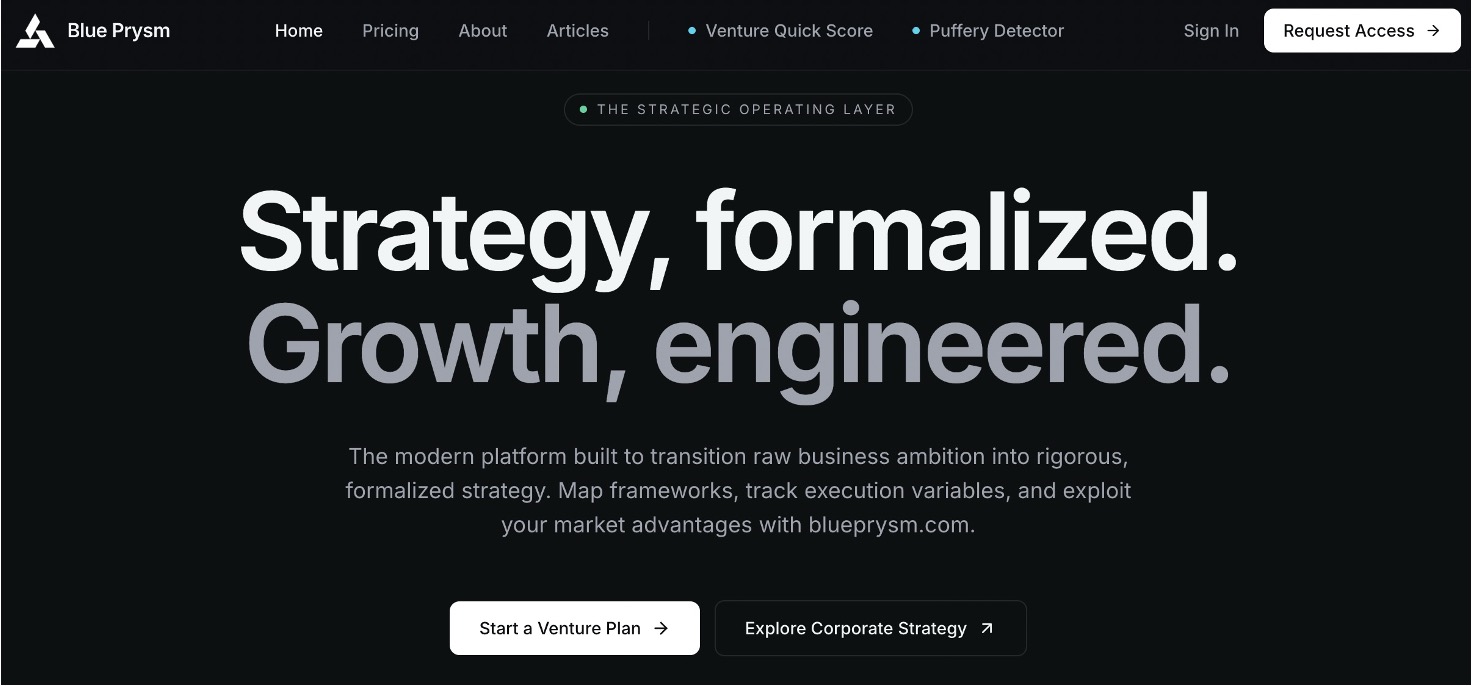
Blue Prysm’s market analysis platform pulls real-time competitor signals, pricing shifts, hiring spikes, messaging changes, into one feed instead of six browser tabs you forget to check. Pair that with the competitive intelligence tracking tools for ongoing monitoring, and a library of 50-plus strategy frameworks that turns your scored matrix directly into a positioning brief or a sales battlecard. If you’d rather see it before committing, walk through the how it works overview and pull the competitor-matrix template into your next planning session.
Sources
- Competitive Analysis: How to Analyze Your Competitors (Template)
- How To Create A Competitive Analysis: Guide + Templates | Similarweb
- ScienceDirect article (competitive advantage and automated tools)
FAQ
What Are Competitors in a Business?
A competitor is any business targeting the same customer decision as you, whether they sell an identical product, an alternative approach, or a substitute that removes the need for your category entirely.
What Are Some Examples of Competitors?
A direct competitor sells the same product to the same buyer, an indirect competitor solves the same problem differently, and a substitute replaces the need for your category, like video calls replacing business travel.
What Are the Four Main Types of Competitors?
Direct, indirect, substitute, and potential or new entrants. Each requires a different research depth and a different strategic response, with direct competitors deserving your most detailed analysis.
How Many Competitors Should a Small Business Track Closely?
Most owners get the best return from deep analysis on 3 to 5 direct competitors, paired with a lighter quarterly scan of indirect and substitute players.
Can Automation Replace Manual Competitor Research?
No. Automated tools like Blue Prysm’s competitive intelligence platform speed up discovery and catch signals a manual scan would miss, but reading actual customer reviews and talking to your sales team still surfaces insight no algorithm replicates.