


Social sentiment analysis measures the emotional tone behind what people say about your brand online, scoring it as positive, negative, or neutral so marketing teams can act instead of guess. If you’re evaluating it for the first time, skip the debate and run a two-week pilot on a single product line or campaign. It’s low risk, costs you almost nothing beyond staff time, and tells you fast whether the accuracy and the insight are worth scaling. Everything below explains why that pilot works and how to run one properly.
Key Takeaways
Social sentiment analysis turns emotional tone from social conversations into a scored, trackable signal that marketing teams can act on, but only when validated and weighted by business impact.
| Point | Details |
|---|---|
| Start with a pilot | Run sentiment analysis on one product or campaign for two weeks before scaling company-wide. |
| Know the score scale | Most tools report sentiment on a -1 to +1 scale, with zero as neutral. |
| Validate before trusting | Manually label 200 to 300 posts and check precision and recall before relying on automated scores. |
| Weight by impact, not volume | Prioritize signals by influence and credibility to avoid acting on bot-driven noise. |
| Expect 70 to 75 percent accuracy | Real-world sentiment models on noisy social streams rarely exceed this range without heavy tuning. |
| Blue Prysm connects sentiment to action | Its Agentic AI routes prioritized sentiment signals into strategy templates and execution dashboards, with a Puffery Detector checking claims before they shape a brief. |
What Is Social Sentiment Analysis, Exactly?
Social sentiment analysis is the use of AI and natural language processing to categorize online conversations, posts, reviews, and comments as positive, negative, or neutral. Most platforms report the result on a continuous scale, often -1 to +1, where negative one is scathing, positive one is glowing, and zero is neutral. That numeric range is what separates real sentiment analysis from a vague “vibe check” of your mentions.
Here’s where marketers get confused: social listening and sentiment analysis are not the same discipline, even though vendors bundle them together.
- Social listening tracks volume and topics. It tells you how many people mentioned your brand and what they talked about. Output: mention counts, trending keywords, share of voice. Primary users: PR and comms teams scanning for spikes.
- Sentiment analysis tells you how people felt about what they mentioned. Output: a polarity score, an intensity reading, and often an emotion label. Primary users: brand and product teams deciding what to fix or fund.
The difference matters because volume alone can mislead you. A thousand mentions after a product launch sounds like a win until sentiment analysis shows 80% of them are people confused by a broken checkout flow.
What Types of Sentiment Analysis Show Up on Social Data?
Not every sentiment tool works the same way, and the approach behind it determines how much you can trust the output. Marketing teams generally encounter seven flavors:
- Rule-based sentiment scans for keyword lists and lexicons. Fast and cheap, but it misses context and gets fooled by negation (“not bad” reads as negative).
- Supervised machine learning classifiers train on labeled examples to predict sentiment on new text. More accurate than rule-based, but only as good as the training data.
- Aspect-based sentiment analysis (ABSA) breaks a single post into components, so “the app is fast but the support team is useless” scores the app positive and support negative in one pass.
- Fine-grained polarity goes beyond three buckets into a five- or seven-point scale, distinguishing “pretty good” from “excellent.”
- Emotion detection labels specific feelings (anger, joy, frustration) rather than just polarity, useful for crisis triage.
- Multimodal analysis reads images, video, and audio alongside text, a method academic reviews now treat as standard for platforms like TikTok and Instagram.
- Knowledge-graph and contextual methods connect a mention to related entities, competitors, or events, adding context a keyword scanner can’t see.
Pro Tip: Multimodal tools still struggle with sarcasm, memes, and inside jokes specific to a subculture. If your audience communicates in irony, budget for human review of anything the model scores as strongly positive or negative.
Choose a more advanced method when your campaigns lean heavily visual, your industry has its own jargon (healthcare, finance, gaming), or you’re monitoring more than one language at once.
What Business Value Does Sentiment Analysis Actually Deliver?
Sentiment data only matters if it changes a decision. Here’s where it does:
- Brand health monitoring: Track sentiment trend lines monthly. A slow negative drift over eight weeks, invisible in raw mention counts, often precedes a churn spike.
- Campaign measurement: Score reactions to a new ad within 48 hours of launch. If sentiment turns negative on a specific line of copy, you pull it before the full media spend lands.
- Crisis detection: Set an alert threshold for sudden negative spikes tied to a keyword. Comms teams that catch this within hours, not days, cut escalation time dramatically.
- Product feedback: Run aspect-based analysis on reviews and comments to isolate which feature draws complaints. One recurring “checkout” or “shipping” complaint cluster becomes a prioritized ticket for product, not a hunch.
- Competitive benchmarking: Compare your sentiment trend against a competitor’s over the same launch window to see who is winning the narrative.
- Influencer and advocacy detection: Identify accounts generating consistently positive, high-reach mentions, then route them to partnerships instead of ignoring them as background noise.
Each use case converts a feeling into a decision: fund it, fix it, escalate it, or double down on it.
How Do You Run a Social Sentiment Analysis Program?
Running sentiment analysis well comes down to four steps, in order. Skip one and the output is unreliable no matter how good the underlying model is.
- Define scope and signals. Pick the product, campaign, or brand terms you’re monitoring. Write the exact search terms, hashtags, and competitor names you’ll track. Decide whether you need aspect-level tagging (features, support, pricing) or just overall polarity.
- Gather and normalize data. Pull from your chosen platforms, then clean the data: strip duplicate posts, filter obvious bots, and standardize timestamps and language tags before scoring.
- Score and validate sentiment. Run the model, then manually check a sample against your own read. This is where most teams skip a step and pay for it later with inaccurate dashboards.
- Route and operationalize insights. Decide who sees an alert when sentiment crosses a threshold, who validates it’s real, and who has authority to act, whether that’s comms, product, or the CEO.
A practical implementation checklist looks like this:
- Search terms and boolean logic documented and reviewed monthly
- Sampling rules defined (percentage of mentions reviewed, minimum reach threshold)
- Data cleaning rules for bot and spam filtering
- Aspect tags mapped to internal team owners
- Alert thresholds set for volume spikes and sentiment shifts
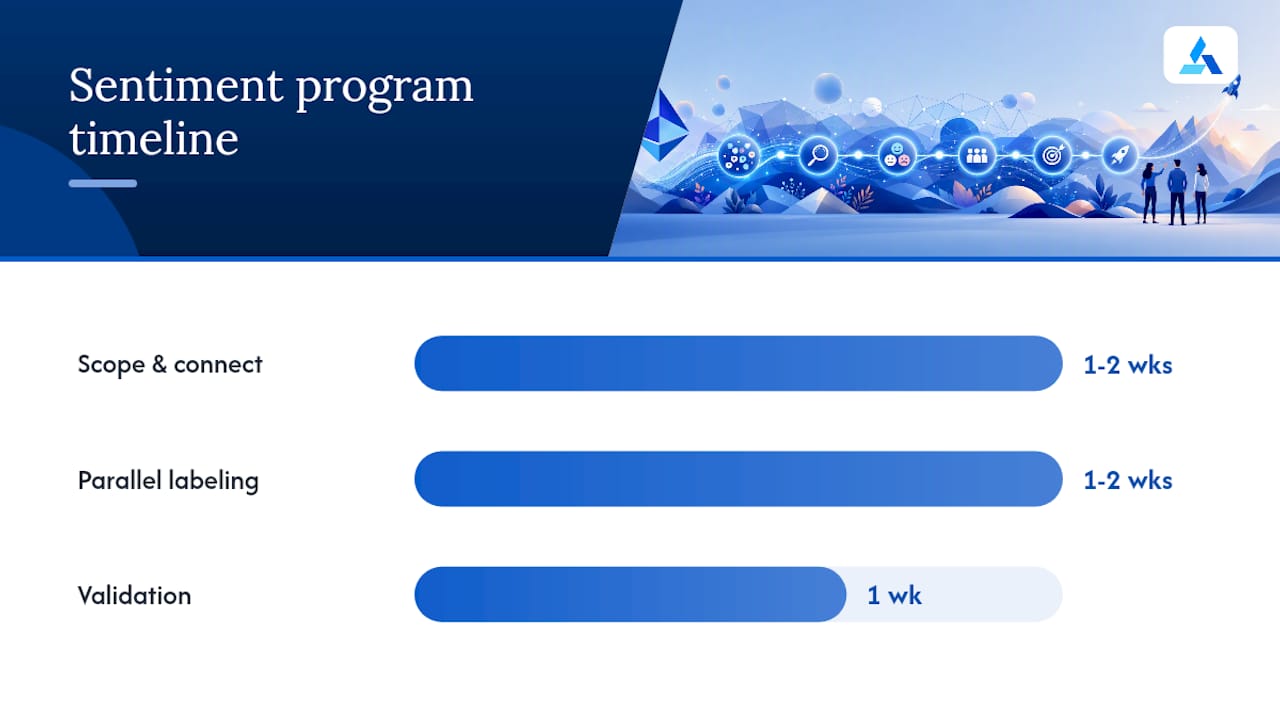
For timeline, expect one to two weeks to configure scope and connect data sources, another one to two weeks running parallel manual labeling against model output, and a final week validating accuracy before you move from pilot to ongoing monitoring. That puts most teams at four to six weeks from kickoff to a working program, faster if you’re using an existing platform rather than building from scratch.
Assign clear roles before launch: one owner monitors alerts daily, one analyst validates flagged spikes against actual conversation, and one decision-maker has authority to greenlight a comms or product response. Without that handoff chain, sentiment dashboards become something people glance at, not something that drives action.
Which Data Sources and Metrics Should You Track?
Not every platform gives you the same signal quality, and mixing sources without knowing their limits skews your read.
- Reddit — Long-form, candid opinion, strong for product feedback. Skews toward a narrower, more vocal demographic.
Once data is flowing, track these core metrics together, not in isolation:
Build one dashboard that pairs trend and intensity side by side. A flat sentiment score hides a lot if the intensity behind it is spiking.

How Do You Interpret Sentiment Scores and Set Benchmarks?
A sentiment score means nothing without context. A shift from +0.2 to +0.1 might be statistical noise; a shift from +0.2 to negative 0.1 over 72 hours is a signal worth escalating.
- Small shift: A movement of 0.05 to 0.1 on a -1 to +1 scale, generally not alert-worthy unless it’s sustained across a full week.
- Medium shift: A movement of 0.1 to 0.3, worth a manual review to confirm it isn’t a labeling error or bot spike.
- Large shift: A movement over 0.3, or a sudden volume spike paired with negative sentiment, warrants immediate escalation.
Scores don’t compare cleanly across tools. Two platforms scoring the same post can land on different numbers because their training data and scale definitions differ, so track trend direction inside one tool rather than comparing absolute scores between vendors. Build separate baselines by product line, geography, and campaign type; a benchmark that works for your flagship product will mislead you if applied to a new market launch.
Build In-House, Use a Cloud API, or Buy an Enterprise Platform?
This is the decision most marketing leaders get stuck on, and the right answer depends on your team’s technical depth and how fast you need results.
- In-house build: Full control and customization, but high maintenance burden. You own model retraining, infrastructure, and data governance entirely. Realistic only if you have a dedicated data science team.
- Cloud NLP APIs: Fast to integrate, pay-as-you-go pricing, structured outputs like score and magnitude. Weaker on industry-specific jargon and multimodal content unless you fine-tune. Specialized commercial classifiers often outperform generic APIs on multilingual, high-volume, hot-path workloads at lower cost than prompt-based large language models.
- Enterprise platforms: Built-in dashboards, alerting, and often multimodal and multilingual support out of the box. Higher upfront cost, but far shorter time-to-impact for teams without engineering resources.
When you’re in vendor demos, ask these questions before signing anything:
- What languages and dialects does the model support natively, and at what accuracy?
- Does it handle multimodal content (images, video captions, audio) or text only?
- What’s the latency between a post going live and it appearing in your dashboard?
- What SLA do they offer on uptime and data freshness?
- Is pricing based on volume, seats, or API calls, and what happens if you exceed a tier mid-contract?
- How often is the underlying model retrained, and can you see version history?
Watch for red flags: vague answers on data retention, no clear explanation of how they filter bots, or reluctance to share accuracy benchmarks for your specific industry. A vendor that can’t answer the multilingual question directly probably hasn’t tested it seriously.
How Do You Validate Sentiment Analysis Accuracy?
No sentiment model is accurate out of the box for your specific audience and vocabulary. You have to test it.
- Manual labeling: Have two or three team members independently label a sample of 200 to 300 posts as positive, negative, or neutral.
- Holdout tests: Reserve 20% of your labeled data to test the model after training rather than using data it already saw.
- Confusion matrix: Map where the model confuses categories, most often mislabeling sarcastic or mixed-sentiment posts as neutral.
- Precision and recall: Precision tells you how many flagged negatives were truly negative; recall tells you how many actual negatives the model caught.
- Inter-annotator agreement: If your human labelers disagree with each other more than 15% of the time, your “ground truth” itself is shaky.
For a starting sample, 200 to 300 labeled examples per category gives you a reasonable first read; expect real-world accuracy on noisy social streams to land around 70 to 75 percent even with a solid model, improving as you feed it more data.
Pro Tip: Re-validate quarterly, not once. Language drifts, slang changes, and a model trained on last year’s conversation degrades quietly if nobody checks it.
What Are the Biggest Limitations to Watch For?
Every sentiment tool has blind spots. Knowing them upfront saves you from a bad decision made on bad data.
- Do flag sarcasm and irony for human review rather than trusting the automated score.
- Don’t assume a multilingual model performs equally well across every language you monitor; test each one separately.
- Do filter bot and spam activity before scoring, or a coordinated campaign will skew your entire dashboard.
- Don’t trust sentiment from a small sample; a handful of loud accounts can swing a score that looks statistically meaningless.
- Do version your labeling standards and review them at least twice a year as language and slang shift.
The most reliable mitigation is human-in-the-loop review on flagged edge cases, combined with aspect-level tagging so a mixed review doesn’t get flattened into one misleading score.
What Do Strategy Teams Get Wrong About Sentiment Data?
The biggest mistake we see is treating raw mention volume as a proxy for importance. It isn’t. Enterprise sentiment programs weight signals by influence, credibility, and business impact rather than counting mentions, because a bot-driven spike and a genuine customer complaint from a high-reach account look identical on a volume chart.
Practical moves that actually work: connect sentiment themes directly to your OKRs and roadmap items instead of leaving them in a separate report nobody reads. When a support-related sentiment cluster spikes, route it as a tagged item into the same execution dashboard product teams already check.
One team caught a pricing complaint cluster early enough to adjust messaging before a full campaign launch, avoiding a costly relaunch. Keep a record of what triggered each strategic pivot; that audit trail is what makes the next sentiment-driven decision easier to defend.
What Sentiment Analysis Looks Like Inside a Real Strategy Team
I’ve watched teams treat a negative sentiment spike as background noise until it wasn’t. A cluster of frustrated comments about a shipping delay, easy to dismiss as isolated complaints, turned into a coordinated escalation once someone connected the aspect-level tags to a real fulfillment problem. Fixing it before it hit press turned a potential story into a footnote. That’s the actual value of sentiment work: catching the thing before it becomes a headline, not after.
Turn Sentiment Signals Into Strategy, Not Just Reports
Most sentiment tools stop at the dashboard. They hand you a score and leave you to figure out what to do with it, which is exactly where most marketing teams get stuck, staring at a trend line with no clear next move. Blue Prysm closes that gap by connecting prioritized sentiment signals directly to strategic action: a negative cluster on a product feature routes into a strategy template, gets assigned an owner, and lands on an execution dashboard your team already checks daily.
Before a sentiment insight ever shapes a strategic brief, Blue Prysm runs company statements and high-impact social narratives through a Puffery Detector and Venture Quick Score, catching overclaim risk before it reaches your roadmap. That matters because a lot of “sentiment-driven” decisions in marketing get made on vibes dressed up as data.
If you want to see how this works on your own product or campaign, start with the market research tools built for exactly this kind of pilot. Run it on one product line, connect the output to a real roadmap decision, and see what changes in two weeks.
Sources
For deeper methodology and technical grounding on the concepts covered here:
- Hootsuite — Social media sentiment analysis tools
- MDPI — Social Media Sentiment Analysis (2024)
- Sprinklr — Social media sentiment analysis: a complete guide for brands
- Klipfolio — What is social sentiment?
FAQ
Can ChatGPT do sentiment analysis?
ChatGPT and similar large language models can classify text sentiment reasonably well on small batches, but they lack the structured scoring, dashboards, and volume handling of dedicated sentiment platforms, making them better for spot checks than ongoing monitoring.
What are examples of sentiment analysis?
Common examples include scoring product reviews as positive or negative, tracking reaction to an ad campaign in real time, and flagging a spike in negative comments about a shipping delay before it becomes a wider complaint.
What is the best tool for sentiment analysis?
The right tool depends on scale and budget: cloud NLP APIs suit teams needing structured score and magnitude data, specialized classifiers suit high-volume multilingual needs, and enterprise platforms like Blue Prysm suit teams that want sentiment connected directly to strategic execution.
How do I perform sentiment analysis?
Define the terms and aspects you want monitored, collect and clean the data, score it with a validated model, and route flagged results to the team member responsible for acting on them, following a four-step process of scoping, gathering, scoring, and operationalizing.