

TL;DR:
- Competitor analysis is often treated as a one-time task, but it should be a continuous, AI-enhanced practice to stay relevant.
- Building and regularly updating accurate, customer-focused positioning maps helps SMBs identify market gaps, refine strategies, and outperform rivals.
“No market need” and “outcompeted” cause 62% of startup failures, and yet most small and medium-sized businesses still treat competitive research as something you do once, stuff into a PowerPoint, and forget about until the next strategy retreat. That’s the trap. Competitive mapping, done right, is not a one-time snapshot. It’s a living practice that tells you exactly where you stand, where the gaps are, and where you should move next. Add AI to that process, and you have what Fortune 100 companies have paid consultants millions for, now available to any SMB willing to use it.
Table of Contents
- Understanding competitive mapping and its business value
- How AI transforms competitive mapping accuracy and efficiency
- Building effective competitive positioning maps that resonate with customers
- Avoiding common pitfalls and focusing competitive mapping for SMB success
- Using competitive mapping insights to drive actionable business strategies
- Why quarterly AI-powered competitive mapping beats traditional approaches
- Explore Blue Prysm’s AI-driven competitive mapping solutions
- Frequently asked questions
Understanding competitive mapping and its business value
Competitive mapping is the process of visualizing your position in the market relative to the competitors around you. It goes well beyond a simple SWOT slide. Done properly, competition mapping informs pricing, positioning, feature priorities, and ad copy, giving you a real picture of how customers see you versus every alternative they could choose.
There are three types of competitors most SMBs fail to account for fully:
- Direct competitors: Companies offering the same product or service to the same audience
- Indirect competitors: Businesses solving the same problem a different way (think a meal-kit service competing with a restaurant)
- Non-consumption competitors: The choice to do nothing, or to keep using whatever the customer already uses
That third category, non-consumption, kills more new entrants than any direct rival ever will. If your map doesn’t include the status quo, your analysis has a blind spot the size of a truck.
A well-executed competitive landscape assessment is also a living document, not a static deliverable. Markets shift. Competitors pivot. New entrants appear. The value of strategic intelligence for SMEs compounds when you treat your map as something that gets updated, challenged, and refined on a regular cadence rather than something that sits in a shared drive gathering digital dust.
How AI transforms competitive mapping accuracy and efficiency
Traditional competitive research is slow, inconsistent, and dangerously biased. You send a junior analyst to scrape competitor websites, pull together a few pricing pages, and compile a report that’s already out of date by the time it’s formatted. That’s not market competition analysis. That’s a gut feeling dressed up in a spreadsheet.
AI changes the equation entirely. Modern AI-driven tools can:
- Process hundreds of documents, competitor filings, reviews, and web pages in the time it would take a human to read one
- Extract insights from PDFs, spreadsheets, and images without writing a line of code
- Identify patterns across unstructured data that no human analyst would catch at scale
- Flag competitor velocity, meaning how fast rivals are moving and in which direction
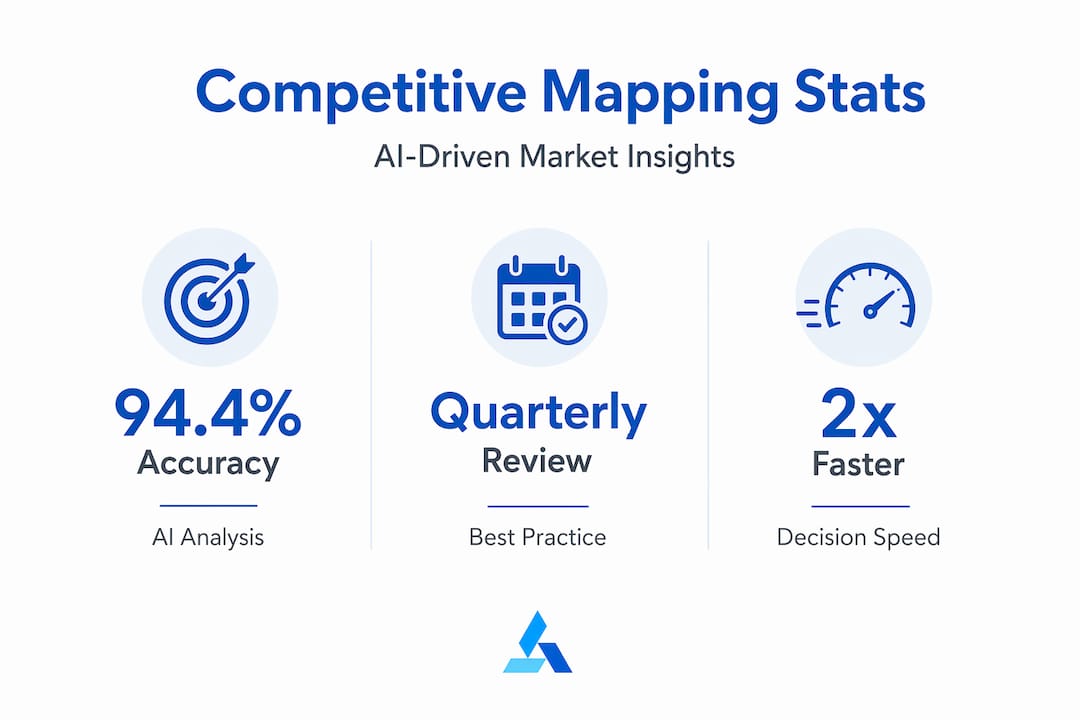
The accuracy gains are not marginal. AI-driven analysis agents achieve up to 94.4% accuracy processing unstructured data, vastly outperforming manual research methods. That gap matters enormously when a bad assumption about a competitor’s pricing model leads you into a positioning mistake that costs you six months of growth.
The deeper value, though, is not just speed. It’s that AI frees your strategic brain to do actual strategy. When the data gathering and pattern recognition are automated, you spend your time on decisions, not on compiling raw inputs. Explore how AI strategies for competitive advantage are already reshaping how SMBs compete, and you’ll see this isn’t theoretical. It’s happening now.

Pro Tip: When evaluating AI tools for competitive research, prioritize multi-modal capability. A tool that can only read text misses the competitor messaging buried in images, slide decks, and product screenshots. The best competitive intelligence tools for SMEs handle all of it.
Building effective competitive positioning maps that resonate with customers
A competitor positioning map (also called a perceptual map) plots competitors on two axes that represent attributes your customers actually care about. The critical word there is actually. This is where most SMBs waste their effort by choosing axes that are easy to measure rather than axes that drive buying decisions.
Here’s how to build one that means something:
- Start with customer language. Survey your best customers and your churned customers. Ask what criteria mattered most when they chose a solution. You want verbatim language, not your internal assumptions.
- Pick two axes that reflect those criteria. According to effective positioning map principles, your axes must be observable in the market and impactful on customer buying decisions. “Ease of Use” vs. “Enterprise Power” is a valid pair. “Logo Shape” vs. “Coding Language” is not.
- Plot every relevant competitor. That means direct, indirect, and the status quo. Use data from reviews, pricing pages, and customer interviews, not internal gut feelings.
- Look for white space. Gaps between clustered competitors reveal underserved positions where you can differentiate.
The table below shows which axis pairs tend to generate real strategic insight versus which ones look sophisticated but tell you nothing actionable:
| Axis pair | Strategic value | Why it works |
|---|---|---|
| Price vs. Ease of Use | High | Directly reflects how most SMB buyers choose tools |
| Speed vs. Accuracy | High | Maps a real trade-off customers consciously navigate |
| Support Quality vs. Feature Depth | Medium-High | Highlights service-led vs. self-serve positioning |
| Brand Age vs. Color Scheme | Low | Not a customer decision criterion |
| HQ Location vs. Team Size | Low | Invisible to buyers at point of decision |
Pro Tip: Build at least two different maps using different axis pairs. A single map gives you one slice of reality. Two maps, especially when they produce conflicting conclusions, force the honest conversation about what your positioning actually prioritizes.
Reviewing data-driven strategy examples for SMEs shows this approach consistently outperforms gut-feel positioning in head-to-head tests.
Avoiding common pitfalls and focusing competitive mapping for SMB success
Here’s a confession most consultants won’t make: the majority of competitive mapping exercises SMBs run are too wide to be useful. You pull together twelve competitors, create a sprawling spreadsheet, and walk away more confused than when you started. That’s not analysis. That’s noise.
The most common mistakes we see:
- Mapping too many competitors. Mapping more than 8 competitors creates noise rather than clarity. Three to five direct competitors is the productive range.
- Ignoring the status quo. The most common alternative to buying your product is not buying anything. If your map doesn’t include “do nothing,” your win-loss analysis will always be incomplete.
- Choosing axes based on available data. If you build your map around what’s easy to measure rather than what customers care about, you’ll produce a map that confirms your existing biases instead of challenging them.
- Treating the map as finished. Markets move fast. A competitor positioning map from eight months ago may no longer reflect reality at all.
Building an AI threat analysis workflow solves the last point by making competitive sensing continuous rather than episodic. You don’t have to manually re-run your research every quarter if you have systems that flag changes as they happen.
Pro Tip: Mark your calendar right now for a quarterly competitive map review. Treat it like a financial close, not like something you’ll get to when you have bandwidth. The businesses that treat rival analysis techniques as a scheduled discipline consistently out-position those that treat it as a reactive exercise.
Using competitive mapping insights to drive actionable business strategies
A well-built map is only worth anything if it changes what you do Monday morning. The trap many SMBs fall into is producing a beautiful competitive landscape assessment and then doing nothing different. Data without a decision is just decoration.
Here’s how to convert your map into real actions:
- Identify white space and claim it deliberately. If your map shows a cluster of competitors all positioned as “powerful but complex,” and no one is occupying “powerful but approachable,” that’s a messaging opportunity you can act on this week.
- Adjust pricing with evidence. If competitors are charging more for fewer features in a segment you serve, your pricing may be leaving money on the table. Your map should reveal that directly.
- Refocus feature development. When you see competitors consistently highlighted for a capability you don’t offer, and customers mention it in reviews, that’s a product roadmap signal, not just a competitive observation.
- Update your sales messaging. Quarterly competitive mapping enables SMBs to avoid “me-too” positioning and surface underserved niches. That insight belongs in your sales deck and your website copy, not just in an internal report.
Use a structured rollout timeline to make sure insights become actions, not intentions:
| Timeline | Action | Owner |
|---|---|---|
| Days 1-30 | Update messaging and sales collateral based on white space findings | Marketing + Sales |
| Days 31-60 | Test pricing changes in one segment based on competitor data | Product + Finance |
| Days 61-90 | Measure win rate changes and adjust positioning if needed | Leadership |
Track win rates and deal cycle length as your primary metrics. If your competitive repositioning is working, deals should close faster and more often against specific rivals. Building competitive battle cards with AI tools is one of the fastest ways to turn your map insights into something your sales team can use in real conversations.
Why quarterly AI-powered competitive mapping beats traditional approaches
Here’s the uncomfortable truth: most SMBs run a competitive analysis once, call it done, and then slowly steer the business based on a market snapshot that’s a year or more out of date. That’s not a strategy. That’s navigating by a map of roads that no longer exist.
Static SWOT analyses are relics of 20th-century management thinking. They were designed for a world where markets moved slowly enough that an annual review was sufficient. That world is gone. Competitors now pivot their GTM strategies in weeks. Pricing models shift overnight. New entrants appear from adjacent categories with no warning.
“The companies winning today aren’t the ones who conducted the best competitive analysis last year. They’re the ones who have built competitive sensing into their operating rhythm, refreshed by AI and reviewed by humans on a quarterly cadence.”
Quarterly AI-powered competitive mapping is different in kind, not just in frequency. AI tools continuously monitor competitor signals, from pricing page changes to new feature announcements to shifts in review sentiment, and surface them in structured briefings your team can act on. It’s the difference between checking the weather once before a long trip and having live GPS that reroutes you as conditions change.
The mindset shift here is critical. Stop thinking of your competitive map as a document. Think of it as a dashboard. Emerging AI trends for competitive advantage show that businesses adopting this continuous intelligence approach consistently identify threats and opportunities weeks before competitors who rely on periodic manual research.
Pro Tip: Assign one person on your team to own the quarterly competitive map review. Not a committee. One owner. Ownership drives accountability, and accountability drives the update actually happening.
Explore Blue Prysm’s AI-driven competitive mapping solutions
Understanding competitive mapping is step one. Having the right tools to execute it without a team of analysts is step two. Blue Prysm was built specifically to close that gap for SMBs.
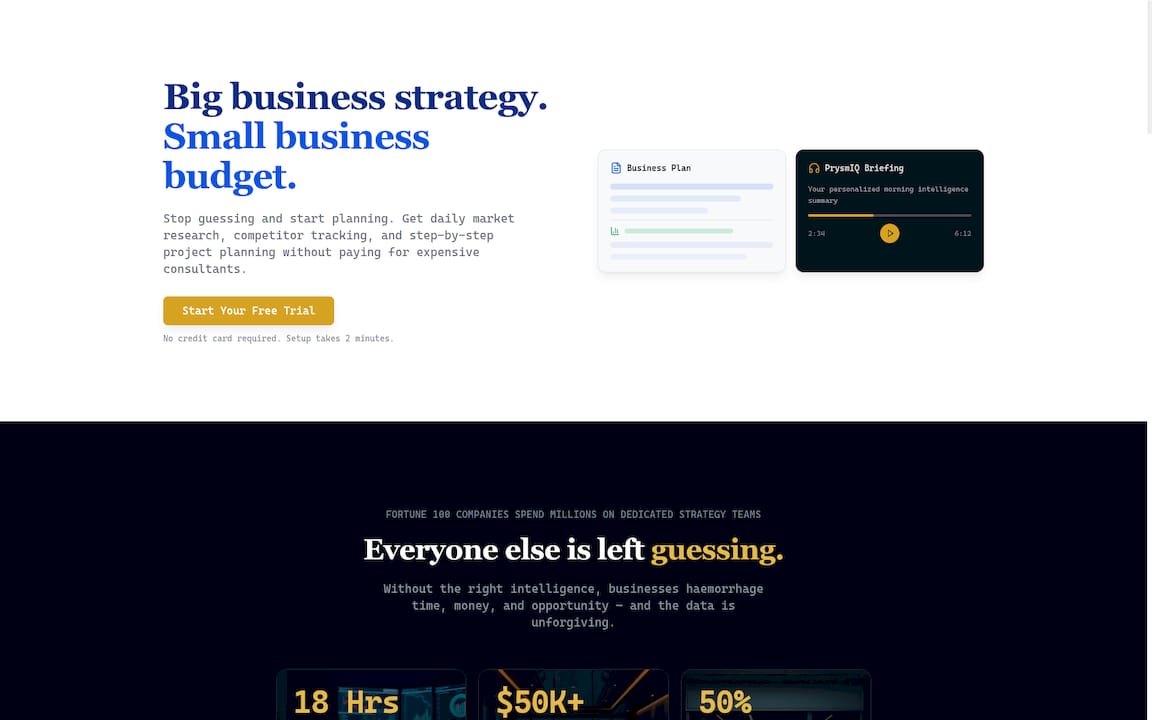
Blue Prysm’s AI platform gives you daily market briefings, competitor monitoring, and business mapping strategies built into one place, so your competitive intelligence is always current without manual effort. Learn how Blue Prysm works and see how quickly you can go from scattered research to structured market insight. Start free with the Venture Quick Score tool to benchmark your competitive positioning right now, or run your messaging through the Puffery Detector tool to see how your claims hold up against what competitors are saying. No consultants needed.
Frequently asked questions
What is competitive mapping and why is it important for SMBs?
Competitive mapping is a strategic process that visualizes your market position relative to key competitors, helping SMBs make sharper decisions on pricing and positioning. Without it, you’re setting strategy based on assumptions rather than evidence.
How do AI tools improve competitive mapping compared to manual methods?
AI tools process vast amounts of unstructured data, including PDFs, reviews, and spreadsheets, with up to 94.4% accuracy, giving you faster and more reliable insights than any manual research process can match.
How often should SMBs update their competitive maps?
Experts recommend updating competitive maps quarterly so you can track fast-moving market changes, competitor pivots, and shifting customer preferences before they catch you off guard. Treat it like a living radar system, not a yearly report.
What are common mistakes to avoid when creating competitive positioning maps?
Avoid plotting more than 8 competitors, choosing axes that don’t reflect actual customer buying criteria, and forgetting to include the “status quo” as a competitor in your analysis.
Recommended
- AI strategies that actually build competitive advantage – Blue Prysm – Articles & Blogs
- Competitive intelligence for SMEs: strategies and tools – Articles & Blogs
- Build powerful competitive battle cards with AI tools fast – Blue Prysm – Articles & Blogs
- Data-Driven Strategy Examples for SMEs: Real-World Wins – Blue Prysm – Articles & Blogs