


TL;DR:
- Most AI decision-making failures result from misclassifying wide, strategic decisions as narrow, data-driven tasks. Proper classification, workflow design, and governance are essential to ensure AI supports, rather than replaces, human judgment. Developing explicit decision inventories and integrating continuous monitoring build trust and improve outcomes over time.
Most business decisions are made with too little data, too much confidence, and not enough time. That’s not an indictment of leadership — it’s the reality of modern enterprise complexity. This ai-powered decision making guide exists because the gap between the decisions you need to make and the intelligence you have available to make them is closing fast. AI is not a magic fix, but when applied correctly to the right decisions in the right way, it changes your outcomes in ways that are measurable and repeatable. Here’s how to do it properly.
Table of Contents
- Key Takeaways
- AI-powered decision making: What you need before you start
- Designing decision workflows with AI and human oversight
- AI risk management and governance that actually works
- Monitoring AI decisions and building learning loops
- My take: Where most leaders get this wrong
- How Blue Prysm helps you put this into practice
- FAQ
Key Takeaways
| Point | Details |
|---|---|
| Classify before you automate | Separate your decisions into narrow and wide categories before applying any AI approach. |
| Design the full workflow | AI predictions fail organizations that skip engineering the human oversight and override process around them. |
| Calibrate AI autonomy by risk | Set AI agency levels based on decision complexity and potential consequences, not just data availability. |
| Governance is infrastructure | Treat audit trails, traceability, and accountability documentation as operational requirements, not compliance afterthoughts. |
| Monitor, review, and iterate | Track model drift and decision outcomes continuously, then adjust AI workflows based on real results. |
AI-powered decision making: What you need before you start
The most common mistake leaders make is treating AI as something you bolt onto existing decision processes. You deploy a forecasting tool, get accurate predictions, and then discover that no one agreed on what to do when the model contradicts the CFO’s instincts. The AI decision making process breaks down not because the model is wrong, but because the workflow around it was never designed.
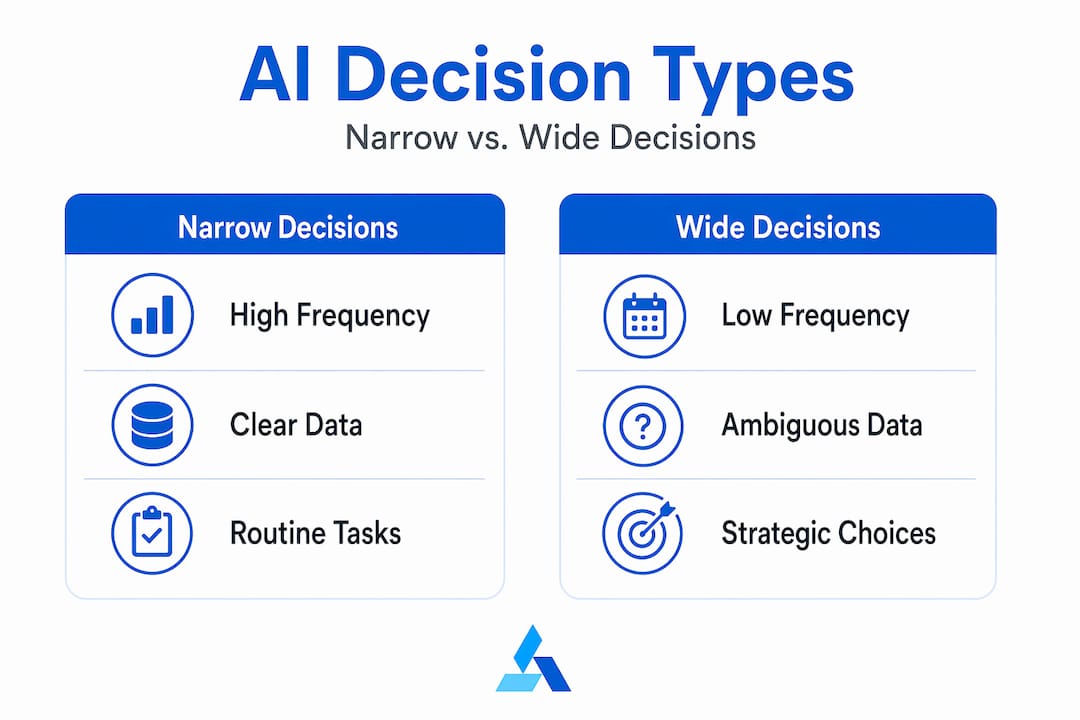
Before you implement anything, you need to inventory and classify your critical decisions. MIT Sloan recommends building two separate AI playbooks based on whether a decision is narrow or wide. Here is how to tell the difference:
- Narrow decisions are high-frequency, data-rich, and well-defined. Think credit scoring, inventory reordering, fraud flagging, or pricing adjustments. The outcome space is bounded and measurable. AI can own more of this process.
- Wide decisions involve ambiguity, competing stakeholder values, and long-term consequences. Market entry strategy, organizational restructuring, major capital allocation. Here, AI is a deliberation partner, not an autopilot.
Your diagnostic for any decision should answer three questions. First, how clear are the success metrics? Second, how structured and complete is the relevant data? Third, how reversible is the decision if it goes wrong? If all three answers point toward clarity, AI can take on more agency. If any answer is murky, you need more human deliberation in the loop.
Pro Tip: Build a decision inventory of your top 20 critical decisions, then score each one on those three criteria. This single exercise tells you where AI creates the most value and where it creates the most risk if misapplied.
The data readiness check deserves special attention. A model trained on incomplete or biased historical data will produce confident-sounding garbage. Before assigning any AI tool to a decision workflow, assess whether you have sufficient volume, recency, and representativeness in your underlying data. This is not a technology problem. It’s a strategic preparation problem.
Designing decision workflows with AI and human oversight
Once you know which decisions belong in which category, you design the workflow. This is where most AI implementations actually fail. Failing to engineer the human-in-the-loop and decision workflow around AI predictions results in ineffective decision solutions despite technical accuracy. The model works perfectly. The process does not.
Designing a sound AI decision workflow requires you to address five things in sequence:
- Define the AI agency level. Will AI recommend, assist, or decide autonomously? This should match the risk profile of the decision. High-frequency, low-stakes decisions can tolerate autonomous AI action. High-stakes, one-directional decisions need AI as an input, not a final word.
- Map the handoff points. Where does AI output enter human review? Who reviews it, by what deadline, and with what authority to override? These are not soft governance questions. They are operational design choices.
- Set the override standard. What evidence does a human reviewer need to override an AI recommendation? Vague standards create either rubber-stamping or chaos. Deloitte advises defining AI agency levels based on risk and being explicit about when and how fast humans can intervene.
- Embed checkpoints and audit trails. Every decision that carries meaningful risk should leave a traceable record: what the AI recommended, what data it used, what the human reviewer decided, and why. This is not bureaucracy. It’s how you learn and how you defend your process.
- Assign disagreement escalation paths. When the AI says one thing and the decision-maker says another, who breaks the tie? How quickly? The OECD accountability principle frames systematic documentation and risk management as an organizational obligation, not an optional feature.
One more distinction worth making here: how you use generative AI differs sharply between narrow and wide decisions. For narrow decisions, gen AI works well as an accelerator. Summarizing documentation, extracting features from unstructured data, and surfacing anomalies. For wide decisions, generative AI functions better as a synthesis partner, helping teams build scenario models, run pre-mortems, and stress-test assumptions before committing. Using it the same way across both decision types is a trap.
Pro Tip: Create a one-page decision rights document for each high-stakes AI-assisted decision. Include who decides, who reviews, what the override threshold is, and what gets documented. This document forces clarity that most teams skip and regret.
AI risk management and governance that actually works
Governance sounds like a compliance task. Treat it as one, and you’ll get a policy document that nobody reads. Treat it as operational infrastructure, and you get something that actually protects the organization and builds trust in AI-assisted outcomes.
The NIST AI Risk Management Framework provides a practical foundation. Its four core functions give you a sequence to follow:
| NIST AI RMF Function | What it means in practice |
|---|---|
| Govern | Establish executive sponsorship, accountability structures, and policies before deployment. |
| Map | Enumerate intended use, stakeholders, and context before setting risk metrics and incident response protocols. |
| Measure | Define and track quantitative and qualitative risk indicators specific to each AI system. |
| Manage | Respond to identified risks through mitigation, escalation, and documented incident response. |
The Stanford AILCCP framework takes this further by building an interoperable, audit-ready governance chain that links principles, controls, international standards, and lifecycle phases. Its 37 governance principles and 48 controls create a knowledge graph that auditors, regulators, and developers can all navigate consistently. That’s governance as infrastructure, not paperwork.
For most business leaders, the practical takeaway from both frameworks is the same. Your governance process needs to answer three things for every AI-assisted decision of consequence. What is this system authorized to do? What evidence will confirm it’s doing that correctly? Who is responsible when it doesn’t? The traceable governance chain that maps controls to lifecycle phases and measurable evidence is what separates organizations that can defend their AI decisions from those that cannot.
Continuous monitoring and incident response deserve equal attention. Governance is not a one-time setup. It requires scheduled reviews of model performance, bias indicators, and real-world outcomes, combined with a clear process for responding when something goes wrong. Build that cadence into operations from day one.

Monitoring AI decisions and building learning loops
Deploying AI into a decision workflow and then ignoring how it performs is roughly equivalent to hiring a financial analyst and never reading their reports. The benefits of AI in decision making compound over time only when you treat monitoring as part of the system.
For narrow decisions, your monitoring checklist should include:
- Model accuracy and drift. Is the model still performing at the level that justified its deployment? Drift happens quietly. Markets change, customer behavior shifts, and a model trained on 2023 data may be giving you confidently wrong answers in 2026.
- Bias and fairness indicators. Are outcomes distributed equitably across the populations or segments the model affects? This matters both ethically and legally.
- Operational impact. Are the decisions the AI is producing actually improving the outcomes you care about? Revenue, efficiency, customer satisfaction? Tie model metrics to business metrics, not just technical benchmarks.
For wide decisions, the monitoring work looks different. You are logging rationale, sources, and checkpoint reviews rather than tracking statistical performance metrics. Effective AI decision management blends quantitative model metrics with logs of reasoning and checkpoint reviews to maintain trust and quality. After each major wide decision, conduct a structured post-decision review: what did AI surface that proved useful, what did it miss, and what would you design differently next time?
Building organizational capability matters as much as any tool you deploy. Deloitte stresses cultivating a culture valuing candor, evidence, and accountability, combined with dynamic workflows that preserve human agency. That culture does not appear because you bought an AI platform. It develops through practice, through post-decision reviews, through honest conversations about when AI helped and when it didn’t. The organizations getting the most from AI decision support are treating decision-making itself as a discipline that can be trained and improved, not just a process that can be automated.
My take: Where most leaders get this wrong
I’ve watched organizations roll out impressive AI decision tools and produce worse outcomes than they had before. Not because the technology failed. Because they skipped the classification step.
The most expensive mistake I see is misclassifying a wide decision as narrow. A distribution company I worked with tried to use a demand-forecasting model to drive major supplier consolidation decisions. The model was technically sound. But supplier consolidation involves relationship risk, negotiating leverage, long-term dependency, and competitive intelligence. It is not a pattern-matching problem. It is a judgment problem with strategic consequences that can take years to reverse.
What I’ve learned is that the AI decision making strategies that hold up under pressure share one characteristic: someone made explicit decisions about the level of AI autonomy and wrote them down before deployment, not after something went wrong. Governance documents written after an incident are just post-mortems with a formal tone.
My practical recommendation: do not skip the decision inventory exercise. Classify your top decisions before you touch a single AI tool. Then design the workflow, including the human override process, before you run a pilot. The organizations that get AI-powered decisions right treat the governance design as equivalent in importance to the model selection. Most treat it as an afterthought.
— Colin Bowdery
How Blue Prysm helps you put this into practice
The frameworks in this guide require one thing most leaders lack: reliable, structured intelligence delivered fast enough to actually inform decisions before they’re made. Blue Prysm was built to close that gap. The platform provides AI-driven market briefings, competitor monitoring, and scenario validation tools specifically designed for the decision workflows this guide describes. Whether you’re classifying a new market entry as a wide decision that needs synthesis support, or monitoring competitive signals as narrow inputs to pricing, Blue Prysm’s strategic intelligence platform gives you the data infrastructure and AI analytics your decision process needs. You can also explore how the platform works to see exactly where it fits in your decision workflow.
FAQ
What are narrow and wide decisions in AI decision making?
Narrow decisions are high-frequency, data-rich, and well-defined, making them suitable for greater AI autonomy. Wide decisions involve ambiguity and long-term consequences, where AI serves as a deliberation partner rather than a decision engine.
How does AI assist decisions without replacing human judgment?
AI surfaces patterns, forecasts outcomes, and synthesizes information, but human oversight governs final authority on high-stakes decisions. Deloitte recommends explicit human override rights and escalation paths to maintain trust and accountability.
What is the NIST AI Risk Management Framework?
The NIST AI RMF outlines four operational functions: Govern, Map, Measure, and Manage. These guide organizations through responsible AI deployment by establishing accountability, mapping risk context, measuring performance, and managing incidents.
How often should AI decision models be monitored?
Model performance should be reviewed continuously for accuracy and drift, with scheduled formal reviews tied to business outcome data. Post-decision reviews after each major wide decision are equally critical for refining AI workflows over time.
What is the biggest risk of AI-powered decision making?
The greatest risk is misclassifying decision types and applying the wrong level of AI autonomy. Treating a complex strategic decision as a narrow optimization problem removes the human judgment that protects organizations from compounding errors.
Recommended
- Master the business decision making process for smarter growth – Articles & Blogs
- AI-driven business insights for SME strategy and growth – Articles & Blogs
- Unlock the power of decision intelligence for SMEs – Blue Prysm – Articles & Blogs
- Decision-making best practices for smarter business moves – Blue Prysm – Articles & Blogs