


TL;DR:
- Most organizations view data privacy as a compliance burden, but integrating it into BI builds trust and competitive advantage. Investing in privacy engineering enhances analytics adoption, mitigates risk, and aligns with upcoming regulations like California’s 2027 ADMT rules. Building privacy into data workflows from the start is a strategic move that yields long-term growth, trust, and regulatory resilience.
Most business leaders treat data privacy as a legal obligation sitting on the desk of their compliance team. That framing is costing them. The role of privacy in business intelligence goes far beyond regulatory checkbox work. Privacy, when built into your BI architecture from the start, becomes a trust signal, a competitive differentiator, and a driver of better analytics adoption across your organization. This article unpacks the regulatory context, the real trade-offs, the technical methods, and the strategic mindset shift that separates organizations that are paralyzed by privacy from those using it to pull ahead.
Table of Contents
- Key Takeaways
- The role of privacy in business intelligence, defined
- How privacy regulations shape BI strategy
- Privacy engineering in practice
- Emerging regulations every BI team must know
- My take: privacy is the most underpriced strategic asset in BI
- How Blue Prysm helps you build privacy-aware BI
- FAQ
Key Takeaways
| Point | Details |
|---|---|
| Privacy enables, not just restricts | Organizations that embed privacy into BI workflows unlock higher analytics adoption and customer trust. |
| Short-term costs, long-term gains | Compliance investment creates initial performance dips, but firms gain legitimacy and loyalty that compound over time. |
| Privacy engineering is non-negotiable | Techniques like differential privacy and data minimization protect individuals while preserving analytical power. |
| 2027 regulations are coming fast | California’s algorithmic accountability rules take effect January 1, 2027, requiring opt-out and explainability in automated systems. |
| Proactive design beats reactive patching | Building privacy into BI systems early is cheaper and more effective than retrofitting compliance after deployment. |
The role of privacy in business intelligence, defined
Before we can talk strategy, we need to clear up a terminology issue. “Privacy in BI” is the everyday phrase, but the formal discipline is called privacy engineering. It refers to the systematic application of privacy principles across the entire data lifecycle, from collection and storage through analysis and reporting. Understanding both terms matters because one is what you search for, and the other is what your technical teams actually build.
Business intelligence, at its core, is the practice of turning raw data into decisions. Customer purchase patterns, employee productivity metrics, supply chain performance data. All of it flows through BI pipelines. And nearly all of it carries some level of personal or sensitive information.
The regulatory environment shaping how you handle that data has expanded significantly. Key frameworks include:
- GDPR (EU): Requires lawful basis for processing, data minimization, and explicit rights for individuals including erasure and portability.
- CCPA/CPRA (California): Grants consumers rights to know, delete, and opt out of data sales, with expanded enforcement as of 2023.
- ADMT rules (California, effective 2027): New automated decision-making technology rules requiring transparency and opt-out rights for algorithmic profiling.
- Sector-specific rules: HIPAA for healthcare, GLBA for financial services, each adding layers of obligation on top of general privacy law.
The tension is real. The more data you feed into your BI systems, the sharper your insights. But the more data you collect, the greater your compliance exposure, your breach risk, and your customer trust deficit if something goes wrong. Privacy breaches increase risk and cost, while privacy-literate firms gain higher trust and reduce incident costs. That asymmetry is exactly why getting this right is a strategic priority, not just a legal one.
How privacy regulations shape BI strategy
Here is where most organizations get it wrong. They see privacy regulation as a cost center. Pay the lawyers, update the policies, add a consent banner, move on. The research tells a different story.
Privacy regulation creates a measurable cost-benefit trade-off for firms. Yes, there are real short-term compliance costs. Upgrading systems, training staff, conducting data audits, revising analytics workflows. These investments can cause a temporary dip in BI performance and decision velocity. But firms that push through that phase earn something more durable: institutional legitimacy. Customers trust them more. Regulators treat them better. Partners are more willing to share data with them.
Think of it like building a reputation. You spend money on quality before you have the revenue to justify it, because you know the alternative is far more expensive later.
The dual pressure here comes from two directions. Internal legitimacy means your own teams feel confident using data responsibly. External legitimacy means customers, regulators, and partners see you as a trustworthy steward of information. Both of these compound in ways that pure compliance never does.
“Companies shifting from defensive privacy to using privacy as a driver for analytics adoption and personalization value are reframing the entire cost equation.” — Data Privacy Is a Growth Strategy, Harvard Business Review
This reframe matters enormously for how you build your BI roadmap. If privacy is just compliance, you minimize spend. If privacy is a growth strategy, you invest in it the same way you invest in data quality or analytics talent.
Pro Tip: When calculating the ROI of privacy investment, include avoided breach costs, customer lifetime value gains from increased trust, and faster regulatory approvals. Model the long-term curve, not just the year-one compliance spend.
The practical implication for your big data strategy is straightforward: treat privacy compliance as infrastructure spending. It creates the foundation your analytics capability sits on. Undermining it to save short-term costs is the equivalent of skipping server maintenance because it does not show up in the revenue line.
Privacy engineering in practice
So how do you actually build privacy into BI systems? This is where the field of privacy engineering gives us concrete tools rather than vague principles.

Privacy-by-design across the data lifecycle
Data minimization is the foundation. Collect exactly what you need for a defined analytical purpose, and no more. This is not just good ethics. It directly reduces your compliance risk surface, your storage costs, and the potential blast radius of any breach. Organizations that build detailed data inventories, mapping every field to its business purpose and retention schedule, find that 20 to 40 percent of the data they were collecting served no active analytical function.
Differential privacy explained simply
Imagine you are running a survey about employee satisfaction. You want aggregate statistics, but you do not want any individual response to be traceable. Differential privacy solves this by adding carefully calibrated statistical noise to the data before analysis. The aggregate insights remain valid, but no individual data point can be reversed out.
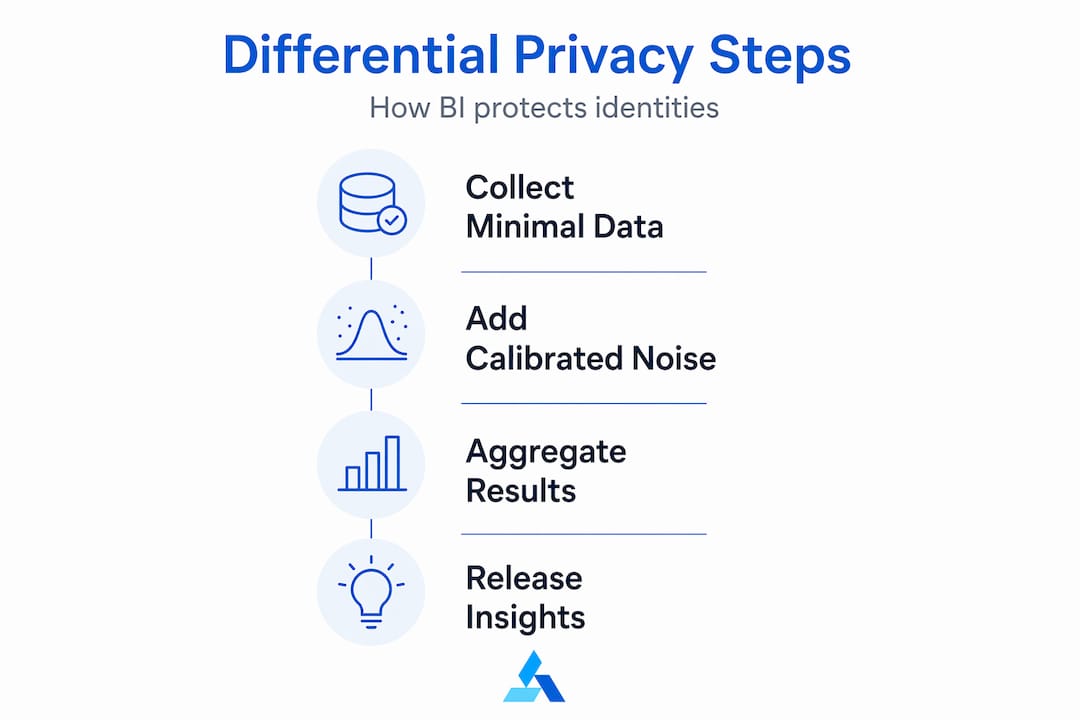
The technical parameter that governs this is called epsilon. A lower epsilon means more noise, stronger privacy protection, but reduced precision. Strict management of epsilon across repeated BI queries is essential because each query “uses up” some of your privacy budget. Run too many queries without managing this, and cumulative privacy erosion occurs even if each individual query looked safe.
Re-identification risk in integrated datasets
This is the trap that catches even sophisticated teams. You take two datasets, each perfectly de-identified on its own. You combine them for a richer analysis. Suddenly, the combination of age, ZIP code, and job title is enough to identify specific individuals. Federated BI data integration creates exactly this risk, and local differential privacy techniques applied before data sharing are the practical mitigation.
Here is a comparison of the main privacy engineering approaches and when to use each:
| Technique | Best for | Trade-off |
|---|---|---|
| Data minimization | All BI systems as a baseline | Limits some exploratory analysis |
| Differential privacy | Aggregate analytics, AI training data | Reduced precision at low epsilon values |
| Local differential privacy | Federated or third-party data sharing | Higher noise than centralized DP |
| Anonymization and pseudonymization | Reporting and dashboards | Re-identification risk if poorly implemented |
| Access controls and audit logs | Internal BI governance | Operational overhead for IT teams |
Privacy failures limit AI and BI scope directly. Teams that have not solved the re-identification problem cannot safely use federated learning or external data partnerships. Teams without proper epsilon budgeting cannot run continuous analytics workloads confidently. Getting the engineering right is not a nice-to-have. It is the unlock that determines which BI use cases are actually available to you.
Emerging regulations every BI team must know
The regulatory clock is ticking faster than most organizations realize. Here are the key changes shaping privacy regulations in data analytics for 2026 and beyond:
-
California ADMT rules (effective January 1, 2027). Automated decision-making transparency requirements mean businesses using algorithmic profiling for decisions about consumers must notify them, allow opt-outs, and provide a plain-language explanation of the decision logic. If your BI system feeds into credit decisions, marketing segmentation, hiring tools, or pricing algorithms, this applies to you.
-
Cybersecurity audit requirements. California is requiring documented cybersecurity audits for high-risk data processors. If you handle data at scale, expect formal audit obligations tied directly to your BI infrastructure.
-
Risk assessment mandates. Companies must conduct and document privacy risk assessments for new BI use cases involving sensitive data categories. This means your product and analytics teams need privacy review built into their project intake process, not added at the end.
-
Expanded opt-out mechanisms. Beyond data sales, consumers can now opt out of cross-context behavioral advertising and certain sharing arrangements. Your analytics attribution models may need structural changes to function without this data.
-
Explainability requirements for AI-driven decisions. Regulators are moving toward requiring that algorithmic outputs be explainable in terms humans can understand. Black-box models feeding BI dashboards that drive consequential decisions face real legal exposure.
The practical response is not to panic. It is to build a compliance calendar, audit your current BI data flows against these requirements, and prioritize the use cases with the highest risk exposure. Organizations that treat this as a project with a deadline, rather than a vague future concern, consistently come out of these transitions with stronger systems and better customer relationships.
My take: privacy is the most underpriced strategic asset in BI
I have spent years watching organizations treat privacy as a necessary inconvenience, something to manage around rather than build into. In my experience, the companies that pay for that attitude do so twice. Once in the compliance scramble, and again in the trust deficit they face when a breach or regulatory action makes headlines.
What I have learned is that privacy investment in BI is one of the highest-return bets a decision-maker can make. Not because regulators demand it, but because customers increasingly reward it. Data privacy as a growth strategy is not a marketing claim. It is a documented shift in how consumers allocate their spending and loyalty.
The biggest mistake I see is treating privacy as a phase that happens after the analytics roadmap is written. By then, the data architecture is set, the pipelines are built, and retrofitting privacy is three times more expensive and half as effective. The organizations winning the intelligence game in 2026 are the ones that asked “how does privacy affect this design?” before they wrote a single line of code.
My advice: make your privacy lead a co-author of your BI strategy, not a reviewer at the end. The importance of privacy in analytics is not a compliance checkbox. It is a design philosophy that pays dividends in data quality, user trust, and regulatory resilience for years.
— Colin Bowdery
How Blue Prysm helps you build privacy-aware BI
Data privacy in business strategies is not something you figure out alone, especially when the regulatory environment shifts this fast. Blue Prysm is built for exactly this challenge. The platform gives decision-makers AI-powered strategic intelligence with privacy and secure data handling built into the architecture from day one, not bolted on after. Whether you are stress-testing a new BI use case against regulatory requirements, validating your data strategy, or monitoring competitors who are navigating the same compliance pressures, Blue Prysm puts Fortune 100-grade tools within reach of any team. See how it works and run a free AI venture assessment to see where privacy gaps may be creating strategic blind spots in your current approach.
FAQ
What is the role of privacy in business intelligence?
Privacy governs what data can be collected, retained, and analyzed within BI systems. When embedded through privacy engineering, it protects individuals while enabling organizations to run analytics with greater legal safety and customer trust.
How do privacy regulations affect BI strategy?
Regulations like GDPR, CCPA, and California’s 2027 ADMT rules require businesses to redesign data flows, add transparency mechanisms, and limit certain uses of automated decision-making. This reshapes which BI use cases are legally viable and how they must be documented.
What is differential privacy and why does it matter for analytics?
Differential privacy adds calibrated noise to datasets so individual records cannot be identified, while aggregate insights remain statistically valid. Managing the epsilon parameter across queries prevents cumulative privacy erosion in continuous BI workloads.
How does re-identification risk affect BI data integration?
Combining de-identified datasets can create re-identification risk when quasi-identifiers like age, location, and role overlap. Local differential privacy applied before data sharing is the standard mitigation for federated BI environments.
Is privacy investment worth it for smaller businesses?
Yes. Smaller firms that invest in privacy-compliant BI architecture face lower breach costs, faster regulatory approvals, and measurably higher customer trust. The short-term compliance spend is significantly outweighed by the long-term legitimacy and data partnership opportunities it creates.